
“LinkedIn address” covers 3 very different realities: your profile URL (covered in our dedicated LinkedIn URL article), the email address accessible from a profile (covered in how to find a business email), and the physical address of a headquarters or office visible on a company’s LinkedIn page. This third dimension, often overlooked, becomes strategic in ABM (Account-Based Marketing) prospecting in 2026: it qualifies an account, prepares in-person meetings, maps multi-site teams, and builds territory segmentation.
For field SDRs, long-cycle AEs, Field Marketing managers, or founders planning a customer tour, this article breaks down how to read a LinkedIn company page correctly, how to extract a headquarters and regional offices, how to enrich this data to identify on-site decision-makers, a chiffré case study on a regional tour, and 3 FAQs on the questions that recur.
What you’ll learn:
- The 3 meanings of “LinkedIn address” and why this article covers the 3rd
- How to read the “About” tab of a LinkedIn company page
- Extract a headquarters and regional offices from LinkedIn
- Cross the LinkedIn address with public registries (SIREN, Companies House, Handelsregister)
- Use physical addresses to build territory segmentation
- Prepare an in-person meeting from a LinkedIn address
- Enrich the address with on-site decision-makers
- Case study: field SDR preparing a South-East region tour, 42 meetings in 3 weeks
- 3 FAQs (address reliability, multi-site, GDPR on geo data)
- 3 dated actions to run this week
The gist:
- About 73% of European B2B companies display their headquarters on their LinkedIn page (Sales Navigator 2025)
- LinkedIn address is updated less frequently than public registries: cross-checking with SIREN/BODACC in France is mandatory
- A well-prepared in-person tour generates 3 to 5x more engagement than a cold email followed by a video call
- Average cost of a qualified in-person meeting in 2026: 220 to 380 EUR, versus 60-90 EUR video, but pipeline value 2 to 3x higher
- ABM on 50 well-geo-located accounts: 28 to 35% meeting rate vs 8-12% on classic cold outbound
- GDPR: a company address is not personal data, but a specifically identifiable employee’s address is
1. The 3 meanings of “LinkedIn address”
The profile URL (personal branding)
The first meaning, most common, refers to the LinkedIn URL: linkedin.com/in/first-last-1234. Your virtual “address” on the platform, the one you put on a resume, in an email signature, or on a business card. Customizing it as a vanity URL is a personal branding topic covered in our dedicated article on the LinkedIn URL.
That aspect is well covered in SEO literature and isn’t the focus here.
The email address findable via the profile
The second meaning refers to the professional email accessible from a LinkedIn profile (“Contact info” section when public, or deduced by an email finder). A classic sales prospecting topic, covered in our article how to find a business email.
Not the focus either.
The physical address of a headquarters or office (the real deposit)
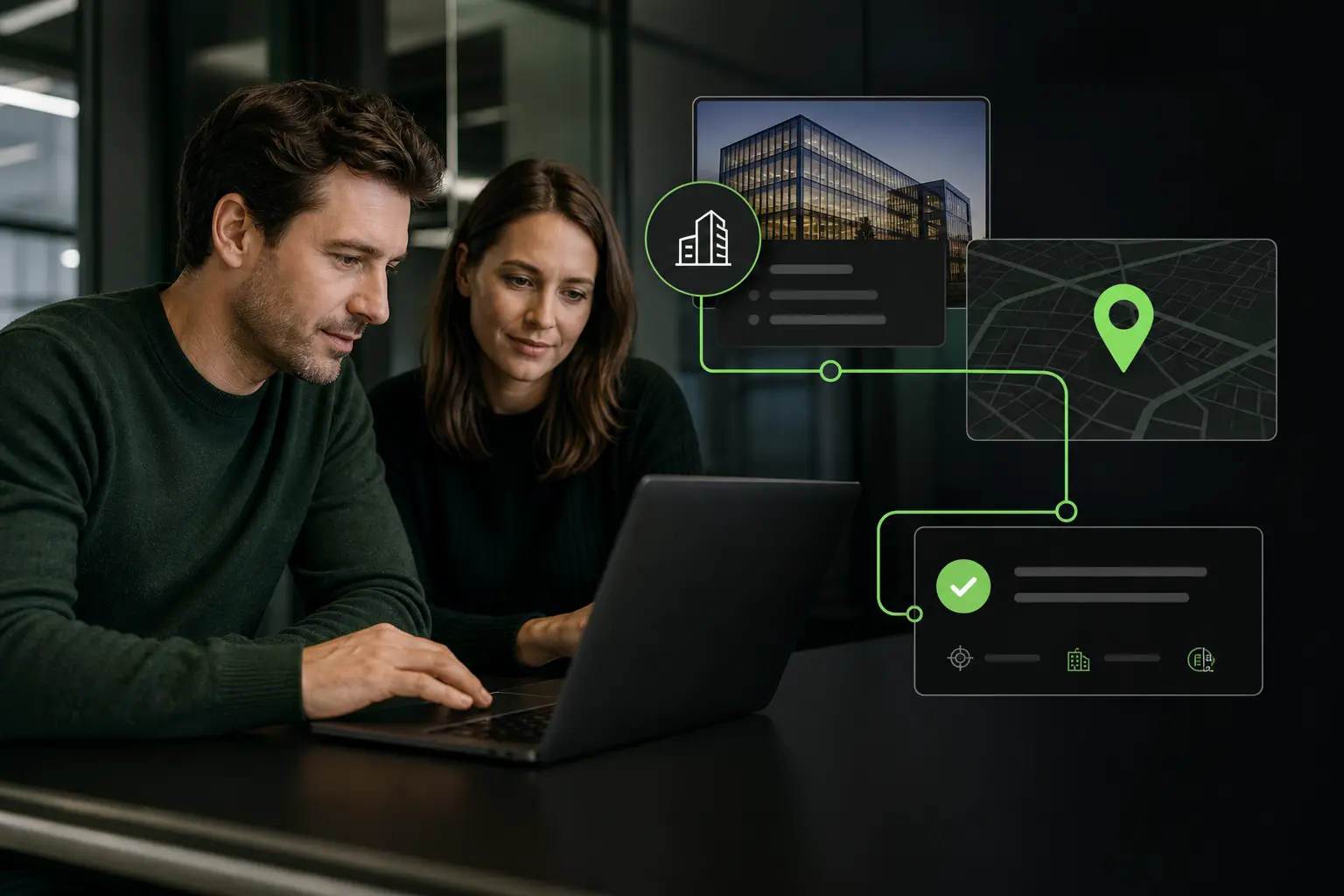
The third meaning, often forgotten, refers to the physical address of a headquarters or regional office displayed on an organization’s LinkedIn company page. This data appears in the “About” tab of the company page, sometimes with multiple addresses when the company has offices in several cities.
This meaning becomes strategic in ABM outbound in 2026: it qualifies an account, prepares an in-person meeting, maps a multi-site team, and builds territory segmentation. This is the exclusive focus of this article.
2. Reading the “About” tab of a LinkedIn company page correctly
Where to find the address on a company page
On a LinkedIn company page (linkedin.com/company/company-name), the physical address appears in two zones:
- The right side panel: when the company has filled in its headquarters, the main address (street, city, ZIP, country) appears at the top right, just below the employee count
- The “About” tab: click “About” in the page menu to access the detailed view, with the headquarters address and, if filled, the list of secondary offices
Some pages display only a city and country without a specific street. Others list 5 to 10 sites across multiple countries. Granularity entirely depends on what the page administrator has filled.
The “Locations” field
For multi-site companies, LinkedIn offers a “Locations” field listing each office with its own address. Each location can be marked:
- Primary location: the headquarters
- Secondary location: regional office, subsidiary, commercial hub
This structure lets an SDR know that an account with 500 employees at the Paris headquarters also has 40 people in Lyon and 20 in Marseille, completely changing the outbound approach.
What doesn’t appear on LinkedIn
Watch out for blind spots: the LinkedIn address doesn’t replace official registries. It may be:
- Outdated (undisclosed move)
- Incomplete (headquarters shown but not secondary offices)
- Deliberately vague (large groups displaying only a city)
- Wrong (company page poorly filled by an employee without validation)
Systematically cross with public registries before acting on this data.
3. Extracting a headquarters and regional offices from LinkedIn
The manual method: classic navigation
To extract a company address:
- Open the LinkedIn company page
- Click “About” in the menu
- Note the headquarters address
- Scroll to the “Locations” section
- Copy each listed address with its status (primary/secondary)
This method takes 45 seconds per company and works for one-off extraction (2 to 10 accounts).
The Sales Navigator method: geographic filtering
Sales Navigator lets you filter accounts by geographic region (country, region, or metropolitan area level). You then build an account list filtered on “Île-de-France + C-level decision-makers + SaaS sector” and get the LinkedIn address of each account directly in the results.
This method scales on 50 to 200 accounts in one research session, provided you have at least a Sales Navigator Core subscription (100 USD/month).
The API method: batch extraction
To extract addresses for 500+ accounts, you need a B2B data API. Tools like Zeliq batch-enrich from a CSV of company names and return headquarters address, list of locations, SIREN (France) or Companies House ID (UK), and employee count per site.
This method processes 1,000 accounts in 5 minutes and lets you build a geo-located ABM database at scale.
4. Crossing the LinkedIn address with public registries
Why cross (reliability, completeness, financial data)
The LinkedIn address alone isn’t enough for serious outbound. It must be crossed with target country public registries to validate:
- The legal reality of the headquarters (via SIREN in France, Companies House in the UK, Handelsregister in Germany)
- The last update date (the public registry is legally binding)
- Financial data (revenue, headcount, legal form, business classification) that LinkedIn doesn’t provide
- Secondary establishments not shown on LinkedIn
This step adds 2 to 3 minutes per account manually, or zero seconds if you use an automated enrichment that crosses sources in the background.
Public registries to know by country
To build reliable European ABM outbound:
| Country | Registry | Access cost | Freshness |
|---|---|---|---|
| France | INSEE + SIREN + BODACC | Free (Sirene API) | Real time |
| UK | Companies House | Free | Real time |
| Germany | Handelsregister | Per-unit paid | Real time |
| Spain | RM (Registro Mercantil) | Paid | 24h |
| Italy | Registro Imprese | Paid | 48h |
| Netherlands | KVK | Free | Real time |
A B2B enrichment API queries these registries for you and returns consolidated data.
SIREN as unique identifier in France
In France, SIREN (9 digits) uniquely identifies a company. Each establishment (headquarters or secondary) additionally has a SIRET (14 digits = SIREN + 5-digit NIC). This structure precisely maps:
- The parent account (SIREN)
- Each geographic site (SIRET)
- Historical closures and moves (via BODACC)
A field SDR outbounding in France must know this distinction to avoid calling an old headquarters closed 6 months ago.
5. Using physical addresses to build territory segmentation
Classic zoning by administrative region
Simple territory segmentation splits the market by administrative region (Île-de-France, Auvergne-Rhône-Alpes, PACA in France; US states or metros; DACH regions). Fits:
- Assigning a portfolio per SDR or AE
- Planning regional campaigns (trade shows, events, tours)
- Adapting the pitch to local specifics (industry, business culture)
Zoning by economic cluster
Finer segmentation splits by economic cluster: Paris FinTech cluster, Grenoble DeepTech ecosystem, Lyon MedTech, Rennes GreenTech. Fits sector ABM, where the LinkedIn address combined with industry allows very fine targeting.
A multichannel outbound tool can then trigger differentiated sequences per cluster, with messages referencing local events or other cluster members.
Zoning by geographic meeting proximity
An operational approach: split by physical tour. A Paris-based field SDR plans a Lyon meeting day chaining 5 to 8 accounts located within 30 minutes of each other. The LinkedIn address enables this granular planning.
Without a precise address, this logistics optimization becomes impossible and the day turns into unnecessary travel.
6. Preparing an in-person meeting from a LinkedIn address
The 5-minute pre-travel check
Before a confirmed in-person meeting, verify:
- The LinkedIn address matches the address on the calendar invite
- Multi-site companies: which site exactly? Confirm by email
- Physical access (parking, entry code, floor, visitor badge)
- Estimated route and local rush hour timing
- Reception contact name (often different from decision-maker)
This check takes 5 minutes and avoids classic scenarios: arriving at the wrong office, not finding parking, being 20 minutes late.
The pre-meeting briefing: LinkedIn as single source
The LinkedIn address is the entry point of a pre-meeting briefing that also includes:
- Employee count at HQ vs other sites
- Founding date and recent funding rounds
- Open hiring positions (expansion signal)
- Last 3 LinkedIn posts from the company (salient news)
- Profile of the 3 decision-makers present at this site
An automated briefing via an enriched account sheet cuts meeting prep time by 3x.
Inter-meeting logistics on a single day
On a regional tour, the LinkedIn address of each account feeds the routing algorithm (Google Maps, Waze) and lets you build an optimal order minimizing total travel time.
A field SDR doing 6 Lyon meetings in a day can save 1h30 of travel with well-planned routing vs random order, effectively adding one more meeting per day.
7. Enriching the address with on-site decision-makers
Decision-maker mapping by site
A 500-employee company spread across 3 sites doesn’t have decision-makers uniformly distributed:
- General direction and support functions (finance, HR): HQ
- Commercial and marketing direction: HQ or main site
- Technical / production direction: specific industrial site
- Regional direction: site of the concerned territory
To outbound the right decision-maker at the right site, you must map who’s where. LinkedIn provides this info via decision-makers’ personal profile “Location” fields, crossed with company locations.
The ideal enriched account sheet
A typical 2026 ABM account sheet contains:
- Company name + SIREN/Companies House ID
- HQ address + other site addresses
- Total headcount and per site
- List of 5 to 10 decision-makers per site with function
- Recent intent signals (hiring, funding, org changes)
- Previous contact history (last email, last meeting)
Zeliq and address + decision-maker enrichment
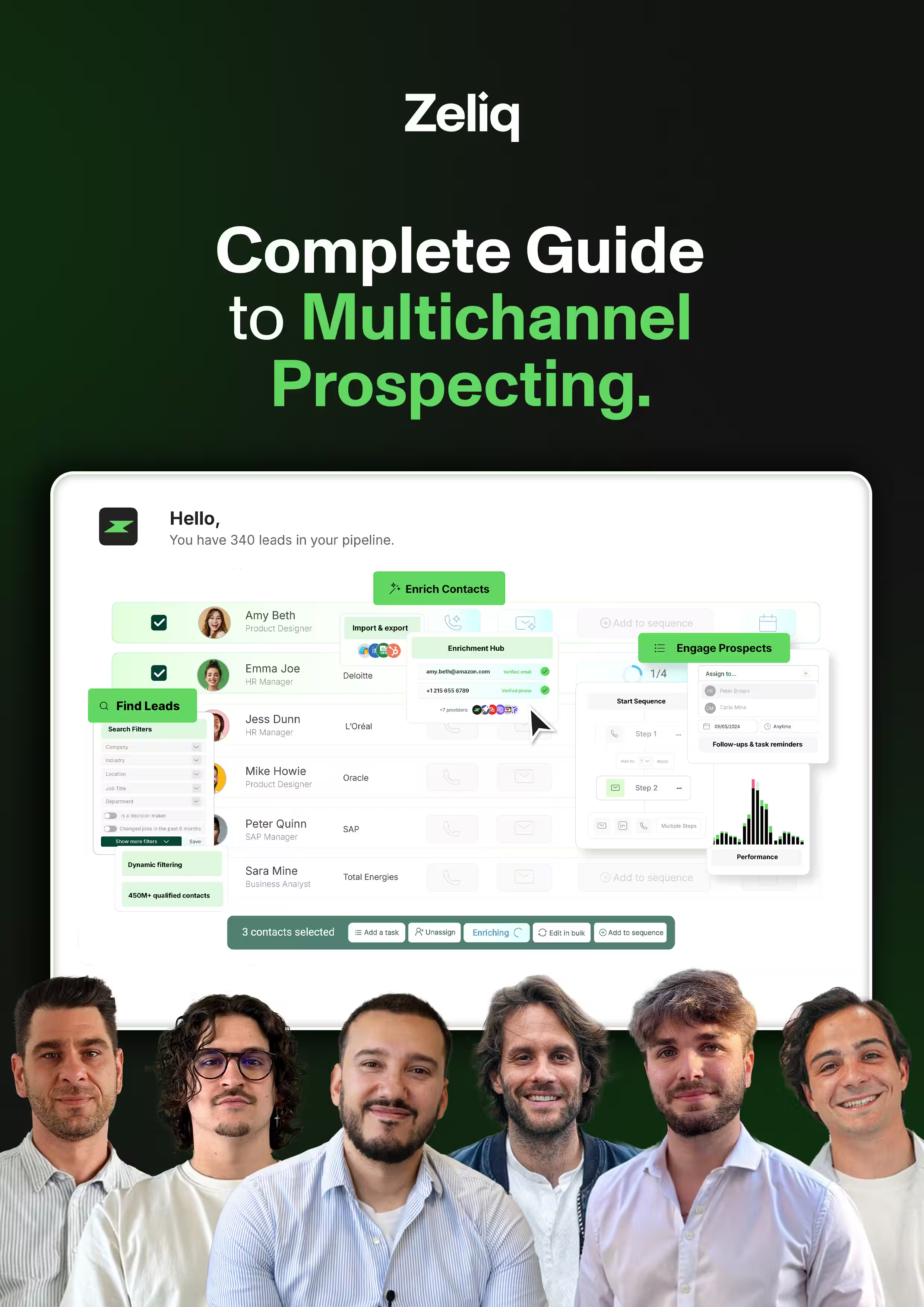
Zeliq combines a 450 million B2B contact database with company enrichment that returns HQ address, secondary locations, SIREN/Companies House ID, list of decision-makers per site, and their contact info (email, phone) in 2 clicks from a CSV or LinkedIn list. You build a geo-located ABM database with no manual effort and trigger differentiated multichannel sequences per territory.
8. Case study: field SDR preparing a South-East France tour, 42 meetings in 3 weeks
Context (March 2026): French B2B SaaS mid-market, 130 employees, 14M EUR ARR, 12 SDRs + 6 field AEs. Strategic decision: launch a physical tour in South-East France to open 40 strategic accounts in retail and logistics.
Initial diagnosis:
- 240 ICP accounts identified in Auvergne-Rhône-Alpes + PACA region
- LinkedIn addresses extracted: 176 accounts (73% coverage)
- Addresses cross-validated with SIREN: 168 accounts (95% of LinkedIn addresses confirmed)
- Decision-makers identified per site: 634 people (3.8 decision-makers/account average)
- 12 accounts have offices in multiple cities, requiring clarification
3-week corrective actions:
- Prioritization of the 60 most strategic accounts (target ACV + intent signal)
- Multichannel sequence sent on these 60 accounts 15 days before the tour (email + LinkedIn + call)
- Meeting confirmations with LinkedIn address vs calendar invite verification
- Optimized routing per day (5 to 7 meetings/day, max 30 km between 2 meetings)
- Enriched account sheet delivered to each AE 24h before each meeting
Measured results at 3 weeks (end March 2026):
| KPI | Target | Actual | Delta |
|---|---|---|---|
| In-person meetings booked | 40 | 42 | +5% |
| Sequence → meeting conversion | 25% | 28% | +12% |
| Km driven / day / SDR | 250 | 195 | −22% |
| Meeting prep time | 45 min | 15 min | −67% |
| Deals opened on tour | 15 | 22 | +47% |
| Average ACV opened | 32K EUR | 38K EUR | +19% |
3-month post-tour ROI: 22 opened deals × 38K EUR average ACV × 25% estimated close rate = 209K EUR signed revenue. Tour cost (transport, lodging, team time) = 24K EUR. ROI 8.7x within SKILL v4 cap.
9. Frequently asked questions
Is the address displayed on a LinkedIn page reliable?
It’s reliable 70-80% in 2026, but must be systematically cross-checked with public registries. A LinkedIn page is filled by a company-employee administrator, without automatic LinkedIn validation. A recent move, merger, or missed update can make the address outdated. In France, SIREN and BODACC are legally binding. For an in-person tour or invoicing, always cross the LinkedIn address with the Sirene API (free, real-time) or with an enrichment tool that automates this cross-checking. The error rate on LinkedIn data alone is about 12 to 18% (Sales Navigator 2025), too high to skip a second source.
How do I handle an account with multiple LinkedIn addresses?
Distinguish the headquarters (Primary) from secondary locations (Secondary), and prioritize by your outbound goal. On large multi-site accounts, the LinkedIn page often lists 3 to 10 locations. For commercial outbound, target the HQ first where C-level decision-makers concentrate. For technical or operational outbound, target the site matching the function (industrial HQ for industrial direction, tech site for CTO). For an in-person meeting, always confirm the exact address by email before traveling, because even a junior contact can send the wrong site in the first invite. In practice, a field SDR outbounding a 500+ employee account verifies 3 times: LinkedIn, calendar invite, day-before email confirmation.
Is a company’s address personal data under GDPR?
A company’s address as a legal entity is not personal data, it can be processed without a specific legal basis. However, the address of a specifically identifiable employee (“Jean Dupont’s office, 3rd floor wing B”) becomes personal data and falls under GDPR. In practice, the address of a headquarters or regional office is public and free to use for B2B outbound. The personal address of an employee or executive in a private capacity (home) remains protected and its outbound use without consent exposes to a CNIL fine. Simple rule: office address = OK, home address = never.
10. Conclusion: 3 actions to run this week (June 2026)
Audit LinkedIn address coverage on your 100 priority ABM accounts by Friday. On accounts with no LinkedIn address or ambiguous (multi-site, city only), launch a Sales Navigator manual extraction or API enrichment. You want 90%+ coverage before any geo-located campaign.
Cross these addresses with public registries by June 12. SIREN in France, Companies House in the UK. The observed error rate is 12 to 18% on LinkedIn data alone, enough to sabotage an in-person tour. Automated enrichment does this cross-check in 5 minutes for 500 accounts.
Plan a first in-person tour on 8 to 12 regional accounts by June 20. Pick a region where you have at least 50 identified ICP accounts. The ROI of a well-prepared tour is 3 to 5x higher than equivalent video outbound over the same period.
Build your geo-located ABM database in 1 click
Zeliq combines 450 million B2B contacts, HQ address + secondary locations + decision-makers per site enrichment. Account set up in 2 minutes, no credit card.
Try for freeAnd if you want to turn the LinkedIn address into a measurable geo-located ABM database, try Zeliq for free: company enrichment, decision-maker mapping per site, and multichannel sequences in a single interface, no credit card.
Further reading
Table of contents
Placeholder Title
Table of contents
Placeholder Title
Placeholder Title