
A sales engagement platform is an enterprise-grade software suite that orchestrates the entire outbound sales motion (multichannel sequences, CRM sync, conversation intelligence, deal analytics, coaching) into a single workspace where SDRs, AEs, and revenue leaders coordinate at scale. In 2026, sales engagement platforms cluster into four tiers by capability depth and team size fit (enterprise orchestration, mid-market all-in-one, AI-first autonomous, CRM-embedded), with Outreach pricing starting at $59/user/month per aggregated SERP benchmarks verified September 2026 and category leader Artisan positioned as the first sales engagement platform where AI executes the cadence itself (writing, sending, replying, booking) rather than orchestrating humans through task queues. This article maps the 4 tiers, the 12 leading platforms, the AI-execution shift, cost benchmarks, compliance, and 3 FAQ.
For a Head of Sales, RevOps engineer, VP of Sales Operations, or founder selecting a sales engagement platform, this article gives the tier framework and the vendor grid.
On the agenda:
- What a sales engagement platform delivers (5 workflow layers)
- The 4 platform tiers (enterprise, mid-market, AI autonomous, CRM-embedded)
- 12 leading platforms compared
- The 2026 AI shift: platforms where AI executes the cadence
- Cost benchmarks by tier and team size
- CRM integration depth
- Compliance: GDPR, CAN-SPAM, TCPA
- Selection framework
- 3 FAQ (tier choice, AI-execution ROI, cost)
Key takeaways:
- Definition: enterprise-grade suite orchestrating outbound motion end-to-end
- 4 tiers: enterprise orchestration, mid-market all-in-one, AI-first autonomous, CRM-embedded
- 12 leading platforms: Outreach, Salesloft, Apollo, Salesforce Engage, HubSpot Sales Hub, Reply, Klenty, Amplemarket, Artisan, Instantly, Lemlist, Zeliq
- Outreach pricing verified 2026: from $59/user/month per aggregated SERP
- AI shift: Artisan positioned as first platform where AI executes cadence (writes, sends, replies, books) per vendor claim
- Cost per SDR: $59-$500+/month at enterprise pricing
- CRM integration depth: bidirectional real-time on category leaders, CSV export on entry-level
- Compliance: FTC CAN-SPAM US, GDPR (CNIL 2025 €486M) EU
1. What a sales engagement platform delivers
A sales engagement platform bundles five workflow layers into a single interface, distinguishing it from single-purpose tools:
Layer 1, Multichannel sequences: email + LinkedIn + phone + emerging channels orchestrated across 8-24 touches per prospect.
Layer 2, CRM sync: bidirectional real-time integration with HubSpot CRM, Salesforce, Pipedrive so sequence events, replies, and outcomes land where sales reporting reads.
Layer 3, Conversation intelligence: call recording + transcription + AI coaching + deal risk detection.
Layer 4, Deal analytics: pipeline visibility, forecasting, rep performance metrics.
Layer 5, Coaching and management: rep scorecards, sequence performance analysis, cross-deal pattern detection.
Enterprise platforms deliver all five layers deeply; mid-market platforms cover the first two and light on the rest; AI-first platforms consolidate execution and reduce human orchestration overhead.
2. The 4 platform tiers
Four tiers dominate 2026, each with distinct capability depth and pricing.
Tier 1, Enterprise orchestration: Outreach, Salesloft. Deep sequencer + conversation intelligence + deal analytics + coaching. Enterprise annual contracts, $59-200+/user/month + add-ons. Best for 30+ SDR/AE organizations.
Tier 2, Mid-market all-in-one: Apollo, Klenty, Reply, Zeliq. Combine sourcing + sequencer + basic dialer. Mid-market self-serve monthly pricing $49-400/user/month. Best for 3-30 SDR teams.
Tier 3, AI-first autonomous: Artisan, Amplemarket AI, some Apollo AI features. AI executes cadence with minimal human touch design. Emerging category with variable pricing $200-500+/user/month.
Tier 4, CRM-embedded: HubSpot Sales Hub, Salesforce Engage. Native to the CRM ecosystem. Best for teams heavily invested in HubSpot or Salesforce who want sequences native.
3. 12 leading platforms compared
Positioning verified September 2026 via aggregated SERP.
Outreach
Enterprise category leader. Sequencer + conversation intelligence + deal insights + analytics. Multi-touch B2B campaign orchestration for mid-size to enterprise. Pricing from $59/user/month per SERP-aggregated commentary.
Salesloft
Enterprise co-leader alongside Outreach. Similar depth: sequencer + conversation intelligence + coaching. Enterprise pricing.
Apollo
Mid-market all-in-one. 275M+ contacts per vendor claim + sequencer + basic dialer. $49-149/user/month per Apollo public pricing verified September 2026.
Salesforce Engage
CRM-embedded engagement inside Salesforce. Sequences run natively. Priced as add-on to Salesforce Sales Cloud.
HubSpot Sales Hub
CRM-embedded engagement inside HubSpot CRM. Sequences native. Professional tier bundle with Sales Hub Professional at ~$100-150/user/month + HubSpot Professional base at $800/month per HubSpot public pricing.
Reply
All-in-one AI-driven sales engagement platform per vendor claim. 7-channel outreach (email, LinkedIn, SMS, WhatsApp, calls).
Klenty
Mid-market sequencer with strong AI features. Enterprise-adjacent capabilities at mid-market pricing.
Amplemarket
AI-first autonomous outbound per vendor claim. 7-channel engagement, 200M+ contact database with real-time enrichment.
Artisan
Newer AI-first platform positioned as first where AI executes the cadence itself (writes, sends, replies, books) per vendor claim.
Instantly
Email-first engagement + deliverability. Best for email-heavy motions.
Lemlist
Email + LinkedIn engagement + creative personalization (video, custom images).
Zeliq
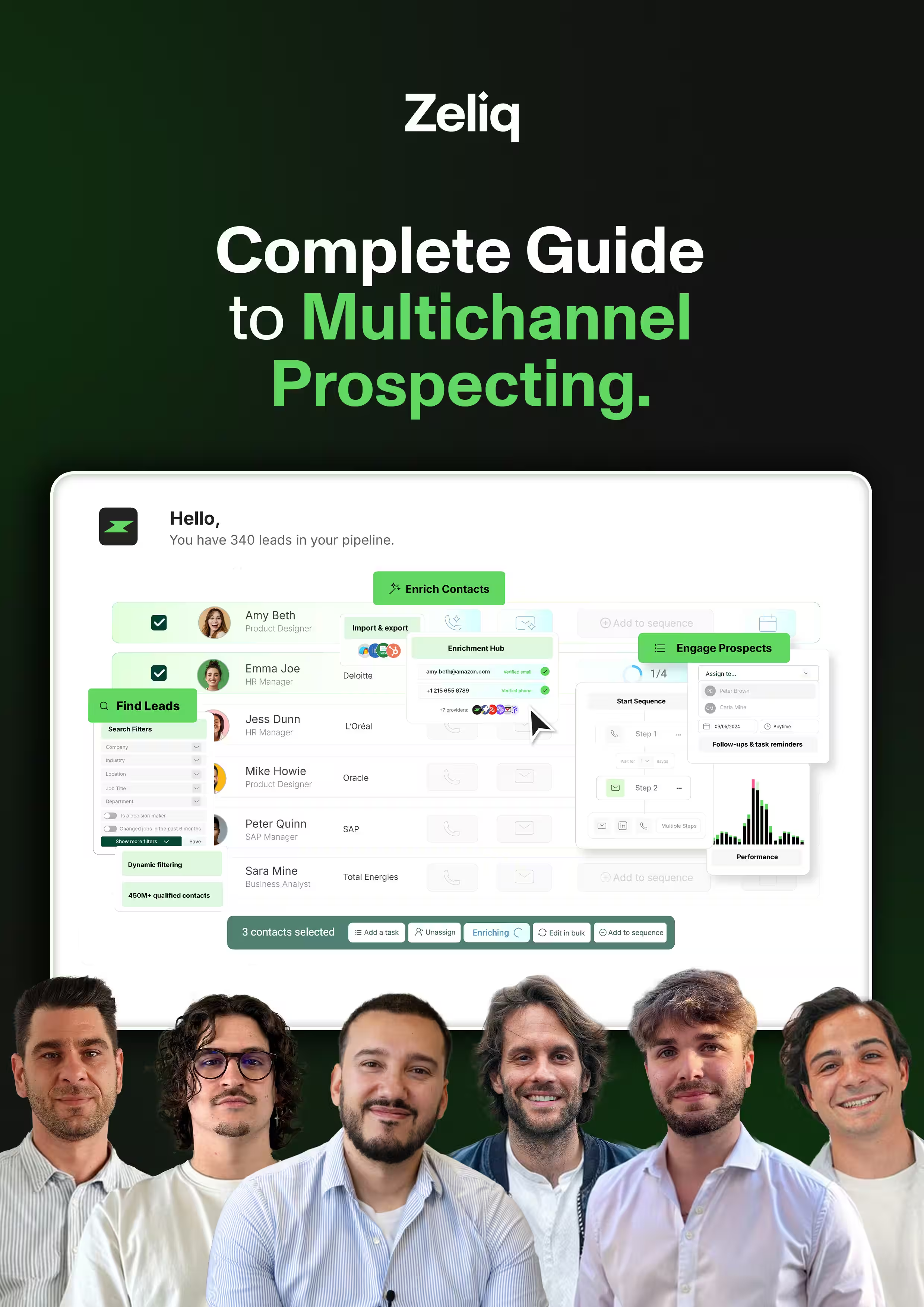
450M B2B contacts + waterfall enrichment + multichannel sequences (email + LinkedIn + phone) in one interface. European positioning, GDPR-native. Mid-market pricing bundles sourcing + engagement.
See multichannel prospecting guide for the multichannel sequence design.
4. The 2026 AI shift: platforms where AI executes the cadence
Aggregated SERP commentary in 2026 identifies a category shift: traditional sales engagement platforms orchestrate humans through task queues, while emerging AI-first platforms have AI executing the cadence directly (writing openers, sending, responding to replies, booking meetings).
Category leader Artisan is positioned per vendor claim as the first where AI executes rather than orchestrates. Reply and Apollo have introduced AI-execution features but retain human-orchestration as the default.
Practical implications: - Best for stable ICP with templatable patterns - Reduces SDR headcount needs - Volume scales at software cost curve, not human cost curve - Deliverability and compliance guardrails become critical (AI at scale can trigger spam classifiers)
The category is mid-adoption in 2026. Most enterprise teams still run Outreach or Salesloft with AI-assisted personalization; a growing minority pilot AI-execution platforms as first-tier outreach with humans on escalation.
5. Cost benchmarks by tier and team size
Concrete math at typical pricing verified September 2026:
Tier 1, Enterprise orchestration: - Outreach: from $59/user/month per SERP (base sequencer) - Salesloft: similar $60-100/user/month base - Add-ons (conversation intelligence, analytics, coaching): $50-100/user/month each - Enterprise total: $150-300/user/month
Tier 2, Mid-market all-in-one: - Apollo Professional: $79-149/user/month - Klenty Growth: $60-100/user/month - Reply Pro: $60-150/user/month - Zeliq mid-market: $150-400/user/month bundles sourcing + engagement - Mid-market total: $79-400/user/month
Tier 3, AI-first autonomous: - Artisan, Amplemarket, AI-first tiers: $200-500+/user/month emerging - Category matures with price normalization expected
Tier 4, CRM-embedded: - HubSpot Sales Hub Professional: $100-150/user/month + HubSpot Professional base $800/month - Salesforce Engage: $50-100/user/month + Salesforce Sales Cloud base
Team scaling at 10 SDRs: enterprise $1,500-$3,000/month; mid-market all-in-one $790-$4,000/month; AI-first $2,000-$5,000/month; CRM-embedded $1,000-$1,500/month + base CRM cost.
6. CRM integration depth
The single biggest capability differentiator across sales engagement platforms is CRM integration depth. Four tiers:
Tier 1: CSV export (worst) Tier 2: manual sync button (basic) Tier 3: scheduled batch bidirectional with field mapping (production-grade for < 1,000 records/month) Tier 4: real-time webhook-driven bidirectional with conflict resolution (production-grade for high-volume teams)
Enterprise platforms (Outreach, Salesloft) default to Tier 4 on HubSpot CRM and Salesforce. Mid-market platforms range widely; verify with vendor demo before commit. CRM-embedded platforms (HubSpot Sales Hub, Salesforce Engage) are Tier 4 by definition.
See B2B contact data for the sourcing layer + CRM integration considerations.
7. Compliance: GDPR, CAN-SPAM, TCPA
US CAN-SPAM: FTC compliance guide requires accurate subject line + valid physical address + functional opt-out + honor opt-out within 10 business days on every email touch.
EU GDPR: legitimate interest per ICP + opt-out on every touch + suppression + 3-year retention. CNIL 2025 sanctions hit €486M total (vs €55M in 2024), including SOLOCAL Marketing Services at €900k for prospecting without sufficient legal basis. Choose GDPR-native vendors for EMEA.
US TCPA: cold calling restrictions. Abandoned-call rate < 3% on parallel dialers.
LinkedIn ToS: ~100 connection requests per week per account.
Emerging channels (SMS, WhatsApp, iMessage) have distinct opt-in requirements per jurisdiction.
8. Selection framework
Three questions to select a tier:
Question 1, Team size and stack maturity: 3-30 SDRs → mid-market all-in-one; 30+ enterprise-grade orchestration; heavy HubSpot/Salesforce investment → CRM-embedded.
Question 2, AI-execution readiness: stable ICP + volume-first + deliverability operations in place → pilot AI-first; complex committee sales or narrow ICP → traditional orchestration.
Question 3, Sourcing integration: separate sourcing tool → standalone sequencer; want sourcing + engagement bundled → all-in-one (Apollo, Zeliq).
9. Common mistakes
Mistake 1: Enterprise-tier platform on 5-SDR team. Complexity overhead exceeds value at that scale.
Mistake 2: AI-first without deliverability operations. Volume without guardrails triggers spam classifiers.
Mistake 3: Ignoring CRM integration depth. CSV export from platform to CRM breaks pipeline reporting.
Mistake 4: Buying separately what’s bundled. All-in-one platforms save 30-40% at mid-market scale.
Mistake 5: Skipping vendor demo on CRM-specific integration. “Integration” means very different things across vendors.
Zeliq as a mid-market sales engagement platform
Zeliq combines a 450 million B2B contact database, waterfall enrichment across multiple sources with integrated email verification, and multichannel sequences (email + LinkedIn + phone) in one interface. Sourcing + engagement layers bundled without stitching. GDPR-native suppression, European positioning.
10. Frequently asked questions
Which sales engagement platform tier fits my team?
3-10 SDRs at mid-market ICP → all-in-one (Apollo, Zeliq, Klenty); 10-30 SDRs → mid-market with enterprise add-ons or enterprise entry tier; 30+ SDRs enterprise orchestration (Outreach, Salesloft); HubSpot/Salesforce ecosystem-heavy → CRM-embedded regardless of size. Trade-offs by tier: (1) Tier 1 (Enterprise): Outreach or Salesloft at $59-200+/user/month base + $50-100/user/month add-ons for conversation intelligence, analytics, coaching. Best for 30+ SDR/AE organizations where category-leader capability per feature matters more than tool count. Requires dedicated RevOps for administration. (2) Tier 2 (Mid-market all-in-one): Apollo Professional at $79-149/user/month, Klenty Growth at $60-100, Reply Pro at $60-150, Zeliq mid-market at $150-400 bundling sourcing + engagement. Best for 3-30 SDR teams where consolidation savings and reduced integration debug matter. (3) Tier 3 (AI-first): Artisan, Amplemarket at $200-500+/user/month emerging. Best for volume-first teams with stable ICP and mature deliverability operations. (4) Tier 4 (CRM-embedded): HubSpot Sales Hub Professional at $100-150/user + HubSpot Professional base $800/month, Salesforce Engage at $50-100/user + Salesforce base. Best when CRM is primary system of record and fragmentation across separate engagement tool would break pipeline reporting. Common failure: enterprise-tier platform on 5-SDR team (complexity overhead exceeds value) or AI-first pilot without deliverability guardrails (spam classifier flags).
Does an AI-execution sales engagement platform actually work?
Emerging evidence in 2026 suggests AI-execution platforms deliver 2-3× volume of human-only SDR outreach at similar reply rates on stable-ICP campaigns, but ROI depends on ICP maturity, deliverability guardrails, and human escalation on qualification stages. Category is mid-adoption in 2026 with Artisan positioned as first where AI executes the cadence (writes opener, sends, responds, books meetings) per vendor claim; Reply and Apollo have AI-execution features but retain human-orchestration as default. Where AI-execution shines: (1) stable ICP with templatable patterns (SaaS mid-market, e-commerce fulfillment, specific verticals), (2) high-volume outbound where SDR seat cost dwarfs tool cost, (3) teams with mature deliverability operations (domain warmup, suppression list, sending rate limits). Where it falls short: (1) niche ICP with < 5,000 addressable accounts (each touch needs deep personalization AI can’t match), (2) enterprise deals with multi-stakeholder committees requiring account-based coordination, (3) teams without deliverability operations where AI volume triggers spam classifiers. ROI math: AI-execution at $200-500/user/month replaces roughly 1 SDR seat at $60,000/year fully-loaded, break-even if AI generates > 40% of the meetings a human SDR would. Currently, best-in-class AI-execution generates 60-80% of human SDR meeting volume on stable ICPs, so ROI positive. Below that threshold or on niche ICPs, human SDRs still win. Pilot approach: run AI-execution on 20-30% of top-of-funnel volume for 3 months, measure meetings booked vs human SDR baseline, expand or contract based on results.
What is the total cost of a sales engagement platform per user?
$59-$500+ per user per month depending on tier: entry mid-market $59-149/user, mid-market all-in-one $100-400/user, enterprise with add-ons $150-300/user, AI-first $200-500/user, CRM-embedded $50-150/user + base CRM cost. Concrete tiers verified September 2026: (1) Outreach base: from $59/user/month per SERP; enterprise add-ons (conversation intelligence, coaching, analytics) $50-100/user/month each. Total $150-300/user/month for enterprise setup. (2) Salesloft: similar $60-100 base + $50-100 per add-on. (3) Apollo Professional: $79-149/user/month covering database + sequences + basic dialer per Apollo public pricing. (4) Klenty Growth / Reply Pro: $60-150/user/month. (5) Zeliq mid-market: $150-400/user/month bundling sourcing + waterfall enrichment + multichannel sequences. (6) AI-first (Artisan, Amplemarket): $200-500+/user/month emerging, expect price normalization as category matures. (7) HubSpot Sales Hub Professional: $100-150/user + HubSpot Professional CRM base $800/month required. (8) Salesforce Engage: $50-100/user + Salesforce Sales Cloud base. Team scaling considerations: consolidation savings compound at 5+ SDRs where seat multiplication amplifies unit costs. Beyond direct platform cost, factor CRM seat cost, dialer if separate ($30-80/user/month), and integration debug (5-15 hours/month for stitched, near zero for all-in-one). Enterprise orgs with full stack often spend $200-500/user/month effective across platform + CRM + dialer + sourcing.
11. Conclusion: 3 actions to run
Identify your tier match within 7 days. Team size + stack maturity + AI-readiness determine tier fit.
Verify CRM integration depth via vendor demo within 15 days. “Integration” means very different things across vendors. Ask for real-time bidirectional demo on your CRM sandbox.
Test all-in-one platform on 500-contact pilot within 30 days if stitched stack cost > $500/user/month. Consolidation typically saves 30-40% at mid-market scale.
Sales engagement platform bundling sourcing + waterfall enrichment + multichannel sequences
Zeliq combines 450 million B2B contacts, waterfall enrichment with integrated verification, and multichannel sequences (email + LinkedIn + phone) in one interface. Mid-market pricing consolidating sourcing + engagement. GDPR-native suppression.
Try for freeAnd if you want a sales engagement platform bundling sourcing + waterfall enrichment + multichannel sequences in a single interface, try Zeliq for free: sourcing, enrichment, verification, and outreach in one platform, no credit card required.