

Cold Email: The Complete B2B Guide to Booking Meetings in 2026
Cold email has been declared dead at least once a year since 2018. It survived spam filters, Gmail Promotions, GDPR, the LinkedIn outbound surge, and the ChatGPT flood that drowned every B2B inbox in 2024. In 2026, cold email is still the most predictable, most measurable, most scalable outbound channel a B2B team has. But the rules have changed. What worked five years ago will torch your domain reputation today, and what works today demands a level of technical and editorial rigor that most teams still skip.
This guide is the full playbook. You will find the working definition that separates cold email from spam, the deliverability stack you cannot launch without (SPF, DKIM, DMARC, warm-up, secondary domains), the copywriting framework that gets replies in a saturated inbox, how to personalize at scale without sounding like a chatbot, the multichannel cadence that doubles reply rates, the 2026 benchmarks for open, reply and positive reply, the tooling landscape, the seven mistakes that quietly tank your numbers, and the A/B testing protocol that actually compounds. No magic recipes. Just the method that compounds into a real outbound pipeline.
What is a cold email, exactly?
A cold email is a one-to-one message sent to a business contact who has not asked to hear from you, with a commercial intent: book a meeting, qualify a need, open a conversation. Three traits define it.
- No prior relationship. The recipient is not a current customer, has not filled in a form, has not attended your event, has not opted in to any list.
- Commercial intent. You are reaching out to test a fit and, eventually, sell. Not to inform, not to entertain.
- Sent to one named person. A cold email goes to a specific human in a specific role at a specific company. The moment you send the same message to ten thousand addresses, you are doing email marketing or spam.
Cold email is not cold calling. Cold calls are interruptive and synchronous: you ring, the prospect picks up, you have ten seconds to earn the next minute. Cold email is permission-light and asynchronous: the prospect chooses when to read, when to ignore, when to reply. The two channels share an audience and an ICP, but the craft is different. (For the language of cold calling, our sales terminology A to Z glossary covers the vocabulary worth knowing.)
Cold email is not spam either. Spam is unsolicited mass mail with no targeting and no commercial relationship logic. A cold email is targeted, contextual, and addressed to a person whose role is plausibly interested in what you sell. In B2B, cold email is legal in the United States under CAN-SPAM if you identify yourself, give a physical address, and honor opt-outs. It is legal in the EU and UK under GDPR and PECR if you rely on legitimate interest, target professionals in roles relevant to your offer, and respect the right to object. Consumer cold email is a different game and, in most EU markets, simply not allowed.
What changed since 2020
Five shifts have rewritten the playbook between 2020 and 2026. Skip them and your numbers will quietly collapse.
1. Inbox providers tightened the screws. Google and Yahoo enforced bulk-sender rules in early 2024. Microsoft followed. Today, SPF, DKIM and DMARC are not best practice. They are a hard requirement to land in the primary inbox at all. Spam complaint rates above 0.3% throttle you. Above 0.5%, you get blocked.
2. Inboxes are saturated. A VP Sales received five to ten cold emails per week in 2018. In 2026, the same inbox sees 60 to 120 a week. Attention is not low, it is exhausted. Your subject line and your first sentence carry more weight than they ever did.
3. AI made bad cold email free. Anyone can spin up a thousand “personalized” emails in ten minutes with an LLM and a list. The result is a wave of cold emails that all sound the same: “I noticed [Company] is in the [industry] space and I thought I’d reach out…” Buyers detect that opening in under three seconds. The bar for what counts as personalized has moved.
4. Cosmetic personalization stopped working. Inserting a first name and a company name in a generic template is no longer personalization. It is the new spam. Reply rates on this kind of email have collapsed to under 1%. What works now is signal-based outreach tied to a specific, real-world trigger: a funding round, a hire, a product launch, a public post, a job opening that matches your buyer’s stack.
5. Multichannel beats email-only by 2x to 3x. Email-only outbound caps around 2% to 3% reply rates. The same prospects, contacted through a coordinated sequence of email plus LinkedIn plus phone, reply at 8% to 15%. The math is not optional anymore. Single-channel SDRs lose to multichannel SDRs on every cohort.
Deliverability: the 80% nobody wants to read
Most cold email guides skip deliverability because it is technical and unsexy. That is exactly why most cold email programs underperform. Deliverability decides whether your email lands in the primary inbox, in promotions, in spam, or simply gets dropped. No copy, no targeting, no offer can save an email that never reaches the recipient.
SPF, DKIM, DMARC: the non-negotiables
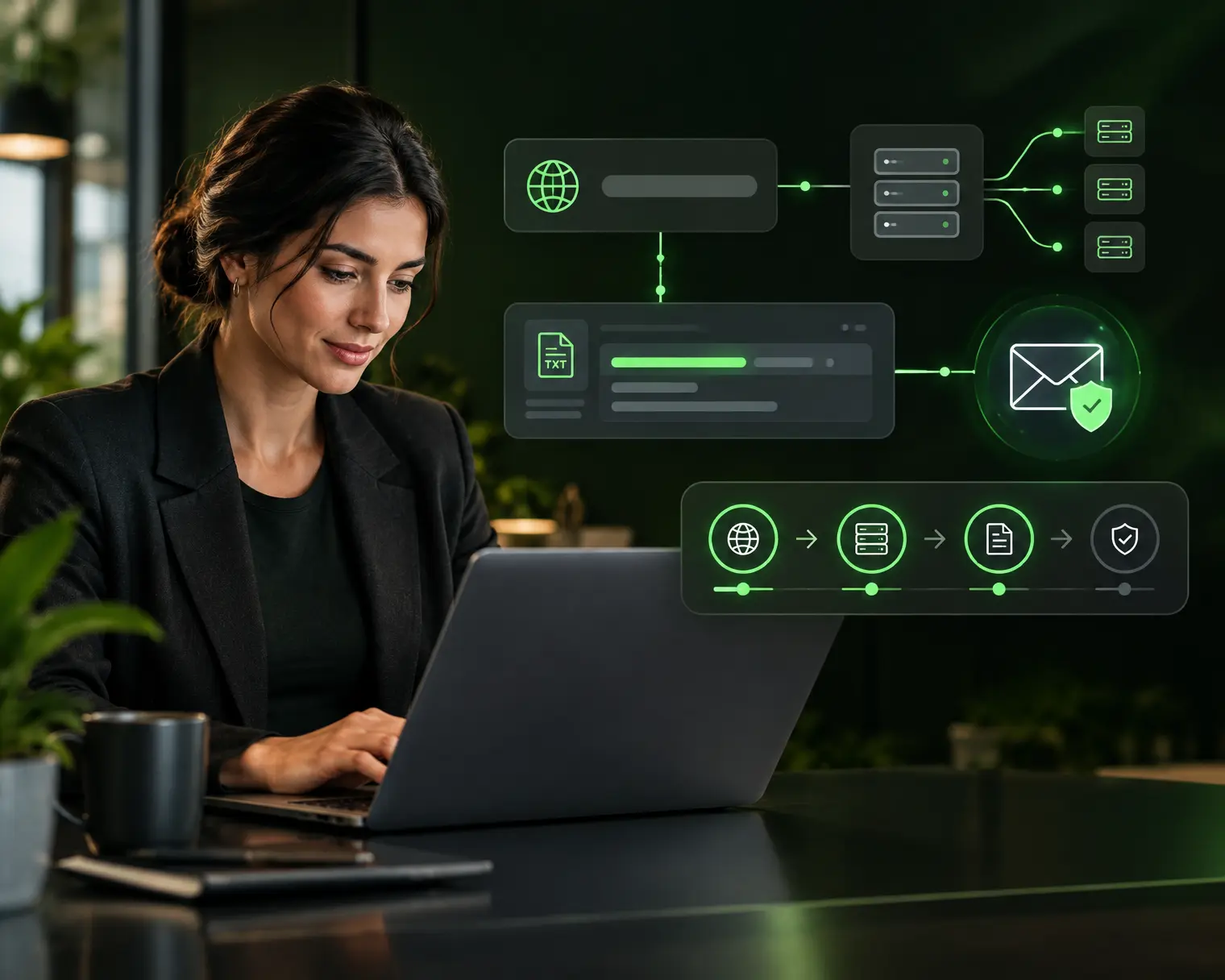
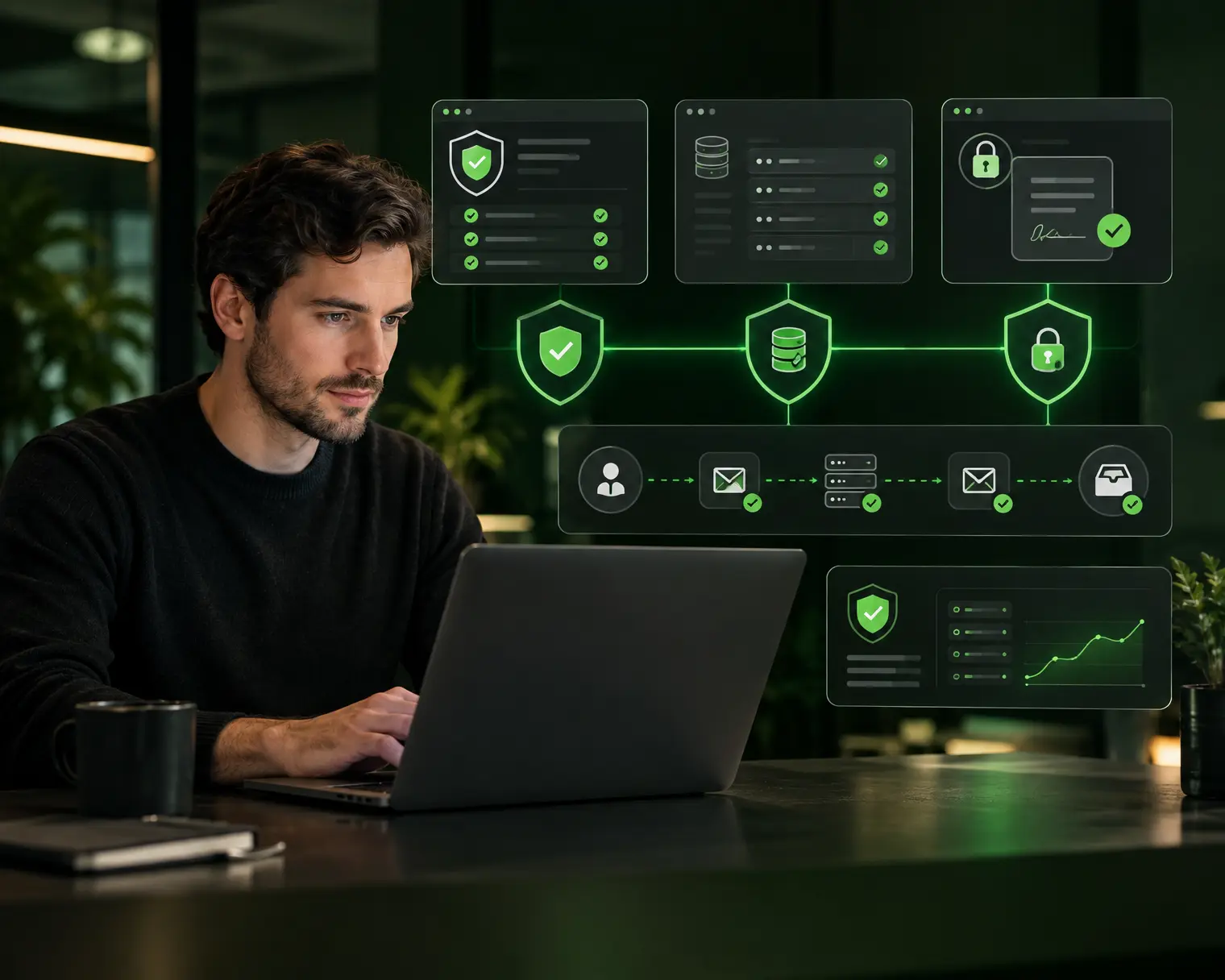
Three DNS records authenticate your domain as a legitimate sender. Without all three, Gmail and Microsoft 365 treat your messages as suspicious by default.
- SPF (Sender Policy Framework) is a TXT record listing the servers allowed to send mail for your domain. If a server not on the list sends mail in your name, receiving servers can flag or reject it.
- DKIM (DomainKeys Identified Mail) signs every outgoing message with a cryptographic key whose public half lives in your DNS. Receivers verify the signature, which proves the email was not tampered with in transit and that it really originated from your domain.
- DMARC (Domain-based Message Authentication) tells receivers what to do when SPF or DKIM fail. Configure it as quarantine or reject and add a reporting address so you can monitor failures.
Run your sending domain through a tool like Mail-Tester or MXToolbox before launching any campaign. A score below 9 out of 10 means you have homework before pressing send. Re-run the test once a quarter, after every infrastructure change, and the day you change ESPs.
Use a secondary, dedicated sending domain
Never run cold email from your main brand domain. If your company is acmecorp.com, register acmecorp.io, getacme.com or tryacme.com and route all outbound from there. Two reasons.
The first is risk containment. If you blow your sending reputation, you do not also blow your CFO’s invoices, your support replies, or your CEO’s email to the board. The second is scale. You will eventually want two, three, five secondary domains running in rotation, each with its own reputation, each protecting the others.
Buy your secondary domain at least 30 days before sending anything from it. Aged domains land better than freshly registered ones, which fraud filters treat as suspicious by default.
Warm up every mailbox before you launch
A new mailbox sending 50 cold emails on day one is a textbook spam pattern. You need to ramp gradually so inbox providers learn that your address sends real, engaged messages.
Use a warm-up tool to simulate organic exchanges with a network of seed inboxes for four to six weeks before a real campaign hits. The shape of the ramp:
- Weeks 1 to 2: 5 to 10 emails per day, mostly to engaged senders.
- Weeks 3 to 4: 15 to 30 per day.
- Weeks 5 to 6: 30 to 50 per day, including some real prospect emails.
- Week 7 onward: hold at your steady-state cap.
Keep at least 15% of your daily volume on warm-up traffic forever. It maintains the engagement signal that protects your reputation when reply rates dip.
Cap volume at 50 emails per mailbox per day
This number is the modern consensus. Above 50, you trip volume thresholds at Gmail and Microsoft. To scale beyond 50 a day, do not push a single mailbox harder. Multiply mailboxes. Five well-warmed mailboxes across two domains give you 250 sends a day, sustainably. Twenty mailboxes across four domains give you 1,000.
Plain text. No images. No attachments. No tracking pixels in the first message. Every one of those triggers spam scoring. Add tracking and visuals later in a sequence, after the prospect has engaged, and never in the breakup email.
Monitor inbox placement, not just opens
Apple Mail Privacy and Gmail’s image proxy made open rates a soft metric. They are still useful in relative terms (campaign A versus campaign B in the same week, on the same list) but useless as an absolute deliverability indicator. Run seed-list tests once a week: send the same email to a panel of test inboxes across Gmail, Outlook, Apple iCloud, and observe the actual placement. If the same campaign is in primary on Gmail but in spam on Outlook, you have a Microsoft-specific problem to fix.
The anatomy of a cold email that gets a reply in 2026
A working cold email holds five elements: subject line, hook, body, CTA, signature. Each one fails in distinctive ways.
The subject line
Twenty to fifty characters. Lowercase or sentence case, never all caps. No emoji unless the rest of your brand voice already uses them. Three patterns work in 2026.
- A direct question to the recipient’s role. “How does Acme handle SDR onboarding?”
- A short, intriguing fragment. “quick question on Q1 hiring”, “idea for Acme’s outbound”.
- A signal-based reference. “Saw your Series B announcement”, “On your post about attribution”.
Avoid promotional patterns: “Save 30% on…”, “Limited time offer”, anything that screams marketing email. Avoid clickbait that does not match the body. Mismatched subject and body kills the next email in the sequence even if this one gets opened.
Do not personalize the subject with a first name. It looks like a mail merge to anyone who has been on LinkedIn for more than a year, and it lights up filters that look for the obvious “Hi {{first_name}}” pattern.
The hook (first line)
The hook is the line your recipient sees in the inbox preview before the email is opened. Its job is to prove this is not a templated blast. Two seconds, two missions: signal real research, earn the click.
What does not work in 2026:
Hi John, I hope this email finds you well.
What works:
Saw your post on Tuesday about attribution being broken in B2B. The example with the partner channel matched something we keep seeing.
Or:
Acme just opened a Senior Sales Manager role in New York. If you are scaling the team, the next 60 days are usually when teams reconsider their outbound stack.
The hook references something specific the recipient (or their company) actually did. Not just “I see you are growing.” Show your work.
The body (50 to 120 words)
Three movements, no more.
- Why I am writing. The specific reason tied to the company or person. One sentence.
- What I propose. The value, in a sentence. Not a feature list. Not your company’s mission.
- A proof point. A comparable customer, a number, a relevant case. One sentence.
No superlatives. No “leading”, “best-in-class”, “innovative”, “synergies”, “ecosystem”, “ROI of x10”. A buyer should be able to summarize what you do in five words after reading. If they cannot, you are too vague.
The CTA (one, never two)
Offer one action. One. Two CTAs cut response rates in half because the recipient now has a decision to make instead of a yes or no. Three CTAs that work in 2026.
- The closed question. “Is fixing outbound deliverability on the roadmap for Q1?” Easy yes, easy no.
- The interest probe. “Worth a 15-minute call to compare notes, or not relevant right now?” Gives explicit permission to decline.
- The right-person check. “Are you the right person on this at Acme, or should I reach out to someone else?” Often forwards your email to the right buyer.
What does not work as a first-touch CTA: a Calendly link asking for a 30-minute slot. Too much commitment from a stranger. Calendar links work in the third or fourth touch, after engagement.
The signature
Plain. Name. Role. Company. One LinkedIn link. No logo. No banner. No quote of the day. No mobile signature (“Sent from my iPhone”) unless you are actually sending from a phone for that one message. The fewer images and links in a first cold email, the better the placement.
Personalization at scale: the framework that actually works
Cosmetic personalization, the kind that just inserts {{first_name}} and {{company}}, is over. The reply rate on that approach has collapsed to under 1%. Everyone uses the same templates. Everyone uses the same LLM-generated openers. The signal is dead.
The replacement is signal-based personalization, which scales surprisingly well if you set it up properly. The principle: tie every email to a real, time-bound trigger that affects the recipient’s job, then let the template do the rest.
Useful triggers that are cheap to monitor:
- Funding round. Pulled from Crunchbase, PitchBook, public news. A Series A or Series B usually means the company is hiring and reconsidering its stack.
- Leadership change. A new VP Sales, CMO, or Head of RevOps almost always reassesses outbound tools in the first 90 days.
- Job opening. A specific role posted on LinkedIn or the company careers page reveals priorities. A “Senior SDR” listing tells you the team is scaling outbound. A “Sales Operations Manager” listing tells you the stack is being rebuilt.
- Tech stack change. Wappalyzer, BuiltWith and similar tools tell you when a prospect rolls out HubSpot, Salesforce, or a new analytics platform. New stack equals new conversations to have.
- Public post. A LinkedIn post by the recipient or their CEO is the cheapest, sharpest hook there is. Quote it. React to it. Show you read it.
- Product launch. A press release or a Product Hunt launch from the prospect’s company is a window of high attention.
Operational reality: you do not need 50 unique emails for 50 prospects. You need five templates, each tied to one trigger type, with one or two variable slots that pull the real-world detail. That is what makes signal-based personalization scale: the trigger sets the angle, the template carries the rest.
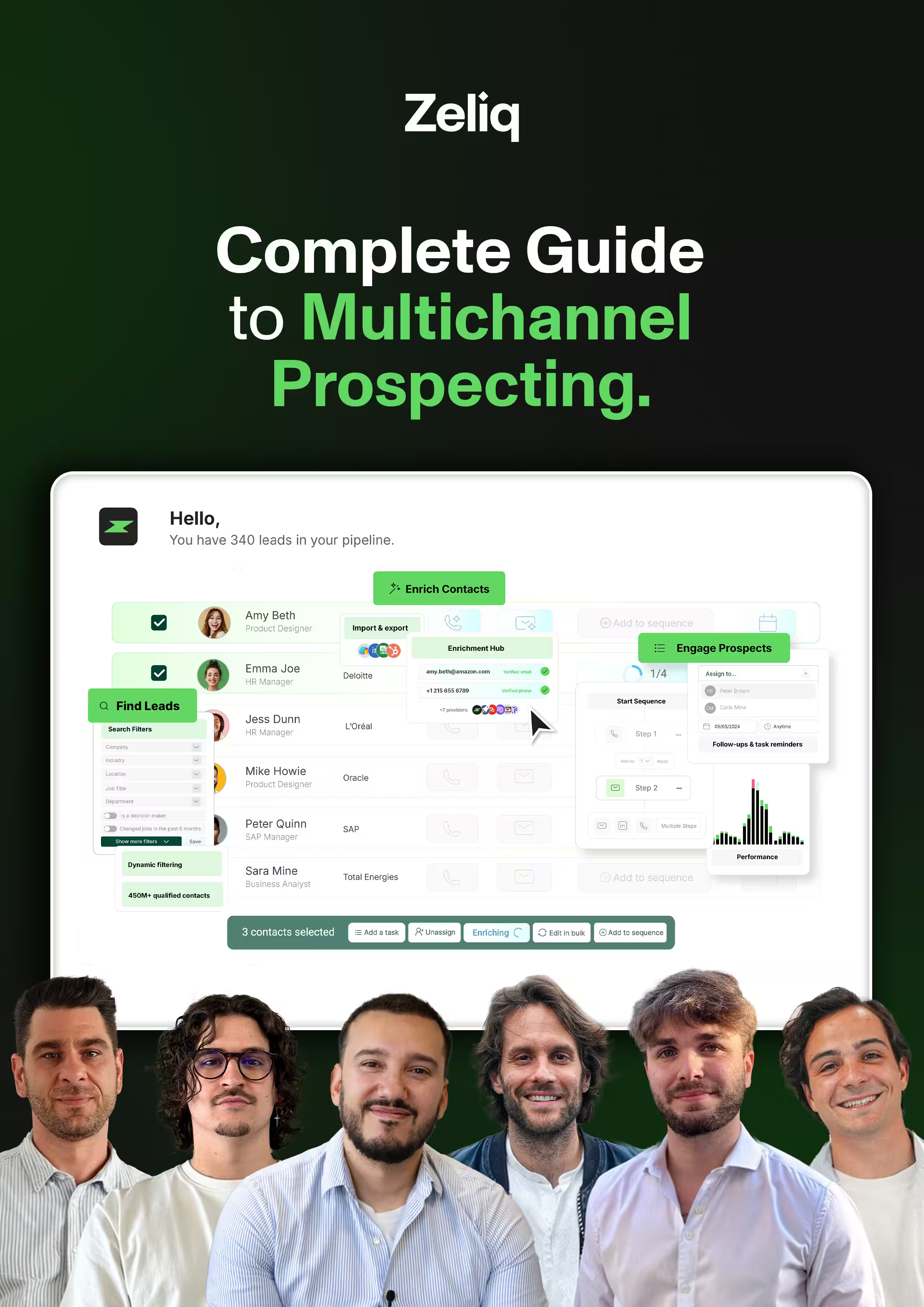
A working stack to do this well combines a B2B contact database for finding the right people, a waterfall enrichment engine to verify their email and direct phone, and a trigger source (signals API, LinkedIn monitoring, news feed). The Zeliq Chrome extension shortcuts the LinkedIn-to-CRM step: see a profile, capture the verified contact in one click, push it into the right sequence.
Want the full prospecting motion in one place? Zeliq combines a 450M+ B2B contact database, waterfall enrichment across 40+ data providers, and the Chrome extension that turns any LinkedIn search into a sequence-ready list. Start free and test the find-enrich-engage loop end to end.
Sequences: the multichannel cadence that doubles your reply rate
A single cold email, even a great one, replies at 2% to 3% on average. The same prospect, the same offer, contacted through a coordinated three-week sequence that mixes email and LinkedIn, replies at 8% to 15%. Multichannel is not a nice-to-have. It is the difference between a marginal and a profitable outbound program.
The 6 to 8 touch cadence that works
Cold email sequences in 2026 run 6 to 8 touches over 21 to 30 days. Below five touches, you leave reply rate on the table. Above ten, you cross into harassment territory and you train the inbox to filter your sender. A working frame:
| Day | Touch | Channel | Purpose |
|---|---|---|---|
| 0 | Email 1 | Trigger-based opener with one CTA | |
| 3 | Profile view | Light social signal | |
| 5 | Connection request, no note | Lower the wall | |
| 8 | Email 2 | New angle or new data point | |
| 12 | LinkedIn message | Only if they accepted | |
| 18 | Email 3 | Customer story or relevant case | |
| 22 | Voice note or call | Phone | Optional, high-value accounts only |
| 28 | Email 4 (breakup) | Polite close, no pressure |
The point of the sequence is not to repeat the first email louder. Each touch carries a different angle, a different proof, a different ask. If touch four says the same thing as touch one, you are training the prospect to ignore the next one.
A platform like Zeliq’s multichannel sequences automates this orchestration: when a prospect replies, opens, clicks, accepts a connection, the sequence pauses or branches automatically without an SDR babysitting it. Manual handoff between channels is where most teams lose 30% of their reply potential.
The breakup email is the most underrated touch
The fourth or fifth email, sent as a polite goodbye, often outperforms every other touch in the sequence. It triggers loss aversion, removes pressure, and rewards the recipient for replying. A working pattern:
Subject: Closing the loop
Hi Sarah,
Have not heard back, which is a totally fair signal. I will stop reaching out for now. If outbound deliverability ends up on the roadmap in Q2, my email is here.
All the best, Marc
Five to fifteen percent of breakup emails get a reply. About half of those replies turn into conversations. Skipping the breakup is leaving real pipeline behind.
Sequence guardrails
- One sequence per ICP segment. Do not blend founders and CFOs in the same cadence.
- Pause the sequence the moment the prospect engages (reply, meeting booked, opt-out).
- Cap simultaneous active prospects per SDR at 200 to 300, no more. Above that, personalization quality collapses and reputation erodes.
- Refresh copy every 4 to 6 weeks. Templates fatigue faster than most teams realize, especially within tight communities (HR-tech founders, sales-tech VPs).
2026 benchmarks: open, reply, positive reply, meeting booked
The single most useful exercise after launching cold email is to benchmark your numbers against the market. The 2026 picture, aggregated across published reports from Saleshandy, Smartlead, Instantly, and Lemlist data:
| KPI | Average | Top quartile | What to track it for |
|---|---|---|---|
| Delivered rate | 95 to 98% | 99%+ | Sender reputation health |
| Open rate | 25 to 35% | 50%+ | Soft metric, useful relative only |
| Reply rate | 3 to 5% | 8 to 15% | The metric that actually matters |
| Positive reply rate | 25 to 40% of replies | 50%+ | ICP and offer fit |
| Meeting booked rate | 0.5 to 2% of contacts | 3 to 5% | The KPI for SDRs |
| Spam complaint rate | < 0.1% | < 0.05% | Your reputation tripwire |
Three honest observations on these numbers.
Open rate is half-broken. Apple Mail Privacy and Gmail image proxying inflate it by 10 to 20 points. Use it for relative comparison within the same week, same client, same setup. Not for absolute targets.
Reply rate is the truth. It cannot be faked, it cannot be inflated, it does not depend on email clients. If your reply rate is under 2%, your problem is targeting or copy, not deliverability.
Positive reply rate is the leading indicator of pipeline. A 12% reply rate where 5% are interested is better than a 20% reply rate where everyone is angry. Track positive replies as the headline metric for SDR performance, not raw replies.
For a deeper dive on the single metric that maps best to pipeline, see how to push your numbers in our guide on cold email response rate (or compare what Zeliq does on cadence and analytics versus the market).
The cold email tools landscape
The cold email stack in 2026 has stabilized around five categories. You need at least one tool in each, ideally consolidated into as few platforms as possible.
- B2B contact database. Where you find the right people. Apollo, Cognism, Lusha, Zeliq. The variables that matter: coverage outside the US, refresh rate, GDPR posture, price per verified contact.
- Email finder and verifier. Where you turn a name and a company into a deliverable email. Hunter, Dropcontact, Zeliq’s waterfall enrichment. Bounce rate must stay under 5%, ideally under 2%.
- Sending platform. Where you send and orchestrate. Lemlist, Smartlead, Instantly, Mailshake, La Growth Machine, Zeliq. Look for: warm-up included, IP rotation, multichannel native (not bolted on), in-platform A/B testing.
- LinkedIn automation. Often a separate tool (Waalaxy, La Growth Machine), increasingly integrated into the sending platform. Volume caps on LinkedIn are tight: 100 to 200 actions per day.
- CRM and reporting. Where the data goes home. HubSpot, Salesforce, Pipedrive. Native two-way sync matters more than nice-looking dashboards.
The trade-off across vendors is consolidation versus specialization. Specialized tools (a best-in-class sending platform plus a best-in-class enricher plus a best-in-class CRM) give you the deepest features in each category but the highest cost and the hardest sync. All-in-one platforms collapse find, enrich and engage into a single login and a single bill, at the cost of giving up some niche features. Both approaches work; the wrong choice is half-consolidated, where two vendors do half the same thing and nobody syncs cleanly.
If you want concrete comparisons, our Zeliq vs Apollo and Zeliq vs Lemlist breakdowns walk through the feature-by-feature deltas. The honest take across categories: pick the tool that matches your sending volume and your CRM. A 5-person team and a 50-person team do not need the same stack.
A/B testing: the discipline that compounds
A/B tests on cold email are easy to run and easy to misread. Two principles save most teams from drawing wrong conclusions.
Test one variable at a time. Subject line, hook, CTA, send time, sender name. Never two at once. If you change both subject and body and reply rate jumps, you do not know which one moved the needle. The only way to compound learnings is to isolate.
Wait for statistical significance. A 2% reply rate on 100 sends versus a 4% reply rate on 100 sends is not a 2x improvement. It is two extra replies on a noisy sample. You need 500 to 1,000 sends per variant before you can trust the delta on reply rate. On meeting booked rate, you often need 2,000+. If you cannot reach those volumes, run longer or accept that the test is directional, not conclusive.
What is worth testing, in priority order:
- Subject line. Highest leverage on open rate and on reply rate (because it filters who actually engages).
- First line / hook. Second highest. Sets whether the email gets read past the preview.
- CTA. Direct question vs interest probe vs right-person check. Often a 50% delta on reply rate.
- Length. 50 words vs 100 vs 150. Short usually wins, but not always: complex SaaS sometimes needs 130 words to land.
- Send time and day. Tuesday at 9 a.m. local versus Thursday at 2 p.m. Smaller deltas, but real.
Set up a calendar: one test per week per sequence. Twelve months of disciplined testing produce 50 confirmed learnings, which is what separates a 3% reply rate program from an 8% one.
Seven mistakes that quietly kill cold email
1. Sending without warm-up. First 100 emails go to spam, the next 1,000 go to spam by association, and your domain reputation needs three months to recover. Always warm up.
2. Cosmetic personalization only. “{{first_name}}, hope you and the team at {{company}} are doing well.” Detected as templated in two seconds. Sub-1% reply rate. If you cannot tie the email to a real signal, do not send it.
3. Pitching in the first email. A first cold email is not a brochure. It is an opening question. If the prospect can already tell what they would have to pay you, you have written the wrong email.
4. One sequence forever. Templates fatigue. The same email that pulled 12% reply rate in January pulls 4% in May because half the ICP has now seen it twice. Refresh every four to six weeks.
5. Sending from your main domain. Burning the reputation of acmecorp.com means your finance and legal emails start landing in spam. Always use a secondary domain, ideally rotate between two or three.
6. Skipping the breakup. The fourth or fifth touch is often the highest reply rate of the entire sequence. Cutting it for “polish” reasons removes 20 to 30% of total pipeline.
7. Measuring opens, not replies and meetings. A program optimized for opens looks great on a dashboard and produces no revenue. The North Star metric for an SDR is meetings booked. Everything upstream is plumbing.
Frequently surfaced questions on cold email
Is cold email legal in 2026?
In B2B, yes, in most jurisdictions, with conditions. The United States allows cold email under CAN-SPAM if you identify yourself, give a valid physical postal address, and honor opt-outs within 10 business days. The EU and UK allow B2B cold email under GDPR and PECR if the recipient is a professional in a role plausibly relevant to your offer (legitimate interest), if you can be transparent about how you got their data, and if you respect the right to object on every email. Consumer cold email is much more restricted in Europe and you should not run B2C cold email campaigns without explicit consent.
How many cold emails should I send per day?
Per mailbox, cap at 50 per day. To scale, multiply mailboxes and domains, not volume per mailbox. A team of five SDRs running two mailboxes each at 50 sends a day pushes 500 emails a day sustainably. Pushing one mailbox to 200 a day burns it inside two weeks.
How long should a cold email be?
50 to 120 words for the first touch. Shorter is usually better, but very technical or high-ACV offers sometimes need 130 to 150 words to land. Above 150, reply rates collapse. Below 30, you lose context and the email looks shallow.
What is a good reply rate in 2026?
Average across categories is 3% to 5%. A reply rate of 5% means your program is healthy. Above 8% means your targeting and copy are tight. Above 15% is rare and usually means a very narrow ICP, very strong signals, or both.
Should I personalize the subject line?
Avoid name-merge subject lines like “Hi {{first_name}}, quick question.” They are the most-used templated pattern of 2024 and 2025 and everyone now reads them as marketing automation. Better: a subject that references a real signal (“Saw your Series B announcement”), or a short, low-key fragment (“quick question on Q1 hiring”). Specific beats personalized.
How do I know if my emails are landing in spam?
Run a seed-list test once a week. Send the same campaign to a panel of five to ten test inboxes you control across Gmail, Outlook, Apple iCloud, and check actual placement. Tools like GlockApps, Mailtoaster, Inboxally automate it. Do not trust open rate alone, especially since Apple Mail Privacy distorts the signal.
Should I write cold emails with AI in 2026?
Yes for research and drafting. No for signing the email. AI is excellent for parsing a LinkedIn profile to extract a useful angle, for pulling a job posting summary, for generating five subject line variants. It is bad at writing the actual email in a way that does not sound like every other AI cold email. Rule: the AI does the prep work, a human writes the final 80 words. The hybrid produces better results than either pure-human or pure-AI workflows.
Email or LinkedIn for cold outreach?
Both, in the same sequence. Email-only outbound caps at 2% to 3% reply rate. LinkedIn-only caps at similar numbers and on top is throttled by the platform. The combination, properly orchestrated, doubles or triples reply rate. Treat them as two channels of one outbound motion, not two separate programs.
How long does cold email take to ramp?
A new outbound program needs 30 to 45 days before producing reliable numbers: 15 days of domain warm-up, 15 days of first-cohort sequences, then 15 days of iteration on what worked. Expect the first month to be data collection, not pipeline. Programs that try to book meetings in week one are the ones that burn out fastest.
What to do this week
If you are starting from zero, sequence the work this way:
- Buy and warm up your secondary domain. Today. The 30-day clock starts now.
- Configure SPF, DKIM, DMARC. Test on Mail-Tester. Score above 9 before you go live.
- Define one ICP segment and one trigger. Not five. One. A funding round, a hire, a public post.
- Build a list of 200 prospects that match that ICP and that trigger, with verified emails.
- Write three sequence templates tied to that single trigger. 5 to 7 touches each. Mix email and LinkedIn.
- Send. Measure. Iterate weekly.
Cold email rewards patience and discipline more than creativity. The best cold email programs in 2026 are not the most clever ones. They are the ones that warmed their domains six weeks ago, that target one trigger at a time, that test one variable a week, and that run their breakup email without flinching.
If you want to compress the setup time, Zeliq gives you the full outbound stack in one platform: a 450M+ B2B contact database, waterfall enrichment across 40+ data providers, multichannel sequences that orchestrate email plus LinkedIn plus phone without manual handoff, a Chrome extension that turns LinkedIn into a sequence-ready list in one click, and native HubSpot sync so your CRM stays clean. Sales leaders running their team on Zeliq report cutting prospecting time in half and handling four times more leads per SDR (more on the sales leader use case).
Start free and run your first sequence end to end in under an hour.