
Outbound Marketing in 2026: Channels, Strategy and Playbook
Most growth leaders still ask the same question every quarter. Should we double down on outbound, or wait for inbound to pick up? In 2026, that framing is broken. Outbound marketing has become a precision discipline, not a volume game, and the teams using it well are pulling pipeline forward by months while their inbound flywheel keeps spinning in the background.
If you run growth, marketing or a young company that needs revenue this quarter, outbound is the lever you can pull on Monday and measure on Friday. Inbound takes 12 to 18 months to compound. Outbound, when it is built properly, is predictable, controllable, and tightly bound to your ICP.
This guide walks through what outbound marketing actually is in 2026, the channels that still work, how to design a campaign that books real meetings, what to measure, what is legal in your market, and the mistakes that quietly drain your pipeline.
What outbound marketing means in 2026
Outbound marketing is the practice of initiating contact with prospects who fit your ICP, on channels you control, with timing you decide. You are not waiting for the buyer to raise a hand. You choose the company, the buyer, and the moment.
That definition matters because the term gets stretched in two directions, and the confusion costs teams real money.
Outbound marketing vs outbound sales
These are linked, but not the same job.
Outbound marketing is the system: who you target, what you say, which channels you use, how you sequence them, how you measure pipeline. It is a marketing or growth function, owned by people who think in cohorts, ICPs and CAC.
Outbound sales is the execution layer on top of that system. SDRs, BDRs and AEs run the calls, send personalised lines, handle objections, qualify and pass deals to closers.
In a mature org, outbound marketing builds the asset (lists, segments, templates, sequences, scoring) and outbound sales operates it. In an immature org, SDRs invent their own ICP, write their own copy and hit a meeting quota at the same time. That is why SDR tenure is six months in most companies.
Outbound vs inbound marketing
Inbound is everything that pulls a buyer toward you: SEO content, paid search, paid social, communities, organic LinkedIn, webinars, a podcast. The buyer raises the hand.
Outbound is everything that pushes you to a chosen buyer: cold email, cold call, LinkedIn outbound, direct mail, ABM plays, programmatic display targeted at named accounts, intent-based outreach.
Both share one goal (pipeline) but trade off differently.
Why outbound still works in 2026
Three structural reasons explain why outbound is not just alive but increasingly important, even with crowded inboxes.
Intent control. Inbound only delivers buyers who are already searching. Outbound lets you talk to buyers who should be searching but are not yet, or who are stuck with a competitor. That is roughly 90% of your TAM at any given moment.
Speed. A new SEO article needs four to nine months to rank. A paid creative needs two to three weeks of testing. A well built outbound sequence books meetings in week two. When a CFO asks where Q1 pipeline is coming from, outbound is the only honest answer that does not start with “we are building”.
ICP precision. Modern data tools mean you can address 312 named accounts that match a tight definition (B2B SaaS, 80 to 250 employees, just hired a VP Sales, raised in the last 12 months) and skip the other 50,000. Inbound cannot do that. Paid can approximate it. Outbound nails it.
The teams losing on outbound in 2026 are the ones still running it like 2017: high volume, single channel, generic copy, no signal.
Outbound vs inbound: the real trade-offs
Inbound and outbound are not competitors, they are complements. But the trade-offs are real and you should pick your mix on purpose, not by default.
| Dimension | Outbound | Inbound |
|---|---|---|
| Time to first qualified lead | 1 to 3 weeks | 6 to 18 months |
| Cost structure | OpEx (tools, SDRs) | CapEx (content, SEO, brand) |
| Volume control | Linear with effort | Compounds slowly, then jumps |
| Lead quality signal | Variable, depends on targeting | Generally higher (self-selection) |
| Sales cycle length | Slightly longer (you initiated) | Slightly shorter (they initiated) |
| Cost per lead | Stable (USD 15 to 80 in B2B) | High at start, low at scale |
| ICP precision | Total | Limited to who searches |
| Scale ceiling | Linear with team and tools | Exponential after the inflection |
| Brand impact | Neutral or negative if done badly | Positive (reach, authority) |
Two practical rules of thumb that hold across most B2B companies.
If you are pre-Series A, your mix should lean 70/30 outbound to inbound. You need pipeline now, and inbound has not had time to compound. If you are post Series B, the ratio usually inverts to 30/70 outbound to inbound, with the outbound 30% laser focused on ABM into enterprise accounts. If you are in between, run them at parity and let the data tell you which one deserves more budget next quarter.
The outbound channels that move pipeline in 2026
Outbound is no longer cold email plus a phone. The 2026 channel mix is wider, and most teams underuse half of it.
Cold email
Still the workhorse. Done well it produces a 2% to 8% reply rate in B2B and a 0.8% to 2.5% meeting booked rate on the contacted base. Done badly it ruins your domain reputation in two weeks. The non negotiables for 2026: a dedicated sending domain warmed up four to six weeks, sender volume capped at 30 to 50 emails per inbox per day, personalisation that goes beyond first name, and a sequence of three to five emails over two to three weeks.
Cold call
The phone is unfashionable, which is exactly why it works on segments where everyone has stopped trying. Direct dial connect rates sit around 8% to 15%. Conversion to meeting on a connected call sits at 10% to 20% with a trained SDR. Best deployed as a follow up to email, on enterprise accounts, or in industries where email open rates are structurally low.
LinkedIn outbound
Connection requests, InMails, voice notes, and DMs after engagement. LinkedIn rewards relevance and punishes volume. The pattern that works in 2026: visit profile, like a recent post, send a connection request without note (acceptance rate 30 to 50%), then a personalised message after acceptance.
Direct mail
Yes, paper. A handwritten card, a book, a small physical gift. Cost per touch is high (USD 15 to 80) but on enterprise accounts the response rate beats email by a factor of three to five. Reserved for top of funnel ABM into accounts worth at least USD 50K ARR.
Paid display, paid search, paid social
Paid is technically inbound (the buyer clicks), but used in account-targeted mode it functions as outbound: you choose the audience, you push the message. LinkedIn Ads with matched audiences, Google Ads with customer match lists, programmatic display via 6sense or Demandbase to surround named accounts. Use paid as air cover before a cold email lands.
Account-Based Marketing (ABM)
ABM is outbound on steroids: a finite list of strategic accounts (50 to 500), a multichannel orchestration per account (email, LinkedIn, ads, direct mail, events), a 3 to 6 month horizon. Works when your ACV is above USD 30K and your TAM is below 5,000 accounts. Below USD 5K ACV, the math kills you.
Intent-based outreach
The 2026 differentiator. You watch signals (G2 page visits, hiring posts, funding news, technographic changes, content downloads) and trigger an outbound touch within 24 to 48 hours. Reply rates on signal-driven outbound run two to four times higher than cold lists.
Programmatic and OOH
Display retargeting on named accounts, billboards near a prospect’s office, sponsored airport lounges. Niche, expensive, real for enterprise software, fintech and pharma. Most growth teams will never use these.
How to build an outbound campaign that produces pipeline
This is the seven-step blueprint we see consistently across the teams that win at outbound. Skip a step and you will feel it in the conversion rate.
Step 1: Define the ICP with surgical precision
A bad ICP is “B2B SaaS companies in Europe”. A good ICP is “B2B SaaS companies, 80 to 250 employees, headquarters in France, UK, Germany or Benelux, raised a Series A or B in the last 18 months, just hired a Head of Sales or VP Sales, using HubSpot or Salesforce”. The second definition gives you 280 accounts, not 28,000. That is workable.
Step 2: Build the list
This is where most outbound campaigns die before they start. You need clean data, deduplicated, with verified email and direct dial. Use a B2B lead database to filter on firmographics (size, sector, geography), buying signals (funding, hiring, technographics) and persona (title, seniority, tenure). Aim for an email validity rate above 95% and a bounce rate below 3%.
A typical campaign list for a SaaS targeting mid-market is 800 to 2,500 contacts spread across 200 to 500 accounts.
Step 3: Write the message
The message is not the email. The message is the answer to one question: why should this specific person, at this specific company, care this specific week?
The structure that performs in 2026:
Problem-first opening (one sentence that names the pain or the context). Proof or relevance (one line that shows you did your homework, not a fake personalisation token). Soft CTA (a question, not a meeting request). Signature with credibility marker.
Three to five sentences total. No paragraphs longer than two lines. No jargon the buyer would not say themselves.
Step 4: Design the sequence
Four to seven touches over 14 to 21 days, mixing channels. A pattern that works:
Day 0, email 1 (problem and soft CTA). Day 2, LinkedIn profile visit. Day 4, LinkedIn connection request without note. Day 6, email 2 (new angle, a fresh data point or proof). Day 9, LinkedIn message after connection. Day 12, cold call. Day 16, email 3 (case study or peer benchmark). Day 21, breakup email (polite close).
That is seven touches across three channels, spread far enough apart to not feel pushy, close enough together to be coherent.
Step 5: Pick the right channel mix
Not every campaign needs all seven channels. A self-serve PLG product targeting founders runs fine on email plus LinkedIn. An enterprise deal targeting a CIO needs email, LinkedIn, calls, ABM ads and direct mail. The higher the ACV, the more channels you can afford to layer.
Step 6: Score and prioritise
Not all replies are equal. Build a quick scoring grid for incoming responses: positive (book a meeting now), curious (send more info), not now (nurture for 90 days), not me (re-route inside the account), unsubscribe (respect it). The first hour after a positive reply is gold. Reply within 60 minutes with a Calendly link or two specific time slots, no longer.
Step 7: Hand off cleanly to sales
Once a meeting is booked, hand off the context. The AE walking into the call should know which sequence touched the prospect, which line resonated, what the signal was, and what the prospect actually said. A sloppy handoff is why 40% of booked meetings end up as no-show or no-fit.
Run outbound on a system, not on willpower
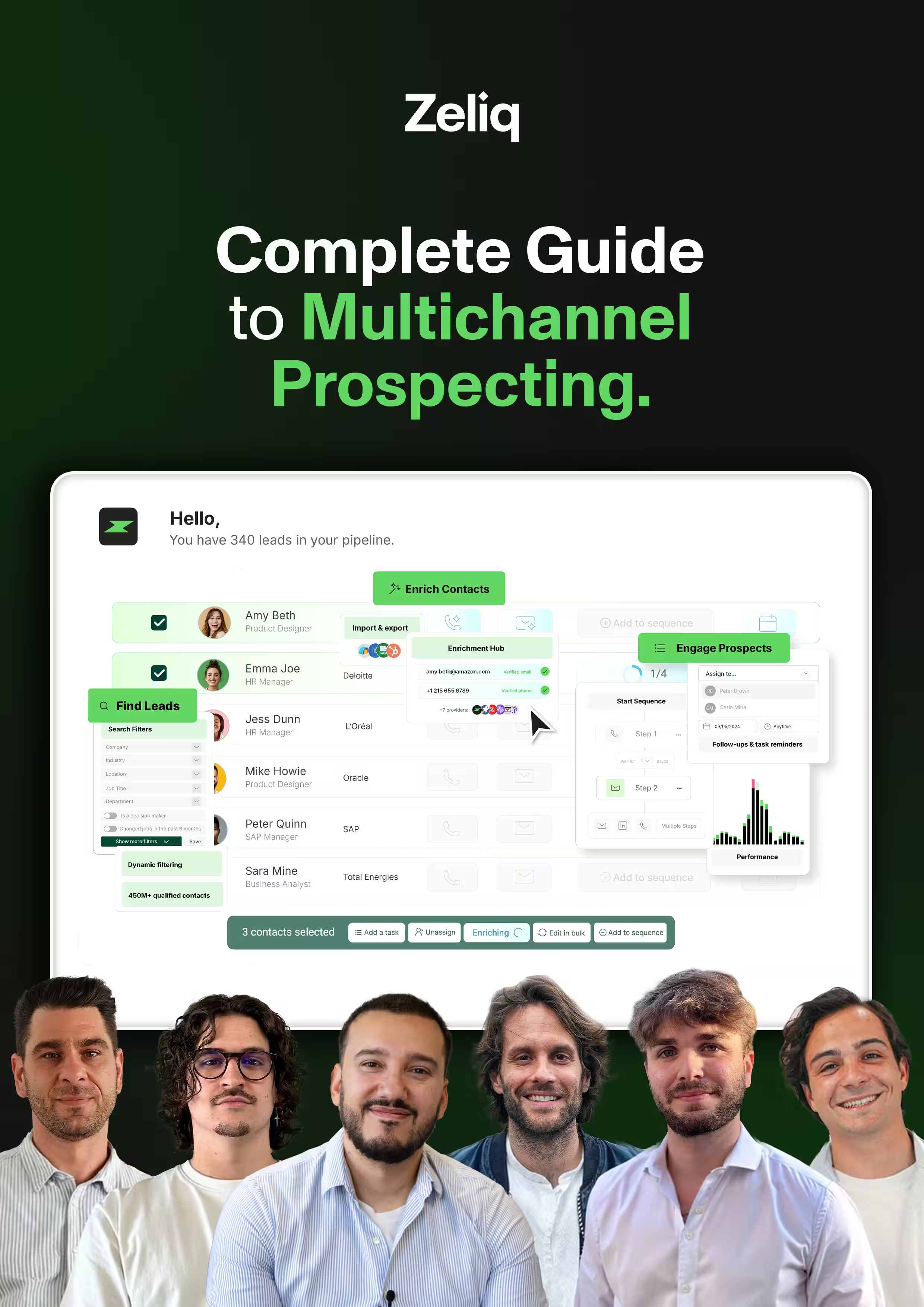
Multichannel sequencing is what turns a list of names into booked meetings. With Zeliq, you build the list, enrich emails and direct dials, run email plus LinkedIn plus call sequences from one place, and watch reply data feed your iteration loop. See how multichannel sequences work in real time.
Modern outbound: multichannel, intent and AI personalisation
Three shifts have rewritten the outbound playbook between 2023 and 2026.
Multichannel is the default. Single channel outbound is a curiosity now. Buyers expect to see your name three or four times across email, LinkedIn and ads before they reply. Teams running pure cold email are losing 30 to 50% of the meetings they could be booking.
Intent data unlocks timing. Watching for funding announcements, headcount changes, G2 visits, RFP downloads and tech stack moves lets you reach a buyer the week they are most likely to listen. Generic outbound to a generic list converts at 1%. Signal-triggered outbound to the same list converts at 3 to 5%.
AI personalisation, used carefully, beats human personalisation at scale. AI cannot replace strategy, but it can read a LinkedIn post and turn it into a relevant opening line in two seconds. Use AI for the variable line only, not the whole email. Teams that fully automate copywriting end up with bland sequences buyers spot immediately.
How to measure outbound marketing
Volume metrics are vanity. Pipeline metrics are truth. The dashboard you actually need:
CPL (cost per lead). Total outbound cost divided by qualified leads. In B2B SaaS, healthy CPL sits between USD 80 and 250.
CAC by outbound. Should be below 30% of first year ACV for outbound to be profitable.
Reply rate. 2 to 8% on cold email is the modern range. Below 1.5%, your list or copy is broken. Above 10%, you might be hitting an audience that already knows you.
Positive reply rate. Of the replies you get, how many are interested. 30 to 50% is healthy. Below 25% means your targeting is misaligned with your message.
Meeting booked rate. 0.8 to 2.5% of contacts on the list. Below 0.5%, the sequence needs rework.
Meeting show rate. Above 70% is healthy. Below 60% means your pre-meeting confirmation flow is leaking.
Pipeline generated. USD value of opportunities created from outbound, by sequence, by SDR, by month. The most important number on the dashboard.
Win rate on outbound deals. Outbound win rate is usually 5 to 15 points below inbound. If yours is 25 points lower, your qualification is off.
Track weekly, review monthly, recut sequences quarterly.
Legal: what you can and cannot do
Outbound marketing is legal in most jurisdictions, but the rules differ and the fines hurt. Three regimes matter for most B2B teams.
GDPR (EU and UK). B2B cold email is allowed under “legitimate interest” if you target professionals on a business email, the message is relevant to their job, you provide a clear opt-out, and you can demonstrate proportionality. You cannot scrape consumer emails. You must honour unsubscribe within 30 days. France adds CNIL guidance on top: B2B prospecting allowed, B2C requires opt-in.
CAN-SPAM (US). Cold email is legal if the message identifies you clearly, includes a physical address, has a working unsubscribe link and a non misleading subject line. No opt-in required. The bar is lower than GDPR.
CASL (Canada). Stricter. Canada generally requires express or implied consent before sending commercial email. Existing business relationship counts as implied consent for two years. Pure cold email to Canadian prospects without prior interaction is risky.
Cold call rules. Do Not Call lists exist in most countries (TCPA in the US, Bloctel in France, TPS in the UK). Most B2B direct dial outreach to professional mobiles is allowed, but check before scaling.
The simple rule: have a documented compliance policy, train SDRs on it, and use a tool that handles unsubscribe automatically.
Common outbound mistakes that quietly kill pipeline
Five patterns we see in nearly every audit of an underperforming outbound program.
Mistake 1: sending from the main domain. Your acme.com domain is for invoices, contracts and customer support. The day it gets flagged for spam, your finance team starts losing emails to suppliers. Always send outbound from a secondary domain (acme-team.com, getacme.com), warmed up properly, with SPF, DKIM and DMARC configured.
Mistake 2: volume over precision. 5,000 emails to a generic list will book fewer meetings than 500 emails to a tight list. Every additional 1,000 contacts on a bad list dilutes your reputation, your data quality and your conversion rate.
Mistake 3: cosmetic personalisation. “Hi {{FirstName}}” is not personalisation, it is mail merge. Real personalisation references the company, the role, a recent event, a piece of content the prospect produced or a specific pain you have evidence they have.
Mistake 4: no follow-up SLA. Positive reply at 9:42, your SDR replies at 14:30 the next day. You just lost 50% of that meeting. Set a one-hour SLA on positive replies during business hours and tool it (Slack alerts, mobile push, dedicated reply queue).
Mistake 5: counting volume instead of pipeline. “We sent 18,000 emails this month” is meaningless. “We generated USD 412K in pipeline from outbound” is the number that gets your budget renewed. If you cannot attribute pipeline to outbound, your tracking is broken before your tactics.
The 2026 outbound stack
A modern outbound stack collapses into three layers.
Data layer. Where you find and verify prospects. A B2B database with firmographic, technographic and intent filters, plus enrichment for email and direct dial. Coverage matters less than freshness and verification.
Engagement layer. Where you run the multichannel sequence. Email sending with rotation and warmup, LinkedIn automation, dialler integration, sequence builder, A/B testing, reply detection.
Orchestration layer. Where you tie it back to revenue. CRM sync (HubSpot, Salesforce, Pipedrive), pipeline reporting, attribution, ABM signal feeds.
In 2022, you needed five to seven tools to cover this. In 2026, the consolidation play is to use one platform that covers data, engagement and orchestration, plus your CRM. Zeliq is built for that consolidation: prospect data, waterfall enrichment, multichannel sequences, scoring and CRM sync in a single workspace, replacing the Apollo plus Lemlist plus Phantombuster plus enrichment vendor stack. If you are in Apollo today and feeling the data and limit pain points, the Zeliq vs Apollo comparison lays out the differences.
Who runs outbound marketing inside the company
The owner depends on company stage.
Founders and early teams (under 20 people). The founder runs outbound. If you cannot describe your ICP, write the first sequence and book the first 10 meetings yourself, no SDR will save you. There is a Zeliq for founders workspace built for that founder-led motion.
Growth-stage teams (20 to 150). A growth marketer or head of growth owns the system, an SDR team executes. Growth owns ICP, list, copy, sequencing and signal feeds. The SDR team owns execution, replies, qualification and handoff. The growth marketing use case walks through this split.
Mature teams (150+). A dedicated outbound lead reports into a Head of Marketing or VP Sales. RevOps owns the data and tooling. The sales leader workspace centralises team performance metrics for that role.
FAQ
Is outbound marketing dead? No. Outbound that mimics 2017 (high volume, no signal, single channel) is dead. Outbound that uses ICP precision, intent data, multichannel orchestration and modern personalisation produces predictable pipeline at every B2B stage.
How fast can outbound produce pipeline? First booked meetings in week two if your domain warmup started early. First closed-won deals between week six and week twelve depending on your sales cycle.
Should we outsource outbound or hire in-house? Outsource list cleaning and sometimes the cold call connection layer. Never outsource the strategy, the copy or the qualification.
Outbound vs paid, which first? Outbound first if your ACV is above USD 5K. Paid first if you sell self-serve at lower price points.
How much should outbound cost? A reasonable budget for a single outbound SDR setup (data, tools, salary, training) is USD 7K to 12K monthly fully loaded. Output should be 6 to 15 booked qualified meetings per month per SDR after month three.
Wrap up: outbound marketing as a system, not a tactic
The teams that win at outbound in 2026 stopped treating it as a list of tactics and started treating it as a system. ICP first, list second, message third, sequence fourth, signal feeds plugged in, measurement weekly, iteration monthly. Channels are tools inside that system, not the system itself.
If you are starting from zero, do not try to build all seven channels in week one. Start with cold email plus LinkedIn, hit a 2% reply rate baseline, then add cold call, then layer ABM and intent data when the foundations are clean.
If you are scaling outbound and tired of stitching five tools together, consolidate the stack. The maths usually saves you 30 to 50% on monthly tooling spend and your SDRs stop losing 90 minutes a day to context switching. Compare plans on the Zeliq pricing page and start a free trial today.