
A funny follow-up email is one of those tactics that looks risky on paper but, when executed correctly, consistently outperforms its straight-faced alternatives. The average professional receives over 120 emails a day. By the time your third or fourth follow-up lands, you are competing not just with other salespeople but with newsletters, internal threads, and the rising dread of an inbox that never quite hits zero. A touch of humor can cut through that noise in a way that another “just circling back” never will.
But humor in professional email is genuinely difficult. The gap between charming and cringey is narrower than most people expect, and the stakes are real: a follow-up that lands wrong does not just go unanswered, it can actively poison a relationship you spent weeks building. This guide covers the risk-reward calculus of funny follow-up emails, the types of humor that work in B2B, seven actual templates you can adapt today, and the situations where you should leave the jokes at home entirely.
Why Humor Works in Follow-Up (and Why It So Often Does Not)
The case for a funny follow-up email is straightforward. When your prospect has already ignored two or three polite, professional messages, another version of the same message produces the same result: silence. Pattern interruption is the only lever left. A well-placed absurdist subject line, a self-deprecating opener, or a light “breakup email” introduces novelty into a predictable sequence and gives the prospect a new emotional entry point.
Research from Boomerang found that emails that provoke emotion, including amusement, generate significantly higher reply rates than neutral messages. Humor signals confidence. It signals that you are not desperate. It can make the prospect feel a flicker of goodwill toward someone who made them smile. All of those things make a reply feel lower-stakes.
The case against is equally real. Humor is culturally specific, contextually fragile, and impossible to unsend. Sarcasm that reads as dry wit to one person reads as passive-aggressive to another. A joke that lands brilliantly in a tech startup context can feel wildly out of place when you are emailing a compliance director at a regulated financial institution. Tone does not travel well across text. You cannot rely on a smile or a raised eyebrow to signal that you are kidding.
The other failure mode is trying too hard. Forced humor is worse than no humor. If the joke requires explanation, or if it feels like you googled “funny sales email,” it signals the opposite of confidence: it signals desperation wearing a costume.
The Types of Humor That Work in B2B Email
Not all humor is equal in a professional follow-up context. Here is what reliably works and what consistently backfires.
What Works
Self-deprecation is the safest form of B2B humor. When you make yourself the subject of the joke, you cannot offend anyone, and you demonstrate self-awareness, which is a quality prospects actually value in salespeople. Acknowledging that you are aware of how follow-up emails feel, and poking gentle fun at your own persistence, disarms the irritation the prospect might feel and replaces it with recognition.
Light absurdism works because it is unexpected and stakes-free. Imagining that you sent a carrier pigeon instead of an email, or picturing the two of you communicating via smoke signal, is funny because it is harmless nonsense. No one is the target of the joke. It simply breaks the pattern in a memorable way.
Wit and wordplay can work when you genuinely have a sharp observation, a neat turn of phrase, or a clever reference relevant to the prospect’s industry. This is higher-risk than self-deprecation because wit that does not land just looks like a failed attempt, but when it works, it makes the email feel genuinely personal.
Playful subject lines that create mild curiosity or set a self-aware tone signal, before the email is even opened, that this message is different from the previous ones.
What Does Not Work
Sarcasm. In text, sarcasm is nearly always misread. What you intend as wry amusement often reads as irritation or condescension. Never use sarcasm in a cold or warm follow-up email.
Humor at the prospect’s expense. Any joke that implies the prospect is busy, disorganized, bad at email, or hard to reach puts them on the defensive. The joke that says “you must be really good at ignoring emails” may feel clever to you and hostile to them.
Industry-specific edgy humor. Unless you have a very well-established relationship, stay away from humor that touches politics, religion, personal circumstances, or anything that requires the prospect to share your worldview to find it funny.
Long setups. Humor in email has to be immediate. If the joke takes three sentences to arrive, it has already failed. The best funny follow-up emails are short precisely because brevity is part of the punchline.
When NOT to Use a Funny Follow-Up Email
Before the templates, a clear list of situations where humor in a follow-up email is the wrong call:
First touch to a C-suite executive you have never met. CEOs and CFOs at large companies receive hundreds of prospecting emails per week. A funny opener on the first message signals misjudgment of the relationship. Earn the familiarity before deploying the humor.
Enterprise deals with complex procurement. When multiple stakeholders are evaluating your solution, your emails may be forwarded to people who have zero context about you. A funny message that reads fine to your primary contact can confuse or put off a procurement manager seeing it for the first time.
Sensitive industries. Healthcare, legal, regulated finance, government. The norms for professional communication are stricter, and the downside of a misfire is greater. In these verticals, default to professional and personalized rather than funny.
Any topic involving layoffs, budget cuts, or company difficulties. If the prospect has recently announced restructuring, missed earnings, or significant workforce changes, humor in a follow-up email reads as oblivious at best and cruel at worst. Read the room before you write the email.
Early in a high-stakes negotiation. Once you are in active deal conversations, the dynamic shifts. The prospect is evaluating you and your company seriously. Funny follow-ups belong in the prospecting phase, not the closing phase.
7 Funny Follow-Up Email Templates That Actually Work
Each template below includes a subject line, a short body, and notes on context. Adapt them to your voice and your prospect. The goal is not to copy-paste but to understand the structure so you can make each one feel genuinely personal.
Template 1: The “I’ll Stop Bothering You” Email
When to use: Last touch in a sequence, or when the prospect has gone completely dark after a few professional messages.
Subject line: Last one, I promise (probably)
Hi [First Name],
I have sent a few messages now with no response, which tells me one of two things: either this is not a priority right now, or my emails are in a deep, dark spam folder living their best life without me.
Either way, I will give you a break after this one. If you ever want to chat about [specific value prop in one sentence], I will be here, slightly less persistent.
[Your name]
Why it works: It names the awkwardness directly, which defuses it. The prospect knows you have been following up. Pretending otherwise is odd. This email acknowledges the dynamic with a light touch, signals that you respect their time, and makes it easy to reply either way.
Template 2: The “Clearly You Are Very Busy” Email (Self-Deprecating)
When to use: Follow-up number 3 or 4, after at least two professional messages have gone unanswered.
Subject line: You are either saving the world or I wrote a terrible email
Hi [First Name],
I am going to assume you have been incredibly busy saving the world since my last couple of notes, because the alternative is that my emails are just not very interesting, and I prefer not to dwell on that.
If there is ever a gap in the world-saving schedule, I would love 15 minutes to show you how [Company] helps [relevant outcome]. I will keep it tighter than this email.
[Your name]
Why it works: The joke is entirely at your own expense. The prospect cannot be offended by an email that assumes the best of them. The self-awareness also signals confidence: you are comfortable acknowledging the possibility that you are boring, which paradoxically makes you more interesting.
Template 3: The “Breaking Up” Email (Light Tone)
When to use: True last-touch message, typically after 5 or more contact attempts across channels.
Subject line: It is not you, it is my pipeline
Hi [First Name],
After several attempts to connect, I am officially taking the hint and moving on, with no hard feelings whatsoever.
I will close your file for now. If [specific pain point or opportunity] ever comes back onto the agenda, feel free to reach back out. I will be here, slightly wiser and with a better subject line.
Wishing you and [their company] all the best in the meantime.
[Your name]
Why it works: The “breakup email” is one of the highest-reply-rate formats in sales precisely because it removes pressure entirely. The prospect who was not ready to say yes often finds it easy to say “wait, actually, can we talk?” when the alternative is closing the door permanently. The light tone keeps it from feeling dramatic.
Template 4: The Carrier Pigeon Email (Absurdist)
When to use: Follow-up number 3 or 4, when you want to interrupt a pattern without coming across as needy.
Subject line: My carrier pigeon seems to have gotten lost too
Hi [First Name],
I have tried email, LinkedIn, and a brief but sincere hope that you would somehow just know I wanted to connect. None of these have worked, so I am now considering the carrier pigeon route, though I understand this may also get stuck in your spam filter.
If there is a better way to reach you, I am completely open to it. If not, happy to give it one more shot by conventional means: [link to calendar or specific CTA].
[Your name]
Why it works: Absurdist humor is universally low-risk because no one is the butt of the joke. The image of a carrier pigeon hitting a spam filter is specific enough to be funny and harmless enough to land across industries. It also implicitly asks whether there is a better channel, which is a useful piece of information for your next touch.
Template 5: The “Quick Question” Bait-and-Switch
When to use: Any follow-up where you want to drive a quick reply through lighthearted curiosity.
Subject line: One quick question (it is not what you think)
Hi [First Name],
Quick question: do you prefer coffee or tea?
The reason I ask is that I would genuinely love to have a 15-minute call with you about [specific topic], and I figure if I know your beverage preference in advance, I am already one step ahead.
Seriously though: I have been trying to connect about [pain point or opportunity] and I think there might be something worth exploring. Would a short call this week or next work?
[Your name]
Why it works: The bait-and-switch is charming when the payoff is self-aware. The subject line promises a quick question and delivers one. The humor is in the gap between the promise and the misdirect. The email then pivots cleanly back to the actual ask, so it does not sacrifice substance for the sake of the joke.
Template 6: The “Out of Ideas” Email
When to use: Late in a sequence, when you want to signal genuine creativity is running low.
Subject line: I am officially running out of creative subject lines
Hi [First Name],
I will be honest: I have used up my best subject lines on the previous emails, and this is what remains. The email underneath is worth reading anyway.
Short version: I believe [specific outcome] is achievable for [their company] in a realistic timeframe, and I have seen it work in similar contexts at [relevant company type or example]. I would love to walk you through it in 15 minutes.
If now is genuinely not the right time, a simple “not now, try me in Q3” is completely fine. I can handle it.
[Your name]
Why it works: Confessing that you are out of ideas is disarming and human. It acknowledges the one-sided nature of the follow-up sequence without whining about it. The email also makes it very easy to respond with a “not now,” which is often the reply that eventually converts into a future conversation.
Template 7: The “Algorithm Made Me Do It” Email
When to use: Follow-up to prospects in tech-adjacent industries who will appreciate a slightly meta joke.
Subject line: My CRM is making me send this
Hi [First Name],
Technically, my CRM flagged this as “overdue follow-up” and would not stop nudging me until I sent something. So here I am, a human being helplessly in thrall to my own software stack.
While I have your attention: I genuinely do think [specific offer or insight] is relevant to what [their company] is working on right now. If there is any chance of a quick call this week, I would love to make the CRM’s nagging worth it.
[Your name]
Why it works: For anyone who works with software tools, the joke is immediately recognizable. The self-deprecating acknowledgment that you are following a process makes the follow-up feel less predatory. It also humanizes the outreach in a way that straight-copy automation can never achieve.
Where Funny Follow-Ups Fit in a Multichannel Sequence
A funny follow-up email is almost never the right opening move. The standard placement in a high-performing outreach sequence looks like this:
Touch 1 (Email): Professional, personalized, specific value proposition. No humor. This is your first impression.
Touch 2 (LinkedIn connection or comment): Genuine engagement with their content or a simple connection request. Still professional.
Touch 3 (Email): A follow-up that adds new value: a relevant stat, a case study, a short insight. Still mostly professional, but you can start to warm the tone.
Touch 4 (Email or call): This is where a funny follow-up email earns its place. You have made at least two genuine attempts. The prospect has your name in their inbox. A pattern interrupt at this stage has the highest probability of generating a new response.
Touch 5 or 6 (Email): The breakup email. The lightest touch with the most explicit exit ramp.
Using multichannel prospecting effectively means knowing which channel carries which message. A funny subject line works well in email, where the prospect can read it in private and choose whether to engage. The same joke sent as a LinkedIn voice note or a cold call opening sounds completely different and usually lands worse.
Best Practices for Sending a Funny Follow-Up Email
Keep it short. The humor evaporates quickly if the email is long. Funny follow-up emails work best at 80 words or fewer. If you need three paragraphs to set up the joke, the joke is not good enough for this format.
Make the reply frictionless. A yes/no question, a calendar link, or a simple “just reply ‘interested’ and I will send details” lowers the barrier to engagement. The easier you make it to respond, the more responses you get.
Never punch down. Every template above puts you, not the prospect, in the slightly absurd position. This is non-negotiable. Humor in follow-up email only works when the sender is the subject of the joke.
Read your prospect’s public presence first. A prospect who posts funny content on LinkedIn is probably a better target for a humorous follow-up than one whose entire public presence is sober and corporate. Use the signals that are already available to you. With Zeliq’s browser extension, you can pull up a prospect’s profile and recent activity in seconds before you write, which means your “personalized” touch can actually be personalized.
Test before you scale. If you are sending to a large list, A/B test the funny subject line against your standard one before rolling it out broadly. Humor that works for one persona may fall flat for another.
Match the tone to the relationship. The funnier the email, the more it implies familiarity. Step the humor up gradually across touches rather than opening with your most irreverent material.
Building the Full Sequence Around a Funny Follow-Up
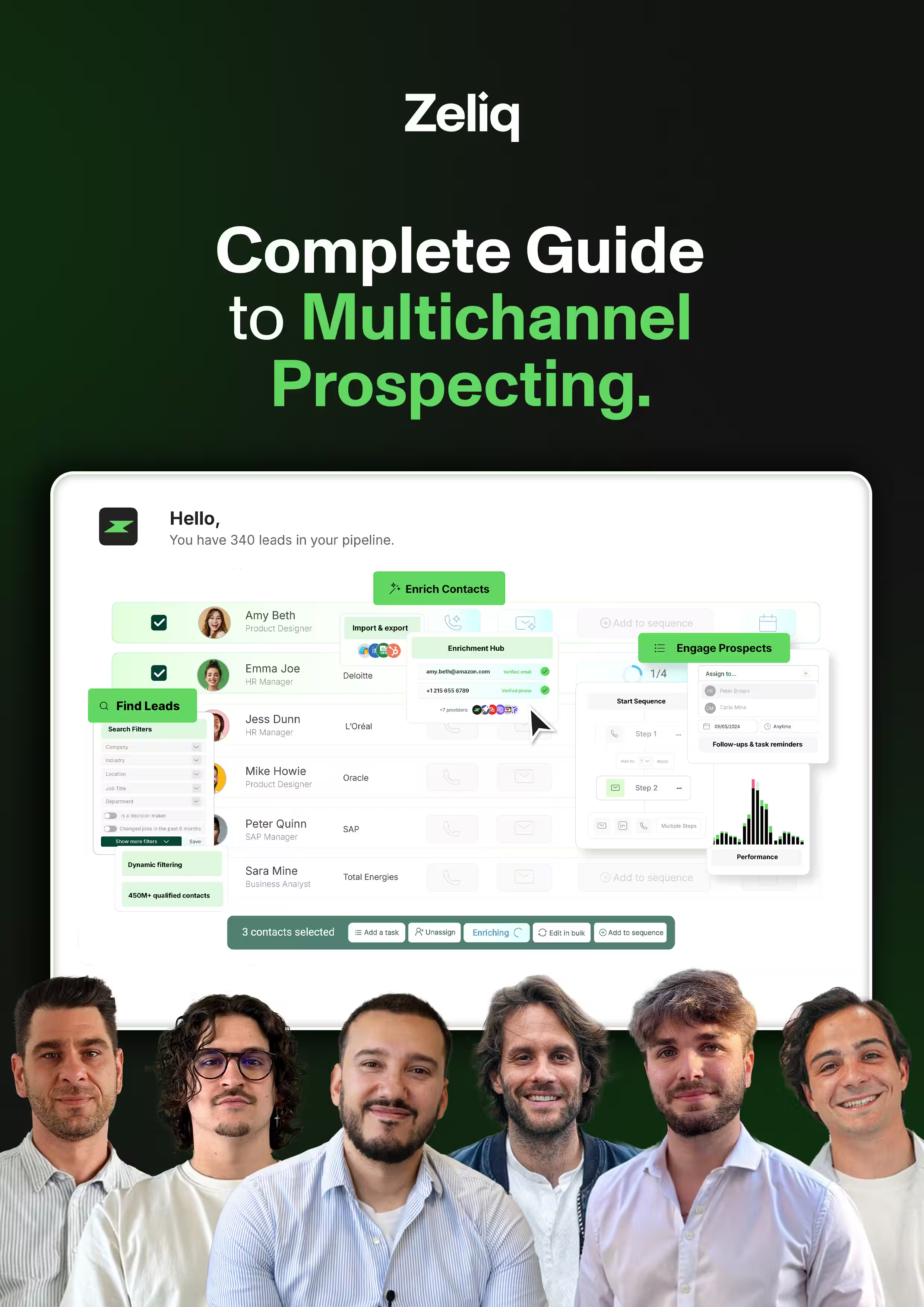
The funny follow-up email is a single card in a larger hand. The sequences that produce the best results combine serious, value-driven touches with one or two pattern-interrupting moments. Using Zeliq lets you find and verify the right contact data before the sequence starts, so you are not wasting your best follow-up humor on a dead email address or the wrong person.
Once the contact is confirmed, you can build and automate the full multichannel sequence: the straight touches and the funny ones, without losing the personal feel. The goal is to feel like a thoughtful human, not a robot running a drip campaign, even when parts of the sequence are automated. That balance is where B2B data enrichment makes a real difference: the more you know about the prospect going in, the more human your outreach feels at every step, including the funny ones.
The follow-ups that get replies are the ones that respect the prospect’s intelligence, acknowledge the situation honestly, and give them an easy way to say yes. Humor, when it serves all three of those goals at once, is not a gimmick. It is a genuine competitive advantage.
Ready to build follow-up sequences that actually get replies? Zeliq gives you verified contact data, multichannel sequencing, and the tools to personalize every touch, including the funny ones.
Try Zeliq for free