
You sent an email four days ago. Nothing back. You know you should follow up, but you do not want to come across as the pushy rep who clogs an inbox. So you hesitate on the delay, the subject line, the tone, and you end up not sending anything at all. The result: a deal that goes quiet, a demo that never converts, an invoice that drifts past its due date.
The follow-up email is one of the highest-ROI tools a B2B sales team has, and one of the worst-used. Done well, it multiplies the reply rate of an entire sequence. Done badly, it burns the relationship and sends your domain into spam folders.
This guide covers everything you need to follow up in 2026: when to send, what cadence to run, what words to use, and which tools to lean on. You will get:
- A clear definition and the four follow-up contexts
- Exact timing windows for cold, post-demo, post-proposal and invoice follow-ups
- 14 copy-paste templates with subject lines and variables
- The mistakes that kill your reply rate
- The legal rules for the US, UK, Canada and EU prospects
- The 2026 tool stack and the KPIs that actually matter
What Is a Follow-Up Email?
A follow-up email is a message sent after a first contact got no response, with the goal of reviving the recipient’s interest. It can follow a cold email, a product demo, a proposal, an invoice, or even an old conversation you want to reopen.
There are four broad families, and they do not share the same rules or the same tone.
Cold outbound follow-up. You reached out to a prospect who does not know you, they did not reply, and you persist. This is the most delicate follow-up because you have zero relationship capital to absorb a misstep.
Warm or post-demo follow-up. The prospect knows you and has shown intent: a positive reply, a demo attended, a free trial started. Then they went dark. The tone shifts. You are no longer introducing yourself, you are continuing a conversation.
Customer or win-back follow-up. An existing or former customer you want to upsell, renew, or bring back after a quiet period. The relationship is already there, so the lever is different.
Invoice or accounts-receivable follow-up. The payment is due, the client has not paid, and you follow a near-protocol sequence that hardens over time. The legal frame is tight here, and we cover it below.
In every case, a follow-up email is not a “just bumping this” sent on a loop. It is a message that gives a fresh reason to reply now, when the first reason was not enough.
Why Follow-Ups Are Critical in B2B Sales
If you only remember one number, remember this: the large majority of B2B deals close after five or more touches. Benchmarks published by the main outbound vendors (Mailshake, Yesware, HubSpot) suggest that a prospecting cycle with no follow-up loses between 60 and 80 percent of its potential. Put another way: without follow-ups, you are working at roughly a quarter of your real capacity.
Several reasons explain this.
First, attention. Your prospect gets dozens of emails a day. Yours is scanned in five seconds, then buried. The follow-up pushes the message back to the top of the inbox at a moment when your prospect may finally have a slot to deal with it.
Second, timing. The right message at the wrong moment does not convert. A founder mid-fundraise has no head space for outbound. Three weeks later the round closes and they flip back into growth mode. If you are not in their inbox at that exact moment, you do not exist.
Third, friction. Replying to an email takes effort. A well-built follow-up lowers that effort: it offers a specific slot, a useful resource, a question that can be answered with a yes or a no. The lower the friction, the higher the reply rate. Mailshake data points to an average lift of around 21 percent in reply rate from the first follow-up alone, with the curve climbing through the fourth or fifth touch. Yesware has reported that sending more follow-ups in a thread keeps producing replies well past the first message, which is why one-and-done outreach leaves so much on the table.
On the billing side, the stakes are different but just as concrete. A B2B client on NET30 terms often takes far longer than 30 days to actually pay. Without a structured reminder sequence the delay stretches further. With a clean cadence (NET30+1, NET30+8, formal demand) you can cut your average collection time by two to three weeks. For a small company that is tens of thousands in cash flow unlocked every year.
When Should You Send a Follow-Up Email?
The right moment depends on the type of email you sent first. Here are the windows that work in 2026.
Cold Outbound
- Touch 1 (D+0): the initial cold email
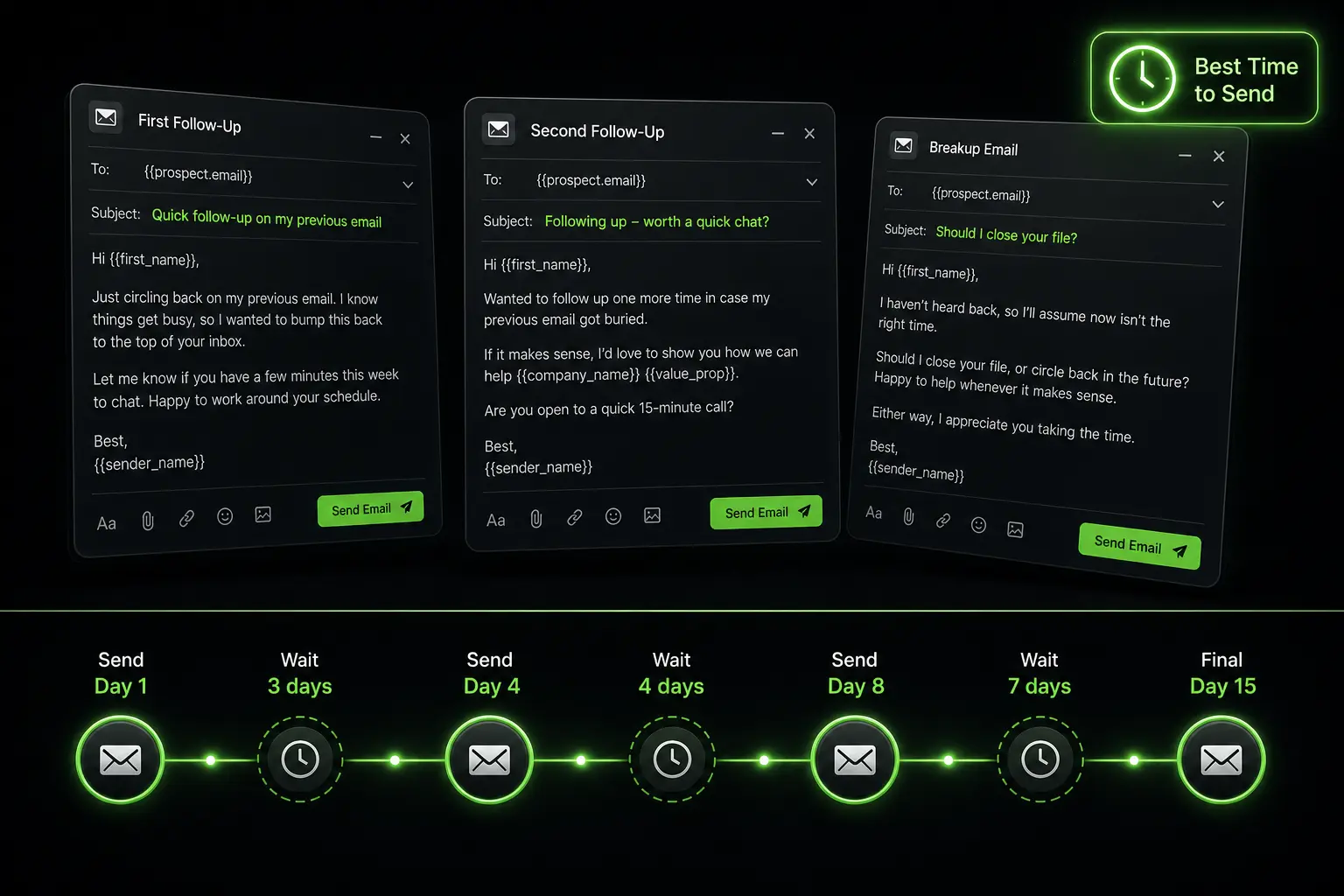
- Touch 2 (D+2): a short follow-up, the “bump”
- Touch 3 (D+5): value-add, a new angle or a resource
- Touch 4 (D+10): pivot, you change the angle or the channel (LinkedIn, call)
- Touch 5 (D+15): the breakup, your final follow-up, you close the loop
Past five touches over roughly three weeks, the marginal gain drops and the spam-complaint risk rises. Better to exit the sequence and come back in three months with a new angle.
Post-Demo
- Within 24 hours: a thank-you email, a recap of the key points, a clear next step
- D+3: if it goes quiet, follow up with a resource tied to something raised in the demo
- D+7: follow up with the proposal or a decision slot
Never leave a demo without a follow-up inside 24 hours. That is the window where interest is at its peak.
Post-Proposal
- D+3: a soft follow-up, confirm the proposal landed
- D+7: a value follow-up, add something new (a customer case, a calculated ROI)
- D+14: a direct follow-up, ask for a go or no-go
Trial Expired
- D+1 after expiry: ask for feedback, offer an extension or an upgrade
- D+5: follow up with a precise question about what blocked them
Invoice Reminder
- NET30+1 business day: a friendly reminder, you assume an oversight
- NET30+8 days: a firm reminder, you reference the contractual late-payment terms
- NET30+15 days: a formal legal demand letter, sent with proof of delivery
The legal frame for invoice follow-ups is detailed further down.
Cadence: 5 to 7 Touches Over 14 to 21 Days, Multichannel
Pure email follow-up hits a ceiling fast. In 2026 the best sequences mix channels: email, LinkedIn, phone, sometimes a voice note. A multichannel cadence runs 5 to 7 touches across 14 to 21 days.
A sample 15-day cadence:
| Day | Channel | Action |
|---|---|---|
| D+0 | Initial cold email, personalized problem | |
| D+1 | Connection request, no message | |
| D+2 | Short bump, resurface the first email | |
| D+5 | DM if the connection is accepted | |
| D+7 | Value-add (customer case, study, ROI math) | |
| D+10 | Phone | Quick call, voicemail if no answer |
| D+13 | Pivot, a new angle or a new benefit | |
| D+15 | Breakup, final touch |
Multichannel meaningfully widens coverage: a prospect you reach on two or three different channels is far more likely to engage than one you only email. This is the logic behind multichannel prospecting platforms that orchestrate these sequences so you are not juggling four tools at once.
Anatomy of a Follow-Up Email That Gets a Reply
A strong follow-up holds together with five elements. If one is missing, the reply rate drops.
The Subject Line: 4 to 6 Words, No Gimmick
The subject line should make someone want to open without screaming “salesperson.” A few rules:
- Short: 4 to 6 words, never more than 8. Beyond that, the mobile preview cuts it off.
- Tied to the original email: keeping the same thread (replying inside it) lifts the open rate by around 30 percent on average.
- No all-caps, no emoji spam.
- No heavy question: “Did you get my last message?” is one of the worst-performing subject lines on record.
What Is the Best Follow-Up Email Subject Line?
There is no single best line, but the strongest ones share a pattern: they are short, specific, and curiosity-driven without being clickbait. Formats that work in 2026:
- “Still a priority, {first name}?”
- “{first name}, one last idea”
- “Quick question about {context}”
- “{original topic}: next step?”
- “Should we keep going?”
The common thread: 4 to 6 words, no apology, and a hook tied to the recipient’s situation rather than to your need for a reply.
The Opener: No Apology
The number one mistake is opening with “Sorry to bother you again” or “Just circling back.” You have no reason to apologize for doing your job. That pleading posture lowers your perceived status and lowers the reply rate.
Instead, restate the context in one neutral, factual sentence:
- “I wrote last week about X.”
- “Coming back on the proposal I sent on March 4.”
- “Following our demo on Tuesday:”
The Body: One Value, Just One
A follow-up is not a copy of the first message. It adds something new: a different angle, a resource, a trigger signal (funding, a hire, a launch), a comparable customer case. Without that new element, you are handing the recipient the same information twice with no extra reason to reply.
Keep it tight: 60 to 100 words maximum for a follow-up. Someone who did not reply to 200 words will not reply to 300.
The CTA: A Closed Question or a Specific Slot
The call to action should ask for minimal effort. Three formats work in 2026:
- A specific slot: “Do you have 15 minutes Tuesday at 2pm or Thursday at 10am?”
- A closed question: “Is this still on your radar right now, yes or no?”
- A low-commitment offer: “Want me to send the {comparable company} case study?”
Never ask “When would you be available?” The mental load of proposing a slot yourself is exactly what makes your email go unanswered.
The Signature: Short and Clear
No sprawling signature with four logos and a quote. First name, last name, role, company, one link (a calendar, ideally). The rest is noise.
Common Mistakes That Kill Your Follow-Ups
These mistakes are so frequent they deserve their own list. If your follow-ups do not convert, it is probably one of these.
“I’m following up because…” The most-used and most counter-productive opener. The recipient already knows you are following up. It is not information worth giving.
A pleading tone. “I know you’re very busy,” “Sorry to be persistent,” “Hope I’m not bothering you.” These lines put you in a low position. Be polite, not obsequious.
An empty follow-up. “Bump,” “Just bumping this,” “Any update?” With no added value, these messages end up in spam or break the relationship.
Too soon. Following up the day after sending feels intrusive. Leave at least 48 to 72 business hours.
Too late. Following up three weeks after the first email with no new information forces the recipient to rebuild the context. Past 14 days with no signal, restart from a fresh angle rather than a follow-up.
A generic template. The worst of them all. A copy-pasted follow-up with zero reference to the prospect instantly signals a mass send and sinks your reply rate.
Too many people in CC. Adding the prospect’s manager to “apply pressure” is a classic. It does not work and it damages the relationship for months.
No breakup. Never closing a cold sequence creates a feeling of harassment. A final touch that says “I will stop here” respects the recipient and often gets a reply in return.
14 Follow-Up Email Templates Ready to Copy
Each template below has a subject line, a body, and the variables to personalize. Adapt the context, do not copy as-is: performance depends on personalization.
Template 1, Cold Outbound Bump (D+3, No Reply)
Subject: Re: {original subject}
Hi {first name},
Not sure my Tuesday note landed. Resurfacing it just in case.
I have been watching {specific prospect context: news, team, signal}: is {benefit} something on your plate right now?
A two-line reply is enough, I will adapt.
{Signature}
Template 2, Cold Outbound Value-Add (D+7)
Subject: An idea for {company}
Hi {first name},
No reply on your side, so I am wondering if my first message missed the mark. Trying a different angle.
I saw yesterday that {factual recent event: funding, hire, launch}. On a setup like yours, teams usually see {measurable benefit} within a few weeks, because {concrete reason, no jargon}.
Want me to send the {comparable company} case, they were in the same spot?
{Signature}
Template 3, Cold Outbound Breakup (D+14, Final Follow-Up)
Subject: Closing the loop
Hi {first name},
This is my last note. If {benefit} is not a priority right now, no problem at all, I will close the file.
If it becomes urgent again in three or six months, you can reply straight to this thread, I will keep it open.
All the best,
{Signature}
Template 4, Post-Demo Follow-Up (Within 24 Hours)
Subject: Following our demo
Hi {first name},
Thanks for the time yesterday. To recap what you told me mattered:
- {point 1 heard in the demo}
- {point 2 heard in the demo}
- {point 3 heard in the demo}
I am attaching {resource discussed: quote, access, document}. The next step on your side is {expected action}. I would suggest a 20-minute call on {day} at {time} to lock the details, does that work?
{Signature}
Template 5, Post-Proposal Follow-Up (D+3, If Silent)
Subject: {company} proposal: keep going?
Hi {first name},
Wanted to make sure the proposal I sent Monday landed. Three options:
- Everything is clear, you will get back to me in a few days
- Something is missing, tell me what and I will clarify it
- The project is not a priority anymore, just say so and I will not push
I am free for a quick call this week if useful.
{Signature}
Template 6, Trial-Expired Follow-Up (D+1)
Subject: Your {product} trial ended yesterday
Hi {first name},
Your {product} trial wrapped up yesterday. Before everything closes: what worked, and what did not?
If you want to extend to finish a specific test, I can switch on 7 more days. If it is no longer a priority, tell me and I will close your account cleanly.
{Signature}
Template 7, Trial-Expired Follow-Up (D+5)
Subject: One question before I close this
Hi {first name},
Five days after your trial ended, I wanted to understand what blocked you. One simple question: was it more of a usage issue (you did not get the time to test it properly) or a product issue (a feature you needed was missing)?
A one-line answer helps me a lot to improve the product.
{Signature}
Template 8, Trigger-Based Follow-Up (Funding, Hire, Launch)
Subject: Congrats on {event}
Hi {first name},
I saw yesterday that you {raised X / hired Y / launched Z}, nice work.
In the phase that follows, {product benefit tied to the event: hiring five more SDRs, opening a new market, scaling outbound} usually becomes the first bottleneck. That is exactly what we help {persona / company type} like {prospect company} with.
Got 20 minutes next week to see if it is useful?
{Signature}
Template 9, LinkedIn DM Follow-Up (Post-Connection)
Hi {first name},
Thanks for connecting. For context: I was following you because {concrete reason tied to a post, the company, a background detail}.
On the {product company} side, we help {persona} do {benefit}. Without going into a pitch, is this something coming up in your priorities this quarter?
If yes, I will send {useful resource}. If not, no worries, we stay connected.
Template 10, Pre-Call Follow-Up
Subject: Call tomorrow 2pm?
Hi {first name},
I would like to take 5 minutes tomorrow around 2pm to explain why I think {benefit} could save you {measurable result}.
If 2pm does not work, send me another slot, or reply “not interested” and I will not call.
{Signature}
Template 11, Win-Back Old Lead (90+ Days)
Subject: You may remember me
Hi {first name},
We exchanged a few messages a few months back about {topic}. At the time you told me {context / objection}.
Since then, two things changed on our side: {change 1} and {change 2}. So I am coming back to check whether the topic is relevant again.
A yes / no / later reply is enough.
{Signature}
Template 12, Invoice Reminder NET30+1 (Friendly)
Subject: Invoice {number}: friendly reminder
Hi {first name},
Quick routine check: invoice #{number} for {amount} was due on {due date}. Payment has not come through yet, likely just an oversight.
You will find the invoice attached along with the bank details.
Could you confirm it is being processed?
Best regards,
{Signature}
Template 13, Invoice Reminder NET30+8 (Firm)
Subject: Invoice {number}: second reminder
Hi {first name},
I still have not received payment for invoice #{number} ({amount}), due on {date}.
Under our agreed terms, late-payment interest applies from the due date, along with any contractual recovery costs. Depending on your jurisdiction, statutory late-payment rules may also apply (see the legal section below).
Please arrange payment within 8 days to avoid a formal demand letter.
Best regards,
{Signature}
Template 14, Invoice Reminder NET30+15 (Legal Demand)
Subject: Formal demand for payment, invoice {number}
Dear {first name / Sir or Madam},
Despite our reminders of {date 1} and {date 2}, invoice #{number} for {amount}, issued on {issue date} and due on {due date}, remains unpaid.
By this letter, we formally demand payment of the outstanding amount, plus late-payment interest at the contractual or statutory rate, and any recovery costs allowed under applicable law, within eight days of receipt of this letter.
Failing payment within that period, we will pursue any available remedy to recover the debt, including referral to a collections process and, if necessary, legal proceedings.
Yours faithfully,
{Signature}
Soft CTA, See Zeliq orchestrate your follow-ups
Running these 14 templates by hand works until about 50 active prospects. Past that, the mental cost beats the gain. A multichannel prospecting platform lets you build the cadence once (email D+0, LinkedIn D+1, bump D+2, value-add D+7, call D+10, breakup D+15), launch it on a list, and let the tool handle the sends, the pauses and the auto-stop the moment a prospect replies. You keep the personalization, you drop the manual piloting.
The Legal Frame: US, UK, Canada and EU Prospects
Two legal blocks shape B2B follow-ups: the anti-spam rules for cold outreach, and the late-payment rules for invoices. Knowing both saves you from nasty surprises.
Cold Outreach Rules by Region
United States: CAN-SPAM. B2B cold email is legal, but every message (including follow-ups) must carry accurate header and subject information, identify itself as a commercial message where required, include a valid physical postal address, and offer a working opt-out that you honor within 10 business days. A follow-up is subject to the same rules as the first send: once someone opts out, you stop.
Canada: CASL. Stricter than CAN-SPAM. CASL generally requires consent, express or implied, before sending a commercial electronic message. Implied consent can exist through an existing business relationship or a conspicuously published business address relevant to the recipient’s role, but it is time-limited. Every message needs clear sender identification and a functional unsubscribe. Penalties are significant, so treat Canadian prospects with extra care.
United Kingdom and EU: GDPR and PECR. For EU and UK prospects, you generally rely on legitimate interest to contact a named professional at their work address on a topic relevant to their role. You must run a legitimate-interest assessment, identify yourself, and provide a clear, functional opt-out in every message, including follow-ups. Honor any objection immediately. Ignoring an opt-out exposes you to regulator action and instantly damages your deliverability.
Across all regions, the deliverability layer matters as much as the law. Since 2024, Gmail and Outlook enforce strict rules: DMARC in place, a spam-complaint rate kept under 0.3 percent, one-click unsubscribe. An overly aggressive follow-up sequence generates complaints, which degrade your domain reputation for months.
Late-Payment Rules for Invoices
When an invoice goes unpaid, statutory rules back up your contractual terms.
United States. Late-payment terms are mostly contractual, so your interest rate and recovery costs should be stated on the invoice or in the master agreement. For work done for the federal government, the Prompt Payment Act sets payment deadlines and automatic interest on late payments by federal agencies, a useful reference point if you sell to public-sector buyers.
United Kingdom. The Late Payment of Commercial Debts (Interest) Act gives suppliers a statutory right to charge interest on overdue commercial invoices, plus a fixed sum to cover recovery costs, even where the contract is silent. This applies between businesses and is a strong lever in your NET30+8 and NET30+15 reminders.
European Union. The EU Late Payment Directive sets maximum payment terms for B2B transactions and a statutory right to interest and a minimum recovery fee on overdue invoices, transposed into each member state’s national law.
The practical takeaway: state your payment terms and late-payment interest clearly on every invoice, keep proof of delivery for your reminders, and escalate on a fixed schedule. A written, systematic reminder process is not optional, it is basic financial hygiene.
How Many Follow-Ups Before You Give Up?
For cold outbound, the answer in 2026 is 5 to 7 touches over 14 to 21 days, then stop. Past the seventh touch, the marginal reply rate is tiny and the spam-complaint risk outweighs the upside. The right move is not to keep going, it is to exit cleanly with a breakup email, then re-enter the prospect three months later with a genuinely new angle (a trigger event, a new product capability, a relevant case study).
For warm contexts the math is different. After a demo or a proposal, you can run 3 to 4 follow-ups because you have relationship capital and a real reason to be in the thread. For invoices, you follow the legal cadence to its end: friendly reminder, firm reminder, formal demand, then a collections process. There is no “giving up” on a debt that is owed.
2026 Tools for Follow-Ups
The outbound ecosystem has consolidated. Here are the tools that matter in 2026, with no ranking and no disparagement.
- Zeliq: an all-in-one platform, find plus enrich plus engage. A fit when you want to consolidate the stack.
- Lemlist: a cold-email reference with deep personalization features. See the Zeliq vs Lemlist comparison for a feature-by-feature breakdown.
- HubSpot Sequences: the sequencing block inside the HubSpot CRM, handy if you already live in HubSpot.
- Salesloft and Outreach.io: North American enterprise platforms, built for teams of 20-plus reps.
To run any of these well you need a clean target list. The B2B lead database lets you start from a qualified list rather than a raw LinkedIn export, and waterfall data enrichment pulls verified emails and direct numbers before you send. A sequence built on fresh data has a reply rate two to three times higher than one built on a stale list.
KPIs to Track for Your Follow-Ups
Without measurement, you do not know which follow-up works. Four indicators at minimum.
Reply rate per follow-up step. The percentage of replies on each touch of a sequence. The typical distribution is 30 to 40 percent of replies on touch 1, 25 to 30 percent on touch 2, 15 to 20 percent on touch 3, and the rest on touches 4 and beyond. If your touch 2 contributes nothing, the follow-up is badly written.
Meetings booked. The number of meetings generated by the sequence. This is the business KPI, not a vanity metric.
Sales cycle length. The time between the first touch and the signature. A well-tuned cadence shortens the cycle by 10 to 30 percent.
A/R recovery rate. For invoices, the recovery rate at 30, 60 and 90 days, plus your overall average collection time. A structured reminder cadence is what moves this number.
AI for Follow-Ups in 2026
AI has changed how teams follow up, for better and for worse.
For the better: personalization at scale. A model can read a LinkedIn profile, a recent post, a company page, and generate a specific opening line in two seconds. The best outbound setups in 2026 mix a stable template (body, CTA) with an AI-personalized opener. The typical lift is 15 to 25 percent more replies with no extra operational cost.
For the better, again: intent triggers. Platforms capture signals (a funding round, a hire, a role change, a product launch) and automatically trigger a contextual follow-up at the right moment. Send-time optimization adds another layer, learning when each prospect tends to open and scheduling the touch accordingly.
For the worse: the drift toward generic automated follow-ups. When everyone feeds the same prompt to the same model, inboxes fill with suddenly very similar messages, and recipients learn to spot the pattern. The fix is to bring human work back to the angle, and to leave AI only the personalization blocks at scale (variables, openers), not the end-to-end writing.
Following Up Is a System, Not a Reflex
A good follow-up is never improvised. It sits inside a cadence, follows a known timing, respects a legal frame, and brings new value at every touch. The rep who follows up well is not more persistent than the others, they are more structured.
One action to put in place today: pick one of your current sequences, and write down the timing and content of every follow-up. You will immediately see the gaps (an empty follow-up, too soon, too late, no value). That is where you gain 20 percent in reply rate, before you even touch a tool.
Industrialize your multichannel follow-ups
Zeliq combines verified contacts, enrichment and multichannel sequences in a single platform. Account created in 2 minutes, no credit card.
Try for freeAnd if you want to industrialize your multichannel follow-ups without bloating your stack, check the Zeliq pricing takes less than five minutes.
And if you want to automate your multichannel follow-ups so no lead slips through the cracks, try Zeliq for free and industrialize the 5-7-14 cadence across 450 million contacts.
Zeliq and industrialized follow-up
80% of B2B deals close between the 5th and 12th follow-up, yet 44% of salespeople give up after the first. Zeliq automates your multi-touch sequences across 450 million enriched B2B contacts (email + direct phone + LinkedIn DM + calls via Aircall/Ringover integration), with behavioral triggers and native 5-7-14 cadence.
Further reading
Table of contents
Placeholder Title
Table of contents
Placeholder Title
Placeholder Title