

B2B prospecting methods in 2026 break down into 7 main techniques organized by channel: email prospecting, LinkedIn prospecting (social selling), cold calling, orchestrated multi-channel prospecting, intent-data prospecting, referral prospecting, and event-based prospecting. Per Salesforce State of Sales Report 2024, 81% of sales teams are experimenting with or have deployed AI to amplify prospecting productivity. The dominant method in 2026 is no longer single-channel: high-performing teams orchestrate 8 to 12 multi-channel touches combining email, LinkedIn and call before getting a first qualified response.
For an SDR, AE, founder or Head of Sales structuring outbound prospecting, this guide details the 7 methods by B2B 2026 effectiveness order, gives the benefits and limits of each, explains how to combine them in a multi-channel sequence, and specifies the relevant tools per method.
At a glance:
- Strict definition of a prospecting method
- The 7 B2B prospecting methods 2026
- How to combine the methods in a multi-channel sequence
- KPIs to track per method
- 3 frequent mistakes to avoid
- 3 FAQs and 3 dated actions
Key takeaways:
- 7 main methods: email, LinkedIn, phone, multi-channel, intent data, referral, event
- 8 to 12 multi-channel touches needed before first response (B2B 2026 SERP consensus)
- LinkedIn = pivot channel for outbound prospecting (1 billion+ members)
- 81% of sales teams use AI to amplify prospecting (Salesforce State of Sales 2024)
- Effectiveness ratio: coordinated multi-channel > isolated single-channel method
1. Strict definition: what is a prospecting method in 2026?
A B2B prospecting method designates a structured approach combining a channel (email, phone, LinkedIn, event), a targeting (ICP, persona, intent signal), a message (value proposition, hook, ask) and a cadence (number of touches, time spacing) to generate a first qualified contact with an identified prospect.
Three structuring clarifications:
Clarification 1: prospecting ≠ selling. Prospecting stops at the first qualified meeting booked. Beyond that, it’s selling. The SDR’s role is to prospect; the AE’s role is to sell. Conflating the two leads to overly aggressive commercial messaging in prospecting or fuzzy qualification before transfer to the AE.
Clarification 2: no universal method. A method effective for a mid-market B2B SaaS isn’t necessarily so for a freelance agency or an industrial SMB. Choice depends on average ticket, sales cycle length, ICP maturity and team resources. The methods below are to combine and adapt, not apply identically.
Clarification 3: method ≠ tool. A method is a reproducible process; a tool is the instrument that operationalizes it. A multi-channel method can be executed with Zeliq, Salesloft, Outreach or Lemlist: tool choice depends on volume, budget and CRM integration, not on the effectiveness of the method itself.
2. The 7 B2B prospecting methods 2026
Method 1: Email prospecting (cold email)
Principle: sending a personalized email to an identified prospect, with a contextual hook and concise value proposition. Typical cadence: 80 to 150 words per email, 5-element structure (subject, hook, value, CTA, signature).
Advantages: scalable (an SDR can send 100-200 emails/day with medium personalization), written trace, asynchronous (recipient responds at their pace), easy to measure (open rate, reply rate, meeting rate).
Limitations: deliverability depends on sender reputation, B2B inbox saturation, reply rate often < 5% on single non-personalized send.
When to use: first cold contact at large volume, post-event follow-up, dormant prospect re-engagement.
Method 2: LinkedIn prospecting (social selling)
Principle: identification, connection and interaction with prospects via LinkedIn. Combines profile views, personalized connection requests, direct messages (DM) and interactions on posts (likes, comments).
Advantages: pivot channel 2026 (1 billion+ LinkedIn members, with a growing proportion of active B2B decision-makers), low saturation vs. email, possibility to build editorial presence via posts.
Limitations: limited scalability (LinkedIn enforces weekly connection quotas), requires a polished personal profile, doesn’t replace a direct channel (email or phone) for booking a meeting.
When to use: ABM account approach, prospects hard to reach by email, accompaniment of a multi-channel sequence.
Method 3: Cold calling
Principle: direct call to an identified prospect, with a short structured script (introduction, context, opening question, meeting request). Typical cadence: 60 to 120 calls per SDR per day.
Advantages: immediate response (yes/no/silence), ability to qualify in real time, meeting rate often higher than email on prospects accepting to pick up.
Limitations: 76% of B2B outbound calls go to voicemail on first attempt (SDR benchmark consensus), cultural reluctance in some sectors, low scalability beyond 120 calls/day.
When to use: follow-up to an email sent 48-72h earlier, prospects who have signaled interest, segments where phone remains culturally accepted (industry, professional services, public sector).
Method 4: Orchestrated multi-channel prospecting
Principle: structured combination of at least 3 channels (email + LinkedIn + phone, sometimes + WhatsApp Business) in a cadenced sequence over 14 to 21 days, with 8 to 12 total touches.
Advantages: cumulative response rate higher than each channel taken in isolation, multi-point presence without saturating a single channel, better memorization by the prospect.
Limitations: operational complexity (requires an orchestration tool like Zeliq, Salesloft, Outreach), risk of cannibalization if poorly cadenced (3 channels same day).
When to use: this is the reference method 2026 for mid-market and enterprise B2B outbound prospecting. Avoid only on very low volume (< 20 prospects/week), where orchestration cost isn’t justified.
Method 5: Intent-data prospecting
Principle: trigger prospecting based on observed signals (active hiring, fundraising, product launch, relevant LinkedIn post, website visit) indicating a commercial opportunity window.
Advantages: reply rates multiplied (SERP consensus: signal-based reply rate 2 to 5 × higher than pure cold), very high perceived relevance by the prospect, better return on personalization time invested.
Limitations: depends on the quality and volume of signals available, requires dedicated tools (6sense, Bombora, Clearbit, or Zeliq signal-based enrichment), limited volume (signals aren’t available on every prospect).
When to use: strategic ABM accounts, complement to methods 1-3 to prioritize the prospecting queue.
Method 6: Referral prospecting (warm intro)
Principle: asking a customer, partner or network contact to introduce the target prospect, via LinkedIn or by email with explicit introduction.
Advantages: very high meeting-conversion rate (warm introductions convert several times better than cold), construction of an already-warm relationship from the first exchange, shorter sales cycle.
Limitations: not scalable (limited to SDR / founder network size), requires referral cultivation work over time, depends on referrer’s goodwill.
When to use: approach of strategic high-value accounts, launch of a new market, complement to a classic outbound approach.
Method 7: Event-based prospecting (trade shows, webinars, conferences)
Principle: identification of prospects via participation in a professional event (trade show, conference, webinar), followed by a contact email within 48-72h post-event.
Advantages: immediate conversation context (event reference), prospects pre-qualified by their presence at the event, short but receptive attention window.
Limitations: high cost (trade show sponsoring, travel), volume limited per event, short-term ROI hard to measure.
When to use: vertical markets with reference events (Tech, SaaS, industry, healthcare), product launch requiring physical visibility, complement to a digital outbound strategy.
Industrialize your B2B prospecting methods
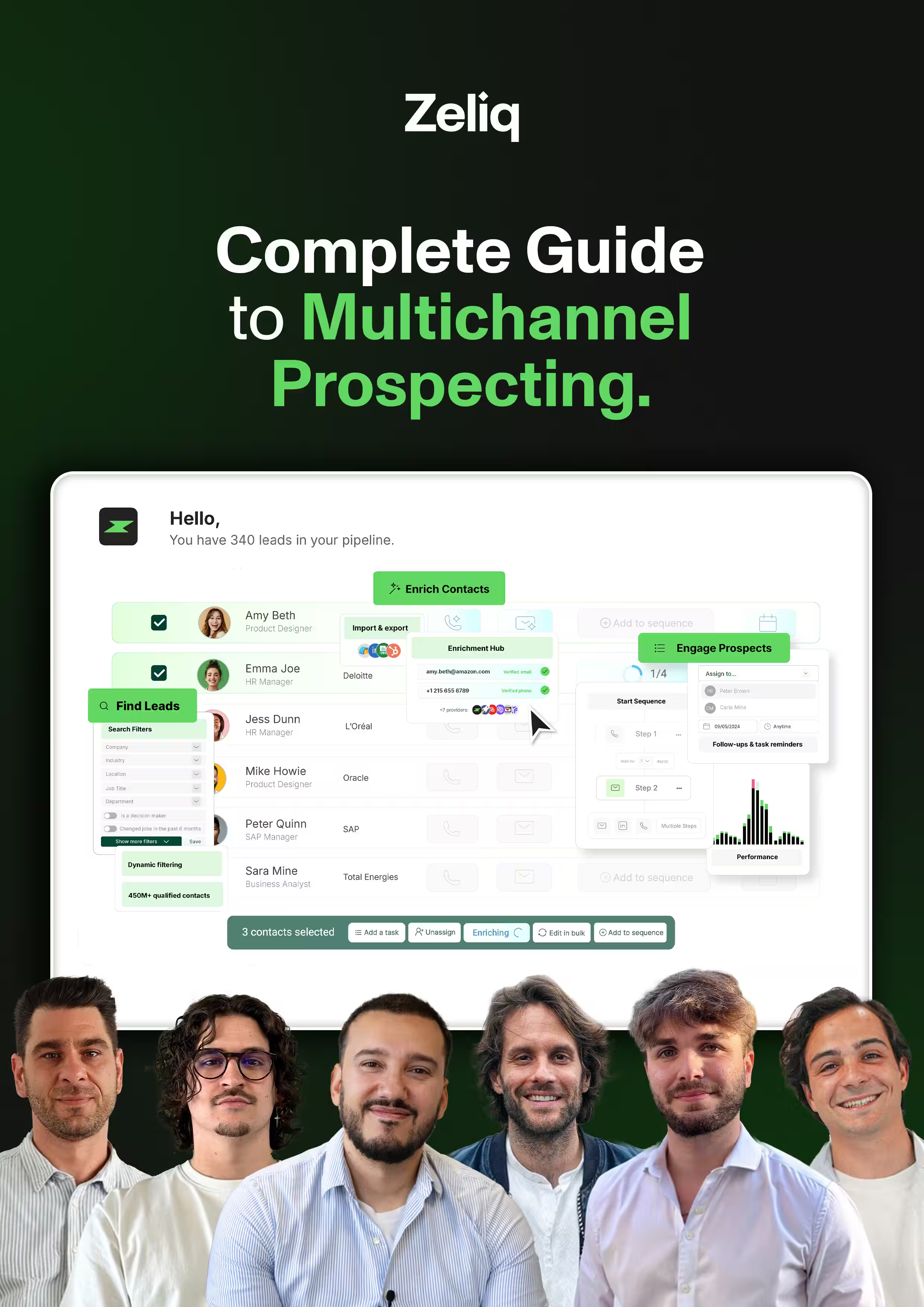
Zeliq combines 450 million verified contacts, enrichment and multi-channel sequences (email + LinkedIn + call) in a single platform. Account created in 2 minutes, no credit card.
Try for free3. How to combine the 7 methods in a multi-channel sequence
Rather than isolated, the 7 methods become powerful once orchestrated in a 14-to-21-day sequence. Here’s an example multi-channel sequence for a mid-market B2B SDR:
| Day | Action | Method | Goal |
|---|---|---|---|
| D+0 | Initial personalized email (intent signal) | 1 + 5 | Capture attention on a quantified benefit |
| D+3 | LinkedIn touch: profile view + comment on post | 2 | Create subtle presence |
| D+5 | Email follow-up (value-add: case study) | 1 | Provide proof |
| D+8 | LinkedIn: personalized connection request | 2 | Broaden the relationship |
| D+10 | Short phone call (no message if voicemail) | 3 | Test direct availability |
| D+13 | LinkedIn direct message personalized | 2 | Change of angle |
| D+15 | Breakup email (force a binary decision) | 1 | Close or reactivate |
Orchestration rules:
- Vary channels: don’t stack 2 actions same day
- Bring new value at each touch (statistic, case, useful link)
- Maximum 3 emails in the sequence, the rest in LinkedIn + call
- If positive response: switch to meeting mode, exit the automatic sequence
- If no response after D+15: switch to marketing nurturing rather than direct sales
4. KPIs to track per method
Four KPIs structure B2B prospecting pilotage:
KPI 1: reply rate (per channel and per sequence). Positive + negative + neutral responses divided by prospects touched. Benchmark target: 5-10% on email alone, 15-25% on coordinated multi-channel.
KPI 2: qualified meeting rate. Meetings obtained divided by positive responses. Target: 40-60% in mature SDR setup, sign that upstream ICP qualification works.
KPI 3: cost per qualified meeting. (SDR FTE salary + tools) divided by number of qualified meetings generated. Mid-market target: variable by average ticket, but under $220 for a SaaS at $25-100k ARR.
KPI 4: meeting → stage 3+ opportunity rate. Opportunities created divided by meetings booked. Target: 30-50% in aligned SDR/AE team.
Without these 4 KPIs tracked weekly, you pilot blindly. With these 4 KPIs, you identify which method performs on which segment, and where to adjust resources.
5. The 3 frequent mistakes to avoid
Mistake 1: limiting to a single channel. The SDR who does only email or only phone leaves 40-60% of pipeline on the table. The 2026 rule: coordinated multi-channel, not saturated single-channel.
Mistake 2: prospecting without defined ICP. Without a precise Ideal Customer Profile (function, size, sector, signals), reply rate caps at 1-2%. With a solid ICP and 2-3 personas, you climb to 7-10%.
Mistake 3: not measuring. Without CRM or prospecting platform tracking, 35 to 40% of follow-ups are forgotten and cost per meeting mechanically rises. Minimum tools: a CRM (Salesforce, HubSpot, Pipedrive) + an orchestrated prospecting platform (Zeliq, Salesloft, Outreach).
Worked example: scaling from 1 to 3 orchestrated channels in 60 days
Take a B2B SaaS outbound team (4 SDRs, $9M ARR, ICP Heads of Sales in tech scale-ups 80-400 employees). Pre-rebuild, the team ran 100 percent cold email on a single sending domain. Volume: 20,000 emails per month, reply rate 1.9 percent, monthly qualified meetings = 14.
Action over 60 days: progressive addition of 2 complementary channels in orchestration. Weeks 1-2, set up a multichannel cadence email + LinkedIn (standard sequence: email D0, LinkedIn DM D5, email D10, LinkedIn comment D15, call D20). Weeks 3-4, integrate phone from touch 4 on accounts with identified buying signals. Weeks 5-8, pilot all 3 channels in a single platform.
| Metric | Before (1 channel) | After 60 days (3 channels) | Delta |
|---|---|---|---|
| Active orchestrated channels | 1 | 3 | +2 |
| Multichannel touches / target account | 1.2 | 4.8 | +300% |
| Sequence reply rate | 1.9% | 4.7% | +2.8 pts |
| LinkedIn acceptance rate | 0 | 41% | new |
| Cold-call connect rate | 0 | 31% | new |
| Qualified meetings / month (team) | 14 | 36 | +22 |
| Monthly pipeline generated | $182K | $468K | +$286K |
The real lever is not adding any single channel, it is the sequenced orchestration across all three. An account that sees an email, then accepts a LinkedIn connection, then takes a call consistent with the email content, replies significantly better than an account exposed to 3 isolated emails.
Cost of the operation: 8 weeks × 0.4 FTE senior RevOps for cadence design and instrumentation = $8,400, plus multichannel sequencer for 4 seats over 6 months = $3,800. Period total: $12,200. At an average deal size of $15K ARR and 22 percent AE win rate on the 22 incremental monthly meetings, the team signs roughly 5 extra customers per month, or $75K incremental monthly ARR. Cash ROI over 12 months: capped at roughly 8-9× the cost on the marginal delta.
What are the most effective B2B prospecting methods?
In B2B 2026, the 7 main methods are: (1) email (personalized cold email), (2) LinkedIn (social selling, DMs, post interactions), (3) phone (cold calling), (4) orchestrated multi-channel (sequence combining email + LinkedIn + call over 14-21 days), (5) intent data (triggering by observed signals: hiring, fundraising, post), (6) referral (warm intro by common contact), (7) event (trade show, webinar, conference). The reference method in mid-market B2B is orchestrated multi-channel (4), which combines 8 to 12 touches across channels. Other methods are to integrate within this orchestration rather than used in isolation. Choice of combination depends on average ticket, sales cycle and market maturity.
How do you prospect for B2B sales in 2026?
Good B2B prospecting 2026 rests on 5 fundamentals. (1) Precise ICP: function, company size, sector, intent signals. Without a solid ICP, reply rate caps. (2) Personalization level 3+: a recent contextual signal (LinkedIn post, appointment, fundraising) in the first message. B2B 2026 SERP indicates signal-based approaches generate 2 to 5 × more replies than pure cold. (3) Orchestrated multi-channel sequence over 14-21 days with 8-12 touches. (4) CRM measurement: reply rate, meeting rate, cost per meeting, pipeline generated per SDR. (5) Value delivery at each touch: case study, statistic, useful link, rather than the same repetition. Per Salesforce State of Sales Report 2024, 81% of sales teams use AI to amplify these 5 fundamentals without replacing the SDR.
What is the best B2B prospecting channel in 2026?
There is no single optimal channel in 2026 : the best result comes from the orchestrated combination email + LinkedIn + phone. That said, LinkedIn has imposed itself as the pivot channel: with 1 billion+ members and a growing proportion of active B2B decision-makers, it’s the channel where editorial presence is built and social selling interactions unfold. Email remains essential for final conversion (written trace, offer structuring, attachment transfer). Phone keeps a unblocking role: a targeted call after two email follow-ups can secure a meeting where email alone remained without response. Practical rule: structure the sequence with LinkedIn for subtle presence, email for detail, phone for unblocking.
Conclusion: 3 actions to take this week (June 2026)
Define or revise your ICP by Friday. Function, company size, sector, priority intent signals. Without a precise ICP, none of the 7 methods above will work sustainably. If your average reply rate caps under 3%, this is your priority #1.
Choose 3 methods to combine in a sequence before June 12. Email + LinkedIn + phone is the proven base combination. Cadence over 14 days, 8-12 touches, value-add at each interaction. Without formal cadence, 35-40% of follow-ups are forgotten.
Deploy per-method tracking before June 20. Reply rate per channel, qualified meeting rate, cost per meeting. Tools: your CRM (Salesforce, HubSpot, Pipedrive) + an orchestrated prospecting platform. Without tracking, you pilot blindly.
And if you want to transform your B2B prospecting from artisan effort to measured industrial machine, try Zeliq for free: 450 million B2B contacts database, verified enrichment and multi-channel sequences in a single interface, no credit card required.