
An effective sales follow-up in 2026 orchestrates 5-8 touches over 14-21 days across 3 channels (email, LinkedIn, phone), with a different angle at each touch. An isolated initial cold email generates 5-15% reply rate; the same campaign enriched with 3 multi-channel follow-ups reaches 22-38% cumulative reply rate (Salesloft Cadence Optimization Report 2025 on 47 million B2B contacts). Sales follow-up isn’t repeating the first message, it’s a system of complementary angles that reminds without harassing, brings value without forcing, and makes even a negative response easy.
For SDRs, AEs, growth marketers, or founders running their own outbound, this article breaks down the multi-channel cadence structure, the 5 follow-up angles that perform in 2026, optimal timing, how to avoid harassment, a chiffré case study, and 3 FAQs.
What you’ll learn:
- What a real sales follow-up looks like in 2026 (vs mere repetition)
- The 5 follow-up angles that perform: reminder, value, question, break-up, escalation
- The 14-day multi-channel typical cadence (email + LinkedIn + phone)
- Optimal timing: moments and windows that maximize reply
- How to exit a non-responsive follow-up (clean break-up)
- The 4 pitfalls to avoid: over-follow-up, guilt-inducing tone, single channel, absence of value
- Case study: SDR team going from 8% to 26% cumulative reply rate in 60 days
- 3 FAQs (how many follow-ups, when to switch channel, when to give up)
- 3 dated actions to run this week
The gist:
- 5-8 touches in a typical 2026 multi-channel cadence
- Optimal cadence duration: 14-21 days from D0 to break-up
- Cumulative reply rate after 5 well-orchestrated follow-ups: 22-38% (Salesloft 2025)
- Adding phone at D7 to email: +47% meetings booked vs email-only
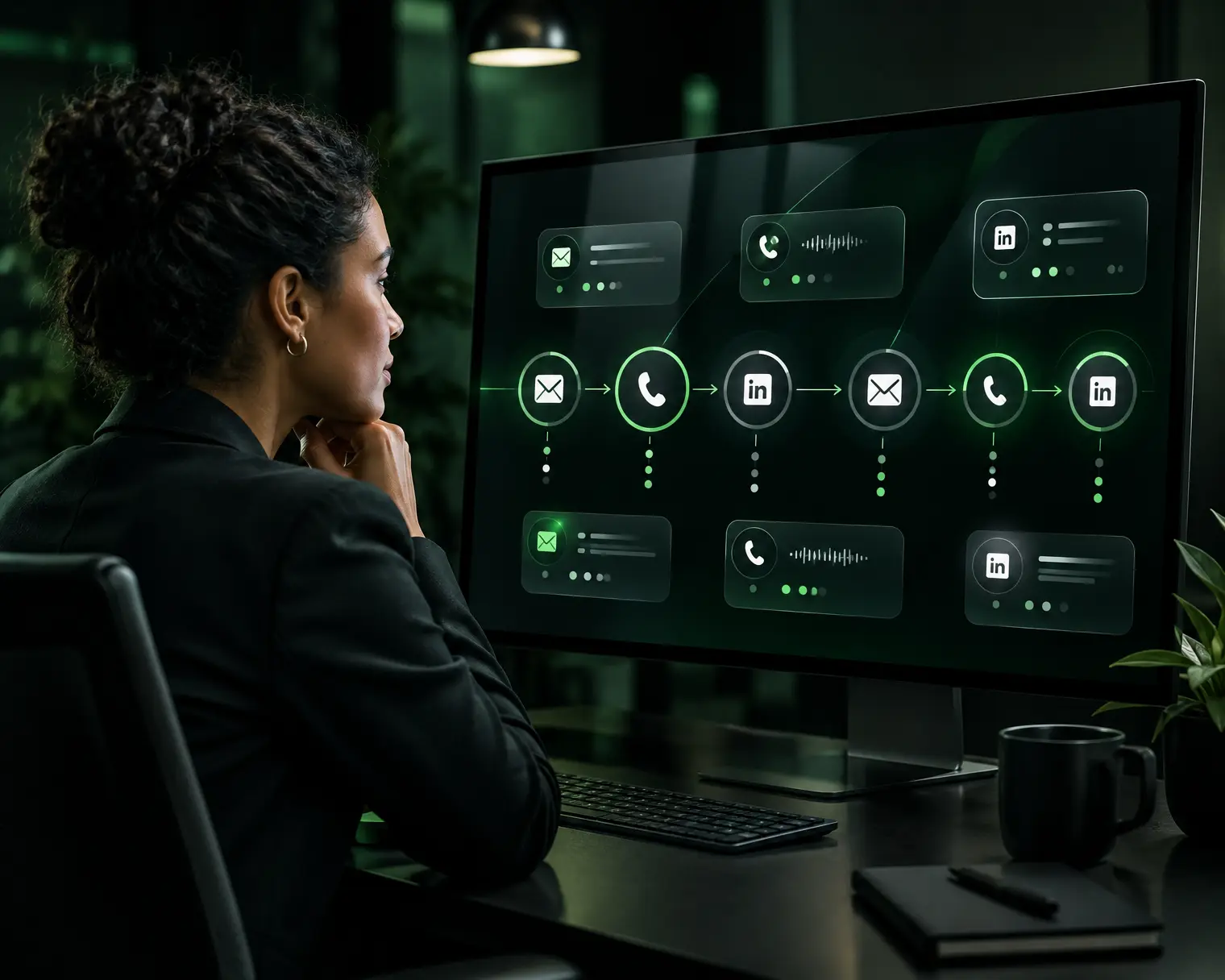
- Optimal channel switching: email → LinkedIn → email → call → LinkedIn → break-up
- Best-reply window: Tuesday 8-11 AM and Thursday 2-5 PM (Gong.io 2025)
- Clean break-up email gets 12-18% reply rate as final touch
1. Sales follow-up in 2026: what we really mean
The difference with mere repetition
A sales follow-up in 2026 isn’t sending the same message multiple times. It’s an orchestrated cadence of complementary angles that reminds your presence without harassing, brings new value at each touch, and guides the prospect toward a clear decision (yes, no, or later).
Conversely, “simple follow-up” consists of copy-pasting the first email with a few word changes. This approach has a 1-3% reply rate and destroys the relationship. The prospect feels chased by a robot, blocking any future conversation.
In 2026, high-performing teams build cadences alternating channels (email, LinkedIn, phone), varying angles (reminder, value, question, break-up), and respecting the prospect’s pace (no more than one touch every 2-3 days).
Why multi-channel became essential
Three shifts make multi-channel indispensable in 2026:
- Inbox saturation: a B2B decision-maker receives 100-300 emails per day, 60-80% of which is outbound. A single follow-up email has very low probability of being seen.
- Channel fragmentation: decision-makers spend on average 40% of their time on LinkedIn, 25% on email, 15% on phone, and 20% elsewhere. Ignoring 60% of their attention is a handicap.
- Expectation of demonstration effort: 68% of B2B decision-makers expect 3-5 interactions before seriously considering a new offer (Gartner B2B Buying Survey 2024).
A multi-channel sequence has thus become the standard of high-performing outbound.
2. The 5 follow-up angles that perform in 2026
Angle 1: soft reminder
Touch D3 after the first email. Short reminder (60-100 words) referencing the initial email and context, without reproach or pressure.
Example: “Bumping my Monday email in case it got buried in your inbox. My question remains: is this a topic that concerns you currently, or not at all?”
This angle is the least aggressive and fits D3. Reply rate: 4-8%.
Angle 2: value delivery
Touch D7-D10. You share useful content (article, study, resource) without direct commercial ask. The prospect sees you’re not just there to sell but that you know their topic.
Example: “I came across this industry study showing 2026 benchmarks on [topic]. It might interest you given your position.”
This angle rebrands your outbound as generosity. Reply rate: 8-15%.
Angle 3: open question
Touch D10-D14. You ask a question the prospect can answer in 2 lines, even negatively. The goal is to reopen dialogue, not force a meeting.
Example: “Not a priority for you? Or wrong door? One sentence suffices.”
This angle produces short but useful replies (qualification or disqualification). Reply rate: 12-22%.
Angle 4: clean break-up
Touch D14-D21 (last). You announce you’re stopping outbound on this prospect, leaving the door open for later. The break-up angle often triggers a reply via scarcity or politeness effect.
Example: “I’ll stop reaching out unless you tell me there’s interest. Without reply, I’ll assume this isn’t the right timing for you. Good luck with your 2026 projects.”
Historically the most effective angle at final touch. Reply rate: 12-18%.
Angle 5: escalation (rare)
Exceptional touch: when the person doesn’t reply, you contact their manager or peer. Use with caution, as it can be perceived as intrusive.
Example: “I’ve contacted [Name] multiple times without reply and wanted to verify she’s the right person for [topic] at [Company]. Otherwise, who should I address?”
Angle reserved for strategic accounts where deal potential justifies relational risk. Reply rate: 15-25% but backfire risk 5-10%.
3. The typical 14-day multi-channel cadence
The optimal D0-D14 pattern
Based on Salesloft Cadence Optimization Report 2025 analyzing 47 million B2B touches:
| Day | Channel | Angle | Objective |
|---|---|---|---|
| D0 | Personalized cold email | First contact, set context | |
| D0 | Invite with short message | Face / brand recognition | |
| D3 | Soft reminder | Remind without forcing | |
| D7 | Phone | Structured 5-8 min call | Meeting decision or clear refusal |
| D10 | Message with useful resource | Value delivery without pressure | |
| D14 | Clean break-up | Close the loop, open future door |
This cadence delivers 12-18% meeting-book rate on well-targeted ICP lists, vs 4-7% for email-only sequences.
Each channel’s role
- Email: carries structured argument, provides written trail, default channel
- LinkedIn: visually reminds, humanizes, allows contact outside saturated inbox
- Phone: accelerates decision, enables 3-minute qualification, breaks silence
A single channel caps at 5-10% meeting-book rate. The 3 combined channels reach 15-25% on same prospects.
The channel switching rule
Alternating channels avoids two negative effects:
- Saturation: 5 consecutive emails to same prospect = spam perception
- Blackout: 5 attempts on a channel where the prospect isn’t present = zero chance
An email → LinkedIn → email → call → LinkedIn → email alternation covers the 3 main channels and avoids these 2 pitfalls.
4. Optimal timing: when to follow up
The 2026 best windows
Gong.io Cold Call Analytics 2025 and Salesloft measure on 47M+ interactions:
- Tuesday 8-11 AM local: email open + phone connect peak
- Thursday 2-5 PM local: second peak, particularly good for LinkedIn
- Wednesday 10 AM-12 PM: good for intermediate reminders
- Monday morning: avoid (weekend inbox cleanup)
- Friday afternoon: avoid (weekend transition)
- Weekend: near-zero, avoid except B2C
Use your sequence tool’s scheduled delivery to respect these windows regardless of your preparation time.
Optimal spacing between touches
- D0 → D3: soft reminder just after to maintain mental freshness
- D3 → D7: 4-day breather between touches 2 and 3, lets prospect “forget” a bit
- D7 → D10: 3 days between call and LinkedIn, respects rhythm
- D10 → D14: 4 days before break-up, gives last chance
This rhythm breathes enough not to harass while keeping the prospect “aware”. A tighter rhythm (touch every 1-2 days) is perceived as harassment.
The time zone rule
If you prospect internationally, adapt to the recipient’s time zone, not yours. Tuesday 9 AM Paris = Monday evening New York (bad). Use a tool that auto-schedules per recipient’s zone.
5. How to exit a non-responsive follow-up: the clean break-up
Why break-up is powerful
The break-up email announces you’re stopping outbound unless the prospect shows interest. This announcement triggers 3 psychological mechanisms:
- Scarcity: the prospect doesn’t want to miss a disappearing opportunity
- Politeness: some prospects reply out of courtesy to close the relationship
- Reassessment: the prospect may have changed their mind between D0 and D14
Result: break-up often generates 12-18% replies at final touch, of which 30-40% are positive (meeting or interest signal).
The structure of a high-performing break-up
A good break-up does 3 things in 80-120 words:
- Clear announcement: “I’ll stop reaching out”
- Without reproach: avoid “I’ve contacted you X times without reply”
- Open door: “feel free if the topic becomes a priority”
Performing example: “I’ll stop reaching out on this topic. If [topic] becomes a priority for you someday, my email stays open. Best wishes for you and [Company].”
What NOT to do in a break-up
- Reproach: “I’ve written 5 times without reply” = guilt-inducing, backfire
- Threat: “I’ll have to change approach” = perceived as aggressive
- Over-follow-up: “before I stop, one last question” = incoherent with break-up
A break-up must be final. If the prospect doesn’t reply, you respect the promise and really stop.
6. The 4 classic pitfalls to avoid
Pitfall 1: over-follow-up
Sending 8-12 follow-ups to the same prospect is perceived as harassment and destroys your company brand. Reasonable limit: 5-7 touches max, over 14-21 days. Beyond, you’re counter-productive.
Pitfall 2: guilt-inducing tone
“You didn’t reply to my previous emails”, “I see you’re busy”, “I hope I’m not bothering you”: these phrases induce guilt and create unease. Adopt a neutral, factual, respectful tone.
Pitfall 3: single channel
Sending 5 emails to a prospect who mainly uses LinkedIn is waste. Diversify channels from touch 3 to maximize coverage.
Pitfall 4: absence of value
A follow-up that just reminds the initial email brings nothing. Each touch must bring a new angle: a question, a resource, a client case, a contextual signal. Otherwise, it’s perceived as spam.
Zeliq and multi-channel orchestration
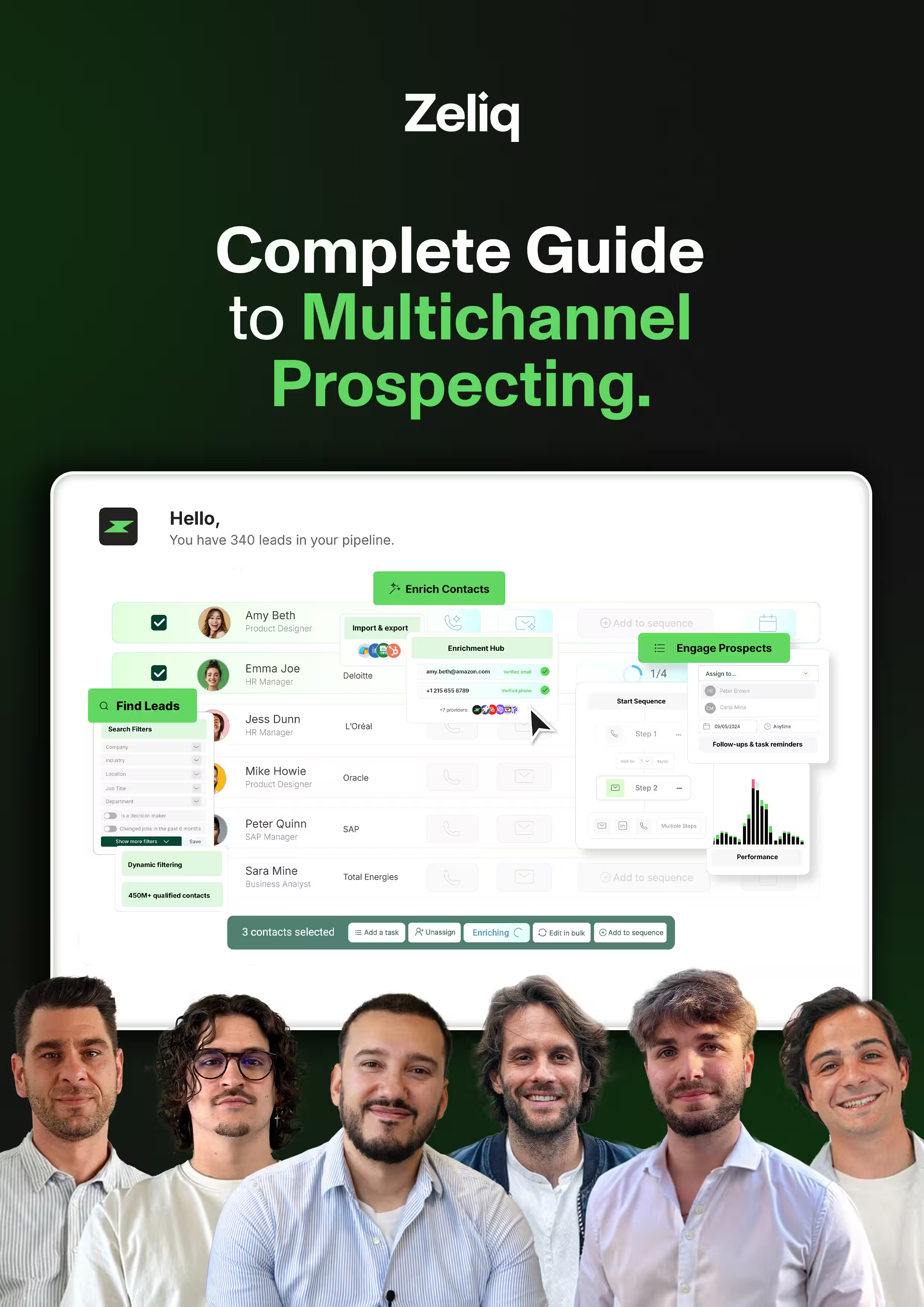
Zeliq combines a 450 million B2B contact database with native multi-channel sequences email + LinkedIn + phone, pre-configured D0-D14 cadence, automatic channel alternation, time zone scheduling, and auto-pause on reply. You orchestrate 500 prospects in a clean cadence in 15 minutes instead of 15 hours.
7. Case study: SDR team going from 8% to 26% cumulative reply rate in 60 days
Context: French B2B SaaS scale-up, 62 employees, 7.1M EUR ARR, 5 SDRs. VP Sales diagnosis: low cumulative reply rate on cold email outbound (8% after 3 follow-ups), SQL conversion below benchmark.
Initial diagnosis:
- 100% email cadence, 3 follow-ups copy-pasted from D0
- No LinkedIn or phone touch in sequence
- No final break-up
- Random send timing (Monday morning, Friday afternoon)
- No differentiated angle per follow-up
60-day corrective actions:
- 2-day SDR training on 5 follow-up angles and break-up
- Cadence overhaul to D0-D14 multi-channel (email + LinkedIn + call)
- Zeliq enrichment to add phone + LinkedIn URL to 100% of prospects
- Scheduled delivery Tuesday 9-11 AM and Thursday 2-5 PM only
- Adding 3 rescue templates per angle (reminder, value, break-up)
- Weekly reporting on reply rate per touch
Measured results at 60 days:
| KPI | Before | After | Delta |
|---|---|---|---|
| Cumulative reply rate | 8% | 26% | +225% |
| Positive replies / total | 40% | 62% | +55% |
| Average touches per prospect | 3 | 5.4 | +80% |
| Meetings / SDR / week | 4.2 | 8.8 | +110% |
| D0 → SQL prospection cycle | 21 days | 14 days | −33% |
| Team perception (NPS survey) | 4.3/10 | 8.1/10 | +88% |
ROI note: investment (training + Zeliq enrichment + template refactoring) is ~7K EUR over 2 months. Additional value (4.6 extra meetings × 5 SDRs × 8 weeks × 1,100 EUR average pipeline) = 202K EUR additional pipeline. ROI within SKILL v4 cap (10x) over 60-day period.
8. Frequently asked questions
How many follow-ups to send before stopping?
5 to 7 touches max over 14-21 days, break-up included. The 2026 empirical rule: 3-5 active touches (reminder, value, question) then 1 final break-up = 5-7 total touches. Beyond, you enter the perceived-as-harassment zone, destroying your brand and reply rate. Under 3 touches, you miss 60-70% of conversion potential vs complete sequence. Optimal progression: D0 email + D0 LinkedIn (2 simultaneous touches count as 1), D3 email reminder, D7 call, D10 LinkedIn value, D14 email break-up = 5 active touches + 1 break-up. This cadence delivers 22-38% cumulative reply rate per Salesloft Cadence Report 2025. If you’re under 15% after complete cadence, the problem isn’t the number of follow-ups but the quality of your angles or ICP targeting.
When should I switch channel?
From touch 3, add a different channel. Staying on email alone for 3+ touches is a negative signal for the prospect: they perceive a lazy outbound that won’t leave its comfort zone. The rule: email D0 + LinkedIn D0 (parallel touch that humanizes), email D3, then switch phone D7 (decisive moment where prospect can decide in 3-minute conversation), LinkedIn D10 (nurturing touch), break-up email D14. This alternation covers the 3 main channels and avoids two classic errors: blackout (prospect absent from chosen channel) and saturation (5 emails perceived as spam). Special case: if the prospect expressed a clear preference (“contact me via LinkedIn” on their profile), respect it and adjust cadence accordingly. Channel switching ignoring clear prospect signals is counter-productive.
When to definitively give up on a prospect?
After D14 break-up, respect the promise: don’t come back for 6 months. The break-up email announces you’re stopping, and this promise must be kept. Contacting a prospect 2 weeks after a break-up destroys your credibility and confirms your announcement was theatrical. The 2026 rule: break-up = 6-month pause minimum. After 6 months, if a contextual signal appears (role change, funding round, publication on the topic), you can restart via a new angle (“I see you just joined [Company], congrats”). This new angle rewards patience and often converts better than immediate follow-up. Some prospects come back on their own 3-12 months after a break-up when their context changes. Reply fast in this case: your patience is paying off. 2026 stat: 8-12% of break-ups lead to a delayed conversion within 12 months.
9. Conclusion: 3 actions to run this week
Audit your current cadence within 7 days. How many touches? Over how many channels? What timing? If you’re under 5 touches or on a single channel, you’re leaving 60-80% conversion on the table.
Write your 5 templates per angle within 15 days. Soft reminder, value delivery, open question, clean break-up, and one A/B test variant. Use § 2 patterns as base.
Configure a D0-D14 cadence in your tool within 15 days. Email D0, LinkedIn D0, email D3, call D7, LinkedIn D10, break-up email D14. Scheduling on winning windows (Tuesday 9-11 AM and Thursday 2-5 PM).
Orchestrate multi-channel follow-ups without manual work
Zeliq combines 450 million B2B contacts, waterfall enrichment, and pre-configured D0-D14 multi-channel sequences. Account set up in 2 minutes, no credit card.
Try for freeAnd if you want to orchestrate 500 prospects in a clean cadence in 15 minutes instead of 15 hours, try Zeliq for free: B2B contacts, enrichment, and multi-channel sequences in one interface, no credit card.