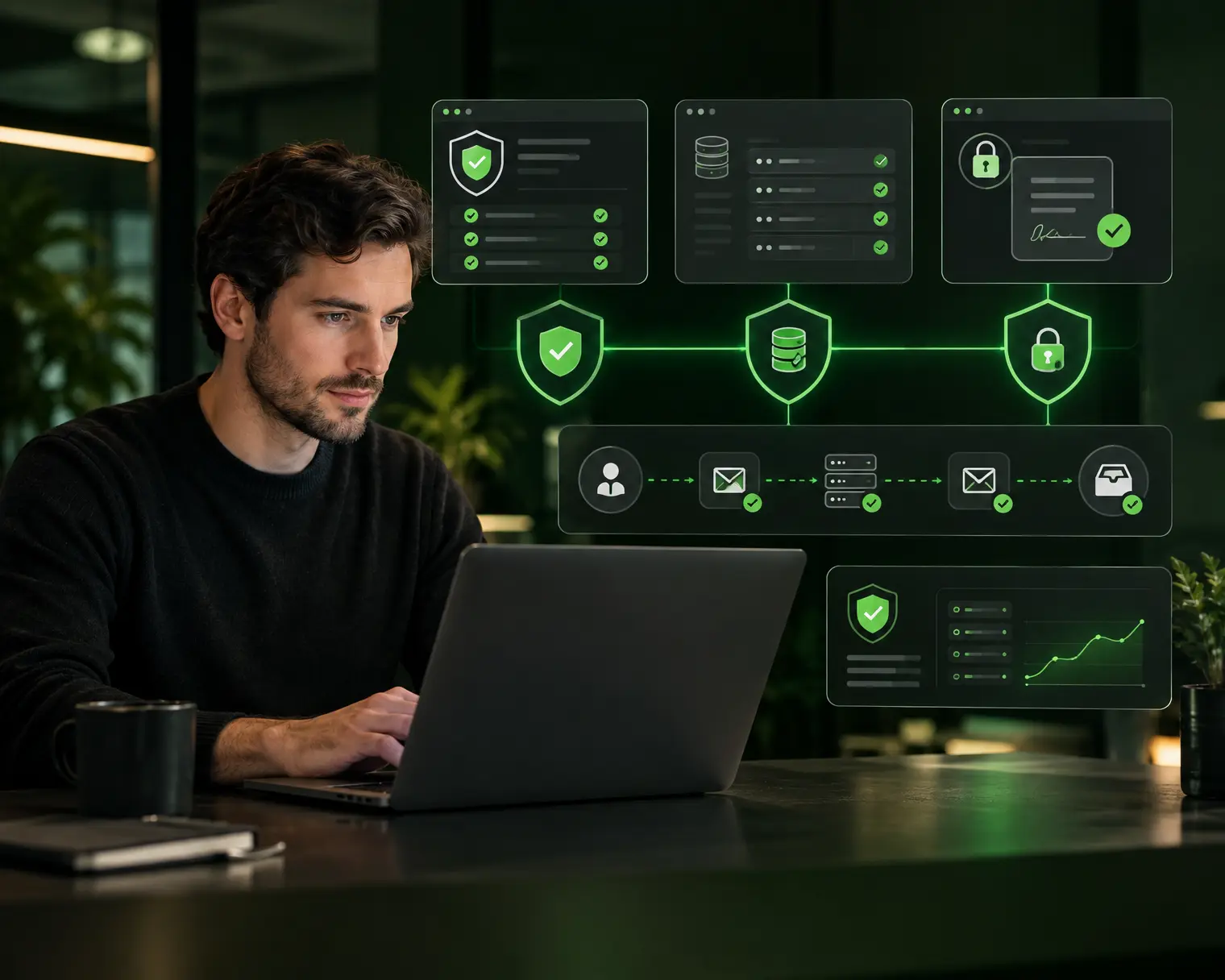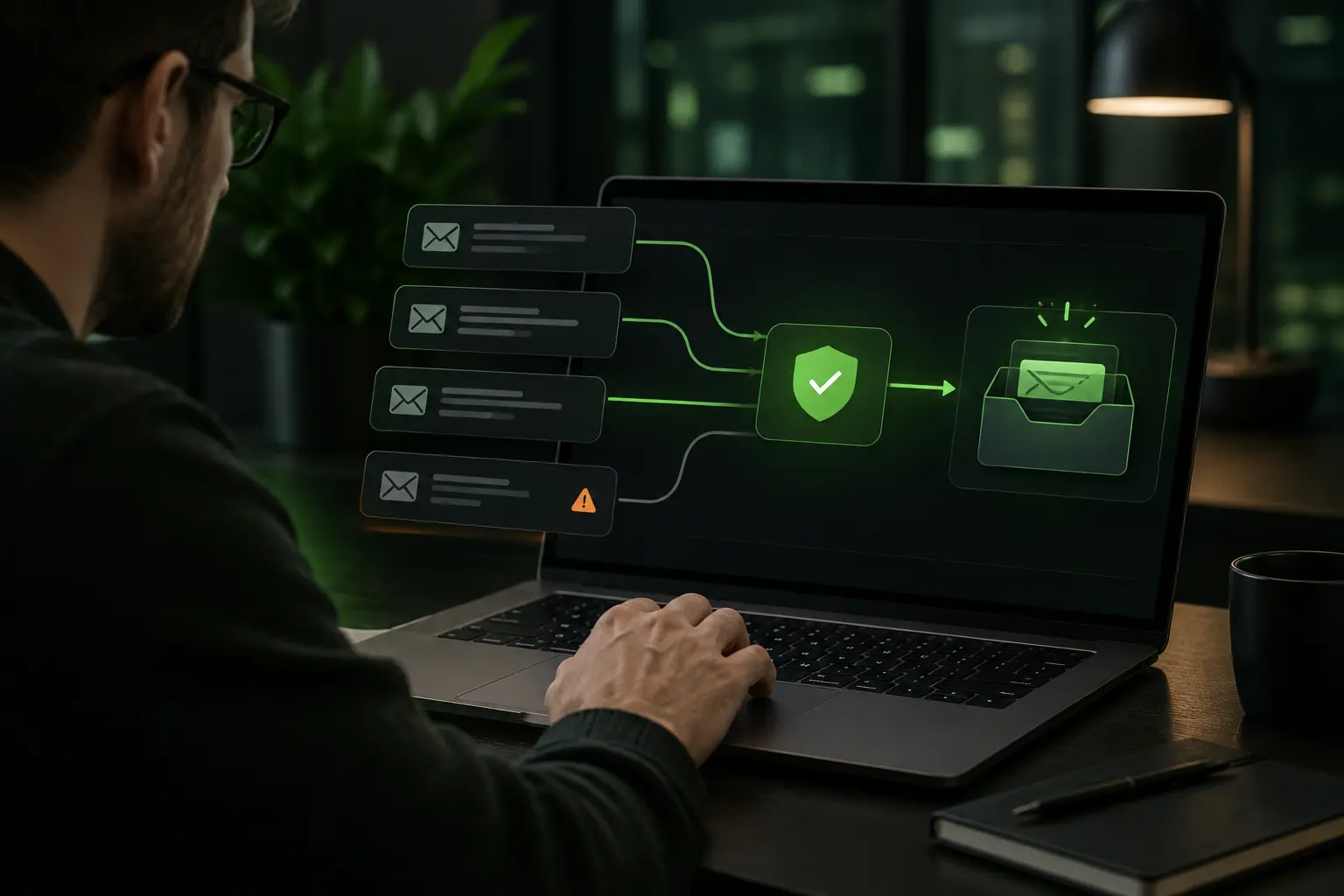


Sales engagement tools are the outbound execution layer of the modern B2B sales stack, orchestrating multichannel outreach (email, phone, LinkedIn, SMS, WhatsApp, voice AI) across sequences with delivery tracking, response capture, and CRM sync, distinct from the sourcing layer (contact databases) and intelligence layer (intent, conversation analytics). In 2026, sales engagement tools cluster into three archetypes (multichannel sequencer, autonomous AI worker, CRM-embedded engagement) each with distinct fit patterns per aggregated SERP benchmarks verified September 2026, and mature platforms now support up to 7 outreach channels (email, phone, LinkedIn, SMS, WhatsApp, iMessage, AI voice) per vendor claim from category leaders. This article maps the 3 archetypes, the 10 leading vendors, the AI-first trend, cost benchmarks, compliance, and 3 FAQ.
For a Head of Sales, RevOps engineer, SDR lead, or founder selecting sales engagement tools, this article gives the archetype selection framework and the vendor grid.
On the agenda:
- What sales engagement tools do (execution layer)
- The 3 engagement archetypes (multichannel sequencer, AI autonomous, CRM-embedded)
- 10 leading vendors compared
- The 2026 shift: AI-first autonomous workers
- Channel expansion: email + LinkedIn + phone + SMS + WhatsApp + iMessage + AI voice
- Cost benchmarks by archetype and team size
- Compliance: GDPR, CAN-SPAM, TCPA
- Selection framework
- 3 FAQ (archetype choice, AI autonomous ROI, cost)
Key takeaways:
- Definition: outbound execution layer, orchestrates multichannel outreach
- 3 archetypes: multichannel sequencer, AI autonomous worker, CRM-embedded engagement
- 10 leading vendors: Apollo, Outreach, Salesloft, Reply, Amplemarket, Klenty, Instantly, Lemlist, Salesforce Engage, Zeliq
- Channel evolution: up to 7 channels in 2026 (email + phone + LinkedIn + SMS + WhatsApp + iMessage + AI voice) per vendor claims
- AI-first trend: autonomous digital workers executing complete outbound functions
- Cost per SDR: $100-$400/month at mid-market pricing
- Compliance: FTC CAN-SPAM US, GDPR (CNIL 2025 €486M) EU
1. What sales engagement tools do
The sales stack in 2026 has three distinct layers:
Layer 1, Sourcing: contact databases and LinkedIn Sales Navigator. Who to reach.
Layer 2, Intelligence: intent signals, conversation intelligence, lead scoring. When and how to reach.
Layer 3, Engagement: the execution layer. Sends the emails, makes the calls, sends the LinkedIn messages, captures replies, syncs to CRM. What gets done.
Sales engagement tools sit at Layer 3. They orchestrate the multichannel sequence, track delivery and response, feed engagement data back to the CRM for pipeline reporting.
The distinction matters because vendors often blur the layers. Apollo and Zeliq combine Layers 1 + 3 (sourcing + engagement). Outreach and Salesloft focus on Layer 3 + partial Layer 2 (engagement + conversation intelligence). Cognism sits on Layer 1 with a light Layer 3 module.
2. The 3 engagement archetypes
Three archetypes dominate 2026, each with distinct fit patterns.
Archetype 1, Multichannel sequencer: traditional sales engagement platform. SDRs design sequences with 8-12 touches across 3-4 channels; the tool executes on schedule. Category leaders: Outreach, Salesloft, Apollo, Reply. Best for teams where SDR craft matters and sequences are hand-designed.
Archetype 2, Autonomous AI worker: AI-first platforms that execute complete outbound functions with minimal human input. The AI generates the opener, personalizes per prospect, sequences, and books meetings. Category emerging in 2026 per aggregated SERP: Amplemarket AI, some Reply features, Apollo AI. Best for teams prioritizing volume over per-touch craft.
Archetype 3, CRM-embedded engagement: engagement workflows built into the CRM natively. HubSpot Sales Hub, Salesforce Engage. Best for teams already invested in the CRM ecosystem who want sequences native to the CRM.
Selection driver: SDR craft-heavy teams → sequencer; volume + minimum SDR headcount → AI autonomous; HubSpot / Salesforce native workflows → CRM-embedded.
3. 10 leading vendors compared
Positioning verified September 2026 via aggregated SERP.
Outreach
Enterprise category leader. Deep sequencer + conversation intelligence + deal insights. Best for enterprise sales orgs prioritizing revenue orchestration.
Salesloft
Enterprise category leader alongside Outreach. Similar positioning + conversation intelligence + sales coaching. Enterprise pricing.
Apollo
Mid-market all-in-one bundling sourcing + engagement + basic dialer. Paid plans start $49/user/month billed annually per Apollo public pricing verified September 2026. 275M+ contacts per vendor claim.
Reply
All-in-one AI-driven sales engagement platform. 7-channel outreach (email, LinkedIn, SMS, WhatsApp, calls per vendor claim). AI-first positioning.
Amplemarket
AI-first autonomous outbound. 7-channel engagement per vendor claim, 200M+ contact database with real-time enrichment.
Klenty
Mid-market sequencer with strong AI features. Best for growing teams that need enterprise features at mid-market price.
Instantly
Email-first engagement + deliverability. Best for email-heavy outbound where inbox placement matters most.
Lemlist
Email + LinkedIn engagement + personalization features. Category leader for creative outbound with videos + custom images.
HubSpot Sales Hub
CRM-embedded engagement. Sequences run natively in HubSpot CRM. Best for HubSpot ecosystem teams.
Zeliq
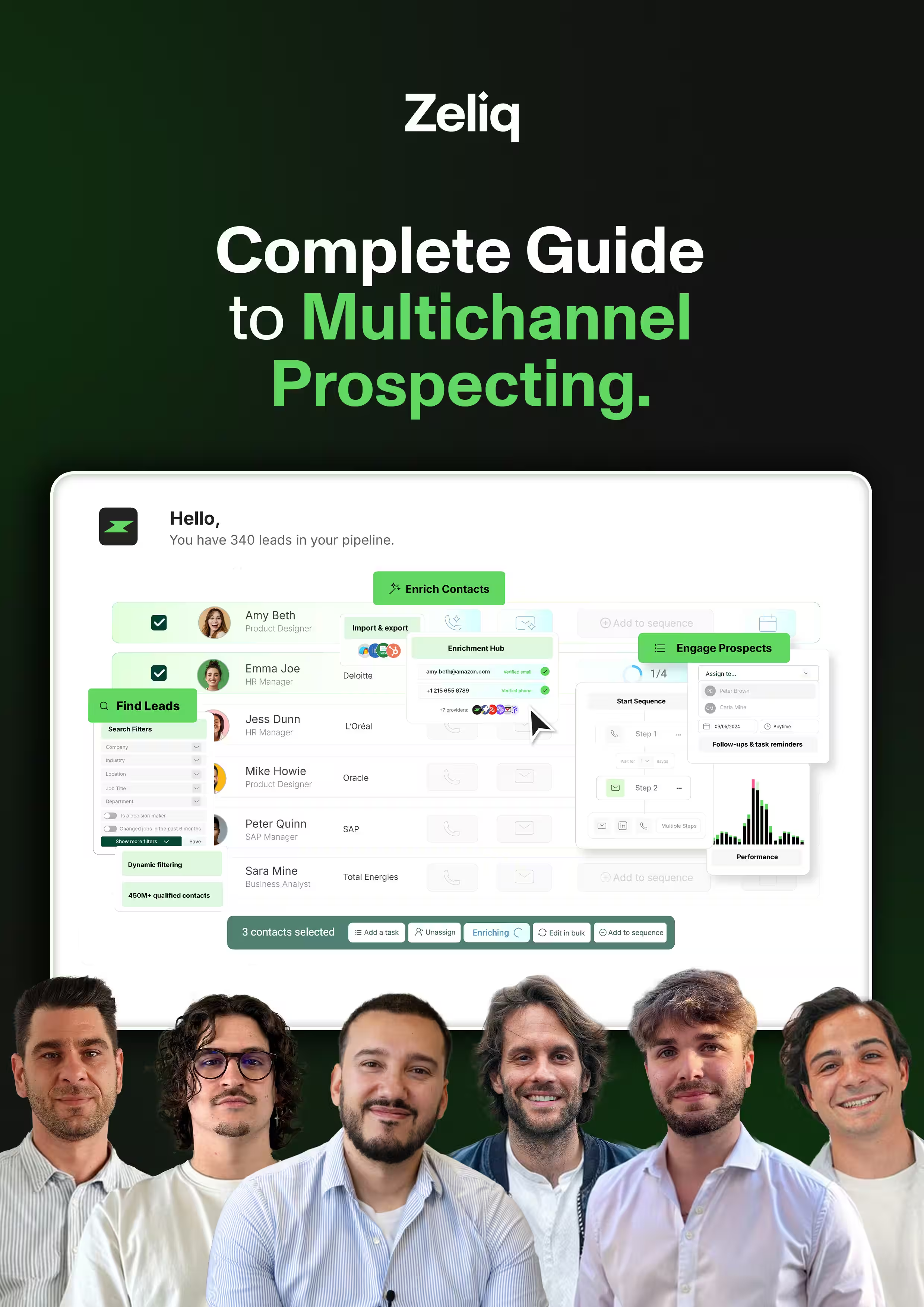
450M B2B contacts + waterfall enrichment + multichannel sequences (email + LinkedIn + phone) in one interface. European positioning, GDPR-native. Best for European SDR teams wanting Layers 1 + 3 bundled.
For deeper multichannel design, see multichannel prospecting guide.
4. The 2026 shift: AI-first autonomous workers
Aggregated SERP commentary in 2026 converges on the finding that AI sales engagement has evolved from simple email sequencers to autonomous digital workers executing complete revenue functions.
Practical implications: - AI generates personalized openers per prospect using intent signals + firmographic data - AI sequences and re-sequences based on prospect response patterns - AI handles low-value conversations (initial qualification) end-to-end - Human SDR focuses on higher-value conversations (demos, negotiations)
The shift is mid-adoption in 2026. Most teams still run traditional multichannel sequencers with AI-assisted personalization; a growing minority run autonomous AI workers as their first-tier outreach with SDRs as escalation.
Watch-out: AI autonomous outreach at scale can trigger deliverability issues and compliance risks if not properly gated. Domain warmup + sending rate limits + suppression list check remain non-negotiable.
5. Channel expansion: 7 channels in 2026
Category leaders (Reply, Amplemarket per vendor claims) now support up to 7 outreach channels:
- LinkedIn (connect, message, InMail)
- Phone (dialer, voicemail)
- SMS
- iMessage
- AI voice (autonomous voice-agent calls)
Most B2B teams use 3-4 channels actively (email + LinkedIn + phone + occasional SMS). The extended channels (WhatsApp, iMessage, AI voice) are emerging and vary widely by geography and industry. B2B in India and LatAm uses WhatsApp heavily; US B2B uses SMS more; enterprise EMEA rarely uses either.
Rule of thumb: match channel selection to prospect geography and industry norms. Adding channels without evidence of prospect preference = noise not lift.
6. Cost benchmarks by archetype and team size
Concrete math at typical mid-market pricing verified September 2026:
Archetype 1, Multichannel sequencer: - Entry (Apollo Basic, Klenty): $49-79/user/month - Mid-market (Apollo Pro, Klenty Growth, Reply): $100-200/user/month - Enterprise (Outreach, Salesloft): $100-200+/user/month for base + add-ons
Archetype 2, AI autonomous: - Amplemarket, AI-first tiers: $200-500/user/month - Emerging pricing, expect variance as category matures
Archetype 3, CRM-embedded: - HubSpot Sales Hub Professional: $100-150/user/month + HubSpot Professional CRM base at $800/month for the team - Salesforce Engage: $50-100/user/month + Salesforce base
Team scaling: at 5 SDRs, sequencer stack $500-1,000/month; AI autonomous $1,000-2,500/month; CRM-embedded $500-1,750/month plus CRM base costs.
7. Compliance: GDPR, CAN-SPAM, TCPA
US CAN-SPAM: FTC compliance guide requires accurate subject line + valid physical address + functional opt-out + honor opt-out within 10 business days.
US TCPA: restricts cold calling and SMS. B2B calls to work phones have narrower restrictions than B2C; abandoned-call rates must stay below 3% on parallel dialers.
EU GDPR: legitimate interest per ICP + opt-out on every touch + suppression list + 3-year retention. CNIL 2025 sanctions hit €486M total (vs €55M in 2024), including SOLOCAL Marketing Services at €900k for prospecting without sufficient legal basis. Choose GDPR-native vendors for EMEA.
LinkedIn ToS: prohibits automated access without permission; stay under ~100 connection requests per week per account.
Emerging channel rules: SMS opt-in requirements vary by state and country. WhatsApp Business API requires opt-in. iMessage has narrow B2B use cases and complex compliance.
8. Selection framework
Three questions to select the archetype:
Question 1, SDR craft vs volume priority: SDR craft-heavy → sequencer; volume-first with minimum SDR headcount → AI autonomous.
Question 2, CRM investment: heavy HubSpot or Salesforce investment → CRM-embedded; agnostic → sequencer or AI autonomous.
Question 3, Sourcing stack: separate sourcing tool → standalone sequencer works; want bundled sourcing + engagement → Apollo, Zeliq consolidate both layers.
9. Common mistakes
Mistake 1: Buying an engagement tool without a sourcing layer. Great engagement on wrong prospects converts less than mediocre engagement on right prospects.
Mistake 2: Enabling all 7 channels indiscriminately. Noise not lift. Match channels to prospect geography.
Mistake 3: AI autonomous without deliverability guardrails. Volume without warmup + rate limits = spam classifier flags.
Mistake 4: Ignoring CRM sync depth. Engagement data trapped in the tool = broken pipeline reporting.
Mistake 5: Skipping compliance review before enabling new channels. SMS, WhatsApp, iMessage have different opt-in requirements than email.
Zeliq and sales engagement
Zeliq combines a 450 million B2B contact database, waterfall enrichment across multiple sources with integrated email verification, and multichannel sequences (email + LinkedIn + phone) in one interface. Sourcing (Layer 1) + engagement (Layer 3) bundled without stitching two vendors. GDPR-native suppression list, European positioning.
10. Frequently asked questions
Which sales engagement archetype fits my team?
Multichannel sequencer fits SDR craft-heavy teams that hand-design sequences (most B2B teams below 50 SDRs); AI autonomous fits volume-first teams with minimum SDR headcount and stable ICP; CRM-embedded fits teams heavily invested in HubSpot or Salesforce ecosystems. Trade-offs: (1) Multichannel sequencer: highest control per touch, SDR designs opener + sequence structure, tool executes. Best when your differentiator is opener craft + signal-led personalization. Category leaders Outreach, Salesloft (enterprise), Apollo, Reply, Klenty (mid-market), Zeliq (bundled with sourcing). (2) AI autonomous: highest volume per SDR, minimal human touch design, AI generates opener + sequence + escalates to human on qualification. Best when your differentiator is scale and ICP is stable enough to templatize. Category emerging in 2026 with Amplemarket, some Reply and Apollo AI features. Risk: deliverability and compliance if not carefully gated. (3) CRM-embedded: deepest CRM integration, sequences run natively in HubSpot or Salesforce, sequence events land in CRM automatically for pipeline reporting. Best for teams where CRM is the primary system of record and engagement tools must not fragment data. Category: HubSpot Sales Hub, Salesforce Engage. Selection driver: identify your #1 differentiator (craft vs volume vs CRM depth) and match archetype. Combining archetypes rarely works: sequencer + AI autonomous produces confusion; CRM-embedded + external sequencer produces sync overhead.
Do AI autonomous sales engagement tools actually deliver ROI?
Emerging evidence in 2026 suggests AI autonomous tools can deliver 2-3× the volume of human-only SDR outreach at similar reply rates on stable-ICP campaigns, but ROI depends heavily on ICP maturity, guardrails on deliverability, and human escalation on qualification stages. Category is mid-adoption in 2026; most teams still run traditional sequencers with AI-assisted personalization rather than fully autonomous AI workers. Where AI autonomous shines: (1) stable ICP where template scales (SaaS mid-market, e-commerce fulfillment, specific industry verticals with predictable buying committees), (2) high-volume outbound where SDR seat cost dwarfs tool cost, (3) teams with mature deliverability operations (domain warmup, suppression list, sending rate limits) already in place. Where AI autonomous falls short: (1) niche ICP with < 5,000 addressable accounts (each touch needs deep personalization AI can’t match), (2) enterprise deals with multi-stakeholder committees requiring account-based coordination, (3) teams without deliverability operations where AI volume triggers spam classifiers. Realistic ROI math: AI autonomous at $200-500/user/month replacing 1 SDR seat at $60,000/year fully-loaded = $5,000/month, break-even if the AI generates > 40% of the meetings a human SDR would. Currently, best-in-class AI autonomous generates 60-80% of human SDR meeting volume on stable ICPs, so ROI positive. Below that threshold, human SDRs still win. Watch: compliance and deliverability if AI autonomous exceeds domain sending capacity.
What is the total cost of a sales engagement tool per SDR?
$100-$400 per SDR per month at mid-market pricing depending on archetype, with sequencer at the low end and AI autonomous at the high end; enterprise sequencers with add-ons reach $500+/SDR/month. Concrete tiers verified September 2026: (1) Multichannel sequencer entry-level: $49-79/user/month (Apollo Basic, Klenty Team). Best for solo operators or 1-3 SDR pilots. (2) Sequencer mid-market: $100-200/user/month (Apollo Professional, Klenty Growth, Reply, Instantly for email-heavy). Best for 5-30 SDR teams. (3) Sequencer enterprise: $100-200/user/month for base + $50-100/user/month for add-ons (conversation intelligence, coaching, advanced analytics). Outreach and Salesloft dominate. Total $150-300/user/month. Best for 30+ SDR enterprise orgs. (4) AI autonomous: $200-500/user/month emerging category (Amplemarket, AI-first tiers of Reply, Apollo). Expect pricing to normalize as category matures. (5) CRM-embedded: $100-150/user/month for HubSpot Sales Hub Professional or $50-100/user/month for Salesforce Engage, plus base CRM cost of $50-150/user/month or team-level Professional tiers. Beyond direct cost, factor sequencer integration with sourcing layer (bundled saves 20-40% vs stitched), CRM seat cost, dialer if separate, and refresh cadence on prospect data. Team scaling: at 5 SDRs, sequencer stack $500-$1,500/month + database $750-$2,000/month = $1,250-$3,500/month total. Consolidated all-in-one (Apollo, Zeliq) $750-$2,000/month covering both layers, saving 30-40% vs stitched.
11. Conclusion: 3 actions to run
Identify your engagement archetype within 7 days. Craft-heavy → sequencer; volume-first → AI autonomous; CRM-native → embedded.
Audit current channel usage within 15 days. How many channels actively used vs enabled? Cut inactive channels; deepen top 3 used.
Reassess tool consolidation within 30 days. Above 3 SDRs, all-in-one platforms bundling sourcing + engagement typically save 30-40% vs stitched.
Sourcing + engagement bundled: waterfall enrichment and multichannel sequences in one
Zeliq combines 450 million B2B contacts, waterfall enrichment with integrated verification, and multichannel sequences (email + LinkedIn + phone) in one interface. Layer 1 + Layer 3 bundled without two vendors. GDPR-native suppression.
Try for freeAnd if you want sourcing + engagement bundled in a single interface with waterfall enrichment and multichannel sequences, try Zeliq for free: sourcing, enrichment, verification, and outreach in one platform, no credit card required.