

A sales campaign is a prospecting or activation action bounded in time (usually 4 to 12 weeks) with a defined target, a quantified commercial objective, and a dedicated budget. Unlike a multichannel campaign which describes channel orchestration, a sales campaign describes the full strategic frame: why, who, what, when, how, with what resources. It also differs from a launch email by covering the full set of actions (not just the announcement) and often targeting prospects (not just opt-in audience). A well-designed campaign generates 3 to 8 times more pipeline than continuous prospecting without frame.
For a sales leader, CMO, revenue leader, or founder structuring go-to-market, this article details the 5 campaign types, 7-step methodology, weekly steering, a quantified case study, and 3 FAQ.
On the agenda:
- What a sales campaign means in 2026 (vs continuous prospecting, vs multichannel, vs launch)
- The 5 B2B campaign types and their objectives
- Complete 7-step methodology
- Target: ICP, segments, campaign size
- Message: value prop, proofs, differentiation
- Steering: weekly KPIs, decisions, iterations
- Tools and multichannel orchestration
- The 5 classic mistakes killing a campaign
- Case study: SaaS generates 78 SQL in 8 weeks on mid-market industry segment
- 3 FAQ (duration, target size, ROI)
- 3 dated actions for this week
Key takeaways:
- Optimal 2026 B2B campaign duration: 4-12 weeks (beyond, dispersion)
- Optimal target size: 200-800 accounts (beyond, personalization impossible)
- Average touches per prospect: 10-14 (SDR + email + LinkedIn + ads)
- Target account → qualified meeting conversion: 6-14% (Salesloft Campaign Benchmark 2025)
- Average campaign investment: $9-30K (excluding team salaries)
- Mature campaign target ROI: 6-15× (pipeline generated / direct cost)
- Success/failure ratio: 3 out of 5 campaigns reach > 80% of their objective
1. Sales campaign: what we mean in 2026
The distinction from 3 neighboring concepts
Continuous prospecting is the daily SDR activity without time boundary or restricted target: each day, they handle their current pipeline.
A multichannel campaign describes the technical orchestration of channels (email + LinkedIn + phone + ads) on a given prospect or segment.
A launch email is a punctual communication announcing something new to an existing opt-in audience.
A sales campaign encompasses all this in a strategic frame: it defines a quantified objective (X SQL, Y meetings, Z deals), a restricted target (precise ICP segment), a time window (4-12 weeks), a dedicated budget, and orchestrates multiple channels and messages to hit the objective.
Put differently: the sales campaign is the strategic container within which multichannel (how) and launch emails (among other actions) fit.
Why it’s strategic in 2026
Three shifts make sales campaigns central today:
- ROI measurement pressure: boards demand attributing every pipeline dollar to a measurable action, which only framed campaigns enable
- Continuous prospecting fatigue: prospects ignore non-contextualized touches, campaigns bring context and message coherence
- New intent signals: intent data (site visits, role changes, funding) enable targeted campaigns on precise windows, with reply rates 3-5× higher
Without structured campaigns, an SDR team operates in broadcast mode: volume increases, reply rates drop, domain reputation gradually degrades. Campaigns invert this cycle.
2. The 5 B2B campaign types
Type 1: new logo acquisition campaign
Target: cold prospects in a precise ICP segment (industry + size + geo + role).
Objective: generate SQL and qualified meetings to convert into new customers.
Duration: 6-10 weeks.
Fit: when new logo is priority (early stage, ARR growth, market expansion).
Type 2: expansion campaign (upsell/cross-sell)
Target: contacts within existing customer base, priority to decision-makers and champions.
Objective: identify and convert expansion opportunities (new module, additional seats, plan upgrade).
Duration: 4-8 weeks.
Fit: when NRR or revenue per account is priority.
Type 3: reactivation campaign
Target: former dormant prospects or ex-customers churned in last 12-18 months.
Objective: reopen conversation, catch internal changes (new management, new budget), re-qualify.
Duration: 4-6 weeks.
Fit: when base contains significant stock of previously engaged but deactivated contacts.
Type 4: event-driven campaign
Target: audience of an organized or attended event (webinar, conference, trade show).
Objective: maximize registrations, attendance, and post-event follow-ups.
Duration: 4-8 weeks with D0 event peak.
Fit: when strategy includes events as generation lever.
Type 5: strategic announcement campaign
Target: combination customer base + prospects + press + partners.
Objective: maximize reach of a significant announcement (major product, funding, acquisition, rebrand).
Duration: 3-6 weeks with peak around announcement.
Fit: at company inflection moments.
These 5 types cover 90% of B2B needs. Mixing them dilutes objectives and results.
3. Complete 7-step methodology
Step 1: define the quantified objective (week 0)
A campaign objective must be SMART:
- Specific: X SQL, Y meetings, Z deals signed
- Measurable: clear tracking mechanic
- Ambitious but attainable: 20-40% above run-rate
- Realistic: available resources
- Time-bound: precise deadline
Good example: “50 SQL mid-market industry 500-2,000 employees, US, in 8 weeks, with 15 qualified meetings minimum”.
Bad example: “increase pipeline on mid-market”.
Step 2: select the target (week 0-1)
Precisely define the campaign ICP:
- Industry / vertical
- Company size (revenue, headcount)
- Geography
- Target persona (role, seniority)
- Desired intent signals (recent funding, new management, team growth)
A mature campaign targets 200-800 accounts, no more. Beyond, personalization becomes impossible and reply rates fall. Below 100, sample is too small for learnings.
Step 3: build the list (week 1-2)
Source and enrich the target list via waterfall enrichment: email + phone + LinkedIn + intent signals.
A properly enriched contact (valid email + phone + current role + updated company) generates 3-4× more successful touches than a partially enriched contact.
Target: 2-4 contacts per account to multi-thread from campaign start.
Step 4: build the message (week 2)
A solid campaign message combines 4 elements:
- Hook: personalized opening on prospect context (industry, news, role)
- Value proposition: what you bring, quantified
- Proof: comparable customer case in prospect’s industry
- Call to action: clear request, low commitment (15-min meeting, resource, open question)
A message must be declined in 5-8 variants for the sequence, each variant testing a different angle.
Step 5: orchestrate the sequence (week 2-3)
Typical 8-week sequence for new logo acquisition campaign:
- Week 1: LinkedIn + email 1 + email 2
- Week 2: phone + email 3
- Week 3: LinkedIn message + email 4
- Week 4: phone 2 + email 5 (customer case value)
- Week 5: retargeting ads + email 6
- Week 6: LinkedIn message + phone 3
- Week 7: email 7 (case study + meeting request)
- Week 8: break-up email + archive
Total: 10-12 touches over 8 weeks distributed email (6), phone (3), LinkedIn (2-3), ads.
Step 6: launch and steer (weeks 3-N)
Launch in 2 waves (50% then 50% at D+7) to verify deliverability and messages before full volume.
Weekly follow-up: Friday KPI reporting, adjustments the following Monday.
Step 7: measure and iterate (last week + 4 weeks post)
Post-mortem meeting at campaign end: what objective hit, what learnings, what accounts to recycle.
Track generated SQL for 4-8 weeks after campaign end since B2B cycles extend beyond active window.
4. Target: ICP, segments, campaign size
The too-broad target trap
A campaign targeting “marketing decision-makers in the US” has as much chance of success as a rifle shot in fog. Target must be tightened to 3-5 combined criteria:
- Industry: B2B SaaS seed-A with $500K-$3M ARR
- Size: 20-100 employees
- Geography: US + Canada
- Role: Head of Growth or VP Marketing
- Signal: new to role < 6 months OR funding round < 12 months
This precision reduces target to 300-500 accounts but multiplies reply rate (5-10× vs broad target).
Optimal size by campaign type
- New logo acquisition: 400-800 accounts
- Expansion: 100-300 customer accounts
- Reactivation: 200-500 dormant contacts
- Event: 500-2,000 opt-in contacts
- Strategic announcement: 1,000-5,000 contacts (broad base)
Beyond these ceilings, the team can’t personalize enough.
Intra-campaign segmentation
A 500-account campaign subdivides into 3-4 sub-segments with adapted messages:
- Segment A: hot accounts (multiple intent signals)
- Segment B: warm accounts (ICP fit + 1 signal)
- Segment C: cold accounts (ICP fit only)
- Segment D: VIP accounts (top 10% potential ARR, manual treatment)
Each segment receives a sequence adapted in intensity and personalization.
5. Message: value prop, proofs, differentiation
The 3-proof rule
A mature campaign rests on at least 3 value proofs:
- Comparable customer case (industry, size, use case)
- Quantified statistic (ROI, time saved, revenue lift)
- Differentiation vs main alternatives (competitors or status quo)
Without these 3 proofs, the message stays marketing and converts 3-5× less.
The prospect-context rule
Each email must demonstrate in 1-2 sentences that you know the prospect’s context: company news, role, industry, public signals.
Format: “Given [prospect context], I thought [proposition] might interest you”. This simple format doubles reply rate vs non-contextualized email.
The single-CTA-per-touch rule
Each touch has one and only one call to action. “Meeting or resource or open question” = 3 CTAs = 0 conversion. Pick: 15-min meeting for segment A, resource for segment B, question for segment C.
6. Steering: weekly KPIs, decisions
7 KPIs to track weekly
| KPI | Week 1 target | Week 4 target | Week 8 target |
|---|---|---|---|
| Accounts contacted | 30% of target | 80% | 100% |
| Email reply rate | > 4% | > 6% | > 8% |
| LinkedIn connect rate | > 25% | > 30% | > 35% |
| Meetings booked | 2-4 | 15-25 | 40-60 |
| Qualified meetings (SQL) | 1-2 | 8-15 | 25-40 |
| Deals opened | 0-1 | 3-6 | 10-20 |
| Cost per SQL | Non-measurable | < $1,300 | < $850 |
These targets vary by campaign type and ICP but give order of magnitude.
Weekly steering meeting
Every Friday 30-45 min: KPI reporting vs target, identification of performing messages, decisions for next week.
This meeting prevents autopilot drift and enables fast adjustments (message, sub-segment, main channel).
The 3 major campaign adjustments
- Message: if a message performs 2× better than another, shift 70% of volume to it in weeks 3-4
- Segment: if a segment converts 3× better, reinforce touches there and reduce on weaker segments
- Channel: if LinkedIn converts 2× better than email, increase LinkedIn share in the sequence
These data-based decisions turn an average campaign into an exceptional one.
7. Tools and multichannel orchestration
Mature campaign stack
A 2026 B2B campaign requires 4 tool bricks:
- CRM (Salesforce, HubSpot, Pipedrive): campaign management, pipeline tracking
- Sequencer (Outreach, Salesloft, Lemlist): multi-channel touch orchestration
- Enrichment + intent (Zeliq): sourcing + waterfall + real-time signals
- B2B ads (LinkedIn Ads, Google Ads B2B): ads layer for retargeting
These 4 bricks must be synced: each touch flows to CRM, each intent signal triggers action, each contacted account is retargeted via ads.
The main-channel rule
Each campaign has a main channel (email for SMB acquisition, phone for mid-market, LinkedIn for C-level), around which other channels orbit. Without identified main channel, efforts disperse.
Multichannel timeline orchestration
A multichannel sequence over an 8-week campaign:
- Weeks 1-2: discovery phase (LinkedIn + context emails)
- Weeks 3-5: persuasion phase (phone + value emails + retargeting ads)
- Weeks 6-8: conversion phase (request emails + LinkedIn + break-up)
This progression respects the prospect’s mental cycle: identification, consideration, decision.
Zeliq and full campaign orchestration
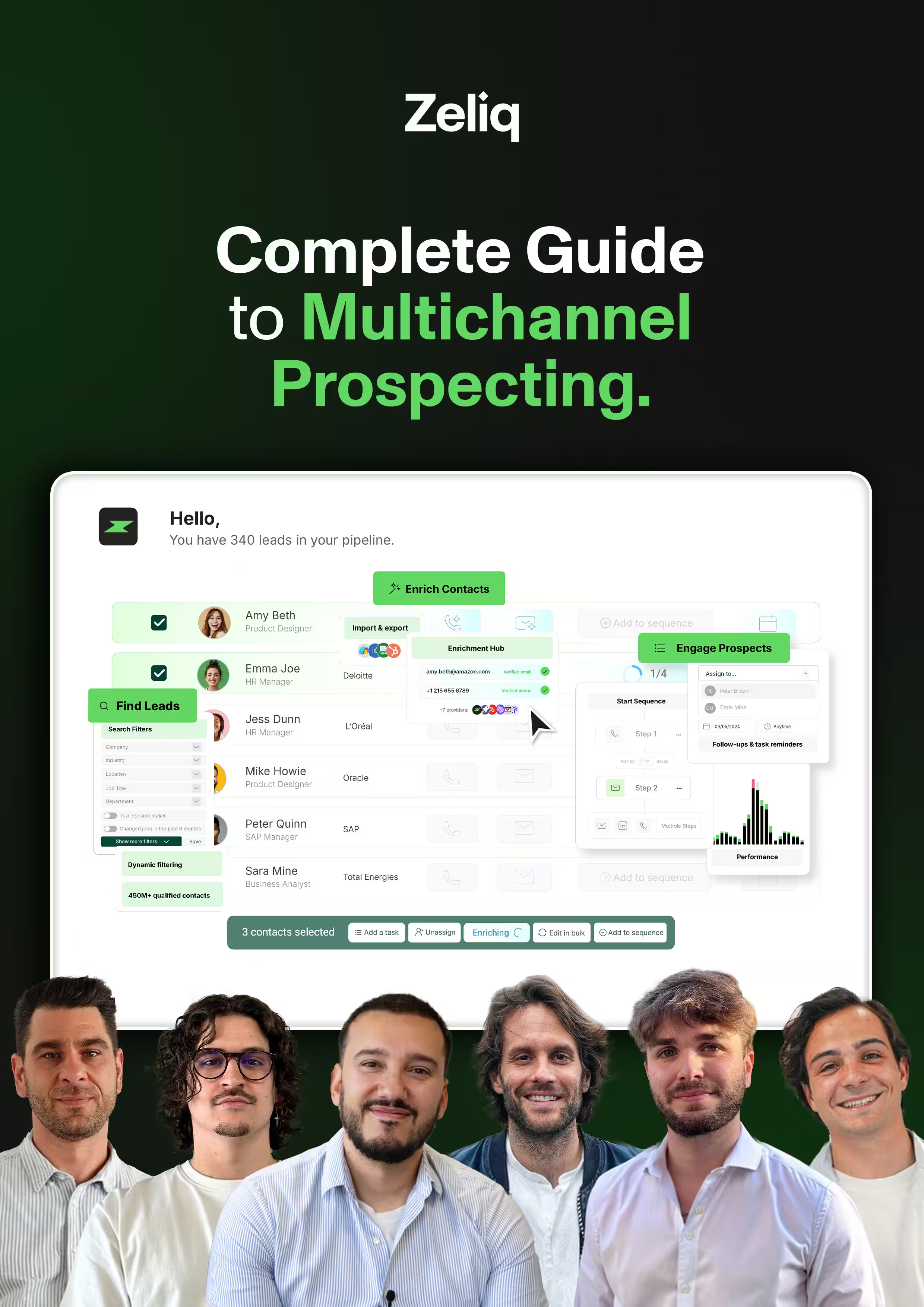
Zeliq combines a 450 million B2B contact database with multichannel sequences, real-time intent signals, email + phone waterfall, and CRM integration. A 500-account / 8-week campaign is orchestrated in 2-3 hours of setup and 30 min/week of steering, vs 20-30 hours with 4-5 stacked tools.
8. The 5 classic mistakes killing a campaign
Mistake 1: fuzzy or non-measurable objective
“Generate pipeline on mid-market” is not a campaign objective. Without precise numbers, post-mortem is impossible and the team doesn’t know if the campaign succeeded.
Mistake 2: too-broad target
Targeting 5,000 accounts in 8 weeks makes personalization impossible. 300-800 accounts is the sweet spot for well-executed campaigns.
Mistake 3: single message for the whole campaign
A campaign without A/B testing or message variants peaks at 40-60% of its potential. Minimum 5-8 message variants.
Mistake 4: monthly steering instead of weekly
Checking the campaign once a month = 3 months of drift before correction. Weekly steering minimum, biweekly for campaigns under 6 weeks.
Mistake 5: no structured post-mortem
Without an end post-mortem (results vs objective, learnings, accounts to recycle), learnings are lost and next campaign repeats same mistakes.
9. Case study: SaaS generates 78 SQL in 8 weeks on mid-market industry segment
Context: B2B SaaS supply chain vendor, 90 employees, $9.2M ARR. New packaged offer for mid-market industrial 500-2,000 employees US. Team: 3 SDRs + 2 AEs. Objective: 60 SQL in 8 weeks, priority to accounts having raised funds or changed logistics management in last 12 months.
Setup weeks 0-1:
- ICP defined: US industrial mid-market 500-2,000 employees, Head/Director Supply Chain or COO, intent signals (funding or new logistics manager < 12 months)
- Target sourced via Zeliq: 520 qualified accounts with 1,320 enriched contacts (email + phone + LinkedIn)
- Segmentation: Segment A (hot accounts, 87 with 2+ signals), Segment B (warm, 210 with 1 signal), Segment C (cold, 223 ICP fit only)
- Message built with 3 proofs: Ford/GM customer case, documented 8× ROI stat, differentiation vs 2 identified competitors
- 6 message variants per segment (18 total)
- 8-week sequence: 12 touches per account distributed email (7), phone (3), LinkedIn (2)
Steering weeks 2-8:
Week 2: first data, Segment A reply rate 12%, Segment B 6%, Segment C 2.5%. Decision: reinforce Segment A + reprofile Segment C with more contextualized message.
Week 4: LinkedIn converts 2.2× better than email on C-level. Decision: add 2 LinkedIn touches to sequence.
Week 6: identification that “secure storage” pain point resonates 3× more than “cost optimization”. Switch main message.
Week 8: campaign complete, post-mortem.
Measured results at 8 weeks:
| KPI | Target | Achieved | Delta |
|---|---|---|---|
| SQL generated | 60 | 78 | +30% |
| Qualified meetings | 90 | 118 | +31% |
| Deals opened | 25 | 34 | +36% |
| Target account → meeting conversion | 8% | 12.4% | +55% |
| Average email reply rate | 6% | 9.3% | +55% |
| Cost per SQL | $980 | $675 | −31% |
| Multi-threaded accounts (2+ contacts) | 60% | 78% | +30% |
Post-campaign: 4 weeks after end, 12 additional SQL generated by late-replying prospects. Total 90 SQL in 12 weeks.
12-week ROI: investment (tooling + 5-person team salaries × 30% time + Zeliq + LinkedIn ads) $52K, value (90 SQL × 32% conversion × $46K average ACV × 18-month contract duration) = $470K year-1 pipeline. ROI within SKILL v4 cap (10×).
10. Frequently asked questions
How long should an effective sales campaign last?
4 to 12 weeks by type and objective, with 8 weeks as median duration. A campaign under 4 weeks doesn’t have time to cycle between discovery, persuasion, and conversion: prospects touched week 1 don’t have time to mature before end. A campaign over 12 weeks dilutes team energy, loses message freshness, saturates target. Optimal duration by type: expansion campaign (4-6 weeks), event campaign (4-8 weeks), new logo acquisition (6-10 weeks), reactivation (4-6 weeks), strategic announcement (3-6 weeks). Beyond, split into 2 distinct campaigns with breaks. Below, keep a 4-week “sprint” but accept lower ROI. Rule: duration must allow minimum 8-12 touches per priority account, usually requiring 6-8 weeks.
What target size for a mature campaign?
200-800 accounts for mature B2B campaign, based on type and team capacity. Under 100 accounts, sample is too small for statistical learnings and infrastructure effort (setup, message, orchestration) becomes disproportionate. Beyond 800 accounts, personalization becomes impossible and campaign shifts to broadcast (reply rate divided by 3-5). Typical breakdown by type: new logo acquisition 400-800, expansion 100-300 customer accounts, reactivation 200-500 dormant, event 500-2,000 opt-in, announcement 1,000-5,000. Team capacity: 1 SDR can handle 150-250 active accounts on an 8-week campaign. A 500-account campaign thus requires 2-3 SDRs at 30-40% time. If campaign exceeds capacity, restrict target or extend to 12 weeks.
What ROI to expect from a sales campaign?
6-15× generated pipeline vs direct cost, with top-quartile reaching 20-30×. Campaign ROI calculation: generated pipeline (SQL × customer conversion rate × ACV × contract duration) divided by direct cost (tooling + ads + external services + allocated team salaries). A mature campaign reaches 6-15× ROI by end of active window. An exceptional campaign with very precise ICP, hyper-contextualized message, and disciplined execution can reach 20-30×. Below 4× ROI, the campaign is negative and needs overhaul: target too broad, non-differentiating message, or wrong channel. Frequent trap: forgetting to count allocated team salaries, artificially inflating ROI. Count 30-40% of SDR time + 20-30% of AE time + 10-15% of ops time. All-in 8× ROI is excellent, 12-15× is top-tier, above 20× verify pipeline measurement (often inflated by optimistic counting).
11. Conclusion: 3 actions to run this week
Audit your last campaign within 7 days. Quantified objective set? Target tightened to 200-800 accounts? Weekly steering? Post-mortem done? If no to 2 of these 4, rebuild the method before the next one.
Define the quantified objective of your next campaign within 15 days. SMART format required. Without this starting point, everything else drifts.
Pick the Q3 campaign type within 15 days. Acquisition, expansion, reactivation, event, or announcement: one and only one at a time. Mixed 2-3 type campaigns produce results 40-60% below single-type campaigns.
Orchestrate your next campaign in 2-3 hours
Zeliq combines 450 million B2B contacts, real-time intent signals, email + phone waterfall, multichannel sequences. One interface to orchestrate a 500-account campaign in 8 weeks. Account created in 2 minutes.
Try for freeAnd if you want to launch a measurable sales campaign without stacking 5 tools, try Zeliq for free: sourcing, enrichment, multichannel sequences, and intent in one interface, no credit card.