
You hit “send” on what you thought was a strong cold email. The subject line felt sharp. The copy was short, polite, maybe even a little clever. You wait. Track the open. Watch the click.
And then… nothing. No reply.
That silence?
It’s not because your product or service isn’t relevant. It’s not because your timing was off (well, maybe a little). More often than not, it’s because your message looked and sounded just like the 30 others sitting in that same inbox.
Email prospecting today is broken, but not beyond repair.
Too many sales teams still rely on outdated prospecting email templates or overly polished bulk email sequences.
Too much generic value. Not enough context. No real reason for the prospect to stop, read, and say: “Okay, let’s talk.”
But when you actually get it right; when your initial email feels timely, specific, and grounded in real business relevance; something shifts. Suddenly, your response rate goes up. Your sales reps are booking more meetings.
In this article, no recycled tips. Just solid frameworks, examples that actually work, and tactics used by real B2B teams doing cold prospecting the smart way, with tools like ZELIQ to help scale, not spam.
Let’s figure out how to make that next email the one they actually reply to.
What is a prospecting email?
A prospecting email isn’t about pitching your product line in paragraph one. It’s more like saying: “I noticed something about your business, and I think it’s worth a quick chat.”
The real objective is to get a reply. Not a contract, not even a full demo: just a reply that opens the door to a meeting.
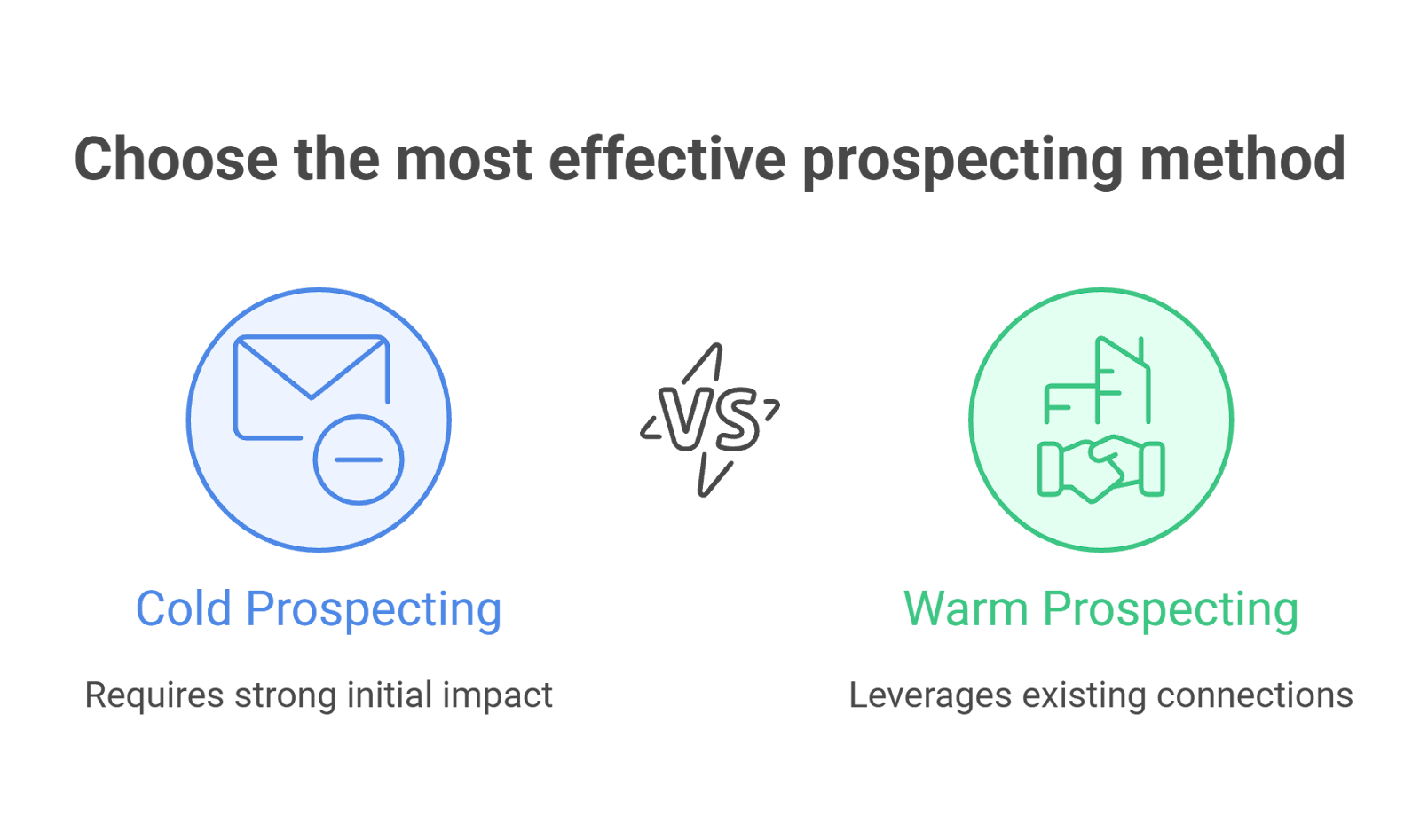
Cold vs. warm prospecting
Picture two scenarios.
Your subject line and first sentence do the heavy lifting.
By line two, your intent should be crystal clear: whether you're following up after a LinkedIn interaction, a shared event, or a warm referral. Make it obvious why you landed in their inbox today.
That’s warm prospecting, and your odds of getting a response are instantly higher.
Use cases in B2B lead generation
Reps use prospecting emails every day to:
- Reach new ICP accounts with a tailored opener
- Reconnect with leads who downloaded a resource or joined a webinar—those actions signal intent.
- Bring stalled deals back to life with a short, high-value follow-up that introduces something new.
Because at the end of the day, prospecting isn’t about blasting sequences—it’s about creating conversations that turn CRM records into real pipeline.
How effective is email prospecting today?
Performance benchmarks across industries
If you ask most sales teams, they’ll admit their inbox feels like a battleground.
Yet the numbers say email still works.
According to HubSpot’s 2025 benchmark report, average open rates across industries hover around 42% (HubSpot, 2025).
When it comes to engagement, MailerLite’s 2025 data shows average click-through rates sitting at about 2%: “The average email click rate across all email marketing campaigns was 2.00%. Clicks rates across industries ranged from 0.77% to 4.36%”. (MailerLite, 2025).
Email is still ROI-positive.
Buyers still read emails. It’s direct, it scales, and it gives reps the ability to track email metrics, something you don’t get from a cold call.
Impact of personalization, timing, and follow-up
Three levers can make or break your campaign:
- Personalization: go beyond first names; mention a role-specific pain point, or a recent funding round
- Timing: mid-morning on a Wednesday still outperforms Monday morning blasts
- Follow-ups: most prospects reply after the 5th touch, execs may take closer to 9 before you land time on their calendar
How to write a compelling prospecting email?
Crafting an engaging subject line
Your subject line is the difference between landing in the inbox and landing in the trash. Forget “Quick question” or “Following up”—they’re overused and invisible. Instead, use specificity and curiosity. For example: “Cutting your onboarding time by 30%?” feels relevant and sparks interest. Keep it short (4-6 words max) and test variations until you see reply rates climb.
Structuring a short, value-driven message
Once your email is opened, you have about 8 seconds before the prospect decides whether to read on. That means no walls of text. A winning structure often looks like this:
- Hook with a personalized opener (reference a mutual connection, recent news, or a role-specific challenge).
- Share a short value statement tied to their situation, not a product pitch.
- End with a simple, frictionless ask: “Would it make sense to discuss this next week?”
Personalization that feels genuine
The fastest way to get ignored? Sending the same message to everyone.
People can “smell it” a mile away.
Instead, slip in something small but specific: maybe a line about their latest product launch, a comment they shared on LinkedIn, or a challenge you know comes with their job.
Nothing fancy, just enough to show you didn’t write this in bulk.
That little touch is often what makes someone stop, read, and think, “okay, this one’s actually for me.”
Frictionless CTAs that convert
The worst CTA in prospecting is: “Would you like a demo?” Too heavy, too soon. Instead, lower the barrier. Try “Open to a quick chat?” or “Happy to share a short case study if helpful.” The CTA should make it easy for the recipient to say yes without committing to a full sales cycle.
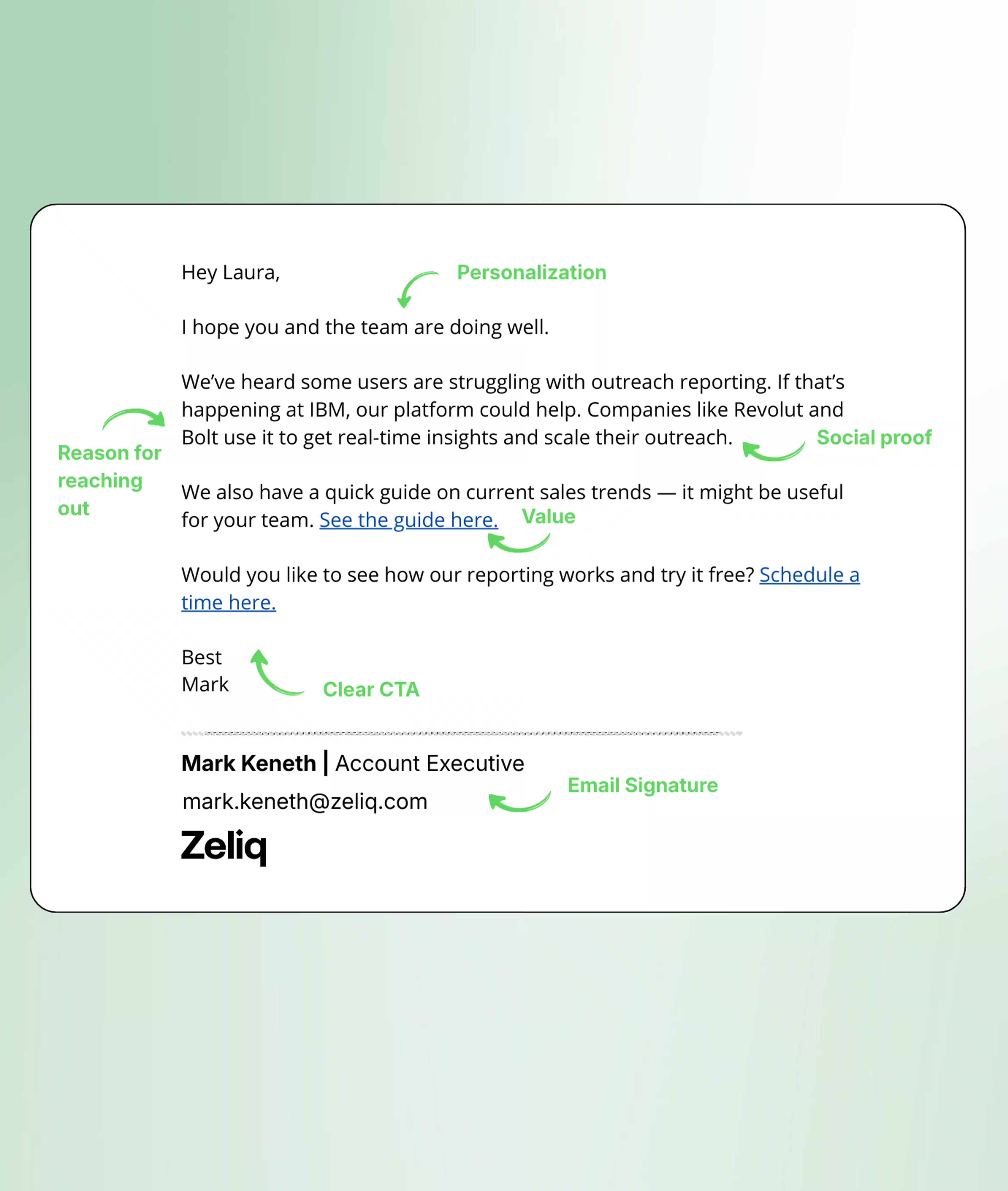
Example of a high-performing sales email
Here’s how a sales email template might look in practice:
Subject: Cutting onboarding time at [Prospect’s Company]
Hi [Name],
I caught your LinkedIn post last week about [topic they shared]. It looks like the team is moving fast on [initiative]—congrats on that progress.
Something I hear a lot from sales leaders is how onboarding new reps ends up pulling senior managers in too many directions. At [Peer Company], we helped trim onboarding time by 25% and made the process easier for the team instead of heavier.
Would you be open to a quick chat next week to see if this could fit your setup at [Prospect’s Company]?
Best,
[Your Email Signature]
Notice how it’s short, personalized, and focused on results, not features.
How to personalize prospecting emails?.
Personalization is about showing you understand the person on the other side and why your message matters to them:
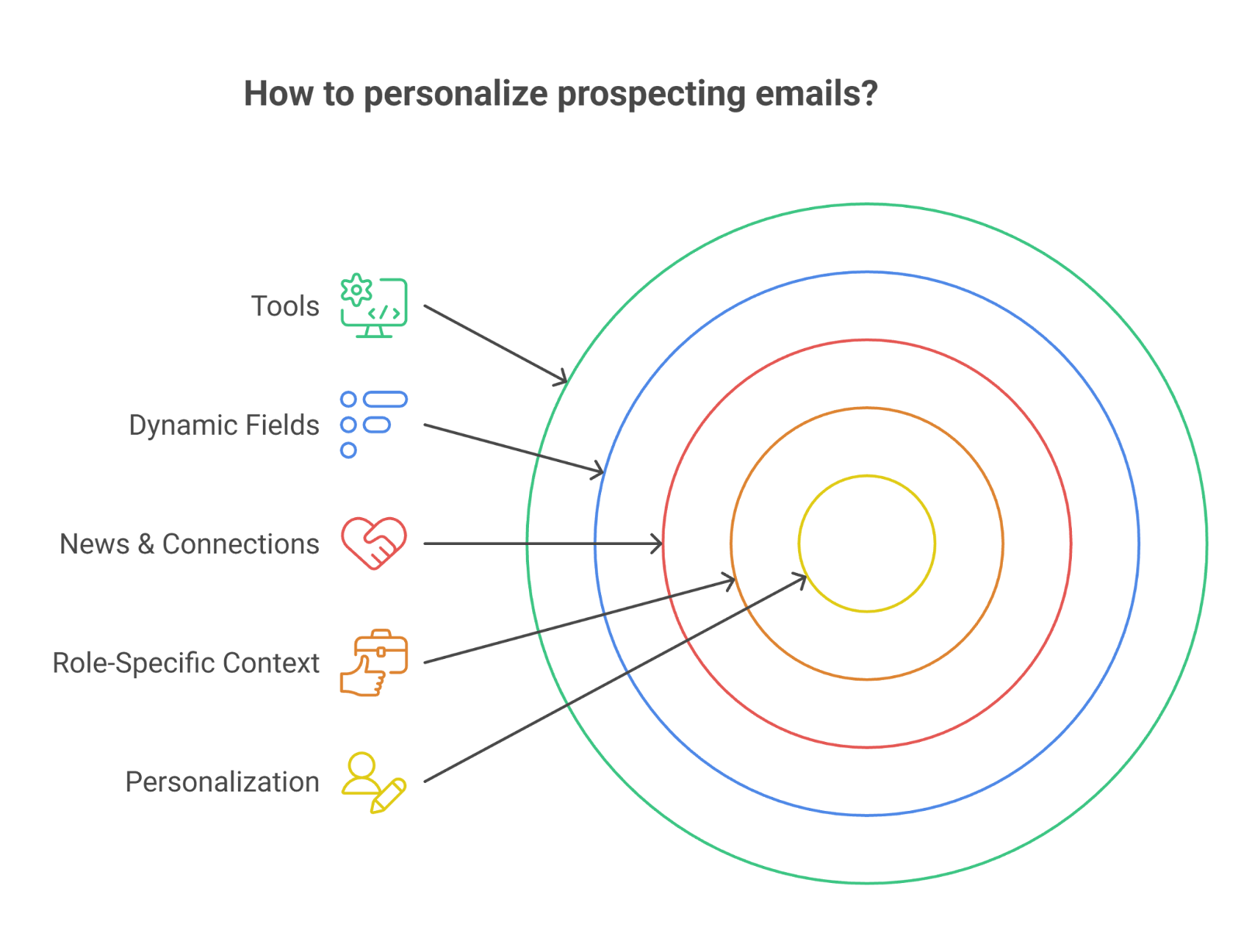
Using role-specific and industry-relevant context
Personalization goes far beyond “Hi [First Name]”.
The fastest way to kill interest is to sound generic. Instead, tie your message to the role-specific challenges your prospect faces.
- A VP Sales will think about pipeline coverage and whether reps are actually getting replies.
- A CMO is more concerned with lead quality and how campaigns drive attribution.
If your email speaks directly to those priorities, it feels relevant, and that’s what gets a response.
Referencing news, hiring, funding or shared connections
Look for fresh triggers.
A funding round, a wave of new hires, or a press release about expansion: those are natural openings to reach out.
And if you can mention a mutual connection or a recent event where you actually crossed paths, your email instantly feels real.
That kind of detail is what gets people to hit reply.
Dynamic personalization fields and automation
Scaling personalization is tough if you’re sending bulk email.
That’s where automation helps:
Use dynamic fields (industry, job title, recent funding) to make templates feel tailor-made.
For example: “Noticed you’re growing your sales team: are reps spending too much time on manual prospecting?” feels far more relevant than a canned pitch.
Tools to scale personalization efficiently
Modern tools like ZELIQ take care of the heavy lifting (enrichment, ice-breakers, sequencing) so reps don’t waste hours copy-pasting LinkedIn bios.
Instead, they can spend that time starting real conversations. Done right, automation doesn’t replace personalization, it makes it stronger.
What are effective prospecting email techniques?
First, keep it short and scannable. Nobody reads a cold email like it’s a blog post—they skim. If the point isn’t clear in a couple of seconds, they move on.
Then, give your message some structure with proven frameworks and openers :
Using frameworks like AIDA, PAS, and BAB
Great emails aren’t written from scratch every time. Sales reps rely on proven copywriting frameworks like:
- AIDA (Attention, Interest, Desire, Action): grab attention with a subject line, create interest with personalization, spark desire with a value point, and close with a clear CTA.
- PAS (Problem, Agitation, Solution): highlight a problem, show the cost of ignoring it, then present your solution as the obvious next step.
- BAB (Before-After-Bridge): show the current pain, describe the better future, and position your product as the bridge.
These frameworks prevent emails from sounding salesy, while keeping messages structured and persuasive.
Curiosity-based openers and pattern interrupts
If your opener looks like everyone else’s, you’re invisible.
A curiosity hook like “Quick thought after seeing [Prospect’s Company] hiring spree” stands out more than “I wanted to introduce myself.”
Another option is a pattern interrupt: a short, unexpected line such as “Not sure if this is even on your radar, but…”. These small tweaks often boost reply rates significantly.
Incorporating multichannel lead warming
Email rarely works in isolation. Smart teams warm up leads before sending the first email by:
- Reacting to a LinkedIn post
- Commenting on company news
- Sharing an article relevant to the prospect’s industry
When the first cold prospecting email lands, the prospect has already seen your name elsewhere, which increases open and response rates.
What templates can boost email outreach?
Below are five proven email templates you can adapt to different situations, roles, and stages of the funnel.
You can also keep a separate library of business introduction email templates to plug into your sequences.
Problem-solution pitch template
Start with the pain, then show how you solve it. Example:
Subject: Reducing time wasted on manual prospecting
Hi [Name], I noticed your team is scaling fast. Many sales reps in your space spend hours chasing unqualified email addresses. Our platform automates enrichment and outreach, freeing reps to focus on closing.
Would it be worth a quick chat next week?
This prospecting email template works because it speaks to a real problem, shares a relevant solution, and ends with a light CTA.
Value asset + soft CTA email
Offering value first can disarm even skeptical prospects. Example:
Subject: Playbook on improving reply rates
Hi [Name], given your role at [Company], I thought you’d find this resource useful: [link]. It’s helped other sales teams boost response rates by 15%.
Happy to walk you through the framework if you’d like.
The soft CTA (“if you’d like”) makes the message feel helpful, not pushy.
Mutual connection or event intro
Leverage social proof. If a mutual connection or recent event is involved, mention it up front:
“We both attended SaaStr last week. Great panel on outbound prospecting. Curious how [Company] is tackling [challenge].”
That immediate relevance gives you credibility and increases reply rates.
Break-up template with exit CTA
Not every prospect replies. That’s fine, acknowledge it respectfully:
Subject: Should I close the file?
Hi [Name], I’ve reached out a few times and don’t want to keep filling your inbox. Should I close your file, or is this still relevant?
This break-up email often triggers a response: sometimes a “not now,” sometimes a “let’s talk.” Either way, you get closure.
Use cases per buyer persona and funnel stage
- C-level execs: short, strategic angle (ROI, growth, efficiency)
- Sales managers: operational value (saving rep time, boosting team performance)
- Marketing leaders: alignment with demand gen, impact on pipeline quality
Matching templates to persona and funnel stage ensures your email outreach hits the right chord.
How to improve email response rates?
Subject line and preview text optimization
Your subject line and the first 40 characters of preview text decide whether your email gets opened.
So, keep it short, specific, and relevant.
Example: “Cutting meeting no-shows at [Company]”.
Avoid spammy triggers like “free,” “winner,” or “limited offer.” Test 2 to 3 variations per campaign to see which drives higher open rates.
A/B testing cadence and CTA phrasing
One of the easiest wins in email marketing is testing your cadence and CTA wording.
Try different intervals (2 vs. 4 business days) and swap CTAs like “Do you have 15 minutes to chat?” vs. “Would next Tuesday work for a quick call?”.
Over time, these small experiments help uncover what resonates best with your prospects.
Follow-up sequencing: 3-5 steps
Most prospecting emails don’t get a reply on the first try. The sweet spot is usually 3-5 follow-up emails spread over two to three weeks.
Sequence ideas:
- Check-in (light reminder)
- Add value (case study, insight, or industry report)
- Break-up email (respectful exit CTA)
For detailed examples and wording ideas, you can borrow sequences from our cold email follow-up guide.
Using ZELIQ or similar tools to track and optimize
Modern sales teams don’t just send: they measure.
Tools like ZELIQ give you email tracking, reply rate analytics, and automated follow-up sequences.
By analyzing email metrics (open, click, reply, bounce), you can double down on what works and quickly cut underperforming approaches.
What are the best practices for email prospecting?
Email prospecting isn’t just about hitting “send.” It’s about showing up smart, respectful, and ready to add value. Here's a checklist to keep your outreach sharp, compliant, and conversion-ready:
- Keep it short and clear. 3 to 5 sentences max. If it feels like a pitch deck, it’s too long.
- Sound human: not like a marketing robot. Write the way you’d speak to a peer on LinkedIn.
- Ditch the attachments and acronyms. Avoid spam triggers like PDFs, images, or overused jargon.
- Time it right. Best windows? Tuesday to Thursday mornings. Avoid Mondays and Friday PMs.
- Stay compliant. Every email must include an easy opt-out and align with GDPR/Can-Spam rules.
- Protect your deliverability. Clean your lists. Warm your domain. Use a reputable sender address.
What are common mistakes in prospecting emails?
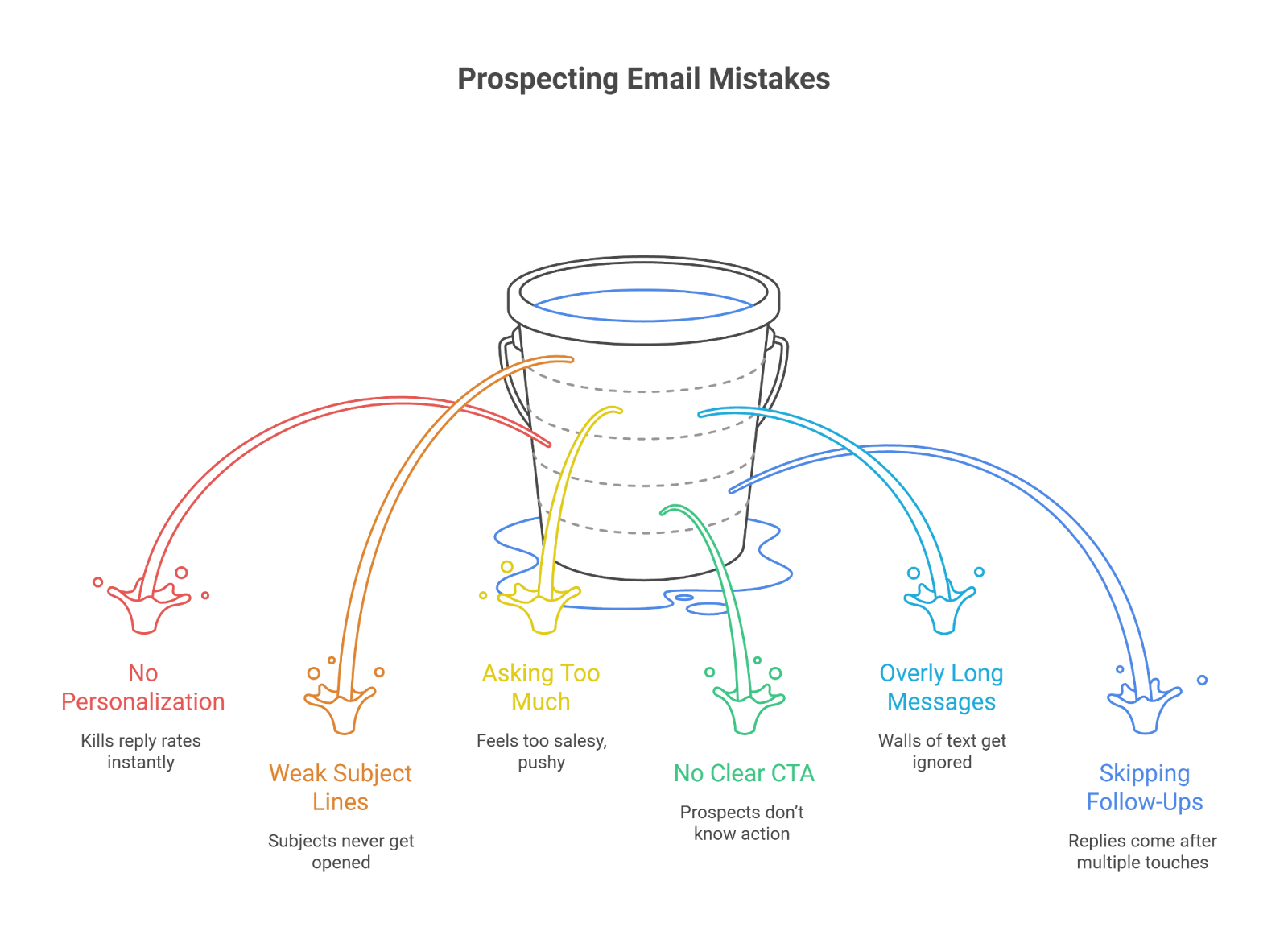
Even experienced sales reps fall into traps that hurt their response rates. Here are the most frequent pitfalls to avoid:
- No personalization: generic outreach kills reply rates instantly.
- Weak subject lines: bland or spammy subjects never get opened.
- Asking too much too early: pushing a demo in the first line feels salesy.
- No clear CTA: prospects don’t know what action to take.
- Overly long messages: walls of text get ignored.
- Skipping follow-ups: most replies come after the 3rd-5th touch.
- Poor timing: sending on Monday morning or Friday afternoon lowers response rates.
- Ignoring deliverability: sending bulk emails without checking domains risks spam filters.
Is cold email outreach illegal?
Cold email is legal when done right.
- In the US, CAN-SPAM requires transparency and easy opt-out.
- In the EU, GDPR allows outreach under “legitimate interest” but demands clear intent. Always make it easy for prospects to unsubscribe and avoid shady data sources.
How to warm up a prospect before emailing
Warming up a lead increases your chances of getting a reply.
Focus on 3 simple steps:
- Interact with their LinkedIn posts (comment, like, share).
- Reference public signals (funding, hiring, PR mentions).
- Leverage a mutual connection or event to build credibility.
How to follow up on prospecting emails
Most replies happen after the first touch, not the first email.
A smart follow-up sequence keeps you on the prospect’s radar without feeling pushy:
- 2-3 days later: short reminder (“Just checking if you saw my note”).
- Next step: add value (case study, article, or insight).
- Final touch: a respectful break-up email (“Should I close your file?”).
If you want more structured examples for different stages of the funnel, you can explore our sales follow-up email playbook.
Prospecting email metrics to track
Measuring performance keeps your team focused on results.
Key email metrics include:
- Open rate: strength of subject lines
- Reply rate: overall engagement level
- Bounce rate: data quality and deliverability
- Meetings booked: ultimate indicator of success
Prospecting email tools to use
Choosing the right tool can make or break your sales team’s productivity.
Here’s a quick comparison:
CONCLUSION - Email prospecting isn’t dead !
Email prospecting isn’t dead: it’s just noisy.
Instead of drowning prospects in marketing speak, the best teams rely on sharp sales prospecting emails built on proven sales email templates, and now enhanced with machine learning (AI) to scale what actually works.
The sales teams who win are the ones who write short, relevant, and human emails, craft a strong email subject that stands out, track the right email metrics, and follow up with discipline.
But doing all of that at scale is nearly impossible without the right tools. That’s why the best teams rely on more than intuition, they use proven cold email templates to reach email clients more effectively and keep their outreach consistent.
That’s where ZELIQ comes in. With AI-powered enrichment, personalization, and automated sequencing, your reps spend less time guessing and more time booking meetings.
If you want to go even deeper on pure outbound tactics, we’ve also put together a cold contact email guide for 2025.
Ready to see how ZELIQ can boost your team’s response rates? Book a demo today.
Table of contents
Placeholder Title
Table of contents
Placeholder Title
Placeholder Title