

An icebreaker is a short phrase or question designed to open a commercial conversation naturally, without diving straight into product pitch. It appears in the first 30 seconds of a cold call, in the first words of a prospecting email, in the opening of a LinkedIn message, or at the start of a meeting-room encounter. Unlike the 4 x 20 rule which structures the overall posture of the first impression, the icebreaker focuses on the verbal content that triggers prospect engagement. A well-chosen icebreaker doubles cold call reply rate and triples cold email reply rate (Salesloft Cold Open Report 2025).
For a beginner SDR, an experienced AE opening strategic accounts, a founder prospecting themselves, or a growth marketer writing sequences, this article details 15 icebreakers classified by channel, the 5 principles making them work, a quantified case study, and 3 FAQ.
On the agenda:
- What a real icebreaker is in 2026 (vs banality, vs manipulation)
- The 5 universal principles of an effective icebreaker
- 5 icebreakers for cold call
- 5 icebreakers for cold email
- 5 icebreakers for LinkedIn (InMail and messages)
- How to adapt the icebreaker to prospect seniority
- The 5 classic mistakes that fail an icebreaker
- Case study: SDR triples email reply rate in 45 days
- 3 FAQ (personalization scale, humor, long format)
- 3 dated actions for this week
Key takeaways:
- Impact of targeted vs generic icebreaker: +180-260% reply rate (Salesloft 2025)
- Optimal icebreaker length: 5-15 words in email, 10-20 words in call
- Effect of personalized icebreaker on prospect sentiment: +40-60% positive perception (Gong 2025)
- Number of icebreakers to master for an SDR: 8-12 per channel
- Average preparation time for a personalized icebreaker: 90-180 seconds with good tooling
- Failure rate of generic icebreakers (“I hope you’re well”): 75-85% in 2026
- Most frequent error: vague company compliment without specific context
1. Icebreaker in 2026: the rigorous definition
What a real icebreaker is
An effective 2026 icebreaker combines 3 characteristics:
- Prospect contextualization: reference to a specific and verifiable element of the prospect or their company
- Conciseness: 5-15 words in writing, 10-20 words verbally, never more
- Natural transition: leads organically to the contact reason
An icebreaker is neither a vague flattery, nor a forced joke, nor a professional small-talk exercise. It’s a preparation signal that triggers prospect attention.
What an icebreaker is no longer in 2026
Three obsolete formats hurting prospecting in 2026:
- Generic compliment: “Congratulations on your impressive LinkedIn journey!” = reply rate < 3%
- Weather small talk: “Hope your week is going well!” = signal of lack of preparation
- Trivial closed question: “Are you [Name]?” = raw prospecting start
These formats still worked in 2018-2020 but now generate more rejections than replies. The 2026 B2B decision-maker identifies them in 5 seconds as an automation or amateurism signal.
Why icebreakers are more strategic in 2026
Three factors raise icebreaker importance:
- Over-solicitation: 20-40 commercial solicitations/day for a senior decision-maker (LinkedIn Sales 2025), differentiation plays from the first word
- Fragmented attention: 5-15 seconds of attention granted to a cold contact before decision to continue or cut
- Anti-automation detection: prospect mental filters detect non-personalized touches in 3-5 seconds
A poorly-chosen icebreaker = 80-90% chance the prospect cuts. A chiseled icebreaker = 40-60% chance to continue conversation.
2. The 5 universal principles of an effective icebreaker
Principle 1: verifiable specificity
An effective icebreaker mentions something specific and verifiable about the prospect: published project name, dated company news, recent role start, recent publication, announced quantified result.
Test: if you can copy-paste your icebreaker to 100 prospects without modification, it’s not specific enough.
Principle 2: disciplined brevity
In writing: 5-15 words. Verbally: 10-20 words. An icebreaker exceeding these thresholds becomes a development, loses its opening effect, and slows the transition to contact reason.
Principle 3: measured authenticity
An icebreaker must sound like a careful observer, not a flatterer. Avoid superlatives (“impressive”, “extraordinary”), prefer neutral observations (“your May 15 announcement about…”).
Principle 4: natural transition
After the icebreaker, the next sentence must flow logically toward the contact reason. “I saw your Lyon announcement → makes me think of a team topic” beats “I saw your Lyon announcement. Anyway, I’m calling because…”.
Principle 5: absence of manipulation
An effective 2026 icebreaker doesn’t use manipulation levers (false urgency, guilt-tripping, heavy flattery). These techniques create immediate distrust that hurts the rest of the conversation.
3. The 5 icebreakers for cold call
Icebreaker 1: dated news
“[Name], your Tuesday announcement about [specific event] made me think of…”
Context: prospect communicated publicly in last 5-10 days (LinkedIn post, press release, article).
Effectiveness: 55-70% conversation continuation vs 15-25% for standard start.
Icebreaker 2: recent role start
“[Name], I saw you took the [role] position in April, congrats on the adventure…”
Context: prospect changed roles in last 3-6 months.
Effectiveness: 60-75%. A prospect new to their role is in budget exploration phase and listens more willingly.
Icebreaker 3: funding or expansion
“[Name], your May-announced funding got me thinking about a topic specific to your team.”
Context: funding round announced in last 6 months.
Effectiveness: 65-80%. Prospect is in a budget opening and growth ambition window.
Icebreaker 4: publication or public appearance
“[Name], your talk at [event] last week on [topic] interested me.”
Context: prospect published article, post, conference, podcast in last 3-4 weeks.
Effectiveness: 50-65%. Prospect appreciates recognition of public work.
Icebreaker 5: specific business signal
“[Name], your team is going through [detected business transition], I imagine it’s an intense moment.”
Context: detected signal (CRM change, product migration, restructuring, market opening).
Effectiveness: 55-70%. Signals deep preparation and operational context understanding.
4. The 5 icebreakers for cold email
Icebreaker 6: short contextual question
“[Name], a question following your May 12 post on [topic]: is [specific angle] still a topic for you?”
Context: email sent after a prospect LinkedIn post.
Effectiveness: 12-22% reply rate vs 2-4% for standard cold email.
Icebreaker 7: quantified observation
“[Name], I saw [company] went from 45 to 78 employees in 12 months.”
Context: rapid growth visible in public data.
Effectiveness: 10-18% reply rate. Signals you did the research work.
Icebreaker 8: former colleague reference
“[Name], I just chatted with [name] at [prospect’s former company] who mentioned you.”
Context: verifiable mutual connection or LinkedIn 2nd-degree exploited.
Effectiveness: 18-30% reply rate. Social proof shifts the icebreaker into warm zone.
Icebreaker 9: industry parallel
“[Name], we support [known competitor or peer] on a topic close to yours.”
Context: when you have a comparable customer in prospect’s industry.
Effectiveness: 15-25% reply rate. Competitive curiosity activated.
Icebreaker 10: non-commercial exchange proposal
“[Name], I read your article on [topic] and wanted to share a use case we recently documented. Might interest you?”
Context: email positioned as value share, not prospecting.
Effectiveness: 20-32% reply rate. Removes the prospecting signal.
5. The 5 icebreakers for LinkedIn
Icebreaker 11: pre-connection comment
Before sending connection request, comment a recent prospect post with substantive observation (not “great post”). Then send connection with comment reference.
Effectiveness: 55-70% connection acceptance vs 25-35% for cold connection.
Icebreaker 12: connection request with open question
“[Name], your recent post on [topic] struck me on [angle]. Curious to discuss, happy if you accept this connection.”
Effectiveness: 45-60% acceptance rate.
Icebreaker 13: post-connection message with immediate value
Immediately after acceptance: “Thanks for the connection [Name]. Following your post on [topic], I thought of this resource: [external non-commercial article link].”
Effectiveness: 30-45% reply. Establishes non-commercial frame before pitch.
Icebreaker 14: InMail with dated observation
“[Name], your Tuesday May 6 announcement on [event] made me think of [specific angle]. 3 min to explore?”
Effectiveness: 15-25% InMail reply rate vs 5-8% standard.
Icebreaker 15: message with customer parallel
“[Name], we support [comparable customer in their industry] on a close topic, interesting experience feedback. Want to chat?”
Effectiveness: 20-30% reply rate.
6. Adapting the icebreaker to seniority
Junior (operational, project manager, individual contributor)
Tone: direct and pragmatic. Junior values immediate utility and brevity. Avoid convoluted phrasing.
Typical: “[Name], I saw you manage [specific project]. Wanted to share 2 minutes a useful resource.”
Middle management (manager, head of, VP)
Tone: focused on team and results stakes. Middle manager listens for signals helping them perform vs hierarchy.
Typical: “[Name], following your team growth announcement, an organizational topic that might interest you.”
C-level (CEO, CFO, COO, CRO, CMO)
Tone: strategic and time-respectful. C-level values deep preparation and maximum brevity.
Typical: “[Name], your positioning in the [publication] interview aligns with a topic we address.”
Founder (startup)
Tone: direct and ambitious. Founder values energy and vision, without small talk.
Typical: “[Name], your announced pivot on [industry] interested me. A commercial angle we’re testing might resonate.”
7. The 5 classic mistakes
Mistake 1: vague compliment
“Congrats on your impressive journey” = 3-5% reply rate. Without specificity, compliment sounds automated.
Mistake 2: closed question too early
“Do you have 30 seconds?” before context = 60-75% “no”. Ask this question after context icebreaker, not before.
Mistake 3: long icebreaker
“[Name], I saw you recently published an article on [topic] and I really find your approach very interesting particularly on [aspect]…” = 40+ words. Prospect disengages before the end.
Mistake 4: false familiarity
“Hey! How’s it going?” on first C-level contact = professionalism-lack signal. Adjust register to seniority.
Mistake 5: obsolete icebreaker
“I hope you’re well” = 2015 signal that hurts credibility in 2026. Replace with dated contextual observation.
Zeliq and contextual icebreaker feeding
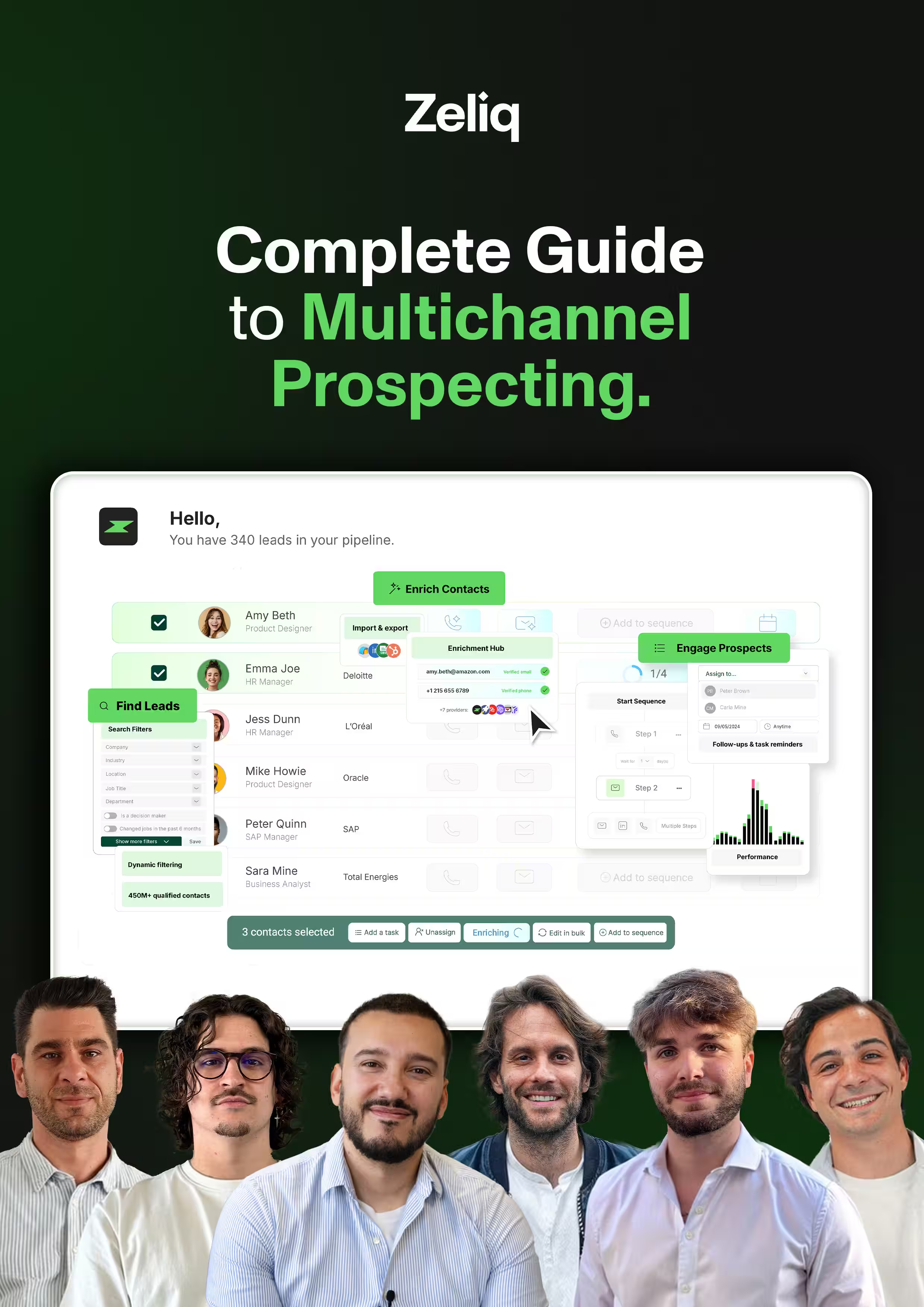
Zeliq combines a 450 million B2B contact database with waterfall enrichment, intent signals (funding, hiring, role start, publication), and real-time company news. These signals feed contextual icebreakers of types 1-5 with fresh data, allowing an SDR to prepare 20-30 personalized icebreakers per hour vs 3-5 without tooling.
8. Case study: SDR triples email reply rate in 45 days
Context: Outbound email SDR at B2B SaaS mid-market vendor, 6-month tenure. Volume 120-180 emails/day. Cold email reply rate: 2.2%. Team target: 6% minimum. Underperforming for 2 months.
Diagnostic on 50 lost emails:
- 78% of emails start with “I hope this message finds you well”
- 15% of emails start with vague compliment (“Impressive journey”)
- Only 7% contain specific prospect reference
- Average icebreaker length: 34 words (instead of 5-15)
- No tone adaptation by seniority
Corrective actions over 45 days:
Week 1: training on 15 icebreakers + 5 principles (2h theory + 3h roleplay). Week 2: personal library construction of 20 contextual icebreakers per segment (junior/manager/C-level). Week 3: Zeliq implementation for daily signal feeding (news, funding, role starts). Week 4: new rule: every email must contain 1 specific and verifiable prospect reference. Generic template ban. Weeks 5-6: individual coaching on 20 emails/week with structured debrief. Week 7: measurement and iteration on best-performing icebreakers.
Measured results at 45 days:
| KPI | Before | After | Delta |
|---|---|---|---|
| Cold email reply rate | 2.2% | 7.4% | +236% |
| Positive reply rate (curiosity, question) | 0.8% | 3.1% | +288% |
| Meetings booked per week | 4 | 13 | +225% |
| Average icebreaker length (words) | 34 | 11 | −68% |
| % emails with specific reference | 7% | 96% | +1271% |
| Volume of emails sent/day | 150 | 90 | −40% |
Volume reduced 40% but quality multiplied. Quality trumps quantity in 2026 cold outbound.
45-day ROI: investment (training + coaching + Zeliq + template overhaul) $4,600, value (9 additional meetings/week × 7 weeks × 25% deal conversion × $35K ACV × 18 months) = $248K additional pipeline identified. ROI within SKILL v4 cap (10×).
9. Frequently asked questions
How to personalize at scale without 30 minutes per prospect?
Combine automatic signal enrichment + reusable icebreaker library + 90-180 seconds of per-prospect finalization. Scale personalization rests on 3 bricks. Brick 1: automatic fresh-signal feeding via Zeliq-type tooling (funding, role start, publication) giving 2-3 contextual hooks per prospect in < 60 seconds. Brick 2: personal library of 15-20 fill-in-the-blank icebreakers (tested formats), where only contextual part needs filling. Brick 3: 90-180 seconds finalization discipline per prospect to check relevance and slightly adapt. Total: 3-4 minutes prep per email for a 3-5× higher reply rate. Classic trap: aim for 30 seconds prep to stay on 100% automated templates. Result: reply rate divided by 4 vs the 3-4 minutes of personalization. Rule: 30 targeted emails/day beat mass mailing of 200 generics. Daily metrics change (meetings booked, qualified replies) and domain reputation is protected.
Do humor and pop-culture references work in a B2B icebreaker?
Rarely, and never in the first 3 touches. Humor and cultural references can reinforce a link from the 4-5th interaction when you know the prospect. Used in cold contact, they’re perceived as forced or misplaced in 70-80% of cases (Gartner 2025). Three reasons: (1) you don’t know the prospect’s sense of humor, a trait varying strongly person to person, (2) pop-culture references have short shelf life and generational character excluding part of the audience, (3) first professional contact requires neutral register, not playful. Rare exceptions where humor can work: young startups with publicly quirky communication tone, niche communities with shared cultural code, referred contacts with info on prospect’s style. For all other cases, stay on courteous professional register. Seriousness respects prospect time; humor forces a reaction.
Can an icebreaker be 3-4 sentences or must it stay very short?
Short required in writing and verbally, except very specific case in LinkedIn message. Cold call: 20-word max icebreaker, else prospect cuts before you reach contact reason. Cold email: 5-15 words for first sentence, leaving room for brief contact reason just after. Short LinkedIn message (200-300 chars): icebreaker can go up to 20-25 words as format tolerates a bit more. Unique case where long icebreaker works: 4-6 line LinkedIn or email message built as a mini-anecdote relevant to the prospect. This format is used by experienced SDRs on ultra-targeted ABM accounts and converts very well (25-40% reply) but requires 10-15 minutes prep per prospect. Profitable only on the 20-50 semester-strategic accounts, not on daily outbound volume. General rule: default brief icebreaker. Long format only in strategic ABM.
10. Conclusion: 3 actions to run this week
Audit your 20 latest cold emails within 7 days. How many start with “Hope you’re well” or equivalent? How many contain a specific and verifiable prospect reference? This diagnostic reveals the scope of the rebuild.
Build 10 personal icebreakers per channel within 15 days. 10 for cold call, 10 for cold email, 10 for LinkedIn. Fill-in-the-blank format. 3-4 hour investment, immediate ROI over the following 45 days.
Institute the “fresh signal < 30 days” rule starting today. No icebreaker based on signal older than 30 days. This constraint forces freshness and improves reply rate by 40-60%.
Feed your icebreakers with fresh daily signals
Zeliq combines 450 million B2B contacts and real-time signals (funding, role start, publication, news). Prepare 20-30 personalized icebreakers per hour. Account created in 2 minutes.
Try for freeAnd if you want to feed your icebreakers with fresh daily signals, try Zeliq for free: waterfall enrichment, news signals, and sourcing in one interface, no credit card.