
How to Find Someone’s Phone Number for B2B Sales in 2026
Finding a phone number sounds simple until you sit down to call 60 prospects in a day with only the company’s main switchboard in your CRM. The switchboard converts at 1 to 3%. A verified direct dial converts at 8 to 15%. The difference shows up in your meetings booked column.
This guide walks through every working method to find a business phone number in 2026, from free options (LinkedIn, company websites, Google operators, social profiles) to paid B2B phone finders (Lusha, RocketReach, Cognism, Apollo, Zeliq), with a side trip into reverse phone lookup, number verification, and the legal frameworks that matter (TCPA in the US, GDPR in the EU, CASL in Canada). By the end you will know which method fits your volume, geography, and budget.
What you will learn:
- How to find a phone number for free (and the realistic limits)
- The B2B phone finder tools worth their price tag
- How reverse phone lookup works and when to use it
- Connect rate benchmarks for direct dials vs switchboards
- Compliance rules to follow before you dial
TL;DR
- Free methods: LinkedIn (rare hits), company website, Google operators, social profiles, business directories like Whitepages or BeenVerified for US numbers. Low volume, mixed quality.
- Paid B2B phone finders: Zeliq, Cognism, Lusha, RocketReach, Apollo. Waterfall enrichment across 40+ providers gives the highest direct dial coverage.
- Reverse phone lookup: useful for identifying inbound callers, not for outbound prospecting.
- Verification: HLR lookup before dialing avoids wasting time and dialer credits on dead numbers.
- Connect rate: a verified direct dial converts 5 to 10 times better than a corporate switchboard.
Free Ways to Find a Phone Number
Free methods rarely give you a direct dial mobile, but they help on accounts where paid databases run dry, and they double as cross-validation for paid hits.
LinkedIn: First Reflex, Real Limits
LinkedIn is where you start. Some profiles list a phone number under “Contact info”, but only when the person opted in (rare in EU markets, slightly more common in the US). You also need to be a 1st-degree connection or use Sales Navigator to see it. Beyond the profile field, the bio and summary sometimes contain a phone number, especially for freelancers, agency founders, and business developers. Look for strings like “+1”, “tel:”, “WhatsApp”, “DM me”.
Hard truth: less than 10% of LinkedIn profiles in the US, and under 5% in Europe, list a phone number publicly. Treat LinkedIn as a bonus channel, not a primary source.
Company Website
The corporate website is underused. Four spots to scan: Contact page (main line and sometimes departmental direct dials), Team or About page (some companies list direct numbers for key people), legal pages and privacy policy footers (often the company number plus founder direct), and the footer itself (B2B startups frequently include “Sales: +1…”).
For service firms (consulting, law, accounting, PR agencies), individual bios almost always include a direct line. That single fact makes service firms the easiest B2B segment to prospect on phone.
Google Search Operators
Google still beats most paid finders for hard-to-reach contacts when you know the operators. Examples that work:
- "first last" "+1" for US numbers paired with a name
- "first last" "(212)" OR "(415)" for area code targeting
- site:linkedin.com "first last" "tel" to scope to LinkedIn
- "first last" "@company.com" phone to combine email and phone mentions
- "company name" "VP sales" "mobile" when you do not know the decision maker yet
Run the query in incognito or signed-out mode to see the unpersonalized SERP. Also try Google Images: a conference badge photo, a slide deck cover, or a scanned business card often shows a phone number in plain text.
Whitepages, BeenVerified, and US Reverse Directories
For US contacts, three free or low-cost services come up first:
- Whitepages: huge database, mostly residential, also captures business landlines. Limited mobile coverage on the free tier.
- BeenVerified: people search engine, more aggressive coverage including mobile, freemium. Compliance note: BeenVerified explicitly forbids B2B prospecting use under its terms of service. Read the TOS before integrating it into a sales workflow.
- Spokeo, Intelius, TruePeopleSearch: similar consumer-grade services. Same compliance caveat applies.
These tools are designed for personal use cases (find an old friend, check who called) more than B2B sales. You can use them for occasional sanity checks, but the bulk of B2B prospecting belongs in dedicated B2B databases. The terms of service difference matters: a B2B database licenses data for sales outreach, a consumer search engine usually does not.
Social Profiles Beyond LinkedIn
Twitter (X), Instagram for business accounts, Facebook business pages, and TikTok bios for creators and agency founders. Bios often include a WhatsApp number or a “DM for booking” line. For corporate prospects, the hit rate is low. For founder-led, creator economy, and agency targets, it can be the fastest path.
Paid B2B Phone Finders Worth Knowing
Once you cross 20 to 30 outbound calls per week, manual finding stops scaling. You move to a B2B database that aggregates verified contact records. Here is the lay of the land in 2026.
Sales Navigator (LinkedIn)
The best tool for identifying the right person, with filters for company size, seniority, tenure, and recent activity. But Sales Navigator does not surface phone numbers. You pair it with an enrichment tool to get the direct dial.
Stack position: Sales Navigator for targeting and qualification, third-party enrichment for the phone.
Zeliq
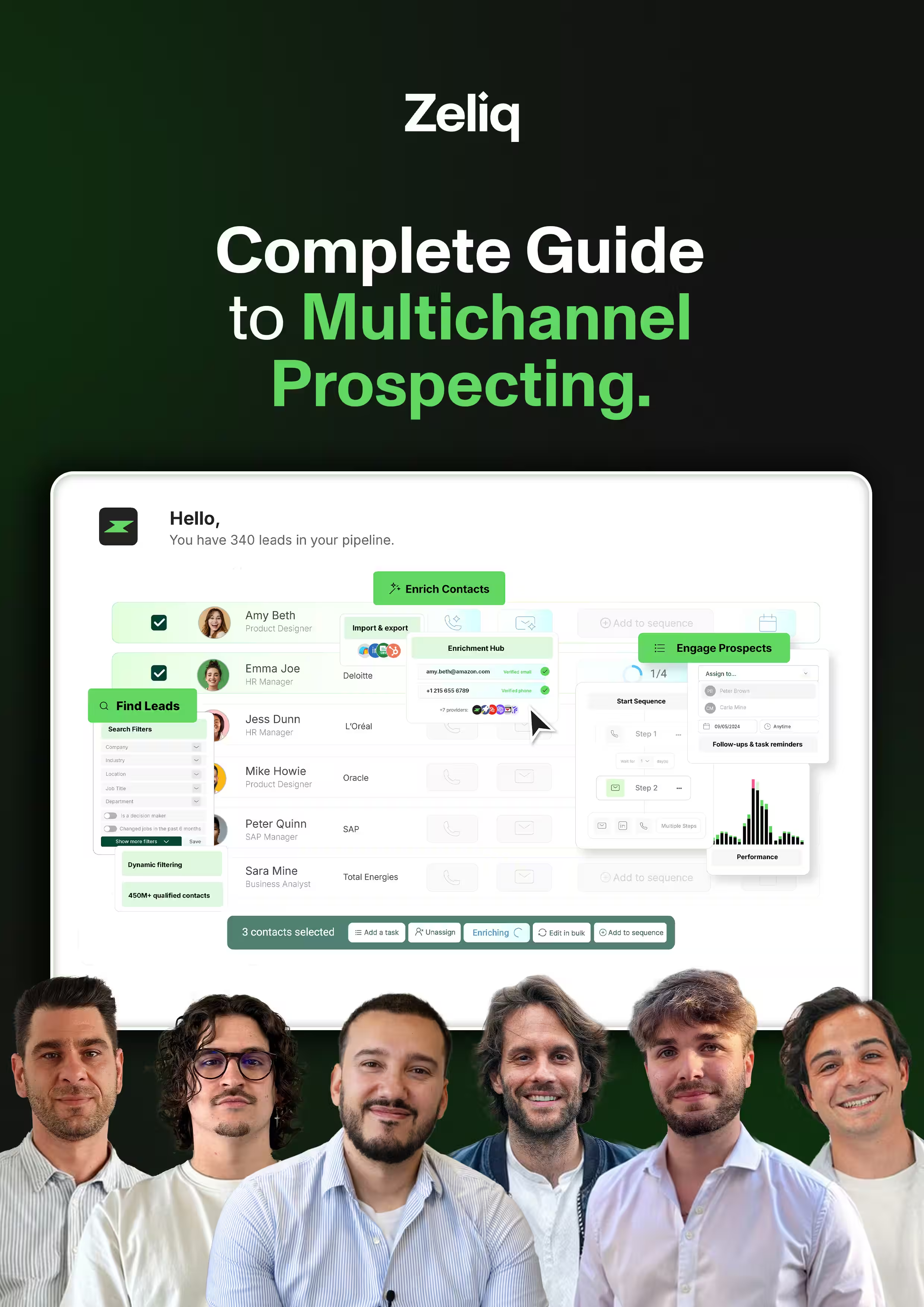
Zeliq combines a 450M+ B2B contact database, waterfall enrichment across 40+ providers (around 60% direct dial coverage on B2B targets), and multichannel sequences (email, LinkedIn, calls). It comes with native integrations for Aircall and Ringover, so the SDR workflow stays in one screen. The waterfall logic means if the first provider does not hit, the system queries the next, and the next. That pattern is what separates 30% direct dial coverage from 60% on a real ICP list.
Cognism
Strong UK roots, growing US and EU footprint. Heavy emphasis on compliance, with phone-verified mobile numbers flagged in the UI. Premium pricing, justified for teams that run high outbound volume in regulated geographies.
Lusha
Chrome extension is the fastest one-click reveal on a LinkedIn profile. US coverage is excellent, EU coverage solid. Free tier gives 5 credits per month, paid plans scale up from there. Strong brand in the SDR community for individual reps.
Apollo
US-first all-in-one platform: contact database, sequencer, basic CRM, dialer. Massive US contact volume, more uneven on Europe. Often used for the US market and paired with a European tool for FR, UK, DE.
RocketReach
Enrichment specialist. Best use case is bulk enrichment of a CSV (a 500-row LinkedIn export, an event attendee list). Strong US coverage, weaker direct mobile coverage in Europe.
How to Choose: Decision Matrix
| Use case | Recommended tool |
|---|---|
| US SDR, high cold call volume | Apollo, Lusha, RocketReach |
| EU SDR, focus on direct mobile | Zeliq, Cognism, Kaspr |
| RevOps doing bulk CRM enrichment | Zeliq, Cognism, Apollo |
| Founder or solo seller, tight budget | Lusha free tier, Kaspr free tier |
| Team that wants find + enrich + engage in one tool | Zeliq, Apollo |
The decision criterion is not the per-contact price. It is the direct dial hit rate on your actual ICP. A tool at 0.30 USD per contact that surfaces 60% of mobiles beats a tool at 0.15 USD that only finds 25%. Run a free-tier benchmark on 50 of your real targets before committing.
How Zeliq Helps You Find Verified Mobile Numbers
Zeliq queries 40+ data providers in cascade to maximize direct dial coverage on your target list, then surfaces the verified work email and LinkedIn URL alongside the number. From the same screen you launch a multichannel sequence that combines cold call, email, and LinkedIn touches, so the data work feeds the engagement workflow without copy paste.
Try Zeliq’s data enrichment on your ICP →
Reverse Phone Lookup: Identifying Who Called You
Reverse phone lookup runs the operation backward: starting from a phone number, you find the owner’s name, sometimes their company and address.
When It Helps
Three common B2B use cases: identifying an unknown missed call before returning it, validating that a number found in a database actually belongs to the expected person, and tracing the source of an inbound sales call from another vendor.
Free and Freemium Tools
- Truecaller: crowdsourced global database, strong on mobiles. Inaccurate when no one in the network has flagged the number.
- Whitepages reverse lookup: best for US landlines, weaker on mobiles.
- Google direct query: just paste the number in quotes. Surprisingly effective when the number has been published on LinkedIn, a vendor site, or a press release.
Paid Reverse Lookup
Twilio Lookup API provides carrier and line-type data plus name and location attributes through optional add-ons. NumLookup, Spokeo, and BeenVerified offer paid reverse lookup tiers. For high-volume sales operations, Twilio is the cleanest API to integrate.
Verifying a Phone Number Before You Dial
Finding the number is half the job. Validating it before you load it into your dialer is the other half.
What an HLR Lookup Does
HLR (Home Location Register) is the central registry that mobile carriers maintain to know which numbers are active, ported, or disconnected. An HLR lookup queries that registry and returns the line status (active, inactive, ported), the current carrier, the country of origin, and the line type (mobile, landline, VoIP).
Tools
Twilio Lookup API (around 0.005 USD per lookup), NumLookup web interface, dedicated services like HLRLookup.com. Most serious B2B databases (Zeliq, Cognism) verify numbers automatically before delivering them, which removes the step from your workflow.
Why It Pays Off
On a list of 1,000 numbers, if 10% are dead, validating upfront saves your SDR around 1 hour of futile dialing per week. Across a sales floor of 10 SDRs over a year, that is several hundred hours redirected to actual conversations.
Cold Call Connect Rate: Why Direct Dial Beats the Switchboard
Spending 30 seconds to 2 minutes finding a direct dial pays off in raw dial economics. Here is the data.
Connect Rate Benchmarks
| Number type | Connect rate (live human) | Meeting booked rate |
|---|---|---|
| Company switchboard | 1 to 3% | 0.1 to 0.3% |
| Direct office landline | 5 to 8% | 0.5 to 1% |
| Verified direct mobile | 8 to 15% | 1 to 2.5% |
On 100 calls, a switchboard yields 1 to 3 conversations and 0 to 1 meeting. A verified direct mobile yields 8 to 15 conversations and 1 to 3 meetings. The ratio is 5 to 10x. For the same dialing effort, you book multiples of the meetings.
Why Mobiles Convert Better
No gatekeeper between you and the prospect. Decision makers tend to answer unknown mobile numbers because they fear missing a customer or a partner call. The conversation is more informal, so objections drop. The prospect can be in a car, at lunch, or on a break, available outside the desk hours when the switchboard is staffed.
Prepare Before You Dial
Finding the number is step one. Before you press “Call”:
- Write your opener: a sentence that proves you know who they are and why this matters to them
- List 3 to 5 pre-baked responses to common objections (“I am in a meeting”, “Not interested”, “Send me an email”)
- Track your connect rate by hour and day to spot the windows where your ICP picks up most often
- Avoid filler openers (“How are you today?”, “Hope I am not catching you at a bad time”) that signal a cold call in the first 5 seconds
Compliance: TCPA, GDPR, CASL, and DNC Lists
Finding a number quickly does not exempt you from local rules. Here are the four frameworks that matter for B2B outbound in 2026.
United States: TCPA and the National DNC Registry
The Telephone Consumer Protection Act (TCPA) regulates calls to US numbers. For B2B prospecting:
- Calls from a human being to a business number, with no autodialer, are generally permitted
- Autodialed calls or pre-recorded messages require prior express written consent
- Calls to consumer numbers on the National Do Not Call Registry are forbidden without an existing business relationship
- States layer on additional restrictions (Florida and Oklahoma have stricter mini-TCPA laws with higher penalties)
Penalties: 500 to 1,500 USD per violating call. Class actions are common. Most B2B databases let you filter out DNC-registered numbers automatically.
European Union: GDPR and Country-Level Lists
GDPR allows B2B phone prospecting under “legitimate interest” if three conditions hold: the contact’s role is relevant to your offer, the data source is documented, and the prospect has a clear opt-out path. Each EU country layers its own rules: Bloctel in France, Robinson List in Germany and Spain, Bel-me-niet Register in the Netherlands.
In practice, mention your data source on request and offer a one-click opt-out in your follow-up email signature.
Canada: CASL and the Canadian DNC List
The Canadian Anti-Spam Legislation (CASL) governs commercial electronic messages but extends its compliance posture to phone outreach in spirit. The Canadian National Do Not Call List applies to consumer outbound; B2B is generally outside scope when the call addresses the business in a professional capacity. Penalties for violations can reach 10M CAD per incident for organizations.
United Kingdom: TPS and CTPS
The UK Telephone Preference Service (TPS) covers consumer numbers. Its corporate sibling, CTPS, lets businesses opt out of B2B sales calls. Before running a UK outbound campaign at scale, screen against CTPS. ICO fines for ignoring CTPS run into the hundreds of thousands of GBP.
Recommended Stack by Profile
US SDR, 100+ calls per day: Apollo or ZoomInfo for the deep US database, Lusha or RocketReach as supplements, Outreach.io or Salesloft for sequences, Aircall or Dialpad for dialing.
EU SDR, 50 calls per day: Sales Navigator for account targeting, Zeliq for waterfall enrichment and multichannel sequences, Aircall or Ringover for dialing, HubSpot or Pipedrive for CRM sync.
Founder or solo SDR with no budget: free LinkedIn, free Sales Navigator trial, Lusha or Kaspr free tier, Google operators for priority accounts. Move to a paid stack as soon as you cross 50 prospects per week. The ROI is immediate.
Common Mistakes to Avoid
Calling unverified numbers. A dead number burns dialer credit and skews your reporting. Run an HLR lookup or use a B2B database that verifies upstream.
Confusing personal mobile with work mobile. US, UK, and EU work mobiles look identical to personal lines. If you are not certain, open the call with “Is this the work line for [name]?”. If the person says it is personal, apologize, hang up, remove the number from the list.
Skipping compliance screening. TCPA fines, ICO penalties, and class actions are not theoretical. Screen every list against the appropriate DNC or opt-out registry before launching a campaign.
Trusting Google search hits without cross-validation. A SERP showing a name and a number could be 5 years stale. Always pair Google hits with a database lookup or an HLR check.
Buying a one-shot CSV list. Static B2B lists decay around 30% per year. Subscriptions to live databases stay fresh and amortize better over time.
Wrapping Up
Finding someone’s phone number for B2B sales has never been easier in absolute terms. Finding a verified direct mobile that respects local compliance and converts on the call is what separates the top 30% of SDRs from the rest. The free methods cover edge cases. The paid databases handle the volume. The compliance layer keeps you out of court.
One thing you can do today: take your top 50 priority accounts for the week, run them through a waterfall enrichment, measure the direct dial hit rate. If it sits below 40%, your data stack is undersized. If it sits above 60%, the bottleneck is elsewhere (targeting, opener, dialing windows).
To start running waterfall enrichment on your real ICP, explore the Zeliq Business Developer playbook and pick the plan that fits.