
Outbound Sales: Complete B2B Playbook for 2026 (SDR Guide)
Outbound sales is the most misunderstood pipeline motion in B2B. Some teams confuse it with cold email spam, others write it off as dead, and a third group keeps running 2018 playbooks in a 2026 environment where mailbox providers, buyers and competitors have all changed the rules.
The truth is simpler. Outbound is the only acquisition motion you can switch on this quarter and predict next quarter. Inbound takes 12 to 18 months to compound, paid keeps charging you to refill the funnel, but a clean outbound engine scales linearly with reps and tooling, and lets you choose exactly which accounts you talk to.
This is the full 2026 outbound sales playbook: the definition, when outbound beats inbound, the channels that still work, the modern stack, the 7-step playbook, copywriting, cadence, KPIs, the legal frame across the US, UK, EU and Canada, the role of AI, and who outbound is not for.
What is outbound sales, exactly?
Definition
Outbound sales is the discipline where a rep initiates contact with a prospect who never asked, with the goal of booking a qualified meeting. The rep picks the account, the persona, the message, the sequence. The prospect did nothing to trigger it.
This is the opposite of inbound sales, where the prospect raises a hand first (form fill, demo request, free trial) and the rep responds.
A healthy B2B revenue org also runs outbound marketing (cold-audience ads, ABM, direct mail) at the program level. Outbound sales is the rep-driven part of that broader motion: human-led, account-by-account, with a quota attached.
Outbound vs inbound: not a religion, a mix
Most “inbound vs outbound” arguments are framed wrong. It is never a binary choice, always a mix tuned to your stage, ICP and unit economics.
| Dimension | Outbound sales | Inbound sales |
|---|---|---|
| Time to first meeting | 1 to 4 weeks | 6 to 18 months |
| Predictability | High, linear with rep capacity | Low at first, high after SEO compounds |
| Targeting control | Total (you pick the account) | Limited (you attract who searches) |
| CAC profile | Stable, scales linearly | High up front, decreasing over time |
| Best for | New markets, narrow ICP, high ACV | Mature categories, broad ICP, explicit demand |
Almost no serious B2B company runs 100% one or the other. The real question is what ratio fits the next 4 quarters.
When outbound sales wins
Outbound is not the right answer for every B2B company. There are four clear situations where it dominates.
1. You are early stage and need pipeline now
A company that just launched cannot wait 12 to 18 months for SEO. Outbound creates the first qualified meetings within weeks, gives you live customer conversations that sharpen the ICP, and buys time to build a long-term inbound engine in parallel.
2. Your ICP is narrow
If you sell to 500 or 5,000 companies worldwide, waiting for them to find you on Google is statistically absurd. Outbound is the natural channel for concentrated markets, where each account justifies a personalized touch.
3. Your ACV is high
The higher the annual contract value, the more headroom for personalized multi-touch sequences. A 50,000 dollar ACV easily justifies an SDR working an account for 21 days. A 50 dollar per month product does not.
4. Your category is new and demand is latent
When your category does not exist in the prospect’s head, they type nothing into Google. SEO is useless. You go out, educate, start the conversation, surface the pain. By definition, outbound.
If you sell a mature product to a broad ICP at a low ACV with explicit demand, the leverage usually sits with inbound and paid intent capture, not outbound.
Outbound sales channels that work in 2026
The 2026 channel mix looks nothing like 2018. Mass cold email from the primary domain is dead. Single-channel is dead. Here is what works today, ranked by centrality.
Cold email
Still the number one outbound channel in B2B, on three conditions:
- Volume capped per inbox: 30 to 50 emails per day per sending address. Past that, deliverability collapses.
- Dedicated secondary domains: never send cold email from your primary domain. Use lookalike domains, warmed up for 4 to 6 weeks.
- Segment-level personalization: 80% of the message is generic to the cohort, 1 or 2 lines are contextual (recent LinkedIn post, funding round, role change).
Well executed, B2B cold email in 2026 lands 3 to 8% reply rate on a tight ICP. Teams reporting double-digit reply rates are usually counting auto-responders.
Cold calling (mobile direct)
The phone is back since 2023. It is less saturated than email, more human, and qualifies in 2 minutes what takes 3 emails. Three rules:
- Direct mobile numbers: switchboards do not pick up. You need verified mobile lines.
- Time the window: 8 to 10 AM and 4 to 6 PM local time outperform the rest of the day.
- Short, problem-first script: do not pitch. Open on the prospect’s pain, ask one qualifying question, propose a 15-minute follow-up.
Integrating a dialer into the outbound stack is now standard. Aircall and Ringover let the SDR call from inside the same interface where they build sequences.
LinkedIn outbound
LinkedIn complements email and phone with three motions: profile view before the first email (warming), connection request with a short note (or InMail as a later touch), and engagement (likes, thoughtful comments) on the prospect’s posts before any direct message.
Respect the platform: 100 to 150 connection requests per week max, fewer than 50 profile views per day, no bulk scraping. Accounts that push these limits get restricted, and a restricted profile resets weeks of warming.
Multichannel sequences (the new standard)
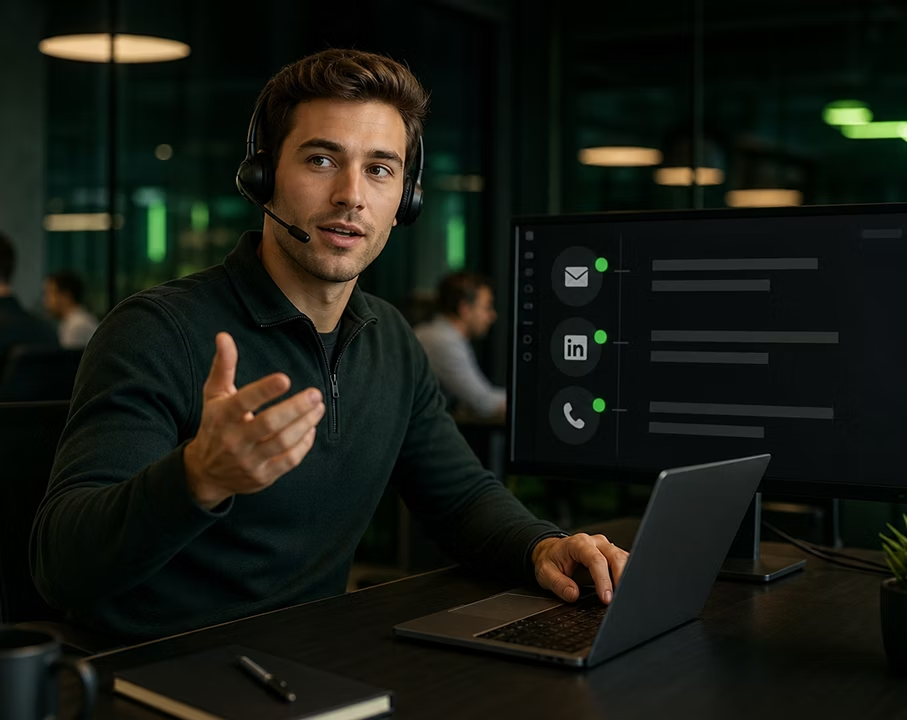
Single-channel outbound is finished in 2026. The standard is a sequence that mixes email, LinkedIn and phone over 14 to 21 days, with 4 to 7 touches in total. Each channel plays a different role: email for volume, LinkedIn for warmth and credibility, phone for fast qualification.
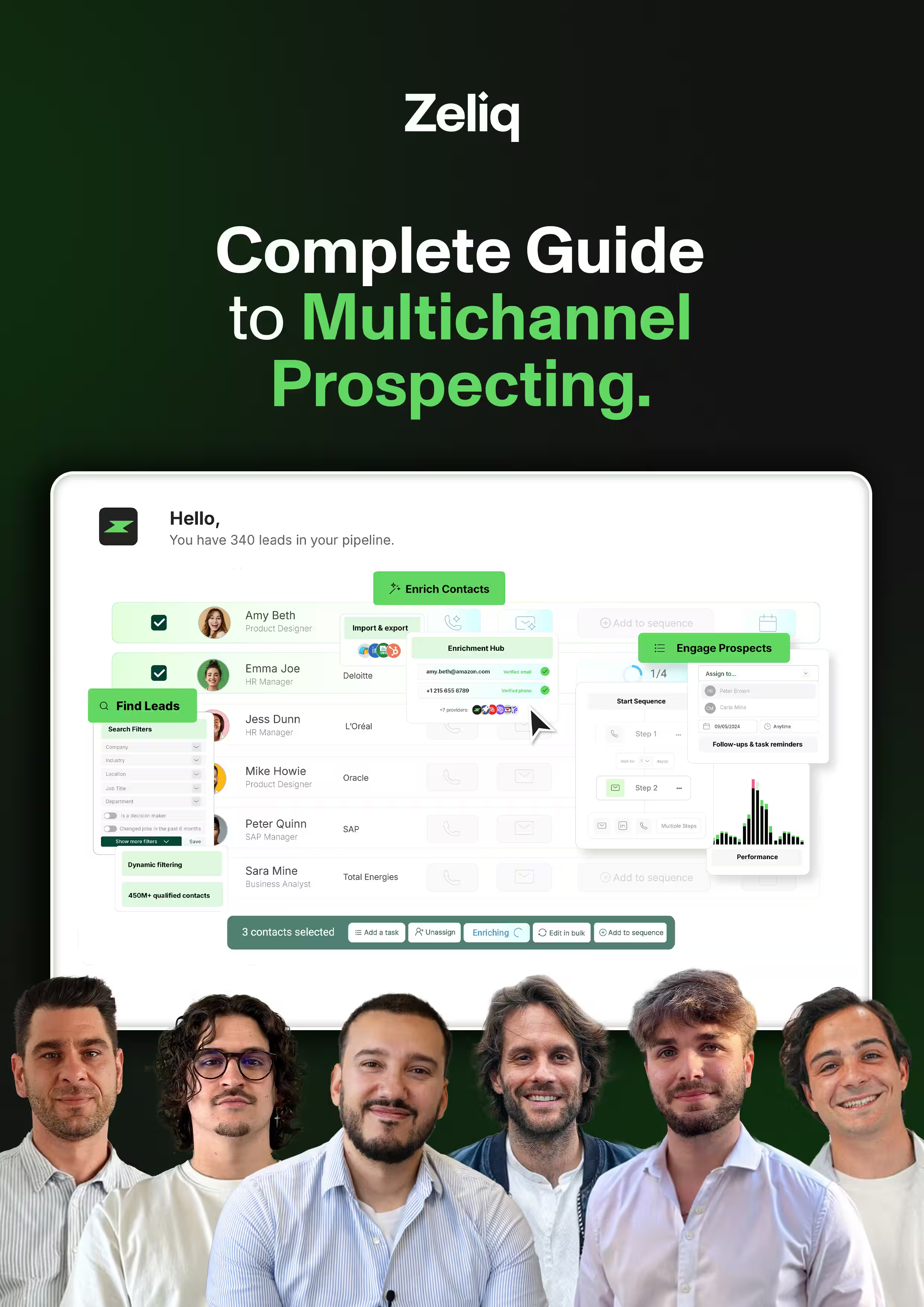
A platform like Zeliq multichannel orchestrates these touches automatically, leaving the rep to focus on the 20% of work that needs a human: personalizing the opener, taking the call, qualifying the reply.
Account-Based Marketing (ABM)
For Tier 1 accounts, you replace volume prospecting with a tightly orchestrated approach: deep research on the company, multiple stakeholders identified (sponsor, decision maker, end user), a sequence personalized per persona, sales and marketing coordinated on the same list. ABM only pays off when ACV justifies the effort, usually above 50,000 dollars per year.
Paid intent (ICP-targeted LinkedIn Ads)
LinkedIn Ads are not inbound by default. When you target a cold audience that never searched for your category, you are running outbound at the program level. The best use is to retarget your ICP-matched audience with display ads in parallel to the email and call sequence. The prospect sees your name in three places at once, and reply rate on the email lifts noticeably.
Direct mail (B2B revival)
Physical mail is back for high-ACV segments: a handwritten envelope, a signed book, a relevant gift. Cost is high (30 to 100 dollars per touch) and volume low (50 to 200 targets), but reply rates can pass 20% on Tier 1 lists. Use it as a mid-sequence touch on strategic accounts, never as the opener.
The modern outbound sales stack
A 2026 outbound team needs five layers:
- B2B lead database: firmographics plus verified contacts (emails, mobile numbers, LinkedIn URLs). Without a serious database, everything downstream is wasted. Zeliq’s B2B lead database covers global firmographics with verified contact data.
- Waterfall enrichment: queries multiple providers in cascade to recover the right email and direct number. No single provider gives full coverage. Zeliq’s data enrichment runs through 40+ providers in waterfall.
- Multichannel sequence engine: orchestrates email, LinkedIn and call touches across the defined cadence, with reply detection and auto-pause.
- Dialer / VoIP integration: places calls from inside the prospecting tool, logs them automatically.
- Lead scoring + CRM sync: prioritizes hot accounts, pushes engagement signals back into HubSpot, Salesforce or Pipedrive in real time.
Before 2022, this stack meant stitching 4 or 5 separate tools. In 2026, consolidated platforms collapse these layers into one interface, cutting cost and ramp time.
How Zeliq fits into the outbound stack
Zeliq replaces a 4 to 5 tool outbound stack with one platform: lead database, waterfall enrichment, multichannel sequences, dialer integration and CRM sync. See how a full outbound motion runs inside one interface, explore the lead database.
The 7-step outbound sales playbook
Here is the operational sequence that produces a repeatable outbound motion. Skip a step and the next one breaks.
Step 1: Define the ICP with precision
The Ideal Customer Profile is not a fuzzy slide. It is an operational document with:
- Firmographic filters: size, industry, geography, tech stack, growth stage.
- Behavioral triggers: funding rounds, key hires, product launches, leadership changes.
- Buying persona: titles, seniority, budget authority.
- Exclusion criteria: who you will never target, with reasons.
A tight ICP beats a loose one ten times out of ten. 200 emails to the right 200 accounts produce more meetings than 2,000 emails to a loose list. If you are a business developer responsible for sourcing pipeline, this is where week one belongs.
Step 2: Build the list
Build the target account list, then identify the right contacts in each account. Sources: B2B database, waterfall enrichment, email verification before send to keep bounce rates low (high bounce kills deliverability).
Segment the list into tight cohorts (“Head of Sales at 50 to 200-person SaaS in the UK”, “VP RevOps at Series B fintech in the US”). Tight cohorts let you personalize at the segment level, where the leverage sits.
Step 3: Write the message (problem-first, not product-first)
A cold message that converts does not open with “Hi, I’m X from company Y and we do Z”. It opens with the prospect’s world.
Working structure:
- Hook: one line showing you understand the prospect’s context.
- Problem: name a concrete pain they probably have.
- Value: one line on how you help, without the product pitch.
- Soft CTA: an open question or low-friction ask (“worth a 15-minute chat?”).
Length cap: under 100 words for a cold opener. Anything longer drops the reply rate.
Step 4: Design the sequence
A converting 2026 sequence over 14 to 21 days roughly looks like this:
- Day 1: LinkedIn profile view, cold email 1 (problem hook).
- Day 3: LinkedIn connection request with short note.
- Day 5: cold email 2 (different angle, social proof).
- Day 8: cold call 1 (short, problem-led).
- Day 12: cold email 3 (case study or free resource).
- Day 16: cold call 2 or LinkedIn InMail.
- Day 21: break-up email.
4 to 7 touches total, never more. Past that, you harass and burn the account.
Step 5: Execute with discipline
Daily discipline: send emails at the right time, make the planned calls, watch opens and clicks, qualify positive replies inside 24 hours. An average SDR holds 80 to 120 prospects in active sequence at any time. Beyond that, quality drops because reply personalization cracks.
A browser extension lets reps add leads in one click from LinkedIn or a company website into the active sequence, without breaking flow.
Step 6: Measure what matters
Track metrics that connect to revenue, not vanity outputs like emails sent. (Full KPI list in the next section.) The trap is to optimize the wrong number: more volume when the real bottleneck is positive reply rate, or more meetings when the real issue is show-up rate.
Step 7: Iterate weekly
A cold email that works today stops working in 90 days. Sequence fatigue is real. Every 7 to 14 days, look at what dropped, test a new hook, retire tired subject lines, kill segments that never reply.
Outbound copywriting that gets replies in 2026
The anatomy of a cold email under 100 words
A 2026 cold email is short, contextual and ends with a soft ask. It opens on the recipient (not on you), names one specific problem, gives one line of value, asks one small question.
Skeleton:
- Subject line: 5-word context line.
- Hook: contextual observation about their company or role, one line.
- Problem: name the concrete pain, one line.
- Value: how you help, one line.
- Soft CTA: open question, one line.
No bullet lists, no images, no 6-line signature. Plain text outperforms HTML for cold sends because spam filters trust it more and humans read it faster.
Personalization at scale
Manual personalization on every send does not scale. Zero personalization is spam. The 2026 standard is 80% cohort-level personalization (industry, size, role) baked into the template, plus 20% individual personalization (recent post, funding, hire) on the opener. Generative AI helps produce that 20% at volume without slipping into “I noticed your impressive work in the [Industry] space” template smell.
What kills reply rate
- Subject lines over 6 words, or with exclamation marks, all caps, or emojis.
- Emails that talk about your company before the recipient.
- A heavy CTA on the first touch (“book 30 minutes on my calendar”).
- Signatures with photo, logo, and 4 links.
- Three identical emails 5 days apart, no angle change.
Cadence design: what actually converts
Cadence matters as much as content. Three rules:
Channel mix. Email alone is dead in 2026. Floor is email plus LinkedIn. Optimum is email plus LinkedIn plus phone. Adding phone alone typically lifts reply rate on Tier 1 accounts by 30 to 40%.
Spacing and duration. 4 to 7 touches over 14 to 21 days. Under 4, the prospect never sees you. Over 7, you are harassing. Minimum 2 days between two touches on the same channel.
Angle variation. Each touch opens a new angle. Touch 1: problem. Touch 2: social proof. Touch 3: free resource. Touch 4: break-up. Repeat the same message and you train the prospect to ignore your name.
The outbound KPIs to actually track
Sending more emails is not progress. Track the metrics that connect activity to revenue.
| KPI | Definition | 2026 B2B benchmark |
|---|---|---|
| Open rate | % of emails opened | 40 to 60% |
| Reply rate | % of replies, all categories | 3 to 8% |
| Positive reply rate | % of replies that qualify | 1 to 3% |
| Meeting booked rate | % of contacted prospects who book | 0.5 to 2% |
| Show-up rate | % of booked meetings honored | 70 to 85% |
| MQL to SQL | % of meetings that become opportunities | 30 to 50% |
| Pipeline created | Total open deal value per month | varies by segment |
| Pipeline coverage | Pipeline open vs quota | 3x to 4x |
| Sales cycle | Average meeting to close duration | varies by segment |
An SDR on plan typically holds 150 to 250 new prospects in sequence per month and produces 10 to 25 qualified meetings. An SDR off plan often sends the same volume, with a looser ICP and weaker qualification. The difference rarely sits in activity, it sits upstream in list quality. For a sales leader, positive reply rate by SDR by cohort is the single most informative metric: it surfaces both rep performance and list quality in one number.
The common outbound mistakes
Six mistakes show up in almost every underperforming outbound team.
Volume over quality
10,000 emails to a loose list produce fewer meetings than 500 emails to a tight list. List quality drives results more than any other lever.
Single-channel
Email alone in 2026 is not enough. Sequences must touch at least two channels, ideally three. Without phone, you leave 30% of potential pipeline on the table.
Sequence too long or too short
Under 4 touches: the prospect never registers you. Over 7: you become noise. Sweet spot is 5 to 7 touches across 14 to 21 days.
No lead scoring
Without scoring, SDRs treat every account at the same intensity. With scoring, they spend 80% of their time on the 20% of accounts that are actually warm.
Poor deliverability
Cold email from the primary domain, with no warm-up, no SPF, DKIM or DMARC, guarantees half the volume lands in spam. Deliverability is a prerequisite, not a bonus. Most “my reply rates dropped” stories are deliverability stories, not copy stories.
No sales-marketing feedback loop
Marketing produces templates, sales executes, but without a weekly feedback loop the templates age fast. A 30-minute sales-marketing sync each week to surface objections and refresh angles is non-negotiable.
Legal frame: US, UK, EU, Canada
Outbound is legal across the major B2B markets, on conditions that differ by jurisdiction.
United States (CAN-SPAM, TCPA)
CAN-SPAM allows B2B cold email with no prior consent, provided you include a valid postal address, an honest subject line, sender identification, and a working unsubscribe mechanism honored within 10 business days. TCPA governs phone outreach: do-not-call list compliance, no automated dialers to mobile numbers without consent. Cold calling business numbers remains legal with reasonable hour restrictions.
United Kingdom (PECR, UK GDPR)
The UK distinguishes corporate from sole-trader contacts. Cold email to corporate addresses (named roles at registered companies) is permitted under legitimate interest. Cold email to sole traders or partnerships needs a soft opt-in or prior consent. All emails must offer a clear opt-out.
European Union (GDPR)
GDPR recognizes legitimate interest as a valid basis for B2B prospecting. You can contact a professional on their business email about a relevant business topic without prior consent, as long as you provide a clear opt-out and respect data minimization (typically 3 years retention after last contact). B2C cold email requires explicit opt-in.
Canada (CASL)
CASL is the strictest of the four. Cold email to Canadian recipients requires prior express consent, or implied consent (existing business relationship within 24 months, or an inquiry within 6 months). Plan a tighter consent workflow when sequences include Canadian accounts.
Across all four jurisdictions the rule is simple: B2B yes, B2C only with opt-in, opt-out mandatory, data retention minimized. Most legal issues in outbound come from B2C lists dressed as B2B, or from databases sourced from sketchy vendors.
AI and outbound in 2026
AI changed two things in outbound, not ten. Knowing which two is the difference between using AI and pretending to use AI.
Personalization at scale
Before generative AI, writing 200 personalized openers per day was impossible. AI now lets a rep produce 200 contextual openers, each grounded in the prospect’s LinkedIn, company news or recent post, in an hour of work. The catch: AI used well writes lines that sound human; AI used badly writes openers a recipient flags in 2 seconds (“I noticed your impressive work at [Company] in the [Industry] space”). AI proposes, human edits and approves. Never send raw AI output.
Intent signals at the account level
Intent data platforms (G2 buyer intent, 6sense, Bombora, LinkedIn data) detect when an account starts actively researching your category. The SDR concentrates the sequence on accounts at the moment they are warm. This is the quiet revolution of 2024 to 2026: outbound has shifted from “send to everyone in the ICP” to “send to the slice of the ICP that is warming this week”.
Who outbound sales is for, who it is not for
Who it works for
- B2B companies with ACV above 5,000 dollars per year.
- Narrow, identifiable ICP (under 50,000 target accounts worldwide).
- New or emerging category, latent demand.
- Sales team with at least one dedicated SDR (or a founder doing founder-led outbound in early stage).
- Product that solves a concrete, nameable problem.
Who it does not work for
- B2C or low-price self-service ACV (under 500 dollars per year).
- ICP too broad (“all SMBs” is not an ICP, it is a wish).
- Ultra-mature category with explicit search demand where SEO and paid intent dominate.
- Team without bandwidth to respond fast to booked meetings (a 24-hour gap kills the meeting).
If you sit in the second list, revenue operations work on inbound conversion, paid intent capture or product-led growth is the higher-leverage bet.
Closing thought
Outbound sales in 2026 has nothing in common with the 2018 mass cold email era. It rests on a tight ICP, a consolidated stack, multichannel sequences, problem-first copy, KPI-driven iteration, a respected legal frame, and measured AI use. Done well, it is the most predictable pipeline lever in B2B. Done badly, it incinerates budget and burns sending domains.
One action this week: pull the last 30 days of outbound output, compute real positive reply rate and meeting-booked rate by SDR by cohort, find the single step in the 7-step playbook (ICP, list, message, sequence, execution, measurement, iteration) where the funnel leaks hardest. That is where next quarter’s pipeline lives, not in adding more volume.
To consolidate your outbound stack into one platform, see Zeliq pricing and start sourcing meetings this week.