
Sales Email Examples: 18 Prospecting Templates That Get Replies in 2026
Reply rates on cold email have not collapsed. Bad cold email has. In 2026, the average B2B inbox sees forty to sixty automated outreach emails per week, and most of them sound like the same ChatGPT draft with three variables swapped in. The ones that still book meetings share four traits: a tight subject line, a real opening hook tied to the prospect, one clear value prop, and a soft CTA that is easy to say yes to.
This guide gives you 18 sales email examples organized by use case. Cold outbound, follow-up sequences, warm intros, post-demo, post-trial, expansion, win-back, partnership, and post-event. Every template includes the context to use it, the subject line, the body copy, why it works, and the variables to swap. You can copy any of them today, paste them into your sequence tool, and ship.
What you will get from this article
- A breakdown of what makes a 2026 prospecting email convert (subject, hook, value prop, social proof, CTA)
- Tone and length benchmarks based on the latest reply-rate data
- 18 prospecting email templates by context, with annotations
- A 5-step personalization workflow you can run in 90 seconds per account
- A deliverability checklist so your best copy does not land in spam
- Quick answers to the questions SDRs ask most about cold email
Anatomy of a great prospecting email
Before the templates, the bones. Every high-performing prospecting email in 2026 has the same five-part structure. If a template skips one, replace it.
1. Subject line: 4 to 6 words, lowercase, specific
The subject line decides whether your email gets opened. Open rates above 50 percent on cold email come from subject lines that look like a real human typed them in a hurry: short, lowercase, no marketing language, ideally tied to the prospect or a recent event.
What works in 2026: - Lowercase, no emoji, no exclamation marks - Between 4 and 6 words on desktop, 3 to 5 on mobile - Reference to something concrete (their post, their hire, their funding round, a peer) - Question marks are fine when the question is real
What does not work anymore: “Quick question”, “Following up”, “Idea for {company}”. These have been used so much that they signal templated outreach by themselves.
2. Opening hook: one line, prospect-first
The first line should not mention you, your company, or your product. It should mention the prospect. A hook is a sentence that proves you spent more than 10 seconds on this email. It can be: - A reaction to a recent post or interview - A note on a product launch, hire, or funding round - A concrete observation about their public stack - A reference to a peer customer they would recognize
If you cannot write a hook that would not fit any other prospect, the email is not ready to send.
3. Value prop: one sentence, outcome-led
After the hook, you have earned roughly 5 seconds. Use them to state, in one sentence, the outcome you can produce for them. Not the feature, not the category, the outcome. “We help SDR teams cut sourcing time by 60 percent” beats “We are a multi-source enrichment platform” every time.
4. Social proof: one specific peer, not five logos
In 2026, logo soup has lost its punch. One peer customer in their segment, with a number, beats a wall of brand logos. “Three Series B fintechs in France ran this play in Q1 and added 400K euros to pipeline” is concrete enough to read twice.
5. CTA: soft, single, low-friction
Two CTAs in one email is one too many. Pick the smallest possible ask. Best-performing CTAs in 2026 are: - “Worth a 15-minute call this week or next?” - “Want me to send the 4-slide breakdown?” - “Open to a quick async loom?”
Avoid “Let me know your availability”. The prospect has to do work to answer that.
Tone and length benchmarks for 2026
A few numbers to anchor your writing before we get to the templates.
- Length: aim for 50 to 90 words in the body. Above 120, reply rates drop sharply on first-touch outbound.
- Reading level: 5th to 7th grade. Run your draft through a free reading-level checker. Sales emails written at 5th-grade level get up to 31 percent more replies.
- Reply rate to expect: 5 to 10 percent on a well-targeted, well-written cold sequence. Below 3 percent, something is broken (deliverability, ICP, or copy).
- Open rate to expect: 40 to 60 percent if your domain is warm and your subject line is human.
- Sequence length: 4 to 7 touches across email and LinkedIn. Single-email outbound is dead.
Now, the templates.
Cold outbound: 7 templates
Template 1: Problem-first opener
Use when: you have ICP fit but no specific trigger event. The hook is a real pain you have validated with peers in their segment.
Subject: messy outbound stack at {company}?
Hi {first name},
Most Series A SaaS teams I talk to in {their vertical} run outbound across three or four tools: a database, an enrichment vendor, a sequencer, a CRM sync. Switching costs eat 30 percent of SDR time.
We replaced that stack for {peer customer} with one platform. Their SDRs went from 6 sequences a week to 14, same headcount.
Worth a 15-minute look this week?
{your name}
Why it works: the subject line names a problem the reader recognizes. The peer customer is specific. The CTA is a single clear ask.
Variables: {first name}, {company}, {their vertical}, {peer customer}.
Template 2: Mutual connection
Use when: you have a real warm path through a shared connection. Never fake this.
Subject: {mutual} suggested I reach out
Hi {first name},
{mutual contact} mentioned you were rebuilding your SDR motion at {company} and that data quality was the current bottleneck.
We solved that exact issue for {peer customer}: cut bounce rate from 18 percent to 4 percent in six weeks by running a waterfall enrichment across 40 vendors instead of one.
Happy to walk you through what we did, or just send the playbook. What works?
{your name}
Why it works: shared connection earns the open. Specific metric earns the read. Two-option CTA respects the prospect’s time.
Variables: {first name}, {company}, {mutual contact}, {peer customer}.
Template 3: Congratulations on funding
Use when: the prospect’s company just raised. Hits within 14 days of the announcement.
Subject: re: the Series B
Hi {first name},
Saw the {round size} round announced Tuesday, congrats. Most teams at this stage either double the SDR headcount or invest in tooling that lets the current team do 2x the volume. The second option usually wins on payback.
We helped {peer customer} take their SDR pipeline from 800K to 1.6M in one quarter without adding headcount, after their Series B.
Open to a 20-minute call to compare notes?
{your name}
Why it works: real timing, real number from public data, a peer who scaled the same way the prospect probably wants to.
Variables: {first name}, {round size}, {peer customer}.
Template 4: Content reaction
Use when: the prospect just published something (LinkedIn post, podcast appearance, blog). The hook is a substantive reaction, not “great post”.
Subject: your take on outbound attribution
Hi {first name},
Read your post on Tuesday on why last-touch attribution kills outbound credit. The point about pipeline-sourced versus pipeline-influenced is one most VPs of Sales miss, and it is exactly why the SDR team gets cut first when the board wants to “rationalize spend”.
We work with {peer customer} on this. Their RevOps now reports influenced pipeline alongside sourced, and outbound budget grew 40 percent year over year.
If that is on your roadmap, happy to share what they did.
{your name}
Why it works: the reaction shows real reading, the value prop ties to their stated thinking, the CTA is conditional and low pressure.
Variables: {first name}, {peer customer}.
Template 5: Role-change trigger
Use when: the prospect was just promoted, hired, or moved to a new company. Hits within 21 days.
Subject: new role at {company}
Hi {first name},
Saw you started as {new role} at {company} two weeks ago. The first 90 days usually go to two things: meeting the team, and figuring out which tools to keep, replace, or sunset.
We are usually a “replace” or a “consolidate” call. Three of your peers in {their vertical} cut their outbound stack from 4 tools to 1 in the first quarter and saved 6 figures on the consolidated bill.
Want me to send the 90-day audit template they used?
{your name}
Why it works: speaks directly to the mental model of someone in their first 90 days. Offers an asset, not a meeting. Easy yes.
Variables: {first name}, {company}, {new role}, {their vertical}.
Template 6: Competitor research
Use when: you can credibly tell that the prospect uses a specific competitor. Use job posts, public stack data, or a Chrome extension that detects tech.
Subject: how is {competitor} working out?
Hi {first name},
I noticed {company} is running on {competitor}. Honest question, not a gotcha: how is it going on the {specific weak point} side?
Most teams that switch to us from {competitor} tell us the same thing: enrichment coverage drops outside their core market, and the sequence builder fights them on multichannel. Both of those got fixed for {peer customer}.
Worth a quick comparison call?
{your name}
Why it works: the question is honest and disarms defensiveness. The pain points are specific to that competitor, which earns credibility.
Variables: {first name}, {company}, {competitor}, {specific weak point}, {peer customer}.
Note on tone: this template assumes you know the competitor’s real weaknesses. Do not bash the competitor. Naming a real limitation factually is fine, hyperbole is not.
Template 7: ICP-specific pain
Use when: you can write a hook that only applies to a narrow ICP. The narrower, the better.
Subject: ramping new SDRs in 30 days
Hi {first name},
If you are scaling a 5-person SDR team to 15 by end of year, the bottleneck is not recruiting. It is ramp time. Most teams take 90 to 120 days to get a new SDR to quota.
We cut that to 45 days for {peer customer} by giving every new rep a single platform with the database, the enrichment, and the sequencer pre-built. No 4-tool onboarding.
Open to a 15-minute call on how they did it?
{your name}
Why it works: the hook is so specific that anyone in that situation feels personally addressed. The number is concrete. The CTA is mild.
Variables: {first name}, {peer customer}.
Follow-up sequence: 3 templates
A first touch with no reply is not a no. Most replies come on touch 3 to 5. Each follow-up needs a new angle, not a copy of the first email.
Template 8: The bump
Use when: 3 to 5 business days after touch 1, no open or no reply. Ultra-short.
Subject: bump
Hi {first name},
Floating this back up. Worth 15 minutes this week?
{your name}
Why it works: the bump is honest about what it is. It removes friction. It works because it gives the prospect a one-line decision: yes, no, or “next week”.
Variables: {first name}.
Template 9: Value-add follow-up
Use when: touch 3 or 4 in the sequence. The prospect did not bite on the meeting, so you give value with no ask.
Subject: 3 numbers from your segment
Hi {first name},
Not chasing a meeting today. Wanted to share three benchmarks we just pulled from 30 Series B SaaS teams in {their region}:
- Median SDR cost per SQL: 280 dollars
- Top quartile: 90 dollars
- Median SDR ramp time: 87 days
Most of the gap comes from tooling, not talent. Happy to send the full breakdown if useful.
{your name}
Why it works: no pitch, no CTA on a meeting. Just data the prospect would actually use. Builds reciprocity for the next touch.
Variables: {first name}, {their region}.
Template 10: The breakup
Use when: last touch in the sequence. The breakup email pulls more replies than touches 1 to 4 combined for many SDR teams.
Subject: closing the loop
Hi {first name},
I have not heard back, which usually means one of three things: bad timing, wrong person, or wrong fit. All three are valid answers and I will close the loop here.
If outbound stack consolidation comes back on the roadmap in Q3, the door is open. Otherwise, no need to reply.
Best, {your name}
Why it works: it gives the prospect three easy ways to be honest. It removes the social cost of saying no. It often unblocks the deal because the prospect realizes they actually do want to talk.
Variables: {first name}.
Warm intro: 1 template
Template 11: Forwarded warm intro
Use when: a real referrer just made an intro. Reply within 24 hours.
Subject: thanks for the intro {referrer first name}
Hi {first name}, hi {referrer first name},
{referrer first name}, thanks for the intro, taking you to BCC.
{first name}, great to e-meet. {referrer first name} mentioned you were looking at how to scale outbound at {company} without adding headcount. That is exactly what we built for, and {peer customer} (also referred by {referrer first name} last year) tripled their meeting volume in one quarter.
Are Tuesday afternoon or Thursday morning better for a 20-minute first call?
{your name}
Why it works: the BCC move is professional courtesy. The peer customer is also a referral, which adds layered trust. The CTA proposes specific times to remove decision friction.
Variables: {first name}, {referrer first name}, {company}, {peer customer}.
Post-demo and post-trial: 3 templates
Template 12: Post-demo recap
Use when: same day as the demo, ideally within 2 hours. The recap is the deal asset.
Subject: recap from today’s call
Hi {first name},
Quick recap of where we landed:
- The pain: SDRs lose 12 hours a week stitching together database exports, enrichment runs, and sequence uploads.
- What you saw: a single workflow from search to sent sequence, plus the waterfall enrichment hitting 84 percent on the test list.
- The number that mattered: at your volume of 200 contacts a week per rep, that is roughly 4 hours saved per rep per week, or one full SDR FTE on a 6-rep team.
- Next step: I send a 30-day pilot scoped on 200 of your real contacts. You measure response rate against your current baseline. Yes or no by Friday?
A question to unblock me: who else needs to be in the loop before we kick off?
{your name}
Why it works: structured, scannable, makes the deal value explicit, and asks the multi-thread question.
Variables: {first name}.
Template 13: Post-demo follow-up after silence
Use when: 5 to 7 business days after the demo, no reply. Polite, low-pressure.
Subject: re: our demo
Hi {first name},
It has been about a week since our call. Usually that means quarter-end is eating the calendar, or the project moved down the priority list.
Two questions to figure out the right next move:
- Is the outbound consolidation project still alive for this quarter?
- If yes, who else should I include in the next conversation?
Either way, no need for a long answer.
{your name}
Why it works: gives the prospect two easy multiple-choice answers. Surfaces the real status without pressure.
Variables: {first name}.
Template 14: Post-trial conversion
Use when: 3 days before trial end, the prospect has used the product but not yet booked the conversion call.
Subject: 3 days left on the trial
Hi {first name},
You hit 240 enrichments and shipped 3 sequences in the trial, which is above the median for teams that end up converting. Three days left before the trial flips back to the free plan.
Two paths:
- Convert now and keep the credits and sequences live. I send the order form, 5 minutes of work.
- Hop on a 15-minute call so I can answer any open questions before you commit.
Which one?
{your name}
Why it works: usage data inside the email proves you read the account. Two clear paths, no third option to overthink.
Variables: {first name}.
Expansion: 1 template
Template 15: Expansion to a peer team
Use when: an existing customer has a sister team (Marketing, RevOps, AE) that does not yet use your product. Champion-led intro is even better, but cold to a peer team also works.
Subject: extending what {existing user} is doing
Hi {first name},
Quick context: {existing user} on the SDR team has been running our platform at {company} for 7 months. They cut sourcing time by 60 percent and now generate 38 percent of company pipeline.
The same data and sequences would unlock the AE prospecting motion you mentioned in your last All Hands. {existing user} is happy to walk you through their setup, or I can run a 20-minute scoped demo.
Which works?
{your name}
Why it works: leverages internal social proof. The peer is already convinced, which lowers the cost of a first call.
Variables: {first name}, {existing user}, {company}.
Win-back: 1 template
Template 16: Win-back churned customer
Use when: 3 to 6 months after churn, you have shipped meaningful product changes that address the churn reason.
Subject: what changed since you left
Hi {first name},
When you off-boarded in {month}, the main reason was {churn reason: e.g. weak Salesforce sync}. Honest update: we shipped a full rebuild of that in March. {peer customer in similar segment} now syncs 100K records a day, no errors.
If you are still on {current tool}, worth a 15-minute look at what changed?
{your name}
Why it works: addresses the actual reason for churn, not a generic “we miss you”. Specific peer, specific stat. Honest tone re-opens the door.
Variables: {first name}, {month}, {churn reason}, {peer customer in similar segment}, {current tool}.
Partnership: 1 template
Template 17: Partnership pitch
Use when: you want to open a partnership conversation (co-marketing, integration, reseller). Different muscle than sales: focus on shared audience and a clear first action.
Subject: {your company} x {their company}?
Hi {first name},
Our two products keep showing up in the same RFPs. Most prospects end up using both: them for {your category}, you for {their category}. There is no native integration today, which means SDRs paste data between the two.
Two options to test joint value, lowest effort first:
- Co-author a piece on the workflow our shared customers actually run. We bring the SEO traffic, you bring the channel newsletter.
- Scope a 2-week integration on the {specific data flow} so customers stop pasting CSVs.
Curious which one fits your roadmap.
{your name}
Why it works: opens with a shared customer truth, not a pitch. Offers two collaboration paths at different commitment levels.
Variables: {first name}, {your category}, {their category}, {specific data flow}.
Post-event and post-webinar: 1 template
Template 18: Post-event follow-up
Use when: 24 to 72 hours after a real event or webinar where you spoke with the prospect. Reference the actual conversation.
Subject: re: our chat at {event name}
Hi {first name},
Good to meet you at {event name} on Tuesday. We started talking about how your team is rebuilding the SDR playbook for 2026 and got cut off when {specific moment}.
To pick up where we left off: the playbook your peer at {peer customer} built last year is the closest match to what you described. 5 sequences, 3 channels, 1 data layer. I can share the artifact, or walk you through it on a 20-minute call.
What works for you?
{your name}
Why it works: real event, real interruption, real continuity. Treats the cold email like the natural second half of an in-person conversation.
Variables: {first name}, {event name}, {specific moment}, {peer customer}.
Personalization tactics that scale
The 18 templates above are scaffolds. The reply rate is not in the template, it is in the personalization layer you add on top. Here is the 90-second-per-account workflow that high-performing SDRs run in 2026.
- LinkedIn signal scan (30 seconds). Open the prospect’s profile, scroll to recent posts, comments, and reactions in the last 30 days. Pick one with a substantive opinion.
- Company news scan (15 seconds). Pull the company’s last news on Crunchbase or Pitchbook: funding, hires in sales/marketing, product launches.
- Stack signal (15 seconds). Use a Chrome extension or a job post to confirm one tool they use that connects to your value prop.
- Peer match (15 seconds). From your customer database, pick one peer in the same vertical and stage. Have a quick public proof point ready (case study URL, public number).
- Hook line (15 seconds). Write the first line, prospect-first, in plain English. Drop it on top of the chosen template body.
Total: 90 seconds. Reply rate uplift versus a non-personalized template: roughly 2 to 3x in our internal benchmark.
If you do not have time to do this for every prospect, do it for the top 30 percent of accounts. The other 70 percent get a less personalized but still well-targeted touch.
Where Zeliq fits on this
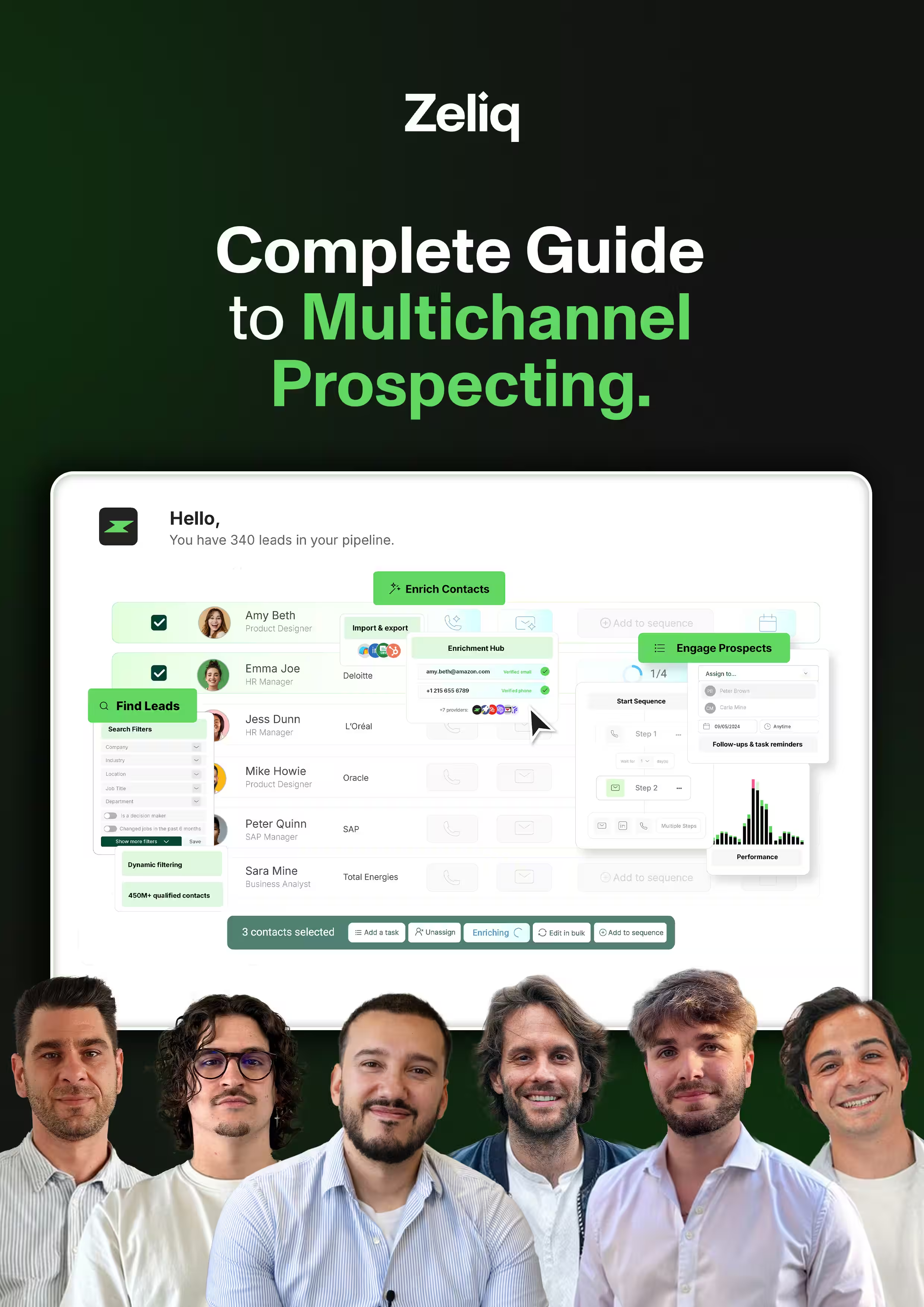
Zeliq is the platform that lets SDRs and AEs run all of the above from one screen: the 450M-contact database to find ICP prospects, waterfall enrichment to verify their email and direct phone, and multichannel sequences to send these templates at scale across email and LinkedIn. The 90-second workflow above runs natively inside the product. Try it free for 14 days.
Deliverability quick checklist
The best email copy in the world dies in spam if your domain is not configured. Before sending volume, check the boxes below.
- SPF, DKIM, DMARC all green on your sending domain. Test on mail-tester.com.
- Secondary domain. Send cold from a domain like get.{yourbrand}.com, not from your primary domain. Protects your main MX from any reputation hit.
- Warmup. New mailboxes need 4 to 6 weeks of warmup before going to volume. Tools like Mailwarm, Warmup Inbox, or your sequencer’s built-in warmup do this.
- Volume per mailbox. Do not exceed 50 cold emails per mailbox per day in 2026. Inbox providers throttle harder than they used to.
- List hygiene. Bounce rate above 5 percent kills your sender score. Run every list through a verification step before sending. A waterfall enrichment, like the one in Zeliq’s lead database, keeps bounces under 3 percent.
- No unsubscribe link, no send. Required by GDPR, CAN-SPAM, and inbox providers’ filters.
- Plain text first. No HTML signatures with images, no tracking pixels for the first email of a sequence. They trip filters.
- Reply tracking. Make sure your sequencer auto-pauses on replies and out-of-office bounces. Two emails after a “thanks, not now” is a fast way to burn the relationship.
If your reply rate is under 3 percent, fix deliverability before rewriting copy. Nine times out of ten, that is the bottleneck.
Common questions about prospecting emails
How long should a prospecting email be?
Between 50 and 90 words for first-touch outbound. Above 120 words, reply rates fall fast. Follow-up emails can be even shorter, the bump email is one line. A good test: read the email out loud. If you cannot finish it in under 25 seconds, it is too long.
How many follow-ups should a sequence include?
Four to seven touches is the current sweet spot, mixed across email and LinkedIn. Single-email outbound has died: most replies (around 70 percent) come from touches 2 through 5. The breakup email at the end of the sequence often pulls more replies than the first three combined.
What is a good reply rate for cold email in 2026?
5 to 10 percent on a well-targeted, well-written sequence is the benchmark. Above 10 percent, you are in the top quartile and should scale that ICP and that template. Below 3 percent, do not touch the copy first: check deliverability, then ICP fit, then copy.
How personalized does a cold email really need to be?
Personalize the opening line and one mid-email reference (the peer customer or the specific pain). Variables alone are not personalization in 2026: every SDR uses {first name} and {company name}. The differentiator is one human-written sentence per prospect, in the first line.
Should I include a calendar link in the first email?
No. A calendar link in touch 1 signals “I want a meeting more than I want a conversation”. Use a soft CTA in the first email (“worth 15 minutes?”). Drop the calendar link only after the prospect says yes.
How do I avoid the spam folder on cold email?
Configure SPF, DKIM, DMARC. Send from a secondary domain, never your primary. Warm up the mailbox for 4 to 6 weeks. Cap volume at 50 per mailbox per day. Verify every email before sending to keep bounces under 3 percent. Avoid spam triggers in copy: no all-caps subject lines, no “FREE”, no excessive exclamation marks. For a deeper list, see our guide on words to avoid in cold outreach.
What subject line length works best?
4 to 6 words on desktop, 3 to 5 words on mobile. Lowercase, no emoji, no exclamation marks. The best subject lines look like a real human typed them in a hurry, not a marketer crafted them in a brief.
Cold email or LinkedIn first?
Both, in sequence. The strongest 2026 outbound plays start with a LinkedIn connection request (no message), then move to email touch 1, then a LinkedIn message on day 5, then email touch 2, and so on. Multichannel sequences hit 30 to 50 percent higher reply rates than email-only.
Wrap up
A prospecting email is not a marketing asset, it is a conversation opener. The 18 templates in this guide work because they keep that in mind: short subject, prospect-first hook, one outcome, one peer, one soft CTA. Pick the ones that match your motion, run them through the 90-second personalization workflow, and ship. Reply rates above 8 percent are not magic, they are the result of doing these basics consistently.
If you want to run these templates at scale across email and LinkedIn, with verified contact data, automated follow-ups, and CRM sync from one screen, start with Zeliq for free. The 14-day trial includes 50 enrichment credits, the full sequence builder, and access to the 450M-contact lead database used by 15,000+ SDRs and business developers every day.