
B2B Prospect List: How to Build One That Actually Converts in 2026
A B2B prospect list is the foundation of every outbound motion. Get it wrong, you waste budget, burn domain reputation, and frustrate reps. Get it right, your SDRs spend less time researching and more time closing meetings.
In 2026, the bar is higher than ever. Inboxes are filtered tighter, decision-makers are harder to reach, and compliance regimes (GDPR, CAN-SPAM, CASL) leave little room for sloppy targeting. The companies winning outbound today are not the ones with the longest lists. They are the ones with the cleanest, best-segmented, most signal-rich lists.
This guide covers what a modern B2B prospect list looks like, how to build one, where to source data, what to verify before sending, and how AI is reshaping the workflow.
TL;DR
- A B2B prospect list is a curated set of companies plus their decision-makers that match your ICP and are ready for outbound.
- Quality beats quantity in 2026: deliverability, reply rate, and CRM hygiene all depend on a tight, verified list.
- Build it in 7 steps: define ICP, pick sources, pull, enrich, verify, score, segment.
- Build vs buy is a tradeoff between freshness and speed. Bought lists carry compliance risk, especially in the EU.
- B2B contact data decays around 2 to 3 percent per month. Plan for monthly verification and quarterly refresh.
What is a B2B prospect list?
A B2B prospect list is a structured set of companies and contacts that match your ICP and are queued for outreach. It is not a CRM dump. It is not a webinar attendee export. It is a deliberately built shortlist of accounts where your offer has a credible reason to land, paired with the decision-makers who can say yes.
A useful B2B prospect list combines two layers of information. The company layer (firmographic and technographic data) tells you whether the account fits. The contact layer (name, title, verified email, phone, LinkedIn) tells you who to reach and how. Without both, outreach falls apart.
The bar for what counts as a prospect list has risen sharply. Five years ago, a scraped list of 5,000 LinkedIn profiles without emails was usable. Today, the same list would burn through your sending domain in two weeks. The modern definition assumes verified contact data, fresh signals, and explicit segmentation.
Why prospect list quality beats quantity in 2026
The math of cold outbound has changed. Inbox providers (Google, Microsoft, and the major B2B mail filters) score sender reputation harder than ever. A list with 30 percent invalid emails will trash your domain before the first reply lands. A list with 0 percent ICP fit will get marked as spam by recipients themselves, which is even worse for deliverability.
There are three reasons quality wins now:
Deliverability is a function of recipient signal. Mail providers watch opens, replies, and complaints. Sending to a list where 70 percent of recipients have no business hearing from you tanks every metric. Sending to 200 well-targeted contacts who actually reply teaches Google your domain is legitimate.
Reply rate is a function of relevance. A generic email to a poorly-targeted list converts at fractions of a percent. A specific message tied to a real trigger (funding round, new hire, tech stack change) on a tight list can produce reply rates above 10 percent.
Cost per meeting collapses when fit improves. A list of 500 well-qualified contacts often generates more pipeline than a list of 50,000 generic ones, at a fraction of the cost.
This is why mass-purchased lists have lost their appeal. The question is no longer “how many contacts” but “how many signals per contact”.
Anatomy of a B2B prospect list: what fields you actually need
A prospect list is only as useful as the fields it carries. Skip a field and you constrain how you can segment, score, or personalize.
Company-level fields (firmographics and signals)
These tell you whether the account fits. Without them, you cannot prioritize, you can only blast.
| Field | Why it matters |
|---|---|
| Company name | Primary key for dedup and CRM sync |
| Industry / vertical | Foundational ICP filter |
| Employee count | Maps to deal size and buying complexity |
| HQ location and additional offices | Time zone, language, compliance regime |
| Annual revenue | Budget proxy, used in scoring |
| Domain | Required for technographic and email enrichment |
| Tech stack | Tells you if you are replacing or coexisting with current tools |
| Funding stage and last round | Strong intent and budget signal |
| Recent triggers | Hiring, leadership change, product launch, M&A |
| LinkedIn company URL | Reference and verification source |
| Industry codes (SIC, NAICS) | Useful for regulated sectors and public registry filtering |
A list without trigger data is a static list. Static lists lose to signal-driven ones because the latter let you reach out at the exact moment the buyer is paying attention.
Contact-level fields
The company tells you the where. The contact tells you the who and the how.
| Field | Why it matters |
|---|---|
| First name and last name | Personalization baseline |
| Job title (current) | Seniority and role signal |
| Seniority level | Filtering on decision-maker vs influencer |
| Department / function | Required for multi-threading across a buying committee |
| Verified work email | Without verification, you burn domain reputation |
| Direct phone or mobile | Reduces gatekeeper friction for cold calls |
| LinkedIn profile URL | Channel for outreach, plus live status check |
| Persona | Maps to your sequence library and messaging |
| Years in current role | Newer hires often convert faster |
| Time zone | Cadence and send-time optimization |
| Source | Provenance for compliance and quality audits |
Persona is the field most teams skip. It looks redundant next to title, but title alone does not tell you what message to send. A Head of Growth at a 20-person SaaS and a Head of Growth at a 2,000-person enterprise need different opening lines. Tag the persona at list-build time so your sequencer picks the right messaging automatically.
How to build a B2B prospect list in 7 steps
Building a prospect list is a repeatable process, not a one-off project. Treat it like a pipeline that runs continuously rather than a spreadsheet you assemble once.
Step 1. Define your ICP, persona, and intent triggers
Everything downstream depends on this step. The strongest ICPs combine three layers:
- Firmographic filters: industry, employee count, revenue band, geography.
- Persona filters: the specific roles that buy or champion your solution. Be precise. Head of Sales is not the same as VP Sales is not the same as CRO.
- Intent triggers: behaviors or events that suggest the account is ready to talk. Hiring SDRs, opening a new region, switching CRM, raising a Series A.
Write the ICP down. If a contact does not match, it does not go on the list, no matter how tempting the volume looks.
Step 2. Pick your data source
There is no single best source. The right combination depends on ICP, geography, and budget. The common options:
- B2B databases (Zeliq, Apollo, Cognism, ZoomInfo, RocketReach, Lusha, Kaspr): pre-built and ready to query.
- LinkedIn Sales Navigator: largest, freshest professional dataset, no contact data on its own.
- Intent and signal platforms (G2, Bombora, custom triggers): behavioral data layered on firmographics.
- Public registries: Companies House (UK), SEC EDGAR, OpenCorporates, INSEE (France). Free, slow, factual.
- Manual scraping or research: for niche ICPs no database covers. Time-intensive but the highest accuracy when done well.
Most mature outbound teams blend two or three: a signal platform to identify accounts at the right moment, a database for contact enrichment, LinkedIn for live verification.
Step 3. Pull the list using filters and search criteria
Now you apply your ICP filters inside the chosen source. Filter too tightly and your list shrinks to a handful of accounts no rep can build a quarter around. Filter too loosely and quality drops fast.
Useful heuristic: start with the strictest version of your ICP, see how many contacts come back, then relax one filter at a time until you have enough volume for a meaningful test. Three to four filters is the sweet spot. Document the filter set in writing, you will run this list again next quarter.
Step 4. Enrich missing fields with waterfall enrichment
Even the best databases miss data. A LinkedIn profile may not surface an email. A company may not list its tech stack.
Modern enrichment uses a waterfall: query provider A, fall back to B if A misses, then C. Different providers have stronger coverage in different geographies and field types. A single-source enrichment misses 30 to 40 percent of contacts a waterfall would have caught.
How Zeliq helps here
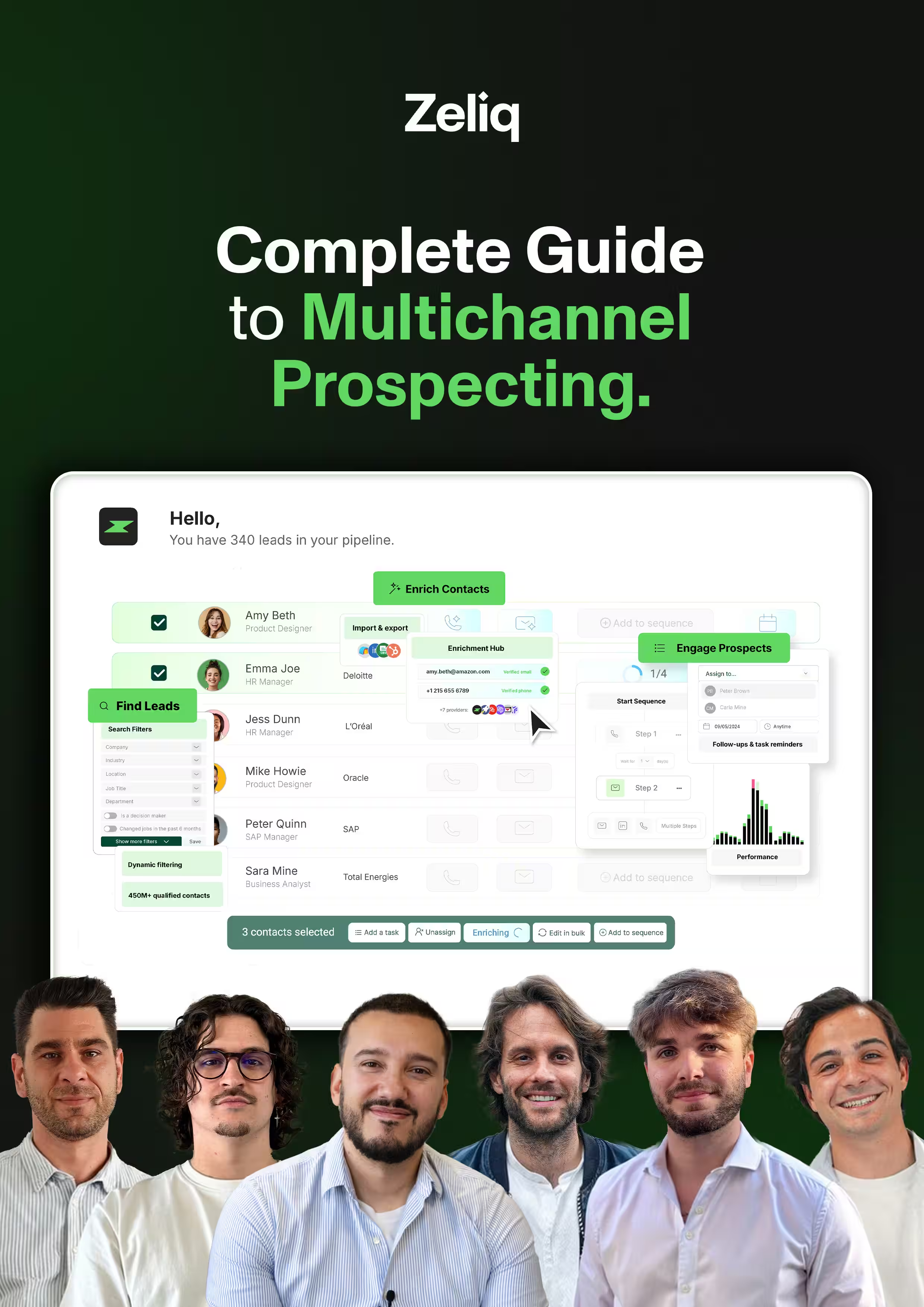
Zeliq combines a 450M+ contact database with waterfall enrichment across 40+ data providers, giving you company and contact-level coverage without juggling separate tools. Pull from the database, enrich the gaps automatically, push the result into a sequence. Discover the B2B data enrichment workflow or browse the lead database directly.
Step 5. Verify every email and phone before sending
Verification is the step most teams cut to save time, and it is the most expensive one to skip.
- Email verification: SMTP-level checks, domain validation, catch-all detection. Anything above 5 percent invalid in a batch hurts your domain reputation.
- Phone verification (HLR lookup): for mobile numbers, an HLR check confirms the line is active and on which network. Saves SDRs from dialing dead numbers.
- LinkedIn live check: a programmatic ping confirms the profile still exists and the contact is still at the company. People move jobs faster than databases track.
A clean list with 200 verified contacts beats a dirty list with 2,000 unverified ones, every time.
Step 6. Score for fit and intent
Once verified, score each contact. A simple two-axis model works well:
- Fit score: how closely does this account match your ICP? Industry, size, geo, tech stack, persona. Score 1 to 5.
- Intent score: what signals say the account is in-market right now? Recent funding, hiring SDRs, traffic spikes, content engagement. Score 1 to 5.
Stack the two and you get a priority ranking. Reps work the top quartile first. The bottom quartile may not be worth sequencing this quarter.
Scoring turns a flat list into a tiered workflow. Without it, every rep starts at row 1 and burns the best accounts on low-effort touches.
Step 7. Segment and assign to sequences
Cut the list into segments tight enough that each shares a single coherent angle. Common cuts:
- By persona (Head of Sales vs CRO vs Revenue Ops)
- By company size (mid-market vs enterprise)
- By trigger (just funded vs hiring SDRs vs replacing CRM)
- By geography and language
Each segment goes into its own sequence. Same product, different angles. A one-size-fits-all sequence averages every angle into a generic message that lands with none of the segments.
Multichannel matters too. A modern sequence touches email, LinkedIn, and sometimes phone. Senior buyers usually engage more on LinkedIn, frontline managers may reply faster to email. Multichannel sequences let you orchestrate this without copy-pasting between tools.
Build vs buy a B2B prospect list
Every sales leader asks this. The honest answer is “both, in different proportions, depending on stage”.
Building your list
You define the ICP, pull the data, enrich, verify. The result is custom, fresh, and yours.
Pros: maximum ICP fit because you set every filter, fresh data because you control timing, cleaner CRM hygiene because every contact has documented provenance.
Cons: time-intensive (hours or days per segment), requires tooling (database plus enrichment layer), hard to scale to multiple ICPs without dedicated ops.
Buying a list
You pay a vendor for a pre-built file. Volume comes in fast.
Pros: speed (live in hours), often cheaper per contact, useful for tests on a new ICP.
Cons: staleness (30 to 40 percent decay in 12 months is common), genericness (the same list is often sold to dozens of other buyers), compliance risk.
The legal angle (CAN-SPAM, GDPR, CASL)
Compliance varies sharply by geography. A bought list legal in one jurisdiction may not be legal in another.
- CAN-SPAM (US): relatively permissive for B2B. Requires accurate sender info, a working unsubscribe, no deceptive subject lines. Bought lists are usable if conditions are met.
- GDPR (EU and UK): much stricter. B2B contacts in the EU need a lawful basis to be processed, and “legitimate interest” only works if you can document a genuine connection. Many bought EU lists fail this test. Fines can hit the millions.
- CASL (Canada): among the strictest in the world. Requires express or implied consent for commercial electronic messages. Cold outreach to bought lists is high-risk.
If your prospects are EU- or Canada-heavy, build, do not buy.
B2B prospect data sources compared
Different sources have different strengths. The best teams blend.
| Source | Strengths | Watch out for |
|---|---|---|
| Zeliq | Find + enrich + engage in one platform, waterfall across 40+ providers, 450M+ contacts, multichannel sequences built in | Newer brand than legacy providers, less name recognition in some enterprise procurement processes |
| Apollo | Large database, generous free tier, built-in sequences | Data accuracy varies by region, especially outside the US |
| Cognism | Strong EMEA coverage, mobile numbers, GDPR-aware | Pricing skews enterprise |
| ZoomInfo | Largest US dataset, deep firmographics, intent data | High price point, contract lock-ins, occasional staleness |
| RocketReach | Email and social finder, simple UX | Limited firmographic depth |
| Lusha | Browser extension for quick contact lookups | Coverage gaps outside English-speaking markets |
| Kaspr | LinkedIn-focused, strong in France and EMEA | Narrower outside Europe |
| Hunter | Email finder, strong domain search | Email-only, no firmographic database |
This is a high-level comparison, not a buying guide. The right tool depends on geography, ICP density, and stack. Most outbound teams use two: one primary, one for waterfall fallback.
Free methods to build a prospect list
You do not need an expensive stack to build a usable list, especially for early validation. The trade-off is time.
- LinkedIn Sales Navigator filters. Best free-ish source for ICP-fit contacts. Filter by industry, seniority, geography, company size, group membership. Export with a tool, or work directly with a browser extension to push contacts into your stack.
- Google search operators. A query like site:linkedin.com/in “VP Sales” “Series B” “SaaS” returns highly specific results. Combine inurl:, intitle:, and quoted strings for precision.
- SEC EDGAR. US public company filings. The 10-K lists executives, subsidiaries, and material business changes.
- Companies House (UK) and OpenCorporates. Company registries with director names, addresses, filings. Great for UK and international company-level data.
- Crunchbase free tier. Funding history, executive moves, recent news. Functional for trigger-based prospecting.
- Industry directories and conference attendee lists. A targeted list of 200 contacts from a niche industry event can outperform a database pull.
Free methods are slow but they teach you what your ICP actually looks like in the wild.
B2B prospect list template
Use this as your starting CSV schema. Adapt to your stack, but do not skip fields without reason.
| Column | Type | Example |
|---|---|---|
| company_name | text | Acme Corp |
| company_domain | text | acme.com |
| company_linkedin_url | URL | linkedin.com/company/acme |
| industry | text | SaaS |
| sub_industry | text | RevOps |
| employee_count | integer | 250 |
| revenue_band | text | 10M-50M USD |
| hq_country | text | United States |
| hq_city | text | San Francisco |
| funding_stage | text | Series B |
| last_funding_amount | text | 25M USD |
| last_funding_date | date | 2025-09-12 |
| tech_stack | text | Salesforce, Outreach, Slack |
| recent_trigger | text | Hired VP Sales last 30 days |
| first_name | text | Jamie |
| last_name | text | Lee |
| job_title | text | Head of Sales |
| seniority | text | Director |
| department | text | Sales |
| persona | text | Sales Leader |
| jamie.lee@acme.com | ||
| email_status | text | verified |
| direct_phone | text | +1-415-555-0182 |
| phone_status | text | verified |
| linkedin_url | URL | linkedin.com/in/jamielee |
| time_zone | text | America/Los_Angeles |
| source | text | Sales Nav + Zeliq enrichment |
| fit_score | integer | 4 |
| intent_score | integer | 5 |
| segment | text | US mid-market, recent funding |
| sequence_assigned | text | seq_us_funded_sales_leader |
| added_on | date | 2026-05-12 |
| last_verified_on | date | 2026-05-15 |
Copy this into a spreadsheet or enrichment tool and adapt segment, sequence, and source columns to your taxonomy.
Data quality and decay: plan for it
B2B contact data goes stale fast. People change jobs, companies pivot, emails get deactivated. The industry rule of thumb: B2B contact data decays roughly 2 to 3 percent per month, compounding to 25 to 35 percent stale data in a year if nothing is refreshed.
In practice:
- Monthly verification of your active list. Re-run emails through a verifier, re-check LinkedIn status, re-confirm phone numbers.
- Quarterly refresh of firmographic and trigger fields. Funding events, headcount, leadership changes.
- Annual ICP review. Look back at which segments actually converted. Tighten or expand the ICP based on what closed, not what you assumed.
Treat the prospect list as a living asset, not a static export.
Common mistakes to avoid
The same mistakes show up across outbound teams. None of them are subtle.
- ICP too broad. If filters return more than ten thousand contacts on a niche product, you have not filtered enough.
- No enrichment. Single-source lists are thinner than they look. The contacts your one provider missed are often the best ones.
- Skipping verification. The fastest way to torch a sending domain.
- Single-source bias. Coverage gaps haunt you, especially across regions.
- No segmentation. Treating a list as one blob and sending the same sequence to everyone. Conversion goes flat.
- No refresh cadence. By month nine, half the contacts are at different companies.
- Buying without a compliance check, especially for EU- or Canada-targeted lists.
If you only fix one this quarter, fix segmentation. It compounds the value of every other improvement.
How AI is changing prospect list building in 2026
AI has shifted from buzzword to working layer of the prospect list workflow. The interesting changes are operational, not cosmetic.
- Auto-ICP refinement. Models trained on your closed-won and closed-lost deals flag patterns you missed (tech stacks, seniority levels, geographies that converted faster). The output is a sharper ICP than you would have set intuitively.
- Signal-based list generation. Instead of static filters, modern tools watch for events (funding rounds, hires, product launches, hiring spikes) and surface accounts at the moment they enter a buying window. List building becomes a stream, not a quarterly export.
- Predictive scoring. Beyond manual fit and intent scoring, predictive models rank contacts on probability to reply, to book a meeting, or to close. Accuracy improves with every closed deal fed back in.
- Automated personalization. AI drafts opening lines from the company website, recent posts, or news mentions. Used well, it removes the bottleneck that used to cap personalized outbound at fifty contacts per rep per day.
- Live verification at send time. AI-driven systems re-verify emails and LinkedIn status seconds before send, catching the staleness that monthly batches miss.
Teams getting the most out of AI in 2026 are not the ones replacing reps with bots. They use AI for what humans do badly at scale: pattern detection, signal monitoring, last-minute verification. The judgment calls still belong to humans.
Build verified B2B prospect lists in minutes
Zeliq combines a 450M+ contact database, waterfall enrichment, and multichannel sequences in one platform.
Book a demoA prospect list is not a one-time deliverable. It is the running surface area of your outbound motion, and its quality sets the ceiling for reply rates, meeting volume, and pipeline coverage. Define the ICP narrowly, enrich and verify ruthlessly, score and segment before you sequence, and refresh on a rhythm you can sustain. Whether you are a business developer running your own pipeline, a sales leader coaching a team, a founder building outbound for the first time, or a revenue operations function tightening the data layer, the discipline is the same. Build the list with care, maintain it relentlessly, and let the numbers do the talking.