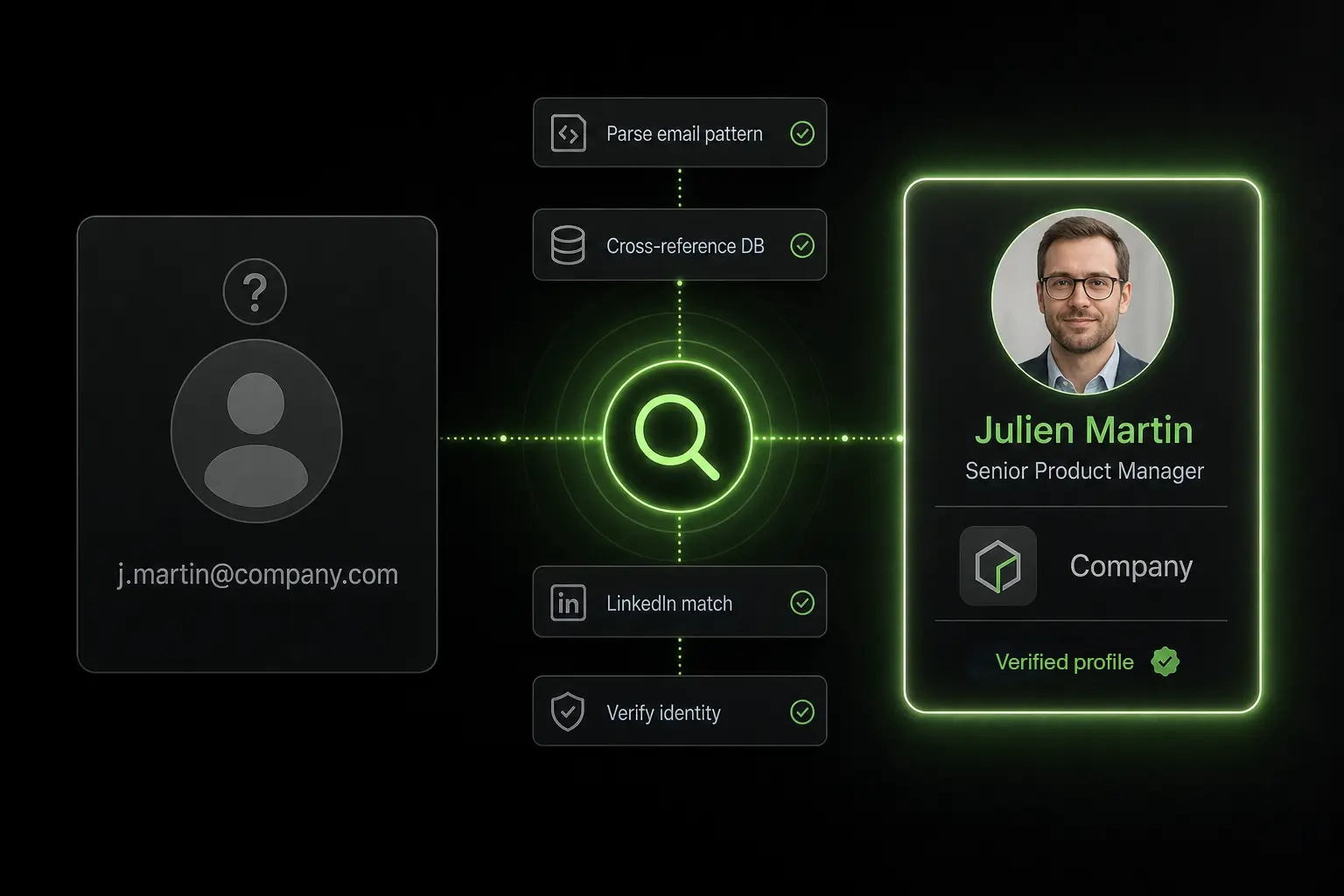

You receive a message from john.smith@consulting-firm.com and you want to know who John Smith is, what he does, in which company exactly. You pull a lead file with only email addresses and you have to attach a name and a role to each one. You want to verify that a contact who reached out actually exists in the company they claim to represent. These three scenarios share the same technical answer: reverse email lookup.
It is a skill that has deeply evolved between 2020 and 2026. B2B databases have massively enriched their reverse indexes, consumer tools have grown in coverage, and GDPR constraints now impose a precise framework on the use of this technique. This guide explains how to identify the name behind an email address in 2026: what the address format already reveals, the market tools, the limits of the exercise, the European legal framework, and a worked example on enriching a contact list.
What you’ll find:
- What reverse lookup is and its main use cases
- The pattern method: what the address format reveals
- Multi-source manual research
- Enrichment tools and a comparison
- The legal framework: GDPR, legitimate interest and purpose
- The worked example: enriching a 5,000-contact list
What is reverse email lookup
Reverse email lookup is the operation of identifying a person (and their professional context) from their email address alone. It is the inverse of an email finder: the latter starts from a name to find an address, reverse lookup starts from the address to find the identity.
Three dominant use cases in 2026:
Identifying an unknown sender. A message arrives from an address you do not know, the tone is professional, you want to know who you are dealing with before replying. It is the most common case in B2B and the most immediate.
Enriching a lead database. You have collected emails through a form that asks only for the address (lead magnet, event signup, demo request) and you want to complete each row with a name, a role and a company to qualify properly. It is the most volume-driven use case.
Verifying a claimed identity. Someone introduces themselves as “Sales Director at {company}” through an inbound contact. You want to verify this person actually exists in that company, in that role. It is the anti-fraud use case, growing with BEC (Business Email Compromise) techniques.
Note: reverse lookup applies primarily to professional addresses. Personal addresses (gmail.com, yahoo.com, hotmail.com) with pseudonyms reveal little through standard B2B tools, which are structured on professional databases.
The pattern method: what the format reveals
Before any paid tool, the address itself contains powerful clues. The vast majority of companies apply a standardized format to all their professional addresses.
Dominant B2B patterns
| Pattern | Example | Estimated market share |
|---|---|---|
| first.last@ | john.smith@company.com | ~70% of B2B companies |
| firstlast@ | johnsmith@company.com | ~8% |
| f.last@ | j.smith@company.com | ~6% |
| flast@ | jsmith@company.com | ~5% |
| first@ | john@company.com | ~4% (startups, very small companies) |
| last.first@ | smith.john@company.com | ~3% |
| first_last@ | john_smith@company.com | ~2% |
| Other internal formats | initials, HR codes, suffixes | ~2% |
The first.last pattern is by far the most widespread, particularly in mid-to-large companies. Startups often use a plain first name. Some large groups add an initial or a number to handle namesakes (john.smith1@, j.smith2@).
What the domain reveals
The domain (the part after the @) identifies the company in 95% of cases. A quick search of the domain:
- On WHOIS (whois.net, who.is) reveals who registered the domain, sometimes the head office or the technical contact
- On Google direct or LinkedIn reveals the corresponding company page
- On company registries (OpenCorporates internationally, Companies House in the UK, Pappers in France) reveals the legal structure and executives
Combining pattern and domain: if you see john.smith@consulting-firm.com, you know almost certainly that you are dealing with John Smith, employee at Consulting Firm. What remains is finding his exact role via LinkedIn.
Generic addresses: the limit
Generic addresses designate no one in particular and resist any reverse lookup:
- contact@, info@, hello@, sales@, support@: shared service addresses
- noreply@, no-reply@, donotreply@: technical addresses with no human recipient
- newsletter@, marketing@, press@: function addresses, non-individual
On these addresses, no method will surface an individual name. The actual contact is found via the company website or via LinkedIn by role.
Multi-source manual research
When the format is not enough, multi-source research completes the investigation on an isolated contact. The method takes 5 to 10 minutes per contact, which limits it to individual cases.
Step 1: Google search of the exact address
Type the full address between quotation marks in Google: "john.smith@consulting-firm.com". This search surfaces:
- Email signatures published in forums, mailing lists or public replies on sites
- Personal pages (LinkedIn cache, About.me, personal sites) where the person displayed their email
- Professional directories where the person registered (bar associations, medical councils, industry bodies)
- Data leaks documented on HaveIBeenPwned (useful to identify which services the person is registered with, indirectly their context)
Step 2: LinkedIn search
LinkedIn no longer officially allows searching by email since 2018, but two techniques remain valid:
- Search by deduced name: use the address format to guess the full name, then search “John Smith {company}” on LinkedIn
- Third-party enrichment tools: Apollo, Lusha, Hunter can find a LinkedIn profile from an email (with their limits)
The browser extension of several B2B tools automatically displays the LinkedIn profile when you visit a page containing the address, which speeds up the search.
Step 3: Domain analysis
The WHOIS of the company domain often gives useful information (creation date, registrar, sometimes admin contact). Combined with a company registry, you get a complete organization fact sheet: head office, headcount, executives, sector, legal structure.
Step 4: Cross-checking
The final step is to cross-check sources: name deduced from format + confirmed LinkedIn profile + company identified by domain. Concordance of the three gives a reliable identifier. Discordance (e.g. a deduced name that appears nowhere) signals an address to verify or to discard.
This manual method works well on 1 to 50 contacts. Beyond that, automation becomes essential.
Enrich addresses at scale
Zeliq retrieves the name, role and company tied to each email address at high volume, with coverage above 80% on B2B contacts. Explore B2B data enrichment.
Reverse lookup enrichment tools
Several tool categories automate reverse lookup at scale. The choice depends on volume, budget and use context.
Specialized B2B tools
| Tool | Coverage | Indicative price | Notable point |
|---|---|---|---|
| Hunter.io | Email reverse + format detection | $49-499/month | Email-finding reference, reverse included |
| Apollo.io | 275M+ B2B contacts | $49-119/user/month | Very good coverage, intent included |
| Cognism | 70M+ contacts (strong EMEA) | Custom quote | Documented GDPR compliance |
| Lusha | 150M+ contacts | $36-89/user/month | Chrome extension, direct email search |
| ZoomInfo | 150M+ B2B contacts | $15-50k/year | US enterprise reference |
| Clearbit | Real-time enrichment | $99-999/month | Fast API, integrations |
| Snov.io | Multi-function | $39-189/month | Reverse + email finder combined |
| Zeliq | 450M+ contacts | Quote | Waterfall enrichment, 40+ providers |
Consumer tools
For searches on individuals or outside strict B2B, consumer tools exist but with important European limits:
- Pipl: very powerful aggregator in the US, limited coverage in Europe
- Spokeo, Whitepages, BeenVerified: US directories, less useful in Europe
- HaveIBeenPwned: not for identifying but for knowing which data leaks an address appears in
These tools raise serious GDPR compliance questions when used from Europe on European contacts. They are designed for the US market and are not GDPR-native.
Selection criteria
For B2B commercial use in Europe, the selection criteria are:
- Coverage on your target (EMEA, US, specific sector)
- Documented GDPR compliance: the provider must be able to produce the lawful basis and purpose of its database
- Match rate on a test sample (systematically request a test on 100-500 addresses before signing)
- Integration into existing workflow (CRM, sequences, marketing tools)
- Cost per enrichment (volume vs unit)
For more, see our complete guide on the email finder (finding an address from a name) and the B2B lead database.
The legal framework: GDPR, legitimate interest and purpose
Reverse email lookup is a personal data processing operation under the GDPR, even when the address is professional. Three principles strictly govern the practice in Europe.
The purpose principle
You can only identify a person from their address for a legitimate and declared purpose. Acceptable B2B purposes:
- Qualification of an inbound lead who contacted you (strong legitimate interest)
- Anti-fraud on a suspicious commercial exchange (strong legitimate interest)
- B2B prospecting database enrichment with documented legitimate interest basis
- Identity verification declared by a contact (anti-phishing)
Unacceptable purposes:
- Unsolicited research on a person with no real commercial project
- Building person indexes for tracking or resale purposes
- Enriching data on individuals with no lawful basis
The minimization principle
You must only collect data strictly necessary for the purpose. To qualify a B2B lead, name, role and company are enough. Pulling age, family status or political opinions is not justified.
Informing the person
From the first post-enrichment contact, you must inform the person that you are processing their data, on what lawful basis, and indicate their rights (access, objection, deletion). In practice, this happens through a clear footer in prospecting emails: “You are receiving this message under our legitimate interest in B2B commercial prospecting. To object to this processing, reply STOP or click here.”
Sanction risk
European authorities (CNIL in France, ICO in the UK, AEPD in Spain) actively sanction breaches of these principles. Sanctions can reach 4% of global revenue or 20 million euros (whichever is higher). Several B2B companies received six-figure fines in 2023-2025 for poorly framed prospecting practices.
Worked example: enriching a 5,000-contact list
A US B2B mid-market company collected 5,000 email addresses through a download form (lead magnet) that only asked for the email. It wants to enrich each line with a name, a role and a company to qualify the database.
Approach A: manual research
- Average time per manual enrichment: 5 minutes
- Volume: 5,000 contacts × 5 min = 25,000 minutes = 417 hours of work
- Loaded hourly cost (junior salesperson): $40/h
- Total cost: ~$16,700
- Delivery time: 10-12 weeks full time
Approach B: automatic enrichment via B2B tool
- Tool (Apollo, Zeliq, or equivalent): $99 × 1 user × 3 months = $297
- Expected coverage: 70-85% of contacts (the rest remain non-identifiable for lack of match)
- Enriched volume: ~4,000 qualified contacts
- Processing time: 1-2 hours to configure the import and check results
- Total cost: ~$400 (tool + internal time)
- Delivery time: 1 day
Differential: ~$16,300 savings, plus a 50x shorter delay, plus more reliable coverage because it rests on verified databases rather than manual cross-checking.
Automatic enrichment is not just faster, it is fundamentally more profitable the moment volume exceeds a few dozen contacts. That is why nearly every modern B2B team has integrated an enrichment tool into its sales stack.
The limits of reverse lookup
Three structural limits remain in 2026, regardless of the tool used.
Generic addresses designate no one. contact@, info@, hello@ correspond to a service, not an individual. No tool will surface a name where there is none.
Personal addresses with pseudonyms on gmail.com, yahoo.com or outlook.com reveal little. B2B tools are indexed on professional databases; they are weak on personal accounts created with an alias or partial name.
Recent contacts (created less than 3-6 months ago) may not appear in enrichment databases, which refresh their indexes with delay. For these cases, manual research remains the only option.
These limits typically represent 15-30% of addresses in an unsorted B2B list. It is the normal cost of the exercise: no tool reaches 100% coverage, and no one should promise the opposite.
How Zeliq identifies your contacts at scale
Zeliq combines the B2B database and waterfall enrichment to automate reverse lookup at scale. The platform takes an email address as input and returns the name, role, company and often other details (phone number, LinkedIn profile) through a series query of more than 40 data providers. Coverage on B2B contacts (Europe and North America) exceeds 80% on classic targets.
The operation also works the other way: from a name and a company, Zeliq finds the verified email. And the whole thing integrates directly into multichannel prospecting sequences. For a Business Developer, it is the end of anonymous contacts: every line in a list becomes a usable record. For more, see our B2B lead database.
From an address to a complete contact record
Zeliq enriches your email addresses with the identity and professional data of your contacts. Account created in 2 minutes, no credit card.
Try for freeHow to find the name behind an email address for free?
Several free methods exist, to use depending on context. A Google search of the exact address between quotation marks surfaces signatures, profiles and pages where the address appears publicly. Deducing the name from the format (first.last@ in 70% of B2B cases) then searching LinkedIn by that name in the domain’s company works in the majority of B2B cases. HaveIBeenPwned indicates which data leaks the address appears in, indirectly revealing services used. For high volume or structured commercial use, paid tools (Hunter freemium, Apollo free plan, Lusha freemium) offer a few free searches per month before billing.
Is reverse email lookup legal in the US and EU?
Yes, under conditions. In the EU, the GDPR allows identifying a person from their email address in a B2B context on the legitimate interest basis, under three conditions: (1) the purpose must be legitimate and declared (commercial qualification, anti-fraud, professional database enrichment), (2) collected data must be minimized to what is necessary for that purpose, (3) the person must be informed of the processing from the first contact and able to object. Use for non-commercial purposes or on individuals remains heavily constrained. In the US, the framework is more permissive but the CAN-SPAM Act and state privacy laws (CCPA in California) apply. CNIL sanctions in the EU can reach 4% of global revenue.
What is the best tool to identify an email sender?
For B2B use in Europe, Cognism (very strong EMEA, documented GDPR) and Apollo.io (broad coverage, accessible price) are the best choices in 2026. For US companies, ZoomInfo remains the enterprise reference and Hunter.io the accessible reference. For occasional use on individual contacts, Lusha’s Chrome extension offers a sufficient freemium. For large-scale enrichment integrated into a prospecting workflow, a platform like Zeliq combines enrichment, database and sequences in a single interface, avoiding the need to stack 3 separate tools.
Zeliq and B2B identity resolution
Finding the name and function behind an email address is the reverse of classic email finding: it’s identity resolution. Zeliq enriches every B2B contact with name, function, company, LinkedIn and direct phone across 450 million B2B contacts. You move from cold contact to full prospect sheet in seconds.
See how Zeliq enriches your base from a single email address
Conclusion: three actions to identify your contacts this week
Reverse lookup has become an operational skill for any B2B team handling unknown contacts. Three concrete actions.
- Audit the orphan contacts in your CRM: how many email addresses in your database have no associated name, role or company? If more than 10% of your base is orphaned, you lose qualification potential daily.
- Choose an enrichment tool matching your target: EMEA → Cognism or Zeliq; US → Apollo or ZoomInfo. Test on 100 addresses before signing to measure the real match rate.
- Document your enrichment lawful basis in your GDPR policy: purpose, legitimate interest basis, disclosure and objection mechanism. It is necessary legal protection beyond a few thousand processed contacts.
To drive reverse lookup and enrichment in a single platform integrated with prospecting sequences, see Zeliq pricing.
And if you want to instantly resolve a B2B email’s identity, try Zeliq for free and move from cold contact to full prospect sheet in seconds.