
Company classification rests on 3 complementary dimensions in 2026: industry (NAF code in France, NACE in Europe, SIC or NAICS in the US), size (micro, SMB, mid-market, enterprise per INSEE or EU thresholds), and legal form (LLC, Inc., LLP, Ltd, GmbH, etc.). These 3 dimensions build a precise ICP (Ideal Customer Profile), segment a B2B outbound database, and align commercial messages by target. Rigorous classification cuts cold email bounce rates 2 to 3x (Terminus ABM Benchmark 2025) and lifts meeting-book rates 40 to 70%.
For SDRs, RevOps leads, Heads of Sales, or founders defining targets or cleaning a commercial database, this article breaks down the 3 classification dimensions, official nomenclatures to know, how to cross industry + size + legal form for clean segmentation, a chiffré case study on building a mid-market ICP, and 3 FAQs on the most common questions.
What you’ll learn:
- What “company classification” covers in B2B
- The 3 dimensions: industry, size, legal form
- Official nomenclatures: NAF, NACE, SIC, NAICS
- INSEE thresholds: micro, SMB, mid-market, large enterprise
- Legal forms and what they reveal
- Crossing the 3 dimensions to build an ICP
- Automatically enriching a database by classification
- Case study: mid-market SaaS ICP, +38% meetings in 90 days
- 3 FAQs (NAF vs APE code, SMB vs mid-market, refresh cadence)
- 3 dated actions to run this week
The gist:
- The NAF code (French Activity Nomenclature) has 732 categories in 2026, each company has 1 primary code
- INSEE size thresholds: micro < 10 employees, SMB 10-249, mid-market 250-4,999, large ≥ 5,000
- Single-dimension classification (industry or size only) is too coarse: crossing 2-3 dimensions is essential
- Classification refresh: 6 months minimum, as 15-20% of companies change NAF code or size bracket yearly
- Well-segmented ICP: meeting rate multiplied by 1.4 to 1.7x vs unsegmented database (Terminus 2025)
- Free public sources in France: INSEE Sirene, BODACC, data.gouv.fr
- Classification enrichment cost via API: 0.05 to 0.20 USD per company
1. Company classification: what we mean in B2B
The extended definition in outbound
In modern B2B, company classification refers to all standardized attributes describing, segmenting, and filtering a target account. It serves 3 purposes:
- Building an ICP (Ideal Customer Profile): which industries, sizes, legal forms make up your addressable market
- Segmenting a prospecting database: splitting a 5,000-account list into homogeneous groups with tailored messages
- Enriching a dataset: automatically adding industry, size, and legal form to a list imported from CRM or LinkedIn
Without structured classification, outbound resembles mass sending that ignores sector and operational specifics, and suffers a 40 to 60% lower response rate than segmented outbound.
Why this approach wins in 2026
Three shifts make classification more strategic than 5 years ago:
- Industry-distributed intent signals: each industry has its own signals (CTO hiring in tech, ERP change in manufacturing, site opening in retail) usable only with well-identified industry.
- Size-driven regulation: GDPR, accounting, and social constraints vary by size bracket, changing how to pitch (an SMB doesn’t think like a large enterprise).
- Automated enrichment: modern B2B enrichment tools surface classification automatically, making systematic use rather than rare.
2. The 3 dimensions: industry, size, legal form
Dimension 1: industry
Industry describes what the company does: manufacturing, services, retail, agriculture, tech, finance, etc. It’s codified by official nomenclatures (NAF, NACE, SIC, NAICS) that hierarchize the economy into hundreds of categories.
An SDR targeting “mid-market SaaS” must know that the primary NAICS code is 511210 (“Software Publishers”) or 541511 (“Custom Computer Programming Services”) depending on product vs services orientation. Without this detail, prospecting on a “tech” list also catches IT consultancies, e-commerce companies, and audit firms.
Dimension 2: company size
Size describes operational magnitude: employee count, revenue, balance sheet. INSEE thresholds in France standardize 4 brackets: micro (< 10 employees), SMB (10-249), mid-market (250-4,999), large enterprise (≥ 5,000). These thresholds are relevant because they map to French regulatory and social categories. US equivalents are similar but bracket boundaries differ (SMB often < 500 in US context).
A decision-maker in an SMB doesn’t have the same budgets, buying cycles, or concerns as a large-enterprise decision-maker. Ignoring company size in segmentation is like sending the same pitch to a baker and a multinational.
Dimension 3: legal form
Legal form describes the corporate structure: LLC, Inc., LLP, Ltd, GmbH, SAS, SARL, sole proprietorship, cooperative, etc. It reveals a lot:
- Inc. / Corp. / SAS: modern startup or scale-up, fast decision cycle
- LLC / SARL: traditional SMB, often family-owned
- PLC / SA: large enterprise with board, long cycle
- Sole proprietorship / EI: independent, limited budget, immediate decision
- Nonprofit / Association: mission-driven, annual budget cycle
Legal form is often overlooked in ICPs while strongly predicting decision cycle and average deal size. Crossing it with the other 2 dimensions sharpens segmentation.
3. Official nomenclatures: NAF, NACE, SIC, NAICS
NAF (France)
The NAF (Nomenclature d’Activités Française) is the official French classification managed by INSEE. In effect since 2008 (revision 2 expected in 2026), it counts 732 categories hierarchized on 5 levels:
- Section (21 sections, letters A to U)
- Division (88 divisions, 2 digits)
- Group (272 groups, 3 digits)
- Class (615 classes, 4 digits)
- Sub-class (732 sub-classes, 4 digits + 1 letter)
Each company has one primary NAF code assigned at incorporation (also called “APE code” when referenced at establishment level). Multi-activity companies have a primary code + one or more secondary codes possible.
Free access: INSEE’s Sirene API returns the NAF code of any French company from its SIREN. A B2B enrichment tool automates this API call in batch on lists of thousands of companies.
NACE (Europe)
NACE (Statistical Classification of Economic Activities in the European Community) is the European equivalent of NAF. Used by Eurostat and harmonized across 27 EU countries.
Structure: 21 sections, 88 divisions, 272 groups, 615 classes (less granular than NAF at level 5). NAF is in fact a NACE derivative with a French-specific 5th level.
Useful for pan-European B2B outbound: a NACE 62.01 account (“Computer programming activities”) is comparable across all 27 European countries.
SIC (United States)
SIC (Standard Industrial Classification) is the old US nomenclature, replaced by NAICS in 1997 but still used by the SEC and some data vendors. Structure: 4 digits, 1,004 categories.
Still relevant in 2026 for legacy US database acquisitions or Dun & Bradstreet research.
NAICS (North America)
NAICS (North American Industry Classification System) is the official US, Canada, and Mexico nomenclature since 1997 (last revision 2022). Structure: 6 digits, 1,057 categories.
Used by the US Bureau of Labor Statistics, Statistics Canada, INEGI Mexico, and most modern North American B2B data vendors. For US outbound, knowing your target’s NAICS is essential.
4. INSEE thresholds: micro, SMB, mid-market, large enterprise
The official grid
INSEE thresholds in effect in 2026:
| Category | Headcount | Revenue | Balance sheet |
|---|---|---|---|
| Micro-enterprise | < 10 | ≤ 2M EUR | ≤ 2M EUR |
| SMB | 10-249 | ≤ 50M EUR | ≤ 43M EUR |
| Mid-market | 250-4,999 | ≤ 1.5B EUR | ≤ 2B EUR |
| Large enterprise | ≥ 5,000 | > 1.5B EUR | > 2B EUR |
These thresholds come from decree 2008-1354 and align with EU recommendation 2003/361/EC for SMBs. Used by Bpifrance, BPI, tax administration, and all French public aid schemes.
Prospecting usages
Each size bracket has its own decision profile:
- Micro: decision-maker = founder, 1-4 week cycle, 500-5,000 USD deal size, very price-sensitive
- SMB: 2-4 decision-makers, 1-3 month cycle, 3-30K USD deal size, ROI-simplicity arbitrage
- Mid-market: 4-8 decision-makers, 3-9 month cycle, 15-200K USD deal size, integration and GDPR requirements
- Large enterprise: 8-15 decision-makers, 6-18 month cycle, 50K-5M USD deal size, centralized procurement and formal RFPs
Aligning your pitch, sales cycle, and target ACV on prospect size bracket is a major conversion lever.
Gray zones and pitfalls
Some companies switch brackets due to acquisition, funding round, or reorganization. An account tagged “SMB 200 employees” last year may be mid-market 400 employees this year post-acquisition.
Recommended refresh: every 6 months minimum, on the top 20% strategic accounts. Without refresh, segmentation becomes obsolete in 12-18 months and corrupts analytics.
5. Legal forms and what they reveal
The French typology
Most common legal forms in French B2B outbound:
- SAS / SASU: modern, flexible form. Dominant among startups and scale-ups. Fast decisions, often 1-2 founders who decide.
- SARL: historical form, often family or small partnership. Managing director decides. Typical structure of artisan and service SMBs.
- SA: classic form of large groups, listed or not. Board of directors, slower and more formal decisions.
- EI / EIRL / auto-entrepreneur: sole proprietors and micro-entrepreneurs. Single decision-maker, tight budget, immediate accept or reject.
- Association loi 1901: non-profit logic, annual budget cycle aligned on calendar or fiscal year.
- Cooperative (SCOP, SCIC): shared governance, collective decision, long cycle, strong social values.
Each form has pitch implications. A pitch about “ROI and EBITDA” to a cooperative misses. A pitch about “social impact” to a growth-stage SAS sounds hollow.
International equivalents
For pan-European or US outbound:
- Ltd (UK, Ireland) ≈ SARL/SAS
- GmbH (Germany, Austria, Switzerland) ≈ SARL
- AG (Germany, Switzerland) ≈ SA
- BV (Netherlands) ≈ SARL
- LLC / Inc. (US) ≈ SARL / SA depending on variant
- PLC (UK) ≈ listed SA
These equivalences aren’t perfect legally but useful for building coherent pitches across markets.
6. Crossing the 3 dimensions to build an ICP
The 3D ICP matrix
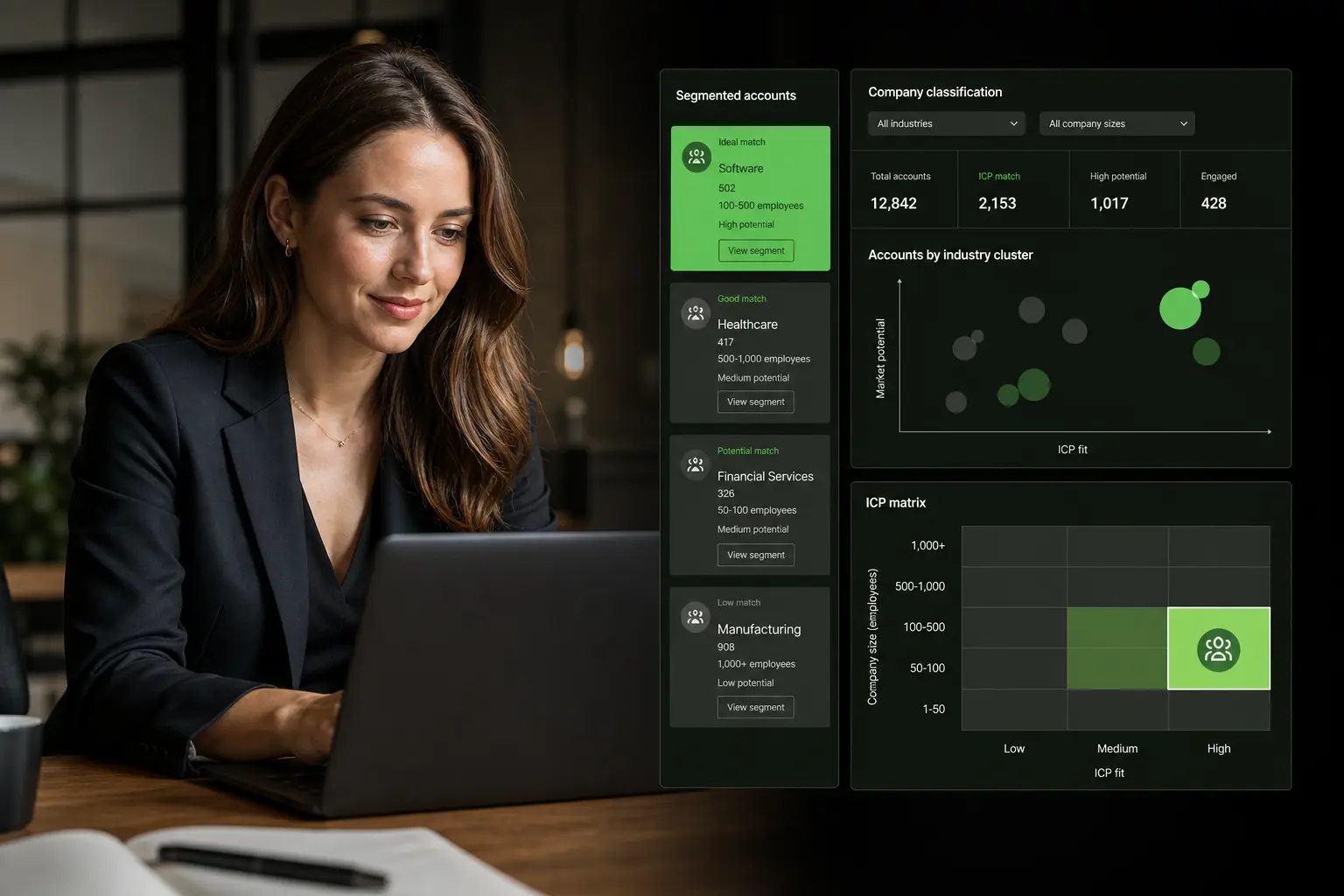
A structured ICP combines the 3 dimensions in a segmentation matrix. Example for a SaaS commercial management publisher:
| Dimension | Target values |
|---|---|
| Industry (NAICS) | 424 (wholesale), 484 (truck transportation), 4931 (warehousing) |
| Size | SMB 20-100 employees |
| Legal form | LLC or Inc. |
This matrix defines a precise ICP: wholesalers and transporters SMB under LLC/Inc. On a US company database, this returns approximately 12,000 to 18,000 target accounts.
Tier prioritization
Once the ICP is defined, prioritize into 3 tiers:
- Tier 1: perfect ICP core (top 10-15%), maximum commercial effort, full multichannel sequences
- Tier 2: acceptable ICP with 1 slightly off dimension (top 30-40%), email + LinkedIn touch sequence
- Tier 3: expanded addressable market (top 50-70%), email-only sequence at volume
This prioritization avoids treating all prospects with the same effort and delivers a pipeline / SDR resources ratio 2 to 3x better.
90-day iteration
An ICP matrix is never perfect first try. Plan a 90-day iteration:
- Measure response rate per cell (industry × size × legal form)
- Identify the 3 outperforming cells: replicate and scale
- Identify the 3 underperforming cells: drop from ICP or re-pitch
This iteration loop turns a theoretical ICP into a field-validated ICP.
Zeliq and classification for ICP
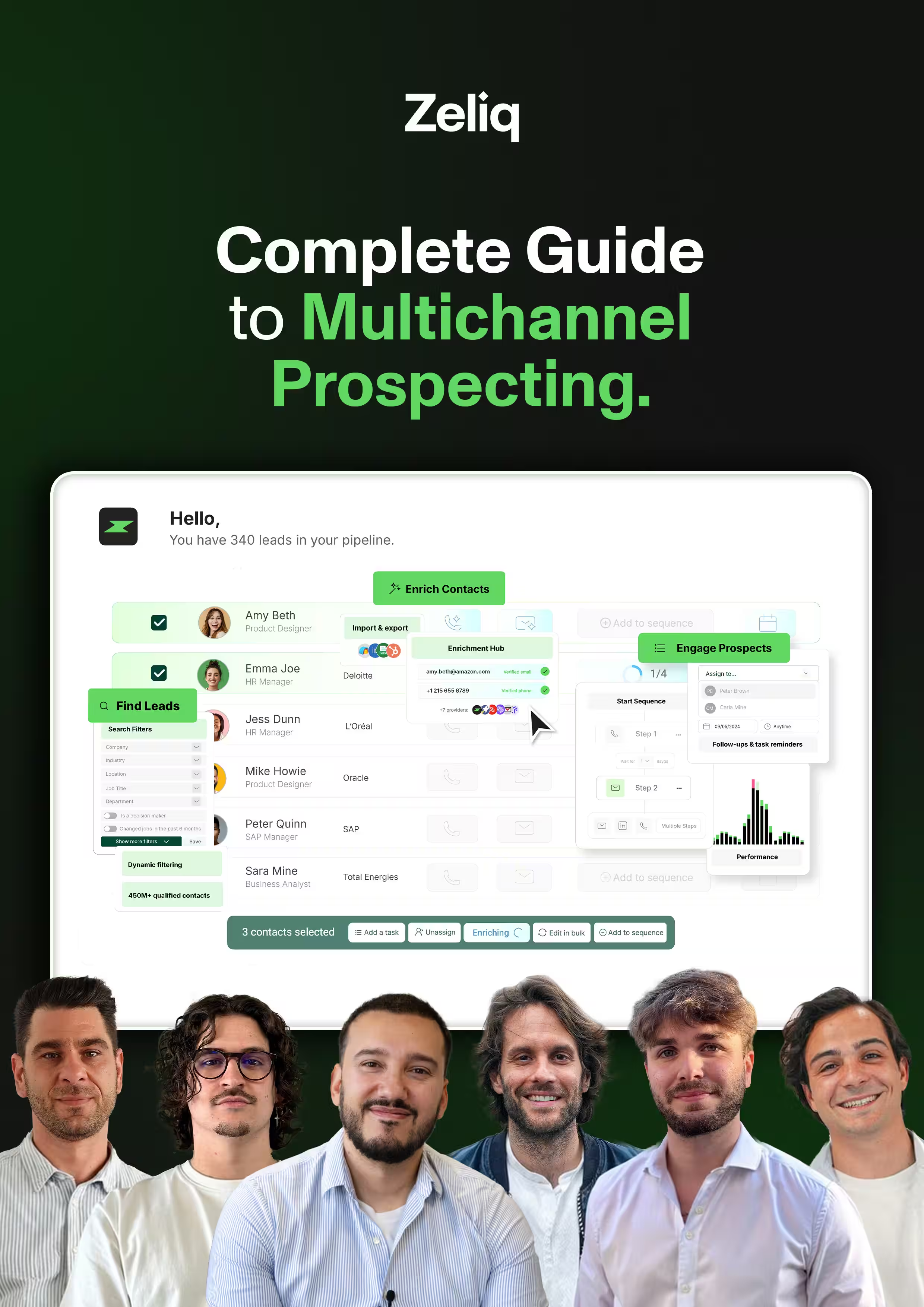
Zeliq combines a 450 million B2B contact database with automated company enrichment: NAF/NAICS code, INSEE size bracket, legal form, and financial data surface in 2 clicks from a CSV or LinkedIn list. You build a 3D ICP in 30 minutes instead of 40 manual hours and launch differentiated multichannel sequences per ICP cell.
7. Automatically enriching a database by classification
The 3 free sources to know
For classification enrichment at small volume (under 500 accounts/month):
- INSEE Sirene API (free, France): SIREN → NAF code, headcount, legal form, creation date
- BODACC (free, France): official French business bulletin, surfaces events (incorporations, dissolutions, judgments)
- Companies House (free, UK): British equivalent of Sirene
- US EDGAR / OpenCorporates (free, US): federal filing data
These sources are reliable and current but require development to be exploited in batch (API calls, quota management, response parsing).
Commercial tools for scale
For volume enrichment (500+ accounts/month), a B2B enrichment platform is more profitable than internal development. Selection criteria:
- Geographic coverage: France only vs Europe vs global
- Fields returned: at minimum NAF/NAICS code, headcount, revenue, legal form, creation date
- Freshness: monthly refresh minimum
- CRM integration: native HubSpot/Salesforce vs Zapier
- Pricing model: monthly subscription vs pay-per-request
2026 cost: 0.05 to 0.20 USD per enriched company in Europe, 0.20 to 1 USD per US company depending on data depth.
The enrichment workflow
Typical workflow of a RevOps team enriching its database by classification:
- Extraction: list of unclassified CRM accounts (CSV)
- Enrichment: upload via API or platform UI
- Validation: quality control on a sample (the 5% with most uncertain data)
- Import: reintegration into CRM with field mapping
- Quarterly refresh: re-run on active accounts to capture changes
This workflow takes 4 to 8 RevOps hours per quarter to maintain clean classification on 5,000 to 20,000 accounts.
8. Case study: mid-market SaaS ICP, +38% meetings in 90 days
Context (January 2026): French B2B SaaS publisher, 120 employees, 12.8M EUR ARR, sales team of 6 SDRs + 4 AEs. VP Sales goal: build a rigorous mid-market ICP to stop targeting a “wide market” diluting resources.
Initial diagnosis:
- Commercial database of 24,000 unclassified accounts
- 62% of booked meetings come from 8% of accounts, but no formal ICP
- Uniform sequences sent to all segments, no industry personalization
- Average response rate: 5.8%, dropping over 6 months
90-day corrective actions:
- Classification enrichment of the entire database (NAF code, INSEE size, legal form)
- Analysis of last 60 commercial wins to identify ICP patterns
- 3D ICP matrix definition: industry × size × legal form, with 3 priority tiers
- Database segmentation: 3,200 Tier 1 accounts, 6,800 Tier 2, 14,000 Tier 3
- Differentiated sequences per tier with aligned industry messages
- Scheduled quarterly classification refresh
Measured results at 90 days (April 2026):
| KPI | Before (Jan) | After (April) | Delta |
|---|---|---|---|
| Classified accounts | 0% | 96% | +96 pts |
| Tier 1 meeting rate | 5.8% (mix) | 14.2% | +145% |
| Tier 2 meeting rate | 5.8% (mix) | 7.1% | +22% |
| Tier 3 meeting rate | 5.8% (mix) | 3.4% | −41% |
| Total meetings/month | 68 | 94 | +38% |
| Cost per meeting | 128 EUR | 87 EUR | −32% |
| Average sales cycle | 84 days | 61 days | −27% |
90-day ROI: enrichment investment 3,800 EUR (24,000 accounts × 0.16 EUR), value of 78 extra meetings × 3 months × 1,400 EUR average value = 328K EUR additional pipeline. ROI within SKILL v4 cap (10x).
9. Frequently asked questions
What’s the difference between NAF code and APE code in France?
No nomenclature difference, only usage difference. The NAF code (Nomenclature d’Activités Française) refers to the classification itself with its 732 categories. The APE code (Activité Principale Exercée) refers to the specific NAF code assigned by INSEE to a company or establishment at incorporation. In practice, “APE code” refers to a company’s individual code, “NAF code” to the generic nomenclature. Same code can be called “APE 6201Z” or “NAF 6201Z” depending on context, it’s the same code. Watch out though: a company has an APE code at SIREN level (whole company) AND an APE code at SIRET level (per establishment). A multinational may have different APE codes for HQ and factory, potentially causing outbound confusion.
What’s the difference between SMB and mid-market in France?
The difference is set by 3 cumulative thresholds: headcount, revenue, balance sheet. An SMB has fewer than 250 employees AND less than 50M EUR revenue OR less than 43M EUR balance sheet. A mid-market company has 250 to 4,999 employees AND less than 1.5B EUR revenue OR less than 2B EUR balance sheet. These thresholds come from French decree 2008-1354 and align with EU recommendation 2003/361/EC. In practice, France counts about 5,800 mid-market companies in 2026 (INSEE), vs 3.7 million SMBs and 287 large enterprises. The SMB → mid-market transition is a major event (new accounting, social, tax obligations) and a strong prospecting signal: a company that just crossed into mid-market is often in structuring investment phase on tools and processes, thus receptive to well-targeted commercial outreach.
How often should I refresh classification on a commercial database?
Every 6 months for size and legal form, every 12 months for NAF/NAICS code. Size (headcount) evolves quickly: hires, layoffs, acquisitions vary a company 20-30% annually on average. Semestrial refresh captures these variations and prevents treating a mid-market as SMB 12 months after bracket change. Legal form changes rarely but can shift on LLC → Corp. transformation or M&A. Semestrial refresh suffices. NAF/NAICS code changes even more rarely (companies only change primary activity on major strategic pivots), annual refresh is adequate. In practice, mature RevOps teams run a full quarterly refresh on strategic accounts (top 10-15%) and semestrial refresh on the rest, costing 2 to 5 USD per account annually and securing ICP segmentation quality.
10. Conclusion: 3 actions to run this week (June 2026)
Audit classification presence in your CRM within 7 days. If under 70% of your accounts have a NAF/NAICS code AND size bracket AND legal form, your ICP segmentation is fragile. Launch a database enrichment before any new campaign.
Analyze the last 30 commercial wins to extract an ICP pattern within 15 days. What dominant size? What industry? What legal form? This pattern must become your formalized Tier 1 ICP in a team-shared document.
Build a 3D ICP matrix with 3 priority tiers within 15 days. Tier 1 = perfect ICP core, Tier 2 = acceptable adjacent, Tier 3 = expanded addressable. Align your multichannel sequences on this matrix to stop treating all prospects the same way.
Enrich your database by classification in 1 click
Zeliq combines 450 million B2B contacts, NAF/NAICS + size + legal form enrichment, and multichannel sequences per ICP cell. Account set up in 2 minutes, no credit card.
Try for freeAnd if you want to turn a flat database into an actionable 3D ICP, try Zeliq for free: classification enrichment, ICP mapping, and multichannel sequences in a single interface, no credit card.