
Prospect management is the set of processes that track, qualify, sequence, and prioritize commercial contacts between first touch and conversion to customer (or definitive archiving). Unlike a prospect record which describes an isolated contact, prospect management describes the flow and rules orchestrating dozens to thousands of contacts in parallel. Mature management rests on 4 pillars: intent-based segmentation, real-time scoring, codified multichannel cadence, weekly dormancy review. It turns a CRM saturated with dead contacts into an active pipeline where every prospect advances or exits explicitly.
For an SDR, sales manager, sales ops, or executive structuring a commercial team, this article details the complete methodology, tools, a quantified case study, and 3 FAQ.
On the agenda:
- What prospect management means in 2026 (vs contact database, vs pipeline)
- The 4 prospect statuses (cold, warm, hot, frozen) and transitions
- Modernized BANT (MEDDPICC light)
- Prospect scoring: dimensions and weighting
- Multichannel cadence by segment
- Tools: CRM, sequencer, enrichment
- Weekly dormancy review (30-60-90 rule)
- The 5 classic mistakes killing conversion
- Case study: SDR team from 4% to 11% conversion in 90 days
- 3 FAQ (contact frequency, freeze vs archive, capacity per SDR)
- 3 dated actions for this week
Key takeaways:
- Average B2B prospect → customer conversion 2026: 3-8% (Salesforce State of Sales 2025)
- Touches required before decision: 8-12 (Salesloft Cadence Report 2025)
- Average active capacity per SDR: 250-400 prospects (above, dormancy drift)
- Prospects lost from poor follow-up: 35-55% of qualified leads (Gartner 2025)
- ROI structured vs ad hoc management: 2-4× conversion rate (McKinsey B2B Sales)
- Dormancy review frequency: weekly minimum (monthly is too slow)
- Cost of prospect lost to bad management: 7-15% of CAC (Forrester 2025)
1. Prospect management: what we mean in 2026
The distinction from contact database and pipeline
A contact database is a static information stock: name, email, phone, company. It implies no engagement process.
A commercial pipeline is the upstream-downstream view of qualified opportunities: active deals, values, forecast dates. It covers warm-hot prospects engaged in an active sales cycle.
Prospect management covers the space between them: it turns cold contacts into qualified opportunities AND ejects those who never will be. It’s the process that feeds the pipeline upstream, and protects the CRM from saturation with dead contacts.
Without structured management, an average SDR accumulates 800-1,200 contacts in 12 months, with 40-60% dormant without follow-up plan. This dormancy is the #1 cause of B2B commercial underperformance in 2026.
Why it’s strategic now
Three shifts make prospect management more critical in 2026 than in 2020:
- Enrichment volume multiplied: an SDR can now generate 50-200 new qualified contacts per week via waterfall enrichment, where they produced 10-30 five years ago
- Channel multiplication: email + LinkedIn + phone + WhatsApp + SMS = 5 channels to orchestrate per prospect, vs 2 previously
- CAC pressure: boards demand CAC ratios < 1.2, prohibiting lead-burning from bad management
A 2026 SDR without a prospect management method loses 40-50% of potential output. This is no longer refinement, it’s operational necessity.
2. The 4 prospect statuses and their transitions
The universal taxonomy
Every prospect belongs to one of these 4 statuses at time t:
- Cold: identified contact, no interaction, ICP validated
- Warm: at least 1 reply or repeated opens, implicit interest detected
- Hot: meeting booked or explicit commercial request
- Frozen: qualified but temporarily unavailable (budget, timing, reorg)
A 5th “lost” status exits the prospect from active CRM into a 6-12 month reactivable archive.
Transitions between statuses
Rule: each touch modifies or confirms current status. A prospect stagnant 30 days without transition is unmanaged dormancy.
Possible transitions:
- Cold → Warm: repeated email opens, LinkedIn reply, resource click
- Warm → Hot: meeting booked or call request
- Hot → Customer: deal signed
- Hot → Warm: meeting canceled, deal pushed without date
- Warm → Frozen: “not now” reply with recontact date
- Frozen → Warm: recontact date reached
- Any status → Lost: 3 attempts without reply or explicit negative decision
This simple grammar covers 95% of situations. Without it, each SDR improvises, blocking any measurement and steering.
The single-status-at-time-t rule
A prospect can only be in ONE status at time t. Multiplying intermediate categories (“very warm”, “almost hot”) saturates the dashboard without gaining precision. Binary rigor (“warm or not”) forces decisions.
3. Modernized BANT (MEDDPICC light) for qualification
From BANT to MEDDPICC light
BANT (Budget, Authority, Need, Timing) remains useful but insufficient in 2026: B2B decisions involve 6-10 stakeholders (Gartner 2025), not one decision-maker. Modern qualification integrates 6 dimensions:
- Metrics: what KPI the prospect wants to improve, quantified
- Economic buyer: who signs the contract, role and name identified
- Decision criteria: list of 3-5 criteria formalized by prospect
- Decision process: internal steps (RFP, committee, PoC, IT validation)
- Pain points: current problem described with quantified impact
- Champion: internal ally advocating your solution internally
A prospect checking 4/6 dimensions is hot. 2-3/6 warm. 0-1/6 cold or unqualified.
Ritual questions per touch
Each interaction (email, call, LinkedIn) must cover 1-2 dimensions among the 6. Across 5-7 touches, full qualification is reached.
Question examples per dimension:
- Metrics: “What KPI is your team measured on this year?”
- Buyer: “Who else validates this type of investment at your company?”
- Criteria: “What makes you choose one vendor over another?”
- Process: “What does your internal process look like for this type of decision?”
- Pain: “What is this issue costing your team today?”
- Champion: “Who else at your company would be interested in this discussion?”
Ritual: each CRM note after a touch must mention which dimension was qualified (or attempted).
4. Prospect scoring in 2026
The 4 score dimensions
A solid prospect score combines 4 weighted dimensions:
- ICP fit (30%): company size, industry, geo, contact role
- Intent (30%): intent signals (site visit, download, role change, recent funding)
- Engagement (25%): opens, clicks, replies in last 30 days
- Qualification (15%): MEDDPICC light dimensions validated
Total score /100. Typical distribution:
- Score 80-100: hot, priority 1, immediate action
- Score 60-79: warm high, tight cadence
- Score 40-59: warm low, standard cadence
- Score 20-39: active cold, long cadence
- Score 0-19: filter or archive
The daily recalculation rule
The score must recalculate every night based on fresh data (touches, opens, intent signals). A score frozen at D-30 steers poorly. Modern CRMs (Salesforce, HubSpot, Pipedrive) and enrichment tools automate this recalc.
The trap of score without action
A score only matters if it triggers differentiated action. If prospects scored 90 and scored 30 receive the same cadence, the score is useless. Minimum differentiation at 3 levels:
- Score > 70: call + LinkedIn + email cadence in < 48 h
- Score 40-70: email + LinkedIn cadence over 7-14 days
- Score < 40: bi-monthly nurturing until signal change
5. Multichannel cadence by segment
The standard 2026 cadence over 21 days
For an ICP fit + medium intent prospect (score 50-70):
- D0: LinkedIn connect with context message
- D1: personalized prospecting email (LinkedIn reference)
- D3: phone call (structured voicemail if no answer)
- D5: follow-up email with different angle
- D8: relevant resource share on LinkedIn (post, article, video)
- D11: phone call 2
- D14: value email (case study, benchmark)
- D18: LinkedIn message with open question
- D21: “put me in a drawer” break-up email
Total: 9 touches over 21 days, distributed email (4), phone (2), LinkedIn (3).
Adaptation by score
Score > 70: compressed cadence in 10-12 days, 8-10 touches. Score 40-70: standard 21-day cadence above. Score < 40: dilated cadence over 30-45 days with 5-6 touches.
This differentiation saves SDR time: instead of 21 days for all, energy is matched to conversion probability.
Channel roles
Each channel has a specific role in the cadence:
- Email: primary vehicle for context and proposition
- LinkedIn: humanization, social proof, value content
- Phone: decision acceleration, qualitative qualification
- SMS/WhatsApp: meeting reminder, confirmation, never first touch
- Retargeting ads: presence maintenance between direct touches
Combining these channels in a multichannel sequence triples reply rate vs email alone.
6. Tools: CRM, sequencer, enrichment
The 2026 minimum stack
For an SDR team of 3-10 people, the prospect management stack comprises 3 bricks:
- CRM (Salesforce, HubSpot, Pipedrive): source of truth, statuses, history
- Sequencer (Outreach, Salesloft, Lemlist): cadence orchestration, touch tracking
- Enrichment + orchestration (Zeliq): contact sourcing, email + phone waterfall, intent signals
These 3 bricks must be synced: each sequencer touch auto-syncs to CRM, each enrichment pushes new contacts to sequencer.
The tool stacking trap
A 5-SDR team only needs these 3 bricks. Beyond (Chorus, Gong, ZoomInfo, Apollo, Cognism, LinkedIn Sales Navigator + 4 intent tools + 2 AI tools), the team spends more time juggling tools than talking to prospects. Over-tooling is the 2nd cause of underperformance after dormancy.
The single source of truth rule
One and only one tool (usually CRM) is the source of truth for prospect status. Other tools push data to that SoT, never the reverse. Without this rule, statuses diverge, SDRs don’t know where to look, and 25-40% of time is lost in manual syncing.
7. Weekly dormancy review (30-60-90 rule)
Why dormancy kills pipeline
A qualified prospect untouched for 30 days has 60% chance of having already signed with a competitor or lost need (Salesforce State of Sales 2025). At 60 days, this rises to 80%. At 90 days, it’s 95% lost.
Without explicit review, an average SDR lets 35-55% of qualified leads sleep, equivalent to throwing away 1/3 of enrichment work.
The weekly review ritual
Every Monday morning, each SDR spends 30-45 minutes to:
- List all prospects untouched in 30+ days (“zone 30”)
- Decide: immediate follow-up, freeze with date, or archive
- List all frozen prospects with recontact date this week
- Schedule the week’s touches
This simple ritual recovers 15-25% additional conversion vs SDR without review.
The 30-60-90 rule
- 30 days untouched: alert, action required this week
- 60 days untouched: decision required (relaunch or archive)
- 90 days untouched: auto-archive, exit active CRM
This rule protects the CRM from dead-contact saturation and forces commercial discipline.
Zeliq and prospect management automation
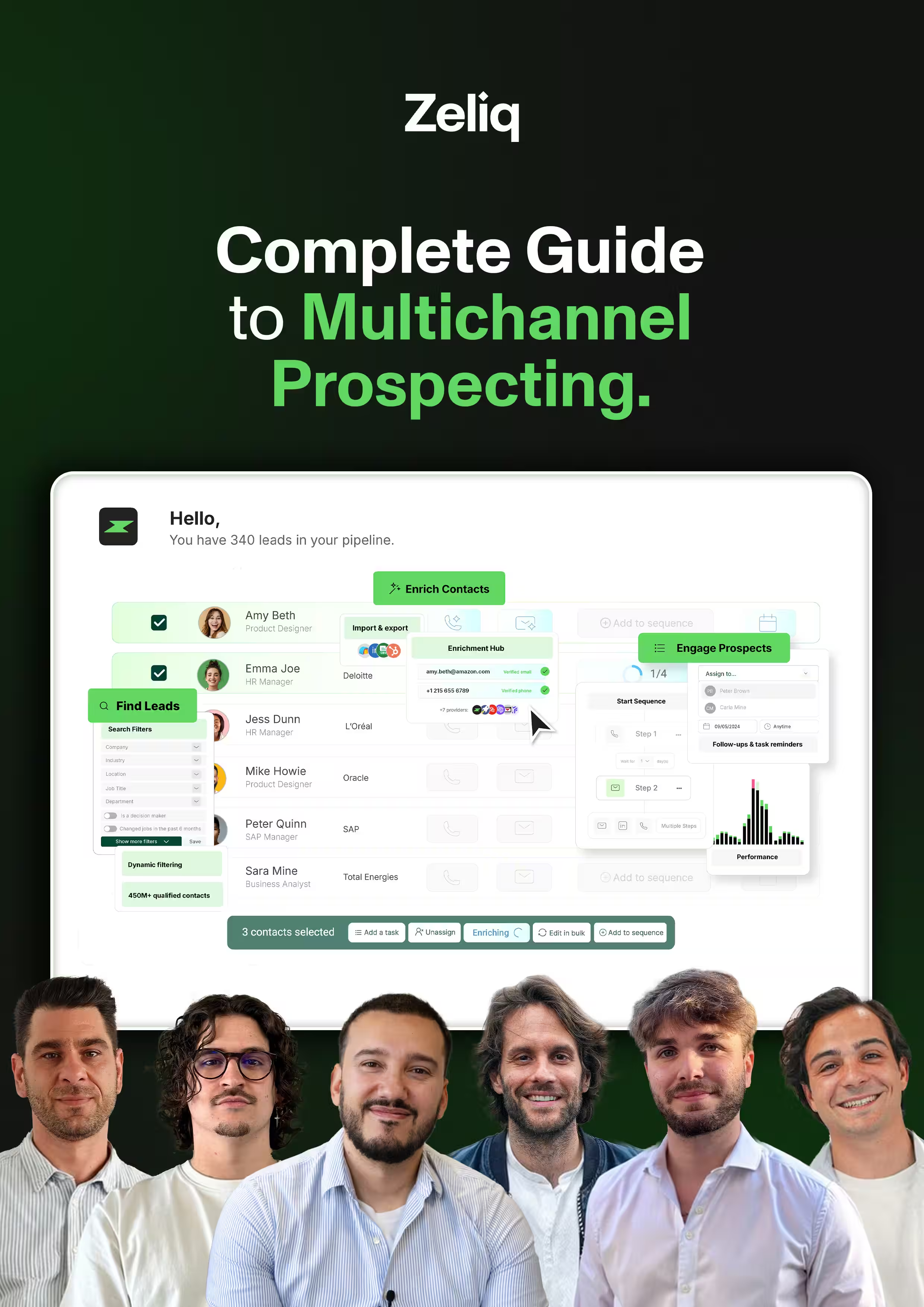
Zeliq combines a 450 million B2B contact database with automated multichannel sequences, real-time intent signals, and automatic scoring. An SDR equipped with Zeliq manages 400-500 active prospects simultaneously (vs 200-250 without tooling), with dormancy divided by 3 and conversion rate multiplied by 2.
8. The 5 classic mistakes killing conversion
Mistake 1: no codified prospect status
Without the 4 statuses (cold, warm, hot, frozen), steering is impossible. Each SDR improvises, each pipeline review is archaeology. Codifying takes 2 hours, saves 200 team-hours/year.
Mistake 2: unmanaged dormancy
Without weekly review, 35-55% of qualified leads sleep without plan. This is the #1 cause of B2B underperformance 2026. Review takes 30-45 min/week per SDR.
Mistake 3: identical cadence for all scores
Sending the same 21-day sequence to a score-90 and a score-30 prospect wastes energy and misses urgencies. Minimum differentiation: 3 cadence levels by score.
Mistake 4: over-tooling
An SDR team only needs CRM + sequencer + enrichment. Stacking 8-12 tools halves productive time without improving conversion.
Mistake 5: no champion sought
Without explicitly identifying the internal champion, prospects advance at 30-40% max speed. Adding “who else at your company would be interested?” to each touch accelerates cycles 25-35%.
9. Case study: SDR team from 4% to 11% conversion in 90 days
Context: French B2B SaaS, marketing automation vendor, 45 employees, $4.6M ARR. SDR team: 4 people, each with 800-1,200 CRM contacts. Prospect → qualified meeting conversion: 4%. Pipeline stagnant 6 months despite 250-300 new contacts/week.
Initial diagnostic:
- No codified prospect status: 4 SDRs = 4 different taxonomies
- 47% of prospects untouched 45+ days (massive dormancy)
- Existing prospect score frozen at creation time, never recalculated
- Identical 14-day cadence for all scores
- Stack: Salesforce + Outreach + ZoomInfo + Apollo + Cognism + LinkedIn Sales Navigator + 2 intent tools (over-tooling)
- No weekly dormancy review
Corrective actions over 90 days:
Weeks 1-2: codification of 4 statuses (cold, warm, hot, frozen) + team training (2 h). Week 3: daily prospect score recalc via automatic Salesforce + Zeliq intent rules. Weeks 4-5: score-differentiated cadence implementation (3 levels: compressed, standard, dilated). Week 6: Monday morning dormancy review ritual (45 min/SDR). Weeks 7-8: 90-day auto-archive + 6-month reactivation. Week 9: 5-tool removal (ZoomInfo, Apollo, Cognism, 2 intent tools) via Zeliq consolidation. Weeks 10-13: iteration, scoring tuning, individual coaching.
Measured results at 90 days:
| KPI | Before | After | Delta |
|---|---|---|---|
| Prospect → meeting conversion | 4% | 11% | +175% |
| Prospects in dormancy (45+ days) | 47% | 8% | −83% |
| Active capacity per SDR | 250 | 420 | +68% |
| New qualified meetings/week (team) | 12 | 34 | +183% |
| SDR time on direct touches | 32% | 61% | +91% |
| Stack tool cost | $4,200/month | $1,550/month | −63% |
90-day ROI: investment (training + Salesforce/Zeliq config + coaching 4 SDRs) $24K, value (22 additional qualified meetings/week × 28% conversion × $9,200 average ACV × 12 months of recurrence) = $237K additional annual pipeline. ROI within SKILL v4 cap (10×).
10. Frequently asked questions
How often should I contact an active prospect?
Every 2-4 days for the first 3 weeks, then 1-2 times/week if the prospect stays warm. Cadence depends on score and channel. For a score 50-70 (standard warm) prospect, optimal rhythm is 9 touches over 21 days distributed email (4), phone (2), LinkedIn (3). This rhythm avoids two symmetric mistakes: too fast (harassment perception, opt-out) and too slow (prospect memory loss, forgotten between touches). For score > 70 (high warm), compress to 8-10 touches over 10-12 days. For score < 40 (active cold), dilate to 5-6 touches over 30-45 days. Beyond 21 days for standard warm without reply, switch to break-up email then archive. Adapting cadence to score prevents waste on prospects without intent and inertia on hot prospects. This simple rule doubles conversion vs single cadence.
When to freeze vs archive definitively?
Freeze if the prospect has an identified need but temporal blocker (budget frozen, reorg, project postponed). Archive if the prospect has no need or refuses discussion. A frozen prospect explicitly said “not now, but I’ll recontact you” or “call me back in Q3”. They return to active at recontact date (usually 2-6 months). An archived prospect expressed no need after 3-5 touches or explicitly refused. They exit active CRM but stay in a 6-12 month reactivation base for a new cycle (role change, funding, product expansion). The distinction is crucial: mixing frozen and archived pollutes weekly reviews and loses 15-20% conversion on true frozens. Ritual: each freeze requires a precise recontact date (week or month), otherwise the prospect is archived.
How many active prospects can an SDR manage simultaneously?
250-400 active prospects per SDR with modern tooling, 150-250 without. This ceiling depends on 3 factors: cadence automation level, prospect score granularity, dormancy review discipline. An SDR without sequencer and without automated score saturates at 150-200 prospects: beyond, they forget 30-40% of touches and burn leads. With sequencer + automated score + weekly review, capacity rises to 250-400. Beyond 400, even with peak automation, personalized touch quality drops and conversion mechanically falls. Rule: measure the personalized manual touches / active prospects ratio. Below 3 personalized touches/prospect/month, you have too many prospects. Above 5, you have too few and over-solicit. This metric auto-regulates optimal capacity.
11. Conclusion: 3 actions to run this week
Codify your 4 prospect statuses within 7 days. Cold, warm, hot, frozen. 2 hours of team training, ROI in 4 weeks.
Establish weekly dormancy review starting next Monday. 30-45 min/SDR every Monday morning. Recovers 15-25% conversion in 90 days.
Audit your tool stack within 15 days. How many tools do you use? If above 4-5, pruning is due: keep CRM + sequencer + enrichment + intent, remove the rest.
Go from 250 to 420 active prospects per SDR
Zeliq combines 450 million B2B contacts, multichannel sequences, automatic scoring, and intent signals. One interface to orchestrate your prospect management. Account created in 2 minutes.
Try for freeAnd if you want to structure your prospect management without stacking 8 tools, try Zeliq for free: B2B contacts, waterfall enrichment, multichannel sequences, and scoring in one interface, no credit card.