
A B2B contact database is a searchable repository of business contact records (typically 50M-250M profiles per aggregated 2026 SERP benchmarks) each carrying identity fields (name, title, company), reachability fields (verified email, direct phone, LinkedIn URL), and contextual fields (firmographic, technographic, buying signals). In 2026, B2B contact database records decay at approximately 22.5% per year per aggregated industry benchmarks, which makes continuous refresh cadence a bigger determinant of real accuracy than the headline contact count. This article breaks down the schema every professional contact database delivers, the accuracy-vs-size trade-off, verification methods, 8 leading vendors, cost benchmarks, and 3 FAQ.
For an SDR lead, RevOps engineer, Head of Sales, or founder selecting a B2B contact database, this article gives the schema map, the ICP-fit accuracy test, and the vendor grid.
On the agenda:
- What a B2B contact database contains (schema)
- The 3 field categories: identity, reachability, context
- Accuracy vs size: why the headline number lies
- The 3 verification methods (human, AI-assisted, automated)
- 8 leading vendors compared
- The 500-contact ICP-fit accuracy test
- Cost per verified contact
- Compliance: GDPR, CAN-SPAM, CCPA
- 3 FAQ (accuracy testing, size vs freshness, cost)
Key takeaways:
- Definition: searchable B2B contact repository with identity, reachability, context fields
- Size range: 50M-250M contacts across leading vendors per aggregated 2026 SERP
- Data decay: ~22.5% per year, continuous refresh beats raw size
- Verification methods: human-verified, AI-assisted, automated
- Accuracy benchmarks: email 90-97% deliverability typical; phone 45-70% single-source, 85%+ waterfall
- Cost per verified contact: $0.05-0.50 depending on volume and method
- 8 leading vendors: Apollo, ZoomInfo, Cognism, Lusha, UpLead, SalesIntel, Kaspr, Zeliq
- Compliance: FTC CAN-SPAM US, GDPR (CNIL 2025 €486M enforcement) EU
1. What a B2B contact database contains (schema)
A professional B2B contact database is a structured record with fields grouped in three categories. Every mature vendor delivers all three; entry-level databases skip categories 2 or 3.
Category 1, Identity fields
- First name, last name
- Job title, seniority level, department
- LinkedIn URL
- Work history (previous positions, tenure)
Identity fields anchor the record. LinkedIn URL is the highest-precision anchor across geographies; email is the second.
Category 2, Reachability fields
- Verified professional email +
email_status(valid,catch_all,invalid) - Direct phone (mobile or line phone)
- Company domain
Reachability fields are what SDRs actually use to send outreach. Field-level verification status (not just presence) is the quality signal that matters.
Category 3, Context fields
- Company firmographics (name, domain, employee count, revenue, industry, HQ, funding stage)
- Technographic data (tech stack detected on the company’s site)
- Behavioral signals (recent hire, funding round, tech switch, executive change)
Context fields feed lead scoring, routing, and personalization workflows. Databases that skip context turn into address books.
2. Accuracy vs size: why the headline number lies
Vendor marketing frames coverage claims (150M, 250M, 500M+) as the primary quality signal. Independent testing published across the SERP top 10 consistently finds a large gap between coverage claim and verified match rate on real ICPs.
The reality: - Vendor coverage claim: typically 95%+ published - Real verified match rate on specific ICP: 65-90% single-source, 90-95% waterfall multi-source
Meaning: a database claiming 250M contacts may only return 65% verified matches on your ICP. The 35% miss burns SDR hours on bad-data outreach.
Root cause: vendors count records touched (partial matches, pattern guesses, catch-all responses) as “matches” in their marketing benchmarks. Independent tests measure only records where the returned email verifies as valid via independent SMTP. That is the ground truth.
3. The 3 verification methods
Vendor verification methods drive the accuracy variance far more than raw database size.
Human-verified: a data operations team physically verifies each record on a rolling basis. Highest per-record accuracy (95%+), lower scale, higher cost. Example: SalesIntel.
AI-assisted: machine learning models score record confidence based on multiple signals (email format, domain patterns, cross-source agreement). Moderate accuracy, high scale, moderate cost. Example: most modern platforms combine this with SMTP verification.
Automated (SMTP + pattern match): pings destination mail server + generates likely emails from name + domain patterns. Highest scale, moderate accuracy, lowest cost. Example: Apollo, UpLead, Hunter.
Waterfall enrichment stacks all three: automated as first pass, AI-assisted for confidence scoring, human for the highest-priority segment.
4. 8 leading vendors compared
Positioning verified September 2026 via aggregated SERP.
Apollo
Mid-market self-serve. 275M+ contacts per vendor claim, 90%+ email deliverability at export. Paid plans start $49/user/month billed annually per Apollo public pricing.
Best for: mid-market self-serve teams testing broad prospecting.
ZoomInfo
Enterprise US-dominant. 500M+ contact records per vendor claim (150M+ verified emails per SERP-verified figure). Deepest US firmographic and org-chart data. Annual enterprise pricing.
Best for: US enterprise sales teams with $50k+ annual sales tool budget.
Cognism
EMEA-native GDPR-compliant. Diamond Data phone verification 98% per vendor claim. Annual enterprise pricing.
Best for: EMEA-focused sales teams with strict GDPR compliance.
Lusha
Phone-first mid-market. 98% email accuracy and 86% phone accuracy per vendor claim, starting at $37/month with free tier per Lusha public pricing verified September 2026.
Best for: phone-heavy outbound, mid-market self-serve.
UpLead
Real-time SMTP verification at export with 95% accuracy guarantee per vendor claim. 160M+ leads.
Best for: small teams prioritizing per-export accuracy.
SalesIntel
Human-verified data model. Smaller volume, higher per-record confidence. Weekly-refresh cadence.
Best for: teams where individual record accuracy matters more than volume breadth.
Kaspr
France/Europe phone-first mid-market. LinkedIn Chrome extension companion.
Best for: SDR teams doing France/Europe outbound with LinkedIn-centric workflow.
Zeliq
450M B2B contacts, waterfall enrichment built into single interface, integrated email verification, multichannel sequences bundled. European positioning, GDPR-native.
Best for: European SDR teams wanting database + waterfall + sequencer bundled at mid-market pricing. See B2B contact data for the full vendor comparison.
5. The 500-contact ICP-fit accuracy test
Before committing to any vendor, run this reproducible test. It takes 3-5 hours and produces defensible ground-truth data.
Step 1: build a 500-contact sample tightly matching your ICP (title + industry + geography + size). Diversify across 5-10 companies to avoid domain skew.
Step 2: enrich the same sample through 2-3 candidate vendors (free tiers or trials).
Step 3: for each vendor, count records where email_status == "verified" after independent SMTP verification via NeverBounce, MillionVerifier, or ZeroBounce.
Step 4: cross-check 50 random verified contacts against current LinkedIn to measure title freshness. Anything above 15% title mismatch signals poor freshness.
Step 5: compute cost per usable verified contact by multiplying credits used × per-credit rate divided by verified records.
Trust your ground-truth numbers over vendor benchmarks. Anything below 60% single-vendor or 85% waterfall on your ICP signals wrong vendor.
6. Cost per verified contact
Concrete ranges by plan tier at mid-market vendor pricing verified September 2026:
- Free tier: $0 base, 20-100 verified contacts/month allocated
- Starter monthly ($37-149/user): $0.15-0.30 per verified contact
- Growth monthly ($500-2,000): $0.10-0.20 per contact
- Enterprise annual ($20k+/year): $0.05-0.10 per contact
Waterfall enrichment multiplies unit cost 1.3-1.8× but delivers +20-40 percentage points more matches. Effective cost per usable verified contact often stays similar or lower with waterfall.
7. Compliance: GDPR, CAN-SPAM, CCPA
EU GDPR: B2B cold email uses “legitimate interest” basis. Requires documented interest per ICP + opt-out + suppression + 3-year retention. CNIL 2025 sanctions hit €486M total (vs €55M in 2024), including SOLOCAL Marketing Services at €900k for prospecting without sufficient legal basis. Vendor choice materially affects risk exposure.
US CAN-SPAM: FTC compliance guide requires accurate subject line + valid physical address + functional opt-out + honor opt-out within 10 business days.
California CCPA/CPRA: right to know, delete, opt-out. B2B partial exemption but disclosures still expected.
For EMEA-heavy ICPs, prefer GDPR-native vendors (Cognism, Zeliq, and a few others).
Zeliq and multi-source contact database access
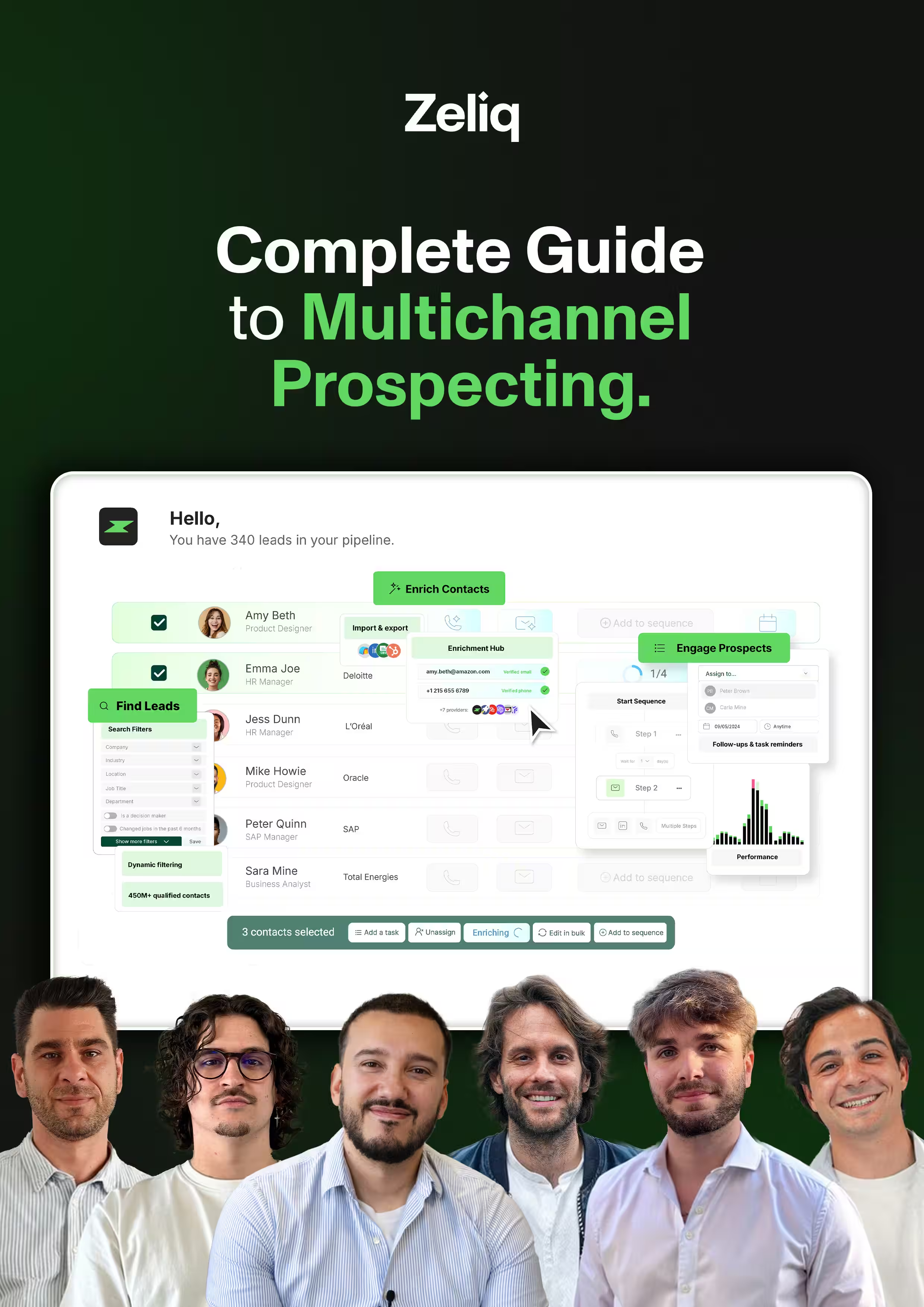
Zeliq combines a 450 million B2B contact database, waterfall enrichment across multiple data sources with integrated email verification, and multichannel sequences in one interface. Contact records span identity + reachability + context fields at Tier 3-4 CRM integration depth. GDPR-native suppression, European positioning.
8. Common mistakes
Mistake 1: Picking on database size claim alone. 500M vendor claim beats 200M in marketing but rarely on real ICP verification.
Mistake 2: Skipping the ICP-fit accuracy test. Every vendor offers free tier or trial. Not testing = flying blind.
Mistake 3: Single-vendor lock-in above 5,000 enrichments/month. Waterfall compensates gaps.
Mistake 4: No refresh cadence. Static databases lose 24-30% quality/year.
Mistake 5: Ignoring integration depth. Cheap tool + 3 weeks engineering = not cheap.
9. Frequently asked questions
How do I test the real accuracy of a B2B contact database?
Run 500 in-ICP contacts through the vendor, cross-verify each returned email against an independent SMTP verifier (NeverBounce, MillionVerifier, ZeroBounce), count email_verified = valid, divide by 500 = your ground truth accuracy on that ICP. Vendor accuracy claims typically cluster at 95%+ published, but independent testing published across the SERP top 10 consistently finds 65-90% single-source and 90-95% waterfall on real ICPs. The gap comes from vendors counting records touched (partial matches, pattern guesses, catch-all responses) as “matches” in their marketing benchmarks. Real ground truth measurement: build a diverse 500-contact ICP sample (spread across 5-10 companies to avoid domain skew), enrich via vendor, then send each returned email through a second SMTP verifier. Only records that verify as valid count. Additional accuracy signal: cross-check 50 random verified contacts against current LinkedIn to measure title freshness. A 15%+ title mismatch rate signals poor freshness regardless of vendor’s refresh cadence claims. Also measure phone match rate separately: typically 30-60% of email match rate due to fragmentation and privacy laws (US > EU > APAC). If a vendor refuses to let you test on their free tier or trial, that’s a red flag; quality-confident vendors welcome measurement.
Database size vs freshness, which matters more?
Freshness matters more than size at typical B2B ICP volumes because records decay 22.5% per year per aggregated benchmarks; a 200M database refreshed weekly beats a 500M database refreshed quarterly. Aggregated industry commentary in the SERP top 10 converges on the finding that continuous refresh cadence dominates over raw contact count. Reasons: (1) at ~2% monthly decay, a database refreshed monthly maintains ~24% higher accuracy than one refreshed quarterly on the same source data, (2) vendors that publicize refresh cadence (ZoomInfo 70M+ records/week, Cognism continuous, others range monthly to quarterly) win over vendors that only publish coverage claims, (3) size matters when your ICP spans niche verticals not covered by smaller databases, but for standard B2B ICPs (SaaS, professional services, mid-market industrial), 100M+ contacts is more than enough coverage. Practical selection: (1) verify vendor’s refresh methodology (frequency + verification technique) via demo, (2) test on your ICP with 500-contact sample, (3) measure title freshness by cross-checking against current LinkedIn on 50 records. Vendors that fail freshness (> 15% title mismatch) lose despite headline size. Rule of thumb: below 250M contacts is enough for standard B2B; above 250M only matters if you need international breadth or niche verticals.
What is the total cost of a B2B contact database subscription?
$37-$500 per user per month at mid-market pricing, dropping to per-verified-contact costs of $0.05-0.10 above 50,000/year in enterprise annual contracts. Concrete tiers verified September 2026: (1) Free tier or entry-level: $37-49/user/month starting (Lusha $37/month with free tier per Lusha public pricing, Apollo $49/user/month starting billed annually per Apollo pricing), covering 500-2,000 verified contacts/month per user. Best for solo operators or teams below 3 SDRs. (2) Mid-market monthly: $100-300/user/month, covering 5,000-15,000 verified contacts/month. Best for teams of 3-10 SDRs. (3) Enterprise annual: $200-500+/user/month allocated, $20k-100k+/year total, unlimited or negotiated volume. Best above 10 SDRs with stable volume. Waterfall enrichment multiplies unit cost 1.3-1.8× but delivers +20-40 percentage points more matches, so effective cost per usable verified contact often stays similar or lower with waterfall. Beyond direct subscription, factor in: (a) verification tool if not bundled ($0-50/user/month), (b) sequencer if separate ($100-300/user/month), (c) integration debug time (5-15 hours/month for stitched stacks, near zero for all-in-one platforms), (d) CRM seat cost ($50-150/user/month). Consolidated all-in-one (Apollo, Zeliq) saves 30-40% vs stitched at 5+ SDRs while eliminating integration debug hours.
10. Conclusion: 3 actions to run
Shortlist 3 vendors within 7 days. Based on your ICP geography (US vs EMEA vs global), volume needs, and CRM stack.
Run the reproducible 500-contact ICP test within 15 days. Measure verified match rate against independent SMTP. Trust ground truth over vendor benchmarks.
Test month-to-month before annual within 30 days. Validate on 1-3 months of real usage before committing to annual pricing.
A 450M B2B contact database with waterfall enrichment and sequences bundled
Zeliq combines a 450 million B2B contact database, waterfall enrichment with integrated verification, and multichannel sequences in one interface. GDPR-native suppression, European positioning. Free trial credits included.
Try for freeAnd if you want a B2B contact database bundled with waterfall enrichment and multichannel sequences, try Zeliq for free: sourcing, waterfall enrichment, verification, and outreach in one interface, no credit card required.