

AI lead scoring applies machine learning or predictive statistics to B2B leads based on historical close patterns + behavioral signals + firmographic + intent data to output a numerical score indicating conversion probability, sorted into four architectures (CRM-native predictive like HubSpot/Salesforce Einstein, enterprise ABM like 6sense/Demandbase, PLG-specialist like MadKudu, bundled-in-prospecting like Apollo). In 2026, HubSpot predictive scoring is tied to Sales Hub Enterprise from $1,200/month per aggregated SERP commentary verified October 2026, 6sense carries Forrester Leader designation for predictive ABM, and MadKudu pioneered hybrid predictive lead scoring for SaaS + PLG motions. This article maps the 4 architectures, 8 leading tools, motion-match selection, ROI benchmarks, compliance, and 3 FAQ.
For a Head of Sales, RevOps engineer, growth marketer, or founder deploying AI lead scoring, this article gives the architecture framework + vendor grid + motion-match decision rule.
On the agenda:
- What AI lead scoring does vs rules-based scoring
- Architecture 1: CRM-native predictive (HubSpot, Salesforce Einstein)
- Architecture 2: enterprise ABM (6sense, Demandbase)
- Architecture 3: PLG specialist (MadKudu)
- Architecture 4: bundled in prospecting (Apollo)
- 8 leading AI lead scoring tools
- Motion-match selection framework
- ROI benchmarks
- Compliance: GDPR, AI governance
- 3 FAQ (AI vs rules, best tool by motion, cost)
Key takeaways:
- Definition: ML/predictive scoring using historical close + behavior + firmographic + intent
- 4 architectures: CRM-native, enterprise ABM, PLG specialist, bundled-in-prospecting
- 8 leading tools: HubSpot Sales Hub, Salesforce Einstein, 6sense, Demandbase, MadKudu, Apollo, Kumo.ai, Infer
- CRM-native: HubSpot predictive at Sales Hub Enterprise from $1,200/month per aggregated SERP
- Enterprise ABM: 6sense Forrester Leader for predictive, pricing not public typical $60k+/year
- PLG: MadKudu for product-led SaaS motions
- Motion-match rule: already on HubSpot/Salesforce → native; large ABM accounts → 6sense/Demandbase; PLG → MadKudu
- ROI: 20-40% lift in SDR qualification throughput + 20-30% higher sequence reply rate on top-scored
- Compliance: FTC CAN-SPAM US, GDPR (CNIL 2025 €486M) EU
1. What AI lead scoring does vs rules-based scoring
Two scoring architectures with distinct trade-offs:
Rules-based scoring: RevOps sets explicit rules (+15 for VP+ title, +20 for pricing page visit, +15 for webinar attendance). Transparent, easy to debug, easy to explain to sales. Hits ceiling at 20-30 rules where interactions become unpredictable.
AI/predictive scoring: machine learning trained on historical close data learns which features correlate with conversion. More accurate on complex multi-signal ICPs but opaque (hard to explain why a lead scored 87 vs 65). Requires 6-12 months of closed-deal history to train effectively.
Modern tools usually combine both: rules-based for clear signals (executive title, pricing page) + predictive ML for pattern detection on ambiguous signals.
For broader lead scoring context see B2B contact data.
2. Architecture 1: CRM-native predictive
Products: HubSpot predictive scoring (Sales Hub Enterprise from $1,200/month per aggregated SERP), Salesforce Einstein scoring.
How it works: ML model trained inside the CRM on the contact + behavioral + firmographic data CRM already holds. No external data integration required.
Strengths: tight CRM integration (scores visible on contact records), training data readily available if CRM has 12+ months of closed deals, easy adoption (no new vendor relationship).
Weaknesses: model limited to data in CRM (misses external intent, firmographic depth, tech stack signals); dependent on CRM data quality.
Best for: teams heavily invested in HubSpot or Salesforce with 12+ months of pipeline history and clean CRM data.
3. Architecture 2: enterprise ABM (6sense, Demandbase)
Products: 6sense (Forrester Leader per aggregated SERP commentary), Demandbase.
How it works: predictive models combine third-party intent data (Bombora-powered) with first-party engagement to identify in-market accounts + score them. Account-level scoring (not individual lead-level) typical.
Strengths: external intent data signal rules-based scoring can’t capture; account-based orientation matches ABM motions; AI buying stage prediction informs sales timing.
Weaknesses: enterprise pricing ($60k+/year typical, not publicly disclosed), overkill for SMB, requires ABM operating model to realize value.
Best for: enterprise teams selling into named accounts with ABM motion.
4. Architecture 3: PLG specialist (MadKudu)
Product: MadKudu, pioneered hybrid predictive lead scoring for SaaS + product-led companies per aggregated SERP.
How it works: scores leads based on product usage signals (signed up + used feature X + reached usage threshold Y) combined with firmographic fit. Hybrid predictive-ML + rules.
Strengths: purpose-built for PLG motions where product usage drives qualification; AI-powered eligibility scoring + sales-aligned rule visibility.
Weaknesses: limited value for outbound-heavy or non-PLG teams per aggregated SERP.
Best for: SaaS companies with freemium or PLG motion where product usage signals drive sales qualification.
5. Architecture 4: bundled in prospecting (Apollo)
Product: Apollo scoring (feature within database + sequencing platform at $49-149/user per Apollo public pricing).
How it works: scoring runs inside Apollo platform; SDRs see scores directly in prospecting workflow rather than separate dashboard.
Strengths: embedded in daily SDR workflow (consistency with usage), lower incremental cost (bundled), fast time-to-value.
Weaknesses: less depth than specialized scoring tools, scoring quality depends on Apollo data coverage of your ICP.
Best for: mid-market teams using Apollo as primary prospecting platform.
6. 8 leading AI lead scoring tools
Positioning verified October 2026 via aggregated SERP:
| Tool | Architecture | Pricing anchor |
|---|---|---|
| HubSpot Sales Hub Enterprise | CRM-native predictive | from $1,200/month |
| Salesforce Einstein | CRM-native predictive | Salesforce add-on |
| 6sense | Enterprise ABM | $60k+/year typical |
| Demandbase | Enterprise ABM | Enterprise custom |
| MadKudu | PLG specialist | Mid-market custom |
| Apollo | Bundled prospecting | $49-149/user |
| Kumo.ai | Relational ML specialist | Custom |
| Infer (IgniteTech) | Enterprise ML | Enterprise custom |
Other tools in 2026 comparison lists: Gro IQ, Warmly, Salespanel, Clay (with AI blocks + scoring).
See multichannel prospecting guide for how scoring feeds routing.
7. Motion-match selection framework
Three questions to pick architecture:
Question 1, CRM investment: already heavy on HubSpot or Salesforce → CRM-native predictive wins (less integration work).
Question 2, Deal motion: SDR-heavy inbound/outbound mid-market → CRM-native or bundled; enterprise ABM against named accounts → 6sense/Demandbase; PLG with product usage signals → MadKudu.
Question 3, Data history: < 12 months closed deals = ML can’t train well → rules-based + AI-added when history matures; > 12 months = AI predictive viable.
Common failure: enterprise ABM scoring on SDR-driven mid-market = overkill; CRM-native predictive without 12 months data = overfits to noise.
8. ROI benchmarks
Aggregated SERP commentary on AI lead scoring ROI verified October 2026:
- SDR qualification throughput: 20-40% faster (SDRs stop wasting time on low-fit leads)
- Sequence reply rate on top-scored: 20-30% higher than unscored
- Pipeline attribution clarity: 2-3× improvement (scoring + routing + CRM sync creates traceability)
- Forecast accuracy: 10-20% improvement when scoring predicts conversion rate at threshold
ROI measurement method: baseline 90 days pre-scoring → implement → 90 days post-scoring → compare meetings-per-SDR-per-month + close-rate-by-score-bucket.
Threshold for keeping tool: ROI > 1.5× tool cost within 6 months.
9. Compliance: GDPR, AI governance
EU GDPR: automated decision-making affecting individuals requires disclosure + opt-out option. Lead scoring + routing typically stays under disclosure threshold if humans still see all leads; fully automated routing based solely on AI score may trigger disclosure requirement. CNIL 2025 sanctions hit €486M total.
US CAN-SPAM: FTC compliance applies to outreach triggered by scoring.
EU AI Act: emerging regulation; sales scoring typically limited-risk requiring transparency about ML involvement.
California CCPA/CPRA: right to know, delete, opt-out. AI automated decision disclosure requirements evolving.
Model fairness: AI scoring can inadvertently discriminate against demographic patterns in training data. Audit periodically.
Zeliq and AI-ready data layer for scoring
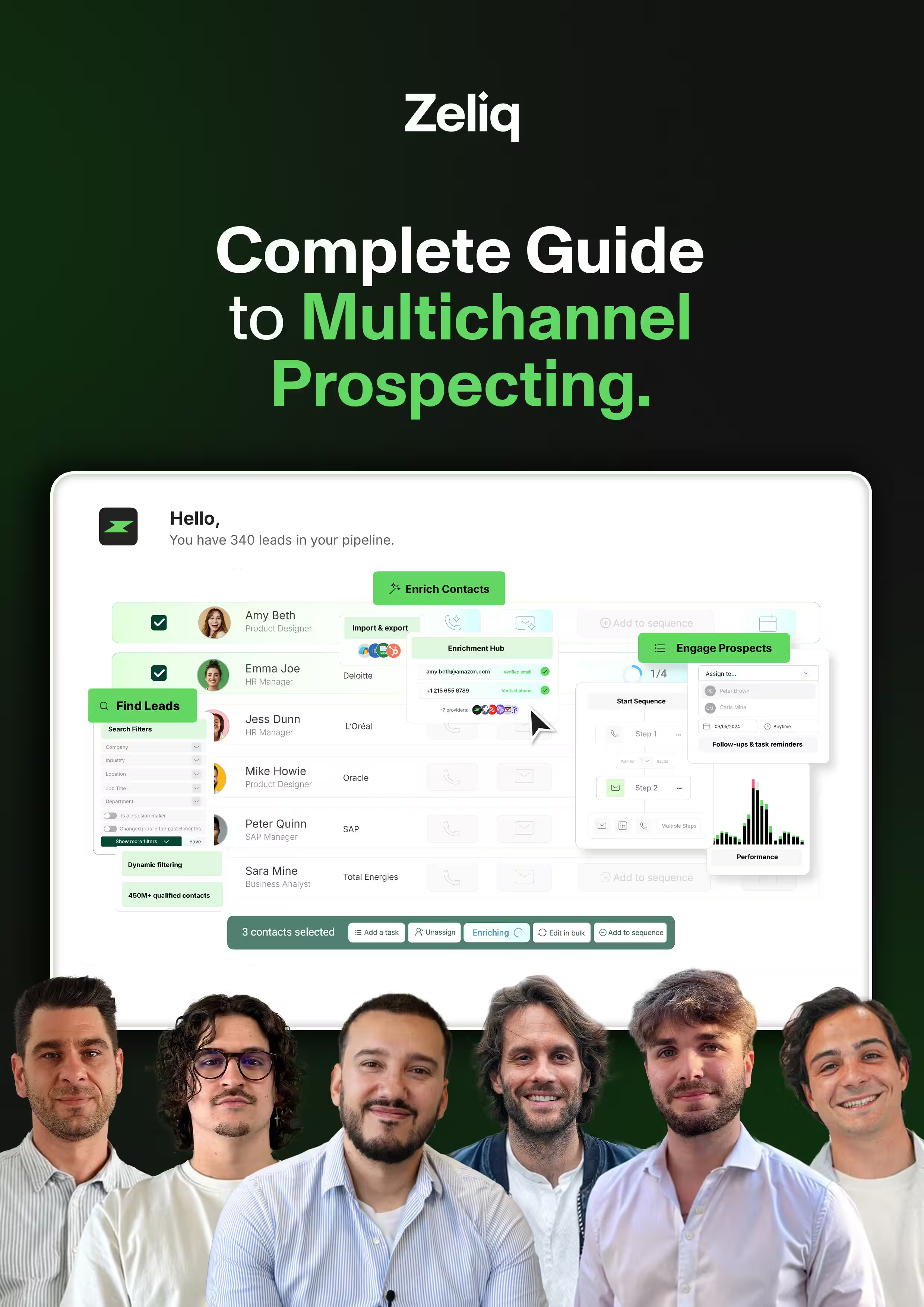
Zeliq combines a 450 million B2B contact database, waterfall enrichment with integrated email verification, API-first architecture, and multichannel sequences in one interface. Provides enriched firmographic + behavioral inputs that AI lead scoring models require at 85-95% match rate for consistent model quality. GDPR-native suppression.
10. Common mistakes
Mistake 1: AI predictive scoring without 12+ months of closed-deal history. Overfits to noise.
Mistake 2: Enterprise ABM scoring on mid-market SDR motion. Overkill, SDRs don’t realize value.
Mistake 3: PLG specialist on outbound-heavy team. MadKudu designed for product usage signals.
Mistake 4: No feedback loop from close outcomes. Scoring stays at launch quality without ongoing retraining.
Mistake 5: Scores not visible in SDR workflow. Dashboard-only scoring = not used consistently.
11. Frequently asked questions
AI lead scoring vs rules-based scoring, which is better?
AI/predictive scoring outperforms rules-based on complex multi-signal ICPs when you have 12+ months of closed-deal history to train on; rules-based wins when ICP is well-understood + behaviors have clear meaning + transparency matters for RevOps iteration; most mature teams use hybrid (rules-based for clear signals + predictive ML for pattern detection on ambiguous signals). Trade-offs: (1) Rules-based advantages: transparent (every score justified by explicit rule), easy to debug when a lead scores wrong, easy to explain to sales, no data-history prerequisite, fast iteration. (2) Rules-based limitations: ceiling at 20-30 rules where interactions become unpredictable, can’t capture non-linear patterns (VP + tech switch + 3 page visits in 48h scoring more than sum of parts), requires manual tuning as ICP evolves. (3) AI predictive advantages: captures complex patterns humans can’t articulate, self-updates as new closed deals feed the model, higher accuracy on mature pipelines, finds non-obvious predictive signals. (4) AI predictive limitations: opaque (why did this lead score 87 vs 65?), requires 6-12+ months of closed-deal history to train effectively, harder to iterate based on sales feedback, can overfit noise if training data is small, requires AI governance oversight. (5) Hybrid pattern (most mature teams): rules-based for clear signals (executive title = +15, pricing page = +15) + predictive ML for pattern detection on ambiguous behaviors. Best of both. Category leaders (HubSpot, Marketo, Pardot) offer both models in the same platform. Rule of thumb: start rules-based, layer predictive ML after 6 months of pipeline history, evaluate hybrid vs rules-only every quarter based on sales-marketing feedback.
Which AI lead scoring tool fits my motion?
HubSpot or Salesforce Einstein if already on their CRM (lowest integration work); 6sense or Demandbase for enterprise ABM against named accounts; MadKudu for PLG/freemium SaaS motion; Apollo bundled for mid-market SDR teams using Apollo as primary prospecting platform. Decision by motion: (1) HubSpot ecosystem SDR team: Sales Hub Enterprise with predictive scoring from $1,200/month covers Categories 1 + 2. Lowest integration work, scoring visible in SDR workflow. (2) Salesforce ecosystem enterprise: Salesforce Einstein scoring Add-On. Trained on your historical conversion records. Years of clean Salesforce data = good fit. (3) Enterprise ABM against named accounts: 6sense (Forrester Leader for predictive) or Demandbase. Enterprise pricing $60k+/year. Account-level scoring combines third-party intent + first-party engagement. (4) PLG SaaS freemium: MadKudu purpose-built for product usage scoring. Hybrid predictive-ML + rules. (5) Mid-market SDR team on Apollo: Apollo bundled scoring at $49-149/user. Fast time-to-value, less depth than specialized but good enough for 10-50 SDRs. (6) Technical RevOps + complex multi-table data: Kumo.ai relational ML. Niche but powerful for teams with warehouse-anchored data operations. Common failure: buying 6sense enterprise ($60k+/year) for a 10-SDR team not running ABM = overkill; buying MadKudu for outbound-heavy team with no PLG = misfit. Match tool to motion. Rule of thumb: if < 20 SDRs, CRM-native predictive or bundled Apollo wins; 20-100 SDRs = CRM-native + specialized tool for secondary motion; 100+ SDRs = multi-tool stack with specialist per motion.
What is the cost of AI lead scoring?
$0 (CRM-native basic) to $60k+/year (enterprise ABM) depending on architecture: HubSpot Sales Hub Enterprise from $1,200/month for predictive scoring, Salesforce Einstein as Salesforce add-on, 6sense + Demandbase enterprise $60k+/year, MadKudu mid-market custom, Apollo bundled at $49-149/user, standalone enterprise ML $20-80k+/year. Concrete tiers verified October 2026 per aggregated SERP: (1) Free/basic rules-based: HubSpot CRM free tier, Salesforce Sales Cloud base. Rules-based only, no predictive. $0 incremental. (2) CRM-native predictive: HubSpot Sales Hub Enterprise from $1,200/month, Salesforce Einstein scoring as Sales Cloud add-on. Tightest CRM integration. (3) PLG specialist: MadKudu custom pricing, typically $500-5,000+/month depending on volume + features. (4) Bundled in prospecting platform: Apollo at $49-149/user bundles basic scoring. Fast time-to-value, less depth. (5) Enterprise ABM: 6sense + Demandbase enterprise $60k+/year typical, not publicly disclosed. Account-level predictive + intent + buying stage. (6) Enterprise specialist ML: Infer, Kumo.ai, Gro IQ at $20-80k+/year. Beyond direct cost, factor data layer requirement (enrichment at $100-300/user/month to feed scoring with firmographic + behavioral), CRM base cost, integration debug (5-15 hours/month for stitched stacks). ROI math: 20-30% SDR qualification throughput lift + 20-30% sequence reply rate lift. On a 10-SDR team at $60-100k/SDR fully loaded, 25% productivity lift = $150-250k/year value, which justifies tool spend up to $50-80k/year easily. Start with CRM-native predictive to validate ROI before layering specialized tools.
12. Conclusion: 3 actions to run
Audit data history within 7 days. < 12 months closed deals = start rules-based + hybrid; > 12 months = AI predictive viable.
Match architecture to motion within 15 days. CRM investment + motion + data history determine fit.
Measure baseline vs AI scoring within 30 days post-deploy. 20-30% SDR qualification lift target for keep decision.
Enriched firmographic + behavioral data feeding AI lead scoring at 85-95% match rate
Zeliq combines 450 million B2B contacts, waterfall enrichment with integrated verification, API-first architecture, and multichannel sequences in one interface. Enriched data feeds scoring models for consistent output quality. GDPR-native suppression.
Try for freeAnd if you want enriched data feeding AI lead scoring models at 85-95% match rate with multichannel sequences bundled, try Zeliq for free: sourcing, waterfall enrichment, verification, and outreach in one interface, no credit card required.