

AI prospecting tools are not one monolithic product but a 3-layer stack combining a data tool + an AI layer + a multichannel sender working together, with teams choosing between AI-native platforms (built AI-first from day one like Artisan, Amplemarket) and AI-added platforms (traditional sales tools adding AI features like Apollo AI, ZoomInfo Copilot, HubSpot Breeze). In 2026, the best AI prospecting setup depends on whether teams prioritize deep AI execution (AI-native wins), broad coverage with AI layered on top (AI-added wins), or custom composable workflows (workflow-first platforms like Clay win), per aggregated SERP benchmarks verified September 2026. This article maps the 3-layer stack, AI-native vs AI-added distinction, 10 leading tools, cost benchmarks, compliance, and 3 FAQ.
For a Head of Sales, RevOps engineer, SDR lead, or founder evaluating AI prospecting tools, this article gives the layer framework and the vendor grid.
On the agenda:
- What makes a tool “AI prospecting” vs regular prospecting
- The 3-layer stack (data + AI + sender)
- AI-native vs AI-added vs workflow-first distinction
- Layer 1: data (how AI tools source)
- Layer 2: AI (what the AI actually does)
- Layer 3: sender (where AI output lands)
- 10 leading AI prospecting tools
- Build vs buy for AI prospecting
- Cost benchmarks
- Compliance: GDPR, CAN-SPAM, AI governance
- 3 FAQ (AI-native vs AI-added, best for team size, build vs buy)
Key takeaways:
- 3-layer stack: data tool + AI layer + multichannel sender working together
- AI-native tools: Artisan, Amplemarket (built AI-first)
- AI-added tools: Apollo AI, ZoomInfo Copilot, HubSpot Breeze (traditional + AI)
- Workflow-first: Clay (composable, 100+ data providers + AI research)
- 10 leading: Artisan, Amplemarket, Apollo AI, ZoomInfo Copilot, Clay, 6sense, Nooks, HubSpot Breeze, Reply AI, Zeliq
- Cost per SDR: $100-$1,000/user/month depending on stack composition
- Enterprise choice: ZoomInfo + AI layer typically wins for broad coverage
- Mid-market choice: Apollo or Zeliq (bundled 3-layer) typically wins
- Compliance: AI governance + FTC CAN-SPAM + GDPR (CNIL 2025 €486M)
1. What makes a tool “AI prospecting” vs regular prospecting
The distinction between AI prospecting and regular prospecting isn’t black-and-white in 2026 because nearly every sales tool now includes some AI feature. Three signals that distinguish genuine AI prospecting:
Signal 1, Autonomous workflow execution: AI handles end-to-end discovery → research → sequence → booking without human intervention between stages.
Signal 2, Learning feedback loop: AI improves over time based on conversation outcomes (reply, meeting, lost deal), not just launch-day quality.
Signal 3, Integrated across 3 layers: AI touches data (ICP matching), execution (opener generation), and routing (CRM updates) rather than one isolated capability.
Marketing claims aside, verify these three signals via vendor demo on your real data before concluding a tool is “AI prospecting” vs “prospecting with AI buzzwords”.
For broader context see B2B contact data.
2. The 3-layer stack (data + AI + sender)
Per aggregated SERP benchmarks verified September 2026, the best AI prospecting tools work as a 3-layer stack:
Layer 1, Data: contact + firmographic + intent sources. ZoomInfo (300M+ profiles), Apollo (275M+), Cognism (EMEA), Zeliq (450M), Clay (100+ provider marketplace).
Layer 2, AI: generates ICP matching + account research + personalized openers + response handling. Artisan, Amplemarket Duo Copilot, Apollo AI, Clay AI research blocks, GPT/Claude via APIs.
Layer 3, Sender: multichannel sequences + deliverability + CRM sync. Outreach, Salesloft, Apollo sequencer, Smartlead/Instantly for email-heavy, Zeliq.
Teams can stitch (data from ZoomInfo + AI from Artisan + sender from Outreach) or buy consolidated (Apollo bundling 3 layers, Zeliq bundling 3 layers, Amplemarket bundling 3 layers).
Consolidation savings: 30-40% at mid-market vs stitched; integration debt reduction = 5-15 hours/month saved.
3. AI-native vs AI-added vs workflow-first distinction
Three distinct product philosophies in 2026:
AI-native tools: built AI-first from day one. AI is the primary interface, humans approve or override. Examples: Artisan (AI BDR persona), Amplemarket (Duo Copilot 3-agent architecture).
AI-added tools: traditional sales platforms that layered AI on top of existing workflows. AI is a feature, humans drive. Examples: Apollo AI, ZoomInfo Copilot, HubSpot Breeze, Salesforce Einstein.
Workflow-first tools: AI is one capability among many; technical users compose custom workflows. Examples: Clay (100+ provider marketplace + AI research blocks + custom logic).
Decision drivers: - Volume + stable ICP + minimum SDR headcount → AI-native wins - Existing CRM/data investment + want AI without replacing stack → AI-added wins - Technical RevOps + custom logic needs + non-standard workflows → workflow-first wins
4. Layer 1: data (how AI tools source)
AI prospecting tools pull data from one of three source patterns:
Pattern A, Owned proprietary database: tool owns the contact data (ZoomInfo, Apollo, Cognism, Zeliq). Advantage: scale + consistency. Trade-off: vendor lock-in.
Pattern B, Marketplace aggregation: tool queries 100+ external providers (Clay). Advantage: breadth + waterfall freshness. Trade-off: workflow complexity + per-provider cost.
Pattern C, LinkedIn + enrichment: tool starts from LinkedIn Sales Navigator exports + enriches via waterfall (Artisan, Amplemarket often work this way). Advantage: graph-based precision. Trade-off: LinkedIn ToS risk + rate limits.
Match pattern to your sourcing need: pattern A for scale, B for custom, C for LinkedIn-heavy.
5. Layer 2: AI (what the AI actually does)
What AI actually does across tools in 2026:
- ICP identification: find net-new accounts matching your historical close pattern
- Account research: pull firmographic + news + leadership into brief
- Persona identification: find decision-makers per account (CEO, VP Sales, Head of RevOps)
- Signal detection: funding, hiring, tech switch, content download triggers
- Opener generation: personalized first email + LinkedIn message
- Response handling: AI reads reply + classifies (interested, not now, wrong person, unsubscribe) + routes
- CRM updates: auto-log activities + update deal fields + schedule follow-ups
Deepest AI tools (Artisan, Amplemarket) do all 7 autonomously. Shallower AI tools do 2-3 under human direction.
See multichannel prospecting guide.
6. Layer 3: sender (where AI output lands)
AI generates output; sender infrastructure delivers it. Options:
Bundled sender: AI tool includes its own sender (Artisan, Amplemarket, Apollo). Simpler stack.
External sender: AI tool pushes to Outreach, Salesloft, Smartlead, Instantly, or similar. Deeper deliverability features at cost of integration overhead.
CRM-embedded sender: AI tool pushes to HubSpot Sequences or Salesforce Engage. Deepest CRM integration at cost of fragmented email operations.
Deliverability still matters at AI scale: domain warmup + SPF/DKIM/DMARC + rotating mailboxes non-negotiable above 1,000 emails/day per domain.
7. 10 leading AI prospecting tools
Positioning verified September 2026:
| Tool | Philosophy | Primary strength |
|---|---|---|
| Artisan | AI-native | AI BDR persona executes cadence autonomously |
| Amplemarket | AI-native | Duo Copilot 3-agent (Signal + Research + Sequence) |
| Apollo AI | AI-added | 275M+ data + sequencer + AI layer |
| ZoomInfo Copilot | AI-added | 300M+ data + intent + ranked actions |
| Clay | Workflow-first | 100+ data providers + AI research blocks + custom logic |
| 6sense | AI-native (ABM) | Predictive buying stage prediction |
| Nooks | AI-native (signals) | Signal-based prospecting + dialer |
| HubSpot Breeze | AI-added | CRM-embedded with Clearbit intelligence |
| Reply AI | AI-added | Multichannel sequencer with AI features |
| Zeliq | AI-ready data layer | 450M + waterfall + verification feeding AI workflows |
Rank by use case not generic ranking: AI-native for volume + stable ICP, AI-added for CRM-anchored workflows, workflow-first for custom logic.
8. Build vs buy for AI prospecting
Three paths to AI prospecting capability:
Buy an AI-native tool: fastest to value (2-4 weeks to production), highest cost per user ($200-500/user/month), tightest workflow (AI-first).
Buy AI-added tool + stitch: 6-10 weeks to production, mid cost per user ($150-400/user/month combined), moderate workflow flexibility.
Build custom with Clay or workflow tools + LLM APIs: 2-4 months to production, lowest incremental tool cost but highest engineering time, highest workflow flexibility.
Decision drivers: - < 20 SDRs: buy AI-native or AI-added (DIY engineering overhead too high) - 20-100 SDRs: AI-added or workflow-first typically wins - 100+ SDRs with technical RevOps: workflow-first + custom LLM integration can win on specialized workflows
9. Cost benchmarks by setup
Concrete math at typical pricing verified September 2026:
Minimal AI (1 layer + CRM): - HubSpot Breeze add-on: $45-450/month depending on credits - Base HubSpot Starter: $20/month - Total: $65-500/user/month
Mid-market AI-added (Apollo or Zeliq): - Apollo Professional with AI: $79-149/user/month - Zeliq mid-market: $150-400/user/month - Total: $79-400/user/month
AI-native enterprise: - Amplemarket enterprise: $300-500+/user/month - Artisan: variable, $200-400+/user/month typical - Total: $200-500+/user/month
Workflow-first with Clay: - Clay Growth: $495/month base unlimited seats - Data provider credits: $200-500/month for mid-volume - Sender tool: $100-200/user/month - Total: $350-700/user/month (lower per-seat at scale)
10. Compliance: GDPR, CAN-SPAM, AI governance
EU GDPR: automated decision-making affecting individuals requires disclosure. AI-generated outreach must include compliant opt-out. CNIL 2025 sanctions hit €486M total.
US CAN-SPAM: FTC compliance guide requires accurate subject line + valid physical address + functional opt-out + honor opt-out within 10 business days.
EU AI Act: emerging regulation; sales AI typically limited-risk requiring transparency.
California CCPA/CPRA: AI automated decision-making disclosure evolving.
LinkedIn ToS: AI tools scraping LinkedIn skirt ToS; use within rate limits (~100 connection requests/week).
Zeliq as AI-ready data layer for prospecting
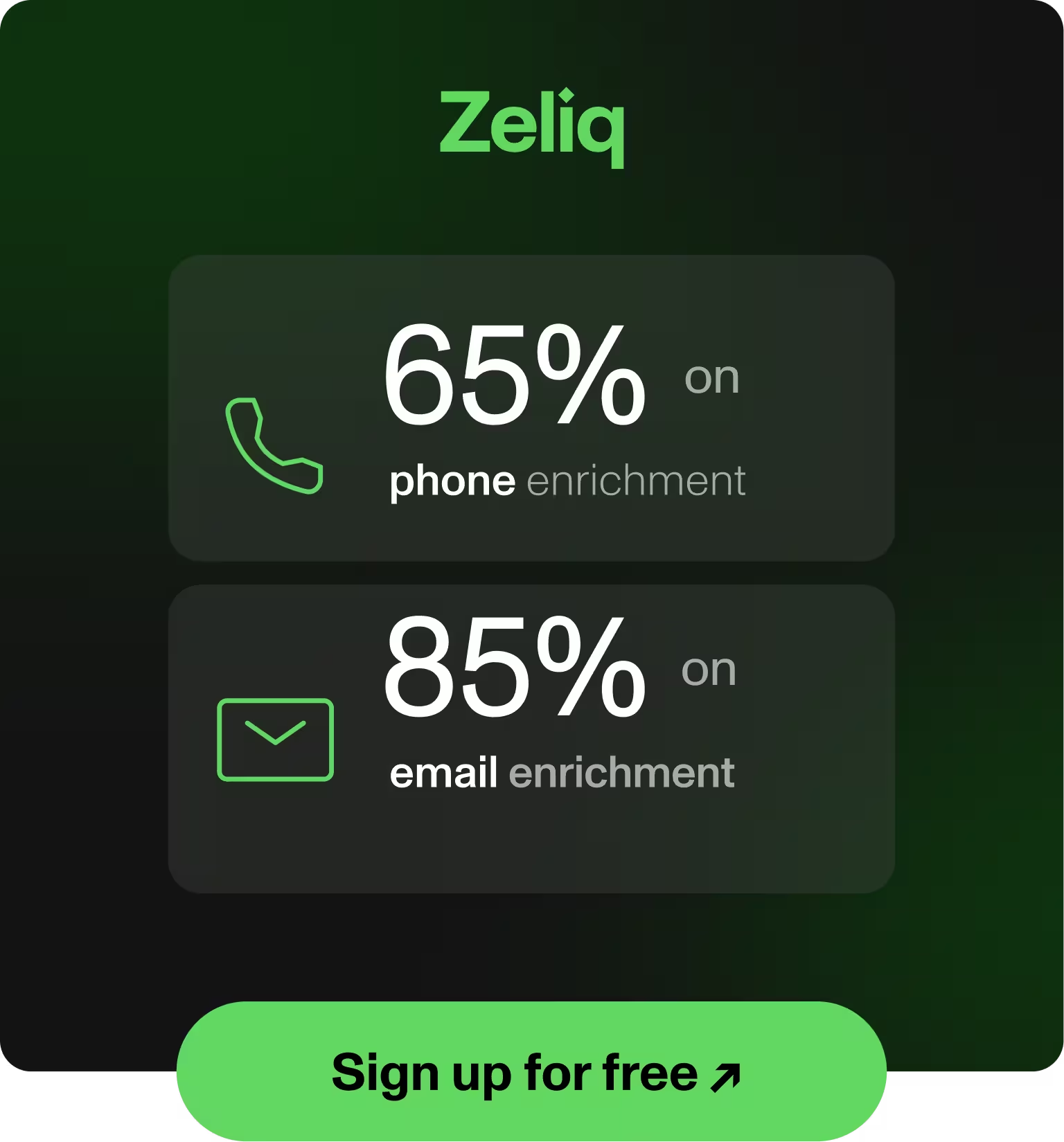
Zeliq combines a 450 million B2B contact database, waterfall enrichment with integrated email verification, API-first architecture, and multichannel sequences in one interface. Feeds AI prospecting workflows (Artisan, Amplemarket, Clay) with verified data at 85-95% match rate. GDPR-native suppression.
11. Common mistakes
Mistake 1: AI prospecting on bad data. AI amplifies noise. Verify data quality before enabling AI at scale.
Mistake 2: AI-native tool on complex multi-stakeholder enterprise ICP. AI-native wins on stable templatable ICP; enterprise needs human nuance.
Mistake 3: Ignoring deliverability at AI volume. AI generates 500+ touches/day = must have warmup + rotation + SPF/DKIM/DMARC.
Mistake 4: Build custom when buy would work. Clay + LLM APIs for < 20 SDRs = engineering overhead > tool value.
Mistake 5: AI without SDR training. AI changes workflow; SDRs need training on approval + feedback loops.
12. Frequently asked questions
AI-native vs AI-added prospecting tools, which should I buy?
AI-native tools (Artisan, Amplemarket) win for volume-first teams with stable templatable ICP + minimum SDR headcount + mature deliverability operations; AI-added tools (Apollo AI, ZoomInfo Copilot, HubSpot Breeze) win for teams with existing CRM/data investment who want AI layered on top; workflow-first tools (Clay) win for technical RevOps teams composing custom logic. Trade-offs: (1) AI-native advantages: deepest AI execution (writes + sends + handles replies autonomously), highest volume per SDR, built-in deliverability. Best for templatable ICPs + volume-first motions. (2) AI-native disadvantages: locks you into their workflow model, less control, premium pricing $200-500+/user. (3) AI-added advantages: works with existing stack, lower incremental cost on top of existing CRM, SDRs retain control, slower learning curve. (4) AI-added disadvantages: AI is a feature not the architecture, depth limited vs AI-native, often doesn’t improve over time (no feedback loop). (5) Workflow-first advantages: highest flexibility, can match any custom logic. Best for technical RevOps + non-standard workflows. (6) Workflow-first disadvantages: steepest learning curve, requires engineering investment, complex ongoing maintenance. Decision drivers: team size (< 20 SDRs = AI-native or AI-added; 20-100 = either; 100+ = any with specialized workflows), ICP complexity (simple stable = AI-native; complex multi-stakeholder = AI-added or workflow-first), existing stack (heavy HubSpot or Salesforce = AI-added for compatibility). Rule of thumb: pilot one approach for 3 months, measure ROI, decide based on data not category preference.
What is the best AI prospecting tool for my team size?
SMB 1-10 SDRs: Apollo AI ($49-149/user) or HubSpot Breeze (if on HubSpot); Mid-market 10-30 SDRs: Zeliq, Apollo Pro, or Amplemarket entry tier ($150-500/user); Enterprise 50+ SDRs: Amplemarket enterprise + ZoomInfo Copilot + Clay for custom + 6sense for ABM ($500-1,500/user depending on mix). By team size: (1) 1-10 SDRs: cost efficiency wins. Apollo at $49-149/user bundles data + enrichment + AI sequencer; HubSpot Breeze at $45-450/month bundles with HubSpot CRM. Avoid enterprise AI-native tools ($300+/user) at this scale, complexity overhead exceeds value. (2) 10-30 SDRs: capability depth wins. Zeliq ($150-400/user) consolidates 3 layers; Amplemarket entry tier ($300-500/user) adds AI execution depth; Clay Growth ($495/month unlimited seats) adds workflow flexibility. Pick based on priority (coverage vs depth vs flexibility). (3) 30-100 SDRs: specialization wins. Combine AI-added for broad daily use (Apollo or Zeliq) + AI-native for execution depth (Amplemarket or Artisan) + workflow-first for custom cases (Clay). Total $400-800/user. (4) 100+ SDRs with technical RevOps: enterprise multi-tool stack. ZoomInfo Copilot (data + intent + AI) + 6sense (ABM) + Amplemarket or Artisan (execution) + Clay (custom workflows) + bundled or external sender. Total $700-1,500/user. Common failures: (a) enterprise tool on small team (overhead), (b) small team tool on enterprise (depth gaps), (c) building when buying would deliver 90% of value, (d) buying when building would deliver custom edge.
Should I build custom AI prospecting with Clay + LLM APIs, or buy a pre-built AI tool?
Buy pre-built AI tool below 50 SDRs or without dedicated RevOps engineering; build custom with Clay + LLM APIs above 50 SDRs with technical RevOps team if your workflow requires non-standard logic that pre-built tools don’t support, most teams underestimate custom build complexity and overestimate pre-built limitations. Build vs buy framework: (1) Buy pre-built AI tool advantages: fastest to value (2-6 weeks production), vendor handles maintenance + upgrades + compliance, support available, lower risk. Trade-off: locked into their workflow model + limited customization + per-user pricing adds up. Best for < 50 SDRs or non-technical teams. (2) Build custom advantages: full workflow flexibility, lower incremental cost at scale, matches your exact process, ownership of IP. Trade-off: 2-4 months to production + ongoing engineering maintenance + vendor dependency on Clay + LLM APIs + no vendor support. Best above 50 SDRs with technical RevOps team and specialized workflows. (3) Hybrid pattern (most mature teams): buy AI-added for 80% of standard use cases + build custom in Clay for 20% specialized workflows. Combines fast time-to-value with flexibility. Decision rule: before building custom, verify no pre-built tool covers 80%+ of your workflow. Pre-built pricing at $300-500/user × 50 SDRs = $15k-25k/month; equivalent custom build with Clay $495/month + LLM API costs $500-2k/month + dedicated GTM engineer at $12-15k/month fully loaded = ~$14-18k/month, similar economics. Flexibility advantage only compounds above 100 SDRs or very non-standard workflows. Below those thresholds, buy wins on time-to-value and risk.
13. Conclusion: 3 actions to run
Classify your use case within 7 days. Volume + stable ICP = AI-native; CRM-anchored + stack preserved = AI-added; custom + technical RevOps = workflow-first.
Verify data quality within 15 days. AI amplifies garbage. Match rate below 85% = clean before deploying AI at scale.
Pilot one tool within 30 days. 90-day baseline → impact measurement. Expand only if ROI > 1.3×.
AI-ready data layer feeding AI prospecting workflows at 85-95% match rate
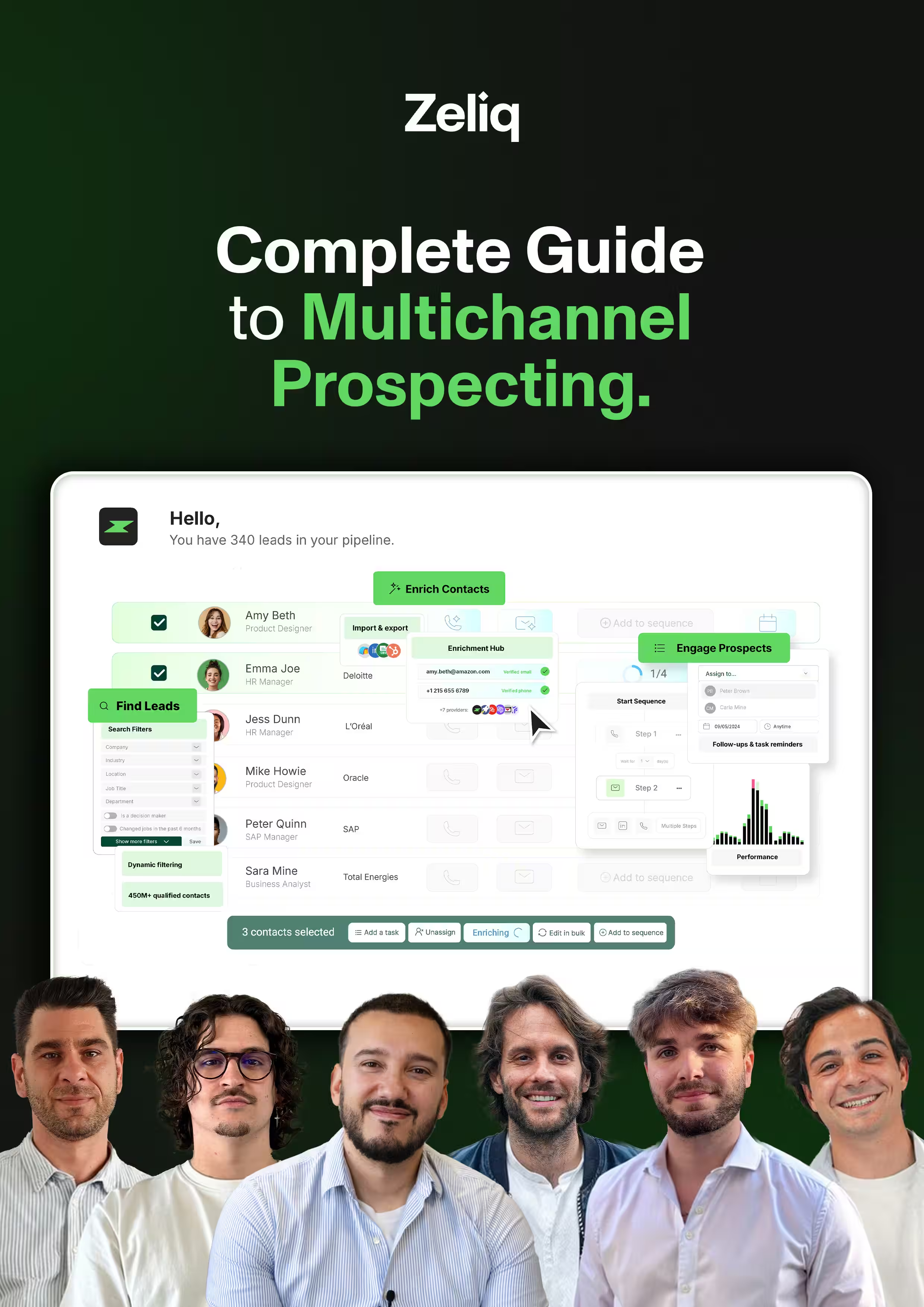
Zeliq combines 450 million B2B contacts, waterfall enrichment with integrated verification, API-first architecture, and multichannel sequences in one interface. AI workflows run on verified data for consistent output quality. GDPR-native suppression.
Try for freeAnd if you want verified data feeding AI prospecting workflows at 85-95% match rate with multichannel sequences bundled, try Zeliq for free: sourcing, waterfall enrichment, verification, and multichannel sequences in one interface, no credit card required.