

GTM engineering (go-to-market engineering) is the practice of combining software engineering, data operations, and sales strategy to build automated systems that generate B2B pipeline, performed by a GTM engineer who designs and codes workflows connecting data providers, CRM, enrichment tools, sales engagement platforms, and AI agents into unattended pipelines. In 2026, the average B2B company now uses 17 tools in its revenue stack (up from 9 in 2021 per aggregated SERP benchmarks verified September 2026), driving the emergence of GTM engineering as a distinct role because teams can no longer manually coordinate the tool sprawl. This article maps the GTM engineer role + core skills + the 7-layer modern stack + hiring + salary benchmarks + 3 FAQ.
For a Head of Sales, VP RevOps, founder, or operator considering hiring (or becoming) a GTM engineer, this article gives the role definition, stack map, and compensation benchmarks.
On the agenda:
- What GTM engineering actually is
- The 7-layer modern GTM stack (data, enrichment, signals, sending, AI agents, automation, CRM)
- Core skills: engineering, data, sales strategy
- Why the role emerged (tool sprawl + AI shift)
- Hiring: full-time employee vs fractional vs agency
- Salary benchmarks
- Common GTM engineer workflows
- Compliance: GDPR, CAN-SPAM
- 3 FAQ (what GTM engineer does, salary, hiring)
Key takeaways:
- Definition: engineering + data ops + sales strategy = automated pipeline systems
- 7 stack layers: data, enrichment, signals, sending, AI agents, automation, CRM
- Tool sprawl driver: 17 tools average in 2026 vs 9 in 2021 per aggregated SERP
- Core skills: SQL, APIs, Clay/n8n workflow tools, prompt engineering, GTM strategy
- Hiring options: full-time employee ($120-180k US), fractional ($5-15k/month), agency ($3-10k/month)
- Emerging role: category new in 2024-2025, mature in 2026
- ROI: typical GTM engineer pays back 3-5× within year 1 via pipeline automation
- Compliance: FTC CAN-SPAM US, GDPR (CNIL 2025 €486M) EU
1. What GTM engineering actually is
GTM engineering combines three disciplines previously separate:
- Software engineering: writing code, calling APIs, managing data pipelines, orchestrating workflows
- Data operations: schema design, deduplication, enrichment, quality monitoring
- Sales strategy: understanding ICP, outbound tactics, qualification criteria, pipeline economics
The combined role builds systems that generate revenue unattended: enrichment pipelines that fire on new CRM records, outbound sequences that trigger on buying signals, lead scoring models that route automatically to the right SDR territory.
Distinguish from adjacent roles: - RevOps: process + tooling + reporting; GTM engineering adds code + automation on top - Growth engineering: product-side user acquisition; GTM engineering is sales/revenue-side - Sales engineering: pre-sales technical support for prospects; GTM engineering builds internal systems
Modern RevOps teams often rebrand internally as “GTM engineering” to signal the code-first + automation-first approach.
For broader prospecting context see B2B contact data.
2. The 7-layer modern GTM stack
Per aggregated SERP commentary verified September 2026, the modern GTM stack runs in seven layers:
Layer 1, Data: contact databases + firmographic + technographic sources (ZoomInfo, Apollo, Cognism, Zeliq providing 450M+ contacts).
Layer 2, Enrichment: waterfall enrichment across providers to lift match rate from 55-70% single-source to 85-95% waterfall.
Layer 3, Signals: intent data (Bombora, 6sense), hiring surges (LinkedIn Jobs), funding (Crunchbase), tech switches (BuiltWith).
Layer 4, Sending: multichannel sequencers (Outreach, Salesloft, Apollo, Zeliq) + deliverability infrastructure (warmup, SPF/DKIM/DMARC).
Layer 5, AI agents: autonomous workflows (Artisan, Amplemarket, Reply AI) + custom LLM integrations.
Layer 6, Automation: workflow orchestrators (Clay, n8n, Zapier, Make) + custom scripts.
Layer 7, CRM: system of record (HubSpot CRM, Salesforce, Pipedrive) with native workflow triggers.
A GTM engineer designs how data flows across all 7 layers end-to-end.
3. Core skills
Expectations for a GTM engineer in 2026:
Technical skills: - SQL (query data across CRM + enrichment + warehouse) - APIs (REST, webhooks, authentication) - Workflow tools (Clay, n8n, Zapier, Make for low-code orchestration) - Python or JavaScript for custom scripts - Prompt engineering for LLM-powered workflows - Basic DevOps (deploy small services, manage secrets)
Data skills: - Schema design for CRM + warehouse - Deduplication logic - Field mapping across tools - Data quality monitoring
GTM strategy skills: - ICP definition + segmentation - Outbound sequence design - Lead scoring methodology - Pipeline attribution + reporting
Hybrid skill-set is why the role commands premium compensation.
4. Why the role emerged (tool sprawl + AI shift)
Two forces converged to create the GTM engineering role:
Force 1, Tool sprawl: average B2B company uses 17 tools in revenue stack in 2026 vs 9 in 2021 per aggregated SERP benchmarks. Marketing operations and sales operations roles designed for 5-10 tool stacks break at 17. Someone with engineering + data + strategy skills becomes necessary.
Force 2, AI shift: Salesforce 2026 State of Sales shows 9 in 10 sales teams use AI agents or expect to within 2 years per aggregated SERP commentary. AI agents require configuration, prompt engineering, workflow design that traditional RevOps doesn’t do. Someone with technical depth to orchestrate AI across the stack becomes necessary.
The result: GTM engineering emerged 2024-2025 as a distinct role, matured in 2026.
5. Hiring: full-time employee vs fractional vs agency
Three paths to GTM engineering capacity:
Full-time employee: direct hire. Pros: dedicated capacity, institutional knowledge, fast iteration. Cons: $120k-180k+ US salary + benefits, 60-90 day hire cycle, retention risk.
Fractional GTM engineer: 10-25 hours/week dedicated contractor. Pros: lower cost ($5-15k/month typical), fast start (1-2 weeks), proven senior talent. Cons: not always available, less institutional knowledge, context switching.
GTM agency: team of engineers delivering projects. Pros: deeper bench ($3-10k/month typical), parallel workstreams, agency accountability. Cons: external context ownership, communication overhead, less tightly integrated.
Decision drivers: - < 20 SDRs: fractional or agency usually best - 20-100 SDRs: full-time hire justifies - 100+ SDRs: 2-3 GTM engineers + supporting ops
6. Salary benchmarks
Concrete ranges verified September 2026 via aggregated SERP:
US salary bands: - Junior GTM engineer (1-2 years): $90-120k base - Mid-level (3-5 years): $120-160k base - Senior (5-8 years): $160-220k base - Staff / Lead (8+ years): $220-300k+ base - Plus equity (SaaS startups typically 0.1-1% depending on stage)
EU/UK salary bands (typically 60-80% of US): - Junior: €55-85k base - Mid-level: €85-120k base - Senior: €120-180k base
Fractional rates: - $100-250/hour or $5-15k/month retainer
Agency rates: - $3-10k/month for ongoing retainer - $10-50k for discrete project (custom pipeline build)
Compensation reflects hybrid skill-set premium; typical sales ops roles earn 30-50% less for similar seniority.
7. Common GTM engineer workflows
What a GTM engineer typically builds in year 1:
- Enrichment pipeline: new CRM record → waterfall enrich → verify email → score → route to SDR within 30 seconds
- Signal-triggered sequences: Bombora or hiring surge detection → add contact to targeted sequence
- Lead scoring model: rules-based + predictive ML scoring with threshold-based routing
- Pipeline attribution reporting: unified reporting across first-touch, last-touch, multi-touch attribution
- Deduplication logic: cross-CRM + enrichment + marketing automation dedup rules
- AI agent orchestration: autonomous ICP research, personalized opener generation, response handling
- Deliverability monitoring: domain health + bounce rate + spam complaint tracking + alerts
- CRM hygiene automation: stale record purging, data quality scoring, enrichment refresh
For how outbound sequencing fits see multichannel prospecting guide.
8. Compliance: GDPR, CAN-SPAM, CCPA
GTM engineering touches personal data at every layer; compliance is a core concern.
EU GDPR: legitimate interest documented per ICP + opt-out + suppression list APIs + 3-year retention. CNIL 2025 sanctions hit €486M total, including SOLOCAL Marketing Services at €900k for prospecting without sufficient legal basis.
US CAN-SPAM: FTC compliance guide requires accurate subject line + valid physical address + functional opt-out + honor opt-out within 10 business days.
California CCPA/CPRA: right to know, delete, opt-out. GTM engineers typically build the suppression list APIs that enforce opt-out across the stack.
AI governance: automated decision-making (lead scoring, routing) may require disclosure in some jurisdictions.
Zeliq as a core data layer for GTM engineering
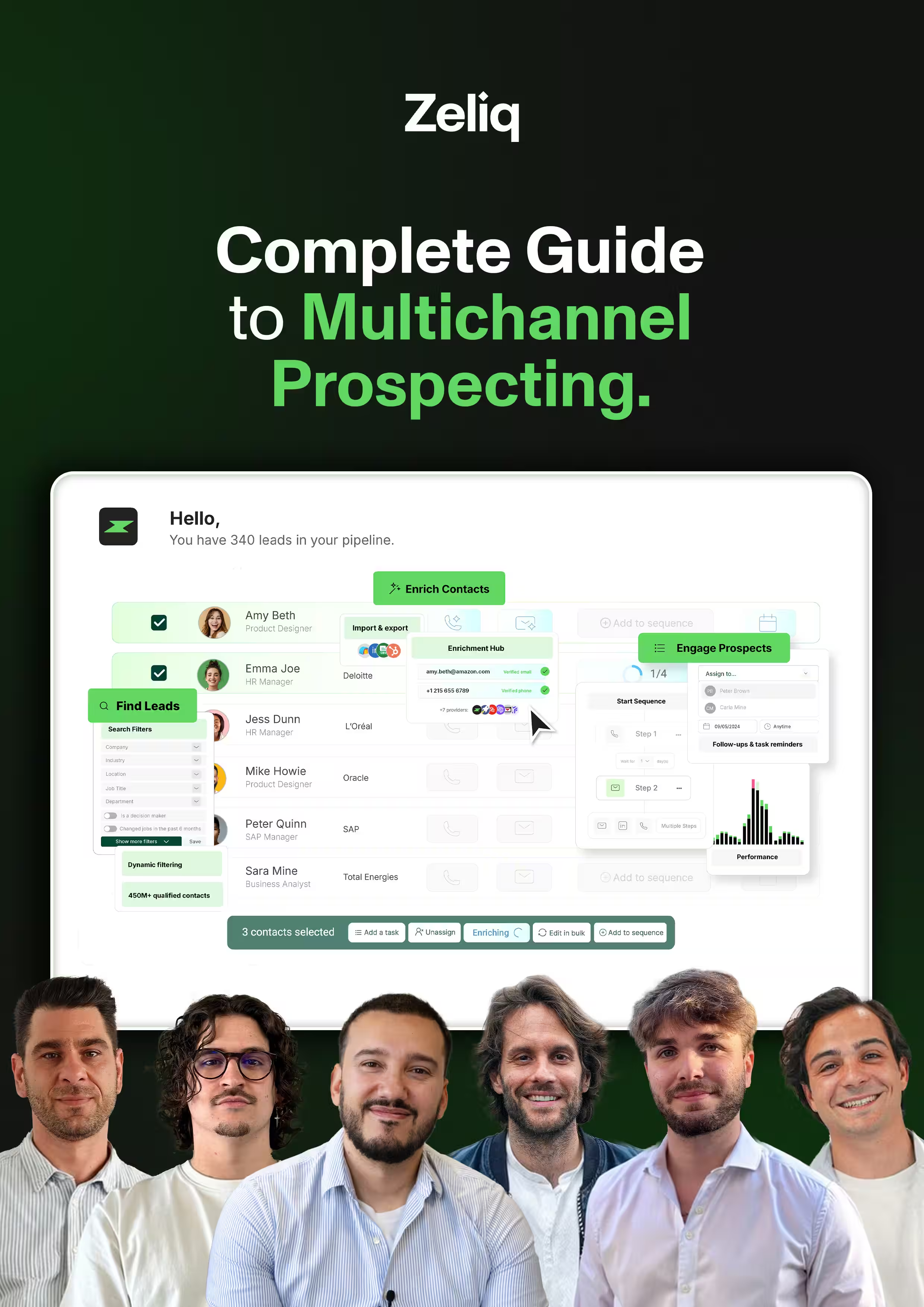
Zeliq combines a 450 million B2B contact database, waterfall enrichment across multiple sources with integrated email verification, API-first architecture, and multichannel sequences. GTM engineers consolidate Layers 1 + 2 + 4 into a single API endpoint instead of orchestrating 3-4 vendors. GDPR-native suppression.
9. Common mistakes
Mistake 1: Hiring full-time at 5-SDR scale. Fractional or agency gives better ROI below 20 SDRs.
Mistake 2: Chasing tool count. 17 tools doesn’t require 17 integrations. Consolidation (all-in-one platforms) + careful API orchestration beats sprawl.
Mistake 3: GTM engineer without GTM strategy context. Hiring pure engineer who doesn’t understand outbound = fancy pipeline producing wrong output.
Mistake 4: Ignoring compliance until audit. GTM engineers build the suppression + opt-out infrastructure; retrofit is painful.
Mistake 5: No clear ROI measurement. Track pipeline attribution to GTM-engineered workflows explicitly.
10. Frequently asked questions
What does a GTM engineer actually do day-to-day?
A GTM engineer spends roughly 40% of time on building pipelines and workflows (SQL, APIs, Clay/n8n automations), 30% on maintenance and monitoring (debugging broken integrations, data quality checks, deliverability monitoring), 20% on strategy and planning (ICP evolution, segment design, pipeline attribution), and 10% on cross-functional coordination (training SDRs, aligning with marketing on signals). Typical week-in-the-life: Monday reviews weekend pipeline runs + fixes anything that broke; Tuesday-Wednesday builds new workflow (new signal source integration, new sequence trigger, new scoring rule); Thursday iterates on existing workflows based on SDR feedback; Friday reports on pipeline attribution + plans next week. Specific projects in a year 1 roadmap: Month 1-2 waterfall enrichment pipeline + CRM hygiene automation. Month 3-4 signal-triggered sequences (Bombora, hiring surge, funding). Month 5-6 lead scoring model + routing automation. Month 7-8 AI agent orchestration (autonomous ICP research + personalized openers). Month 9-10 pipeline attribution reporting + conversion funnel instrumentation. Month 11-12 deliverability optimization + compliance audit prep. Required toolkit: SQL + REST APIs + Clay or n8n workflow tool + Python for custom scripts + prompt engineering for AI integrations. Hybrid skill-set is why compensation premium exists.
What is the salary of a GTM engineer in 2026?
US GTM engineer salaries in 2026 range $90-300k+ base depending on seniority: junior $90-120k, mid-level $120-160k, senior $160-220k, staff/lead $220-300k+ plus 0.1-1% equity in SaaS startups per aggregated SERP benchmarks. EU/UK compensation runs 60-80% of US: junior €55-85k, mid-level €85-120k, senior €120-180k. Alternatives to full-time employment: (1) Fractional GTM engineer at $100-250/hour or $5-15k/month retainer for 10-25 hours/week dedicated work. (2) Agency rates $3-10k/month ongoing or $10-50k for discrete project. Why premium: hybrid skill-set (engineering + data + sales strategy) commands 30-50% premium over typical sales ops roles for similar seniority. Market dynamics: category new in 2024-2025, matured in 2026, demand outstripping supply which drives compensation up. Compensation signals to validate during hiring: (a) ability to write SQL joining 3-4 data sources with window functions, (b) comfort with REST APIs including authentication + rate limiting + error handling, (c) demonstrated project in Clay / n8n / Zapier beyond “I used Zapier once”, (d) sales strategy fluency (can discuss ICP + sequence design + lead scoring without needing translator). Red flag: engineer with no GTM context = builds fancy pipelines producing wrong output. Non-engineer with GTM context = can’t build pipelines at all. Hybrid required.
Should I hire full-time, fractional, or agency for GTM engineering?
< 20 SDRs: fractional ($5-15k/month) or agency ($3-10k/month) usually best because full-time doesn’t amortize across small team; 20-100 SDRs: full-time employee ($120-180k) justifies and institutional knowledge matters; 100+ SDRs: 2-3 full-time GTM engineers + supporting ops team become necessary. Decision framework by team size and complexity: (1) < 20 SDRs: outbound motion straightforward, 3-5 workflow builds suffice. Fractional engineer 10-15 hours/week delivers in 2-3 months. Agency works if structured project with clear deliverables. Full-time overkill. (2) 20-50 SDRs: dedicated capacity starts paying off. Full-time employee faster iteration + deeper context. Alternatively, fractional 20-25 hours/week continues to work. Hybrid: hire first full-time plus fractional specialist for specific projects. (3) 50-100 SDRs: full-time employee required. Need dedicated capacity for ongoing maintenance + strategic projects + cross-team coordination. (4) 100+ SDRs: 2-3 GTM engineers + supporting ops team. Specialist engineer for AI, specialist for pipeline attribution, generalist for day-to-day. Trade-off considerations beyond cost: (a) iteration speed: full-time wins, fractional close second, agency slowest. (b) institutional knowledge: full-time wins by far. (c) senior talent access: fractional and agency often provide more senior engineers than you could hire full-time at salary cap. (d) risk: full-time has retention risk; fractional/agency has availability risk. Rule of thumb: start fractional at < 20 SDRs; hire full-time once you can keep them busy 40 hours/week + budget allows.
11. Conclusion: 3 actions to run
Audit stack sprawl within 7 days. Count tools in revenue stack. If > 10, GTM engineering role worth evaluating.
Score top 3 workflow gaps within 15 days. Which workflows are manual that could be automated? Rank by impact + feasibility.
Decide full-time vs fractional vs agency within 30 days. Below 20 SDRs = fractional or agency; above = full-time hire.
Core data + enrichment + sending layer consolidated for GTM engineering workflows
Zeliq combines 450 million B2B contacts, waterfall enrichment with integrated verification, API-first architecture, and multichannel sequences in one platform. GTM engineers consolidate 3 stack layers via single API. GDPR-native suppression.
Try for freeAnd if you want to consolidate 3 stack layers (data + enrichment + sending) into a single API for GTM engineering workflows, try Zeliq for free: sourcing, enrichment, verification, and multichannel sequences in one platform, no credit card required.