

Sales intelligence tools are the software applications that combine contact data, firmographic enrichment, buying intent signals, and conversation analytics to help B2B sales teams prioritize accounts, personalize outreach, and shorten sales cycles, sorted into four categories (enterprise B2B databases, execution-layer platforms, intent-first predictive ABM, conversation intelligence) each solving a distinct piece of the puzzle. In 2026, ZoomInfo offers 300M+ profiles starting at ~$15k/year, Apollo.io starts free or $49/user/month, 6sense starts at ~$60k/year for AI buying stage prediction, and LinkedIn Sales Navigator at $80-$150/user/month per aggregated SERP benchmarks verified September 2026. This article maps the 4 categories, 15 leading tools, use-case fit, cost benchmarks, compliance, and 3 FAQ.
For a Head of Sales, RevOps engineer, growth marketer, or founder selecting sales intelligence tools, this article gives the category framework and the vendor grid.
On the agenda:
- What sales intelligence tools cover (vs sales enablement, vs CRM)
- Category 1: enterprise B2B databases (coverage first)
- Category 2: execution-layer platforms (data → enrichment → activation)
- Category 3: intent-first predictive ABM (when to reach)
- Category 4: conversation intelligence (how deals are progressing)
- 15 leading tools compared by category
- Use-case fit framework
- Cost benchmarks by team size
- Compliance: GDPR, CAN-SPAM, CCPA
- 3 FAQ (category selection, cost, best for team size)
Key takeaways:
- 4 categories: enterprise databases, execution-layer, intent-first ABM, conversation intelligence
- 15 leading tools: ZoomInfo, Apollo, Cognism, 6sense, Demandbase, Bombora, Gong, Chorus, Sybill, LinkedIn Sales Navigator, SalesIntel, Lusha, Bitscale, Autobound, Zeliq
- Pricing anchor points verified 2026: ZoomInfo ~$15k+/year, Apollo $49/user, 6sense ~$60k+/year, LinkedIn SN $80-150/user
- Category selection drives tool choice: match category to primary bottleneck
- Cost per SDR: $100-$1,000+/month depending on category mix
- Waterfall enrichment: 90%+ match rate on contact data vs 50-70% single-source
- Compliance: FTC CAN-SPAM US, GDPR (CNIL 2025 €486M) EU
1. What sales intelligence tools cover
Sales intelligence occupies a specific slot in the modern B2B sales stack. Distinguish from adjacent categories:
- Sales enablement (Highspot, Seismic): content management, training, certification. NOT intelligence.
- CRM (HubSpot CRM, Salesforce, Pipedrive): system of record for leads + accounts + deals. Receives intelligence outputs.
- Sales engagement (Outreach, Salesloft, Apollo, Zeliq): outbound execution layer. Consumes intelligence.
- Sales intelligence (ZoomInfo, Cognism, 6sense, Gong, Zeliq): combines data + signals + analytics to inform decisions upstream of engagement.
Modern platforms increasingly consolidate: Apollo blends intelligence + engagement, Zeliq blends intelligence + engagement + database. Pure-play intelligence without consolidation becoming rare.
2. Category 1: enterprise B2B databases (coverage first)
Primary job: broad contact + firmographic coverage at scale.
Category leaders: - ZoomInfo: 300M+ profiles per vendor claim verified September 2026, deepest US enterprise coverage, enterprise annual pricing from ~$15k/year. - Cognism: EMEA-strong, GDPR-native, Diamond Data 98% phone verification per vendor claim. - Apollo: 275M+ contacts per vendor claim, mid-market all-in-one, free tier available, $49/user/month starting. - SalesIntel: human-verified records. - Lusha: phone-first, SMB-friendly, free tier.
Best for: teams whose primary bottleneck is finding the right contacts to reach.
For deeper database comparison see B2B contact data.
3. Category 2: execution-layer platforms (data → enrichment → activation)
Primary job: combine data sourcing + enrichment + outbound activation in one platform, bypassing the need to stitch 3-4 vendors.
Category leaders: - Apollo: database + enrichment + sequencer bundled, $49-149/user/month per Apollo public pricing. - Zeliq: 450M B2B contacts + waterfall enrichment + verified email + multichannel sequences in one interface. European positioning, GDPR-native. - Bitscale: positioning as execution-layer platform combining data, enrichment, activation per vendor claim. - Autobound: raw signal data infrastructure per aggregated SERP commentary.
Best for: teams of 3-30 SDRs where consolidation savings compound and integration debug matters.
4. Category 3: intent-first predictive ABM
Primary job: identify which accounts are in-market now using intent signals + predictive AI.
Category leaders: - 6sense: AI buying stage prediction + ABM orchestration. Starting ~$60k/year per aggregated SERP. - Demandbase: ABM platform with intent + account-based advertising. - Bombora: third-party intent data across 5,000+ B2B sites. Industry-standard signal infrastructure.
Best for: enterprise ABM motions targeting named account lists where “when to reach” matters more than “who to reach”.
5. Category 4: conversation intelligence (how deals are progressing)
Primary job: record + analyze sales calls + extract deal insights + coach reps.
Category leaders: - Gong: category leader for conversation intelligence + deal analytics. - Chorus (ZoomInfo-owned): similar positioning + ZoomInfo integration. - Sybill: AI-driven deal intelligence + sales execution per vendor claim.
Best for: AE-heavy teams managing enterprise deals where call quality drives revenue + coaching matters at scale.
6. 15 leading tools compared
Positioning verified September 2026 via aggregated SERP:
Enterprise B2B databases
- ZoomInfo, 300M+ profiles, ~$15k+/year
- Cognism, EMEA GDPR-native, Diamond Data 98% phone claim
- Apollo, 275M+ contacts, $49-149/user
- SalesIntel, human-verified
- Lusha, phone-first, free tier
Execution-layer platforms
- Apollo (same as above, double-counted for its execution layer)
- Zeliq, 450M + waterfall + sequences bundled
- Bitscale, data + enrichment + activation
- Autobound, raw signal infrastructure
Intent-first ABM
- 6sense, AI buying stage prediction, ~$60k+/year
- Demandbase, ABM + intent + ads
- Bombora, third-party intent data infrastructure
Conversation intelligence
- Gong, category leader
- Chorus, ZoomInfo-owned
- Sybill, AI deal intelligence
Network-based selling
LinkedIn Sales Navigator, $80-150/user/month (used alongside all categories).
See multichannel prospecting guide for how intelligence feeds sequences.
7. Use-case fit framework
Three questions to pick category:
Question 1, Primary bottleneck: finding right contacts → Category 1 (databases); orchestrating outbound end-to-end → Category 2 (execution); when to reach → Category 3 (intent); how deals progress → Category 4 (conversation).
Question 2, Team composition: SDR-heavy → Category 1-2 primary; AE-heavy enterprise → Category 3-4 primary.
Question 3, Budget: < $50k/year sales tools → Category 2 (execution-layer bundled); > $100k/year → mix of Categories 1 + 3 + 4.
Most mature teams end at 2-3 categories in their stack. Beyond 4 categories, integration debt exceeds value.
8. Cost benchmarks by team size
Concrete math at typical pricing verified September 2026:
SMB (1-10 SDRs): - Category 1 or 2 only (Apollo $49-149/user or Lusha free tier + paid upgrade) - LinkedIn Sales Navigator optional at $80-150/user - Total: $50-300/user/month
Mid-market (10-50 SDRs): - Category 2 (execution-layer: Apollo or Zeliq at $150-400/user) covers Categories 1 + 2 - LinkedIn Sales Navigator standard $150/user - Optional Category 3 (Bombora or 6sense entry): $50-150/user allocated - Total: $300-700/user/month
Enterprise (50+ SDRs + AE org): - Category 1 enterprise (ZoomInfo or Cognism): $200-500/user allocated - Category 3 ABM (6sense or Demandbase): $100-250/user allocated - Category 4 conversation intelligence (Gong or Chorus): $100-200/user allocated - LinkedIn Sales Navigator Advanced: $167/user - Total: $600-1,200/user/month
9. Compliance: GDPR, CAN-SPAM, CCPA
EU GDPR: legitimate interest per ICP + opt-out + suppression + 3-year retention. CNIL 2025 sanctions hit €486M total, including SOLOCAL Marketing Services at €900k for prospecting without sufficient legal basis.
US CAN-SPAM: FTC compliance guide requires accurate subject line + valid physical address + functional opt-out + honor opt-out within 10 business days.
California CCPA/CPRA: right to know, delete, opt-out. B2B partial exemption but disclosures expected.
Automated decision disclosure: scoring + predictive models in Category 3 may require disclosure in some jurisdictions.
10. Common mistakes
Mistake 1: Buying from all 4 categories simultaneously. Integration debt exceeds value. Pick primary category + optional secondary.
Mistake 2: Enterprise ABM tool on SDR-heavy team. 6sense predictive AI needs AE-stakeholder depth to realize value.
Mistake 3: Conversation intelligence without consistent call recording. Gong requires 80%+ call capture to produce patterns.
Mistake 4: Execution-layer platform without CRM. Platform generates data with no home.
Mistake 5: Picking by feature count not use-case fit. More features = more cost + more integration overhead.
Zeliq as a Category 2 execution-layer platform
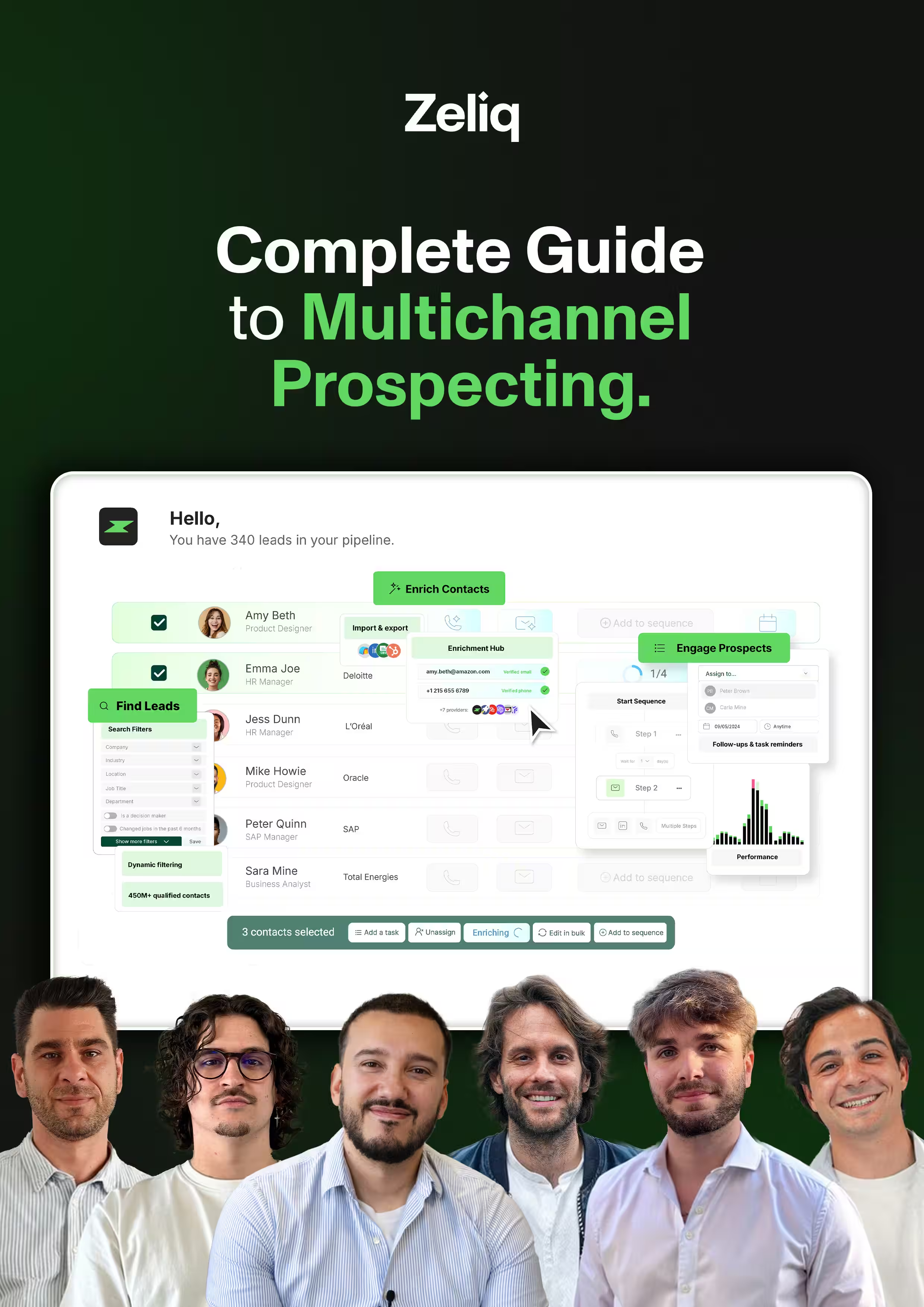
Zeliq combines a 450 million B2B contact database, waterfall enrichment across multiple sources with integrated email verification, and multichannel sequences in one interface. Consolidates Categories 1 + 2 at mid-market pricing. GDPR-native suppression, European positioning.
11. Frequently asked questions
How do I pick the right sales intelligence category?
Match the primary category to your biggest bottleneck: finding right contacts → Category 1 (enterprise databases); orchestrating full outbound → Category 2 (execution-layer); knowing when accounts are in-market → Category 3 (intent-first ABM); understanding how deals progress and coaching reps → Category 4 (conversation intelligence). Decision framework: (1) Audit your current pipeline gaps. If SDRs waste time finding emails and phones, Category 1 or 2 solves it. If SDRs reach plenty of contacts but conversions are low, Category 3 (intent timing) solves it. If AEs manage deals that stall or lose, Category 4 solves it. (2) Match to team composition: SDR-heavy outbound teams need Categories 1-2 primarily; AE-heavy enterprise deal teams need Categories 3-4 primarily. (3) Budget constraint: < $50k/year sales tools = Category 2 (execution-layer bundles Categories 1-2 at mid-market pricing); > $100k/year = mix of 2-3 categories. Most mature teams end at 2-3 categories: SDR team runs Category 2 (Apollo or Zeliq) + Category 1 (ZoomInfo or Cognism for coverage) + Category 4 (Gong for AE handoff). Beyond 4 categories, integration debt exceeds value and tools go unused. Rule of thumb: start with one category, master it, add second category only when the first produces diminishing returns. Common failure: buying 4 categories simultaneously, deploying none fully, wasting 50-70% of tool spend.
What is the total cost of a sales intelligence stack?
$50-$1,200 per SDR per month depending on team size and category mix: SMB $50-300, mid-market $300-700, enterprise $600-1,200. Concrete tiers verified September 2026: (1) SMB 1-10 SDRs: Apollo $49-149/user covering Categories 1+2 + optional LinkedIn Sales Navigator $80-150/user. Total $50-300/user/month. Simple stack, high consolidation. (2) Mid-market 10-50 SDRs: execution-layer platform (Apollo Pro, Zeliq) $150-400/user covering Categories 1+2 + LinkedIn Sales Nav $150/user + optional Bombora or 6sense entry Category 3 $50-150/user allocated. Total $300-700/user/month. (3) Enterprise 50+ SDRs + AE org: ZoomInfo or Cognism enterprise (Category 1) $200-500/user allocated + 6sense or Demandbase (Category 3) $100-250/user allocated + Gong or Chorus (Category 4) $100-200/user allocated + LinkedIn Sales Nav Advanced $167/user. Total $600-1,200/user/month. Beyond direct tool cost, factor CRM base cost (HubSpot Professional $800/month, Salesforce Sales Cloud $150-330/user), integration debug (5-15 hours/month for stitched stacks), and vendor consolidation savings (execution-layer platforms covering Categories 1+2 save 30-40% vs stitched database + separate sequencer). Team scaling: at 10 SDRs enterprise stack ~$6k-12k/month; at 50 SDRs $30-60k/month. ROI threshold: tools should generate 2-3× their cost in attributable pipeline within 90 days.
What is the best sales intelligence tool for my team size?
1-5 SDRs → Apollo free tier or Lusha free + paid upgrade ($49-149/user); 10-50 SDRs → Zeliq or Apollo execution-layer platform ($150-400/user); 50+ SDRs enterprise → ZoomInfo + 6sense + Gong stack ($600-1,200/user). Selection by team size: (1) 1-5 SDRs: free tiers of category leaders cover basic needs (Apollo free 900 credits/year, Lusha free 5 credits/month, HubSpot CRM free). Add $49-149/user paid upgrade when free tiers insufficient. Total < $300/user/month. Keep it simple. (2) 10-50 SDRs: execution-layer platform consolidating Categories 1 + 2 wins. Apollo Professional at $79-149/user bundles database + enrichment + sequencer. Zeliq at $150-400/user adds waterfall enrichment + multichannel. Choose by geography (US + global → Apollo, European-heavy → Zeliq). Total $300-700/user/month. (3) 50+ SDRs with AE org: enterprise stack combining multiple categories wins because category-leader depth per layer compounds. ZoomInfo (Category 1 enterprise database), 6sense or Demandbase (Category 3 ABM intent), Gong or Chorus (Category 4 conversation intelligence), LinkedIn Sales Navigator Advanced. Total $600-1,200/user/month. (4) PLG-first SaaS: product usage signals matter more than cold outbound. MadKudu for Category 3 scoring + HubSpot or Salesforce for CRM + execution via product-led triggers. Different stack logic entirely. Common failure: buying enterprise stack on 10-SDR team (complexity overhead exceeds value) or free tiers on 50-SDR team (coverage gaps cap pipeline). Match tier to actual team size, revisit annually.
12. Conclusion: 3 actions to run
Identify primary bottleneck within 7 days. Finding contacts, orchestrating outbound, timing, or deal coaching? Match category to bottleneck.
Audit current tool utilization within 15 days. Any tool with < 30% seat utilization = consolidate or drop.
Reassess category mix within 30 days. Mature teams run 2-3 categories; beyond 4 = integration debt exceeds value.
Categories 1 + 2 bundled: database + waterfall enrichment + multichannel sequences
Zeliq combines 450 million B2B contacts, waterfall enrichment with integrated verification, and multichannel sequences in one interface. Consolidates Categories 1 + 2 at mid-market pricing. GDPR-native suppression, European positioning.
Try for freeAnd if you want Categories 1 + 2 bundled in a single interface at mid-market pricing, try Zeliq for free: sourcing, enrichment, verification, and multichannel sequences in one platform, no credit card required.