

Lead scoring software assigns a numerical value to each B2B lead based on ICP fit (demographic + firmographic criteria) and engagement behavior (email opens, page visits, content downloads, intent signals), routing high-score leads to sales for immediate outreach and low-score leads to nurture. In 2026, mature lead scoring platforms combine two model types (rules-based and predictive machine learning) and integrate with CRM at real-time bidirectional depth so scores update automatically as leads engage, with category leaders bundling scoring alongside marketing automation (HubSpot Marketing Hub, Salesforce Marketing Cloud Account Engagement, Marketo) or intent data (ZoomInfo Copilot, 6sense). This article maps the 2 scoring model types, the 10 leading platforms, integration patterns, cost benchmarks, compliance, and 3 FAQ.
For a RevOps engineer, Head of Sales, growth marketer, or founder implementing lead scoring, this article gives the model framework, the vendor grid, and the integration checklist.
On the agenda:
- What lead scoring software does (model + routing)
- The 2 scoring model types (rules-based, predictive ML)
- 10 leading platforms compared
- ICP fit scoring vs behavior scoring
- Integration with CRM: Tier 3-4 real-time bidirectional
- The MQL / SQL / PQL routing framework
- Cost benchmarks by team size
- Compliance: GDPR, CAN-SPAM, CCPA
- 3 FAQ (rules vs predictive, score threshold tuning, cost)
Key takeaways:
- Definition: numerical scoring of leads by ICP fit + engagement, routes to sales or nurture
- 2 model types: rules-based (deterministic, transparent) and predictive (ML, opaque but accurate)
- 10 leading platforms: HubSpot Marketing Hub, Marketing Cloud Account Engagement (Pardot), Marketo, ZoomInfo, 6sense, Leadfeeder, Improvado, MadKudu, ActiveCampaign, Freshsales
- Integration depth: real-time bidirectional CRM sync essential; anything less breaks routing
- Score thresholds: MQL (marketing qualified) → SQL (sales qualified) → PQL (product qualified for PLG)
- Cost per team: $50-$500+/user/month depending on model complexity and CRM ecosystem
- Waterfall enrichment: 90%+ match rate on ICP inputs vs 50-70% single-source per aggregated SERP
- Compliance: FTC CAN-SPAM US, GDPR (CNIL 2025 €486M) EU
1. What lead scoring software does
Lead scoring software solves a fundamental sales problem: not every lead is worth an SDR’s time immediately. Some are perfect ICP fits with high intent; others are curious researchers not ready to buy. Scoring separates the two.
The mechanism assigns points based on two dimensions:
Dimension 1, ICP fit: how closely the lead matches your Ideal Customer Profile (title, industry, employee count, revenue, tech stack, geography). Score derived from enriched firmographic + demographic fields.
Dimension 2, Engagement behavior: what the lead has done (opened emails, visited pricing page, downloaded whitepaper, registered for webinar). Score derived from tracked behavior in the CRM and marketing automation.
Combined score triggers routing: high score → sales outreach immediately; medium score → drip nurture; low score → wait for engagement.
2. The 2 scoring model types
Two model architectures dominate 2026, with distinct trade-offs.
Model 1, Rules-based scoring: deterministic rules set by RevOps. Example: +10 points for VP+ title, +20 for pricing page visit, +15 for webinar attendance. Transparent, easy to debug, easy to explain to sales. Best when your ICP is well-understood and behaviors have clear meaning.
Model 2, Predictive scoring (ML-based): machine learning trained on historical lead-to-close data. Model learns which features correlate with actual sales outcomes and outputs a probability score. More accurate than rules-based on complex ICPs but opaque (why did this lead score high?). Best when you have > 6-12 months of historical data + closed deals to train on.
Most mature teams use hybrid: rules-based for clear signals (executive title, pricing page visit) + predictive ML for pattern detection on ambiguous signals.
3. 10 leading platforms compared
Positioning verified September 2026 via aggregated SERP.
HubSpot Marketing Hub + Sales Hub
Native lead scoring inside HubSpot ecosystem. Both rules-based and predictive ML models. Best for HubSpot CRM users.
Marketing Cloud Account Engagement (Pardot)
Salesforce’s B2B marketing automation with lead scoring. Points-based on activity + firmographic criteria. Deep Salesforce Sales Cloud integration.
Marketo Engage
Adobe’s enterprise marketing automation. Multi-dimensional scoring for complex B2B with multiple decision-makers. Enterprise pricing.
ZoomInfo
Contact database + intent data + AI-powered lead scoring via Copilot AI layer. Best for teams already on ZoomInfo for contact data.
6sense
ABM + predictive intent + account-level scoring. Best for account-based motions where accounts (not individual leads) are the scoring unit.
Leadfeeder
Reverse IP identification + website visitor scoring. Assigns scores based on page views, session frequency, high-intent page visits.
Improvado
Unifies scoring signals across paid ads + CRM + email + product analytics + offline events. Multi-channel scoring for marketing ops teams.
MadKudu
Predictive scoring for product-led growth companies. Best for SaaS where product usage signals drive scoring.
ActiveCampaign
SMB-friendly marketing automation with scoring. Budget-conscious option.
Freshsales
CRM + scoring bundled at SMB price point. Good value for growing teams.
For the sourcing layer that feeds enrichment into scoring, see B2B contact data.
4. ICP fit scoring vs behavior scoring
Two scoring dimensions that both contribute to the final score.
ICP fit scoring: - Executive title (+15 points) - Target industry (+10 points) - Company size 100-500 employees (+10 points) - Located in North America (+5 points) - Uses target tech stack (+15 points)
Behavior scoring: - Opened 3+ emails (+5 points) - Visited pricing page (+15 points) - Downloaded product datasheet (+10 points) - Registered for webinar (+20 points) - Requested demo (+50 points)
Total = fit score + behavior score. Route on the total, but track each dimension separately for debugging.
5. Integration with CRM: real-time bidirectional
Lead scoring only creates value when scores drive routing decisions. The score must sit in the CRM at the moment a sales rep views the lead record, and it must update automatically as new engagement happens.
Integration tiers: - Tier 1: CSV export (broken for scoring) - Tier 2: manual sync button (broken) - Tier 3: scheduled batch sync (works for slow-moving scoring) - Tier 4: real-time bidirectional with webhooks (production-grade)
Category leaders (HubSpot, Pardot, Marketo) offer Tier 4 natively for their ecosystem CRMs. Third-party scoring tools vary; verify with vendor demo before commit.
6. The MQL / SQL / PQL routing framework
Once a score exists, it drives routing through three qualification tiers:
MQL (Marketing Qualified Lead): score threshold indicating fit + engagement. Nurture in email drip until behavior escalates. Ownership: marketing.
SQL (Sales Qualified Lead): score threshold indicating readiness for sales outreach. SDR assigned, sequence triggered. Ownership: sales.
PQL (Product Qualified Lead, for PLG companies): score triggered by product-usage signals (signed up + used feature X + reached usage threshold). Different from MQL because intent is proven through product engagement. Ownership: sales expansion or SDR.
Threshold tuning: MQL commonly 40-60 points, SQL 70-100 points, PQL varies by product engagement metrics. Calibrate against actual close rates.
7. Cost benchmarks by team size
Concrete math at typical mid-market pricing verified September 2026:
SMB (< 5 SDRs): - ActiveCampaign or Freshsales with scoring: $50-100/user/month - HubSpot Starter or Marketing Hub Starter: $20-100/month - Total: $70-200/user/month
Mid-market (5-30 SDRs): - HubSpot Marketing Hub Professional: $800+/month base + Sales Hub Professional add-ons - Or Marketing Cloud Account Engagement Growth: $1,250+/month - Or Marketo entry: custom quote - Total: $150-400/user/month effective
Enterprise (30+ SDRs): - Marketo Engage enterprise: custom quote, typically $30k-100k+/year - 6sense enterprise: $50k-150k+/year for account-based ABM scoring - ZoomInfo with Copilot AI: enterprise custom, similar range - Total: $200-500+/user/month effective
8. Compliance: GDPR, CAN-SPAM, CCPA
EU GDPR: scoring involves processing personal data (behavior tracking, firmographic enrichment). Requires legitimate interest documentation + opt-out + suppression + 3-year retention. CNIL 2025 sanctions hit €486M total.
US CAN-SPAM: FTC compliance requires accurate subject line + valid physical address + functional opt-out on marketing emails.
California CCPA/CPRA: right to know, delete, opt-out for California residents; disclosures on how scoring is performed.
Automated decision-making disclosure: some jurisdictions require disclosure when scoring drives significant decisions about individuals. B2B lead scoring for routing purposes typically stays under the disclosure threshold, but verify per-jurisdiction.
9. Common mistakes
Mistake 1: Rules-based scoring with too many rules. Above 20-30 rules, the model becomes ungovernable and rules interact unpredictably.
Mistake 2: Predictive ML on insufficient training data. Below 6-12 months of history with closed deals, ML overfits noise.
Mistake 3: No calibration against actual close rates. Score thresholds set arbitrarily produce noise not signal.
Mistake 4: Missing enrichment on ICP fit inputs. Without verified firmographic data, fit scoring runs on form-submitted data only (60-80% miss on true ICP fit).
Mistake 5: No score decay. Leads that engaged 6 months ago still score high. Add time decay to keep scores fresh.
Zeliq and enriched inputs for lead scoring
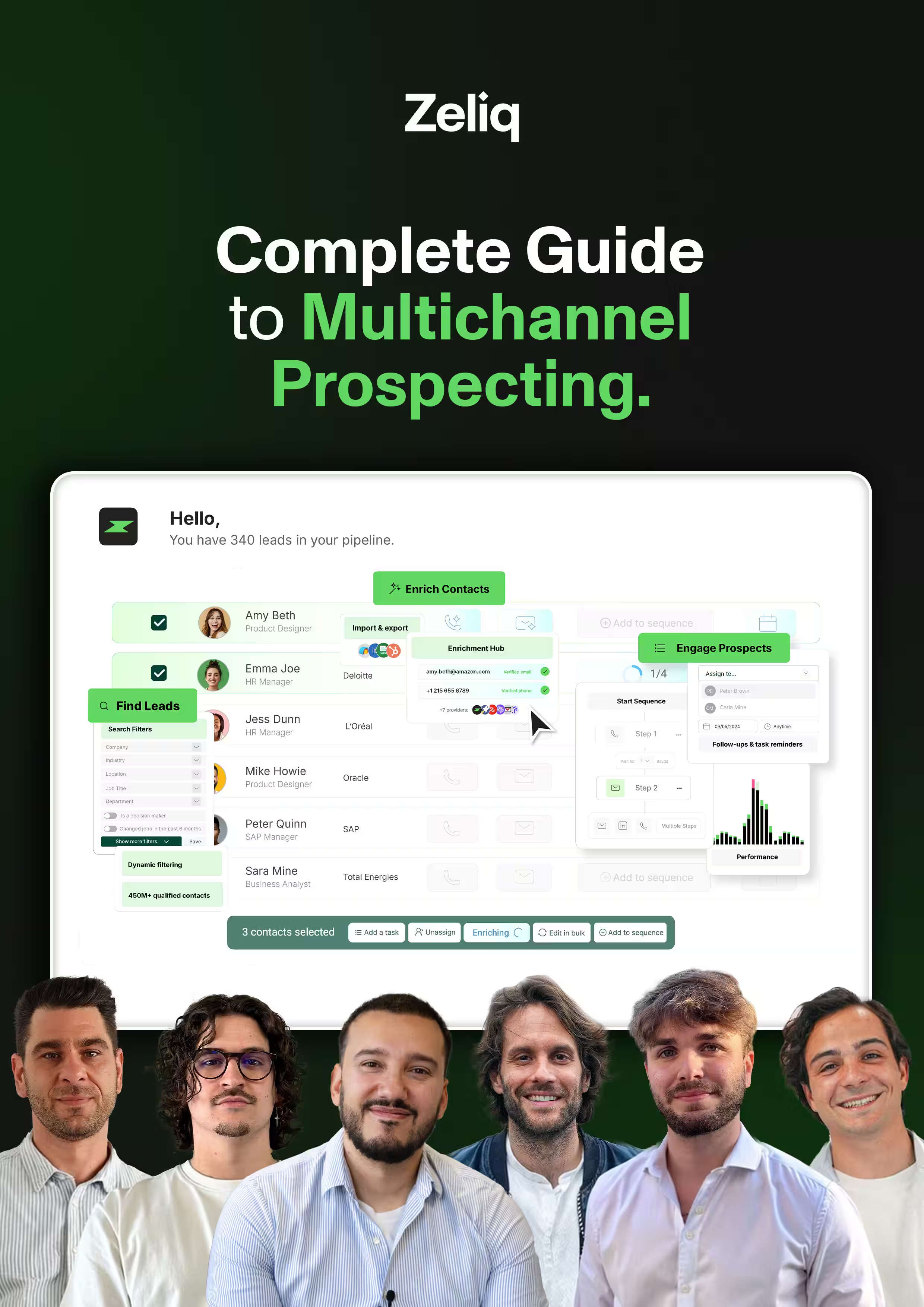
Zeliq combines a 450 million B2B contact database, waterfall enrichment across multiple sources with integrated email verification, and multichannel sequences in one interface. Provides the ICP fit inputs (title, seniority, firmographic, tech stack) that lead scoring models require, at 90%+ match rate. GDPR-native suppression, European positioning.
10. Frequently asked questions
Rules-based scoring vs predictive ML, which should I choose?
Rules-based fits teams below 6-12 months of history or when transparency matters (RevOps needs to explain scores to sales); predictive ML fits teams with > 12 months of closed-deal history and complex multi-signal ICPs; hybrid combines both for best results. Trade-offs: (1) Rules-based advantages: transparent (every score justified by explicit rule), easy to debug when a lead scores wrong, easy to explain to sales team, no data-history prerequisite. Best for < 6 months of pipeline history or when RevOps needs to iterate rules quickly based on sales feedback. (2) Rules-based limitations: ceiling on complexity (above 20-30 rules, interactions become unpredictable), can’t capture non-linear patterns (e.g., “VP title + tech switch + 3 page visits in 48h” scoring more than sum of parts), requires manual tuning as ICP evolves. (3) Predictive ML advantages: captures complex patterns humans can’t articulate, self-updates as new closed deals feed the model, higher accuracy on mature pipelines. (4) Predictive ML limitations: opaque (why did this lead score 87 vs 65?), requires 6-12+ months of closed-deal history to train, harder to iterate based on sales feedback, can overfit noise if training data is small. (5) Hybrid pattern: rules-based for clear signals (executive title = +15, pricing page = +15) + predictive ML for pattern detection on ambiguous behaviors. Best of both. Most category leaders (HubSpot, Marketo, Pardot) offer both models in the same platform. Rule of thumb: start rules-based, layer predictive ML after 6 months of pipeline history, evaluate hybrid vs rules-only every quarter based on sales-marketing feedback.
How do I calibrate MQL and SQL score thresholds?
Calibrate against actual close rates from historical pipeline: MQL threshold at the score where 15-25% of leads close within 90 days; SQL threshold at the score where 35-50% close within 60 days; iterate quarterly as ICP and market evolve. Method: (1) Export last 12 months of leads with their scores and close outcomes. (2) Bucket by score range (0-20, 20-40, 40-60, 60-80, 80-100). (3) Calculate close rate per bucket. (4) MQL threshold: the score range where close rate crosses 15-25% (sweet spot for marketing nurture handoff). SQL threshold: the score range where close rate crosses 35-50% (sweet spot for sales outreach investment). PQL threshold (for PLG companies): typically product-usage-based rather than score-based (feature X used + threshold Y reached). (5) Verify with sales: pull 20 leads at each threshold, ask sales to evaluate. If sales disagrees with score for > 40% of samples, thresholds need adjustment or model needs retraining. Iteration cadence: quarterly review of thresholds + close rates. If close rates drift > 5 percentage points, retune. Common failure: setting thresholds without historical data (arbitrary numbers), then defending them when sales complains. Rule of thumb: MQL commonly lands 40-60 points on a 100-point scale; SQL 70-100. Vary by industry and product complexity; enterprise deals often score lower (fewer signals per lead) than SMB (many signals per lead). Track scoring-to-close correlation as your #1 scoring metric; if correlation drops below 0.5, the model needs work.
What is the total cost of lead scoring software per team?
$70-$500+ per user per month depending on team size and CRM ecosystem: SMB $70-200/user, mid-market $150-400/user, enterprise $200-500+/user with account-based ABM scoring. Concrete tiers verified September 2026: (1) SMB (< 5 users): ActiveCampaign Plus at $70-149/month, Freshsales at $29-79/user, HubSpot Marketing Hub Starter at $20-100/month. Rules-based scoring included; predictive ML on higher tiers. Total $70-200/user/month effective. (2) Mid-market (5-30 users): HubSpot Marketing Hub Professional at $800/month + Sales Hub Professional at $100/seat, Marketing Cloud Account Engagement Growth at $1,250/month base, Marketo entry at custom quote (~$1,000-2,000/month). Both rules-based and predictive ML available. Total $150-400/user/month effective. (3) Enterprise (30+ users): Marketo Engage enterprise at custom quote ($30k-100k+/year), 6sense enterprise ABM at $50k-150k+/year, ZoomInfo with Copilot AI at custom quote (typically $30k-100k+/year). Account-based scoring, predictive ML, AI-driven recommendations. Total $200-500+/user/month effective. (4) Product-led growth: MadKudu, Customer.io scoring based on product usage. Pricing varies widely, $500-5,000+/month. Beyond direct platform cost, factor CRM base cost (HubSpot Professional CRM $800/month, Salesforce Sales Cloud $150-330/user/month, Marketo requires Salesforce or HubSpot), integration debug for third-party scoring feeding into main CRM, and enrichment tool cost for ICP fit inputs ($100-300/user/month). Consolidation savings: platforms bundling marketing automation + CRM + scoring (HubSpot ecosystem) save 20-30% vs stitching scoring tool + separate CRM + separate marketing automation.
11. Conclusion: 3 actions to run
Choose rules-based or ML within 7 days. Below 12 months of history → rules-based. Above 12 months → hybrid.
Calibrate thresholds against close rates within 15 days. Export historical pipeline, bucket by score, verify close rate crosses 15-25% at MQL and 35-50% at SQL.
Verify enrichment on ICP fit inputs within 30 days. Without verified firmographic, fit scoring runs on form data only. Waterfall enrichment lifts match rate 55-70% to 85-95%.
Verified firmographic data feeding lead scoring models at 90%+ match rate
Zeliq combines 450 million B2B contacts, waterfall enrichment with integrated verification, and multichannel sequences in one interface. Provides ICP fit inputs (title, seniority, firmographic, tech stack) at 90%+ match rate. GDPR-native suppression.
Try for freeAnd if you want verified firmographic data feeding lead scoring models at 90%+ match rate with multichannel sequences bundled, try Zeliq for free: sourcing, enrichment, verification, and outreach in one interface, no credit card required.