

CRM data enrichment is the operational layer that fills missing fields, deduplicates records, and standardizes data on a CRM by matching each existing record against one or more external data sources, feeding downstream workflows (lead scoring, routing, sequence personalization, ABM targeting) with complete inputs. In 2026, integration depth matters more than raw enrichment coverage: aggregated SERP benchmarks (verified September 2026) note that “CRM integration” ranges from a CSV export button to fully automated bidirectional sync with field mapping, deduplication, and conflict resolution, a spread that produces 5-10× differences in real workflow value. This article maps the 4 integration depth tiers, the 4 downstream workflows enrichment feeds, tool categories, cost benchmarks, and 3 FAQ.
For a RevOps engineer, Head of Sales, growth manager, or founder configuring CRM enrichment on Salesforce, HubSpot CRM, Pipedrive, or a similar platform, this article gives the integration checklist and the tool decision framework.
On the agenda:
- What CRM data enrichment does (integration layer role)
- The 4 integration depth tiers (CSV export → real-time bidirectional)
- The 4 downstream workflows enrichment feeds
- Tool categories: native CRM add-ons vs standalone vs workflow platforms
- Real-time vs batch enrichment
- Field mapping, deduplication, conflict resolution
- Cost benchmarks per SDR and per team
- Compliance: GDPR, CAN-SPAM, CCPA
- 3 FAQ (integration depth benchmarks, real-time vs batch, cost)
Key takeaways:
- Definition: fills missing fields + deduplicates + standardizes CRM records via external data matching
- 4 integration depth tiers: CSV export, manual sync, scheduled sync, real-time bidirectional
- 4 downstream workflows: lead scoring, CRM routing, personalization, ABM targeting
- Match rate: 55-70% single-vendor, 85-95% waterfall 3-4 vendors
- Data decay: ~2-3% per month drives continuous refresh
- Cost per contact: $0.05-0.50 depending on volume and depth
- Native CRM add-ons: HubSpot Breeze Intelligence (Clearbit), Salesforce Data.com legacy
- Compliance: FTC CAN-SPAM US, GDPR (CNIL 2025 €486M) EU
1. What CRM data enrichment does
A CRM without enrichment holds records with holes: names but no titles, emails but no phones, companies but no size or industry. Enrichment connects the CRM to external data sources (databases, verification APIs, intent providers) and closes those holes automatically.
The scope covers three operations: - Fill missing fields: add verified email, direct phone, title, seniority, firmographic data - Deduplicate: merge or flag records that describe the same person or company - Standardize: normalize inconsistent data (title casing, phone format, industry taxonomy)
Well-configured enrichment turns a partially-filled CRM into a segmentation-ready sales engine. Poorly-configured enrichment produces noise: duplicates, conflicting field values, stale timestamps.
2. The 4 integration depth tiers
Vendors describe “CRM integration” in marketing terms; the real spread of technical depth is wide. Four tiers:
Tier 1, CSV export: user manually downloads enriched contacts from the enrichment tool, imports into CRM. No live sync. Common on entry-level plans.
Tier 2, Manual sync: enrichment tool has a “push to CRM” button; user triggers per record or per batch. Field mapping preset but not customizable. Deduplication basic.
Tier 3, Scheduled sync: enrichment tool runs a batch on a cron schedule (daily, weekly) matching new CRM records and enriching them. Field mapping customizable. Deduplication automated.
Tier 4, Real-time bidirectional: enrichment tool subscribes to CRM webhooks on record creation, enriches immediately, writes back within seconds. Conflict resolution handled (which value wins when enrichment result differs from user-entered data). Bidirectional so CRM changes propagate back.
Tier 4 produces 5-10× more workflow value than Tier 1 per aggregated SERP commentary because Tier 4 feeds lead scoring, routing, and personalization automatically, while Tier 1 requires human intervention every time. Before buying, ask the vendor which tier they actually support for your specific CRM.
3. The 4 downstream workflows enrichment feeds
Enrichment is the input for four operational workflows.
Workflow 1, Lead scoring: assign scores based on ICP fit + intent. Enrichment provides ICP fit inputs (title, seniority, company size, industry, tech stack).
Workflow 2, CRM routing: assign each new lead to the right SDR territory or account team. Enrichment provides routing keys (geography, employee count, industry).
Workflow 3, Sequence personalization: sequences that mention title, department, tech stack, or funding stage convert 3-4× more than generic sequences per aggregated SERP benchmarks. Enrichment provides the personalization tokens.
Workflow 4, ABM targeting: account-based marketing needs a complete map of decision-makers per target account. Enrichment identifies the 5-10 relevant contacts per account.
The value of enrichment scales with the maturity of these downstream workflows. Enrichment feeding no workflows adds no value; enrichment feeding four workflows compounds 5-10×.
4. Tool categories
Three categories of CRM enrichment tools with distinct fit patterns.
Category 1, Native CRM add-ons: HubSpot Breeze Intelligence (built on Clearbit acquisition, native to HubSpot), Salesforce Data.com legacy. Deepest integration by definition. Coverage moderate, integration friction zero.
Category 2, Standalone enrichment platforms: Apollo, Cognism, Lusha, ZoomInfo, UpLead, Zeliq. Broad coverage, integration depth varies vendor-to-vendor. Most cover Tier 3-4 for HubSpot and Salesforce; fewer cover Pipedrive or Zoho natively.
Category 3, Workflow-composable platforms: Clay, Openprise. Best when a technical RevOps team wants fine-grained control over enrichment logic (different providers for different segments, conditional workflows, waterfall composition). Highest ceiling, steepest learning curve.
Most mature teams end at hybrid: native add-on for real-time on record creation + broad standalone platform for batch enrichment + workflow tool for edge cases. See B2B contact data for the vendor comparison in depth.
5. Real-time vs batch enrichment
Enrichment runs on two clocks:
Real-time: triggered at contact creation (form submission, product signup, manual CRM add). Latency budget 500ms to 3 seconds. Feeds lead scoring and routing that happen immediately.
Batch: scheduled (daily, weekly, monthly). Async processing over minutes to hours. Feeds CRM cleanup, ABM list preparation, quarterly refresh cycles.
Mature setups use both. Real-time on new records for immediate routing; batch monthly on the existing base for freshness.
6. Field mapping, deduplication, conflict resolution
The three technical concerns that determine whether integration is smooth or painful.
Field mapping: which enrichment field lands in which CRM field. Example: enrichment returns title, CRM stores Job_Title__c. Vendors that offer visual field mapping save 5-10 hours of RevOps configuration vs vendors that hardcode mappings.
Deduplication: when the enrichment tool returns a record that already exists in CRM. Options: skip, merge, update in place, flag for review. Best-in-class vendors let you configure the rule per data type (never overwrite user-entered fields, always update stale timestamps).
Conflict resolution: when enrichment returns a value that differs from the current CRM value. Rules: enrichment wins on fields older than X days, user-entered fields never overwritten, conflict flagged for review. Missing this configuration produces the worst outcome: enrichment silently corrupts user-entered CRM data.
Vendors that handle these three cleanly integrate at Tier 3-4. Vendors that hand-wave these details integrate at Tier 1-2.
7. Cost benchmarks per SDR and per team
Concrete ranges at mid-market vendor pricing verified September 2026:
Native CRM add-ons: - HubSpot Breeze Intelligence: bundled in HubSpot Enterprise or standalone add-on ($200-500/seat/month typical) - Salesforce native enrichment: usually via AppExchange partners at $50-300/seat/month
Standalone enrichment platforms: - Apollo Basic/Professional: $49-149/seat/month - Cognism enterprise: annual custom, ~$15k-50k+/year - Zeliq mid-market: $150-400/seat/month (bundles enrichment + verification + sequencer)
Workflow platforms: - Clay Launch: from $185/month unlimited seats - Clay Growth: from $495/month unlimited seats
Team scaling: at 5 SDRs, native + standalone stitched runs $2,000-$4,000/month; all-in-one bundle runs $1,500-$3,000/month. Consolidation savings 20-30%.
8. Compliance: GDPR, CAN-SPAM, CCPA
EU GDPR: enrichment feeds outreach; outreach must document legitimate interest per ICP + provide opt-out + honor suppression within 30 days + respect 3-year post-last-contact retention. CNIL 2025 sanctions hit €486M total (vs €55M in 2024), including SOLOCAL Marketing Services at €900k for prospecting without sufficient legal basis. Vendor selection matters: GDPR-native vendors maintain suppression list APIs and produce DPAs on request.
US CAN-SPAM: FTC compliance guide requires accurate subject line + valid physical address + functional opt-out + honor opt-out within 10 business days.
California CCPA/CPRA: right to know, delete, opt-out for California residents. B2B has partial exemption but campaigns targeting California should include disclosures.
Zeliq and CRM data enrichment
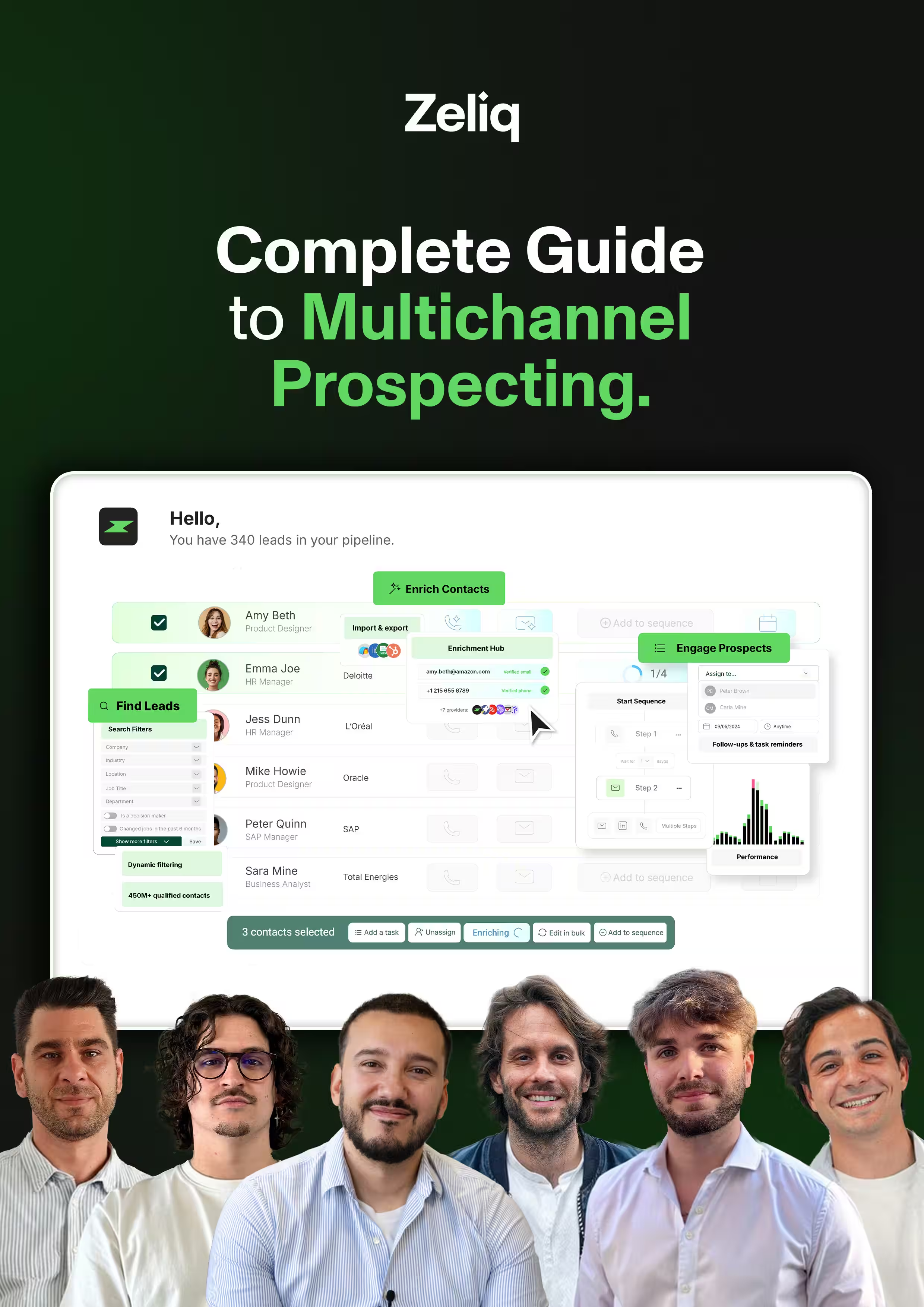
Zeliq combines a 450 million B2B contact database, waterfall enrichment across multiple data sources with integrated email verification, and multichannel sequences with native HubSpot CRM, Salesforce, and Pipedrive integrations at Tier 3-4 depth (real-time on record creation, scheduled batch, bidirectional sync). GDPR-native suppression list.
9. Common mistakes
Mistake 1: Buying enrichment without checking integration depth. Tier 1 CSV export produces 5-10× less value than Tier 4 real-time bidirectional. Ask the vendor which tier.
Mistake 2: No field mapping configuration. Default mappings overwrite user-entered CRM data silently. Configure explicit rules per field.
Mistake 3: Skipping deduplication rules. Enrichment adds duplicates when new records match existing ones on partial fields. Configure merge or skip logic per data type.
Mistake 4: Ignoring conflict resolution. Enrichment result vs user-entered value conflict without rules = data corruption. Rule of thumb: never overwrite user-entered fields, always update stale timestamps.
Mistake 5: One-time enrichment, no refresh cycle. At 2-3% monthly decay, a base enriched a year ago has 24-36% wrong records.
10. Frequently asked questions
What integration depth should I expect from a CRM enrichment tool?
Expect at least Tier 3 (scheduled bidirectional sync with field mapping and deduplication) from any mid-market vendor; Tier 4 (real-time bidirectional with conflict resolution) from any enterprise vendor, anything below Tier 3 is not worth the subscription for production workflows. The four integration tiers explained: (1) Tier 1 (CSV export) = user manually exports enriched records, imports to CRM; produces workflow value only for one-off cleanup, not for ongoing operations. (2) Tier 2 (manual sync button) = per-record or per-batch push with preset field mapping; better than CSV but still requires human intervention per event. (3) Tier 3 (scheduled batch bidirectional sync) = enrichment runs daily/weekly, matches new CRM records, enriches automatically, writes back with field mapping and deduplication; production-grade for teams below 1,000 new records/month. (4) Tier 4 (real-time webhook-driven bidirectional) = enrichment fires immediately on record creation, writes back within seconds, conflict resolution rules configured; production-grade for teams above 1,000 records/month or with real-time routing needs. Verification method: ask vendor to demo the specific CRM integration on your own sandbox instance. If they cannot show real-time enrichment on record creation within 5 seconds, they are Tier 2-3 at best. Also verify: field mapping visual editor available, deduplication rules configurable per data type, conflict resolution rules (never overwrite user-entered fields, update stale timestamps). Vendors that hand-wave these details are hiding Tier 1-2 integration behind marketing terms.
Real-time vs batch enrichment on the CRM, which fits my workflow?
Real-time fits when enrichment drives an immediate downstream action (lead scoring, routing, welcome sequence); batch fits when enrichment feeds a periodic workflow (CRM cleanup, ABM list build, quarterly refresh); most mature teams run both in parallel. Real-time use cases: (1) new inbound form submission → enrichment → routing to correct SDR by geography or industry within 5 seconds, (2) product signup → enrichment → welcome sequence tailored to persona, (3) new CRM record → enrichment → lead score computed immediately. Latency budget: 500ms to 3 seconds user-facing, or 5-30 seconds async. Batch use cases: (1) monthly CRM cleanup: enrich records with last_enriched_at > 6 months, (2) ABM list build for next quarter: enrich a 500-account list ahead of campaign, (3) migration: enrich a legacy 50,000-record base after CRM migration. Latency budget: minutes to hours, async processing. Cost pattern: real-time typically costs slightly more per call (individual API requests) vs batch (bulk endpoint discounts), but the operational value of real-time enrichment often justifies the premium. Most mature setups: real-time on new records, batch monthly on the existing base for freshness. If you can only pick one to start: real-time on inbound (highest ROI for pipeline velocity), then add batch monthly once real-time is stable.
What is the total cost of CRM data enrichment for a mid-market team?
$1,500-$4,000/month for a 5-SDR mid-market team, dropping to $1,500-$2,500 with all-in-one consolidation, before CRM seat cost. Cost breakdown at mid-market pricing verified September 2026: (1) Native CRM add-on (HubSpot Breeze Intelligence or Salesforce native enrichment): $200-500/seat/month bundled or standalone. Deepest integration but coverage moderate. (2) Standalone enrichment platform (Apollo, Cognism, Lusha, Zeliq): $150-400/seat/month covering database + enrichment + typically verification. Best coverage + Tier 3-4 integration on major CRMs. (3) Workflow platform (Clay, Openprise): $185-495/month base, unlimited seats, usage-based credits. Best for teams with technical RevOps designing custom workflows. (4) Verification tool: $0-50/seat/month (often bundled). (5) Integration debug time: 5-15 hours/month for stitched stacks, near zero for all-in-one platforms. Fully-loaded RevOps hourly cost $30-40 means integration debug is real money: 10 hours/month × $35 = $350/month/team of hidden cost. Team of 5 SDRs consolidated on Zeliq or Apollo enterprise: $750-2,000/month direct + $150-350/month allocated CRM seats = $900-$2,350 total. Same team stitched with 3-4 vendors: $2,000-$4,000/month direct + $350-500/month integration overhead. Consolidation saves 30-40% at 5-10 SDRs, more above 10 SDRs.
11. Conclusion: 3 actions to run
Verify current integration depth within 7 days. Ask your enrichment vendor to demo real-time enrichment on your CRM sandbox. If they cannot show it within 5 seconds of record creation, they are Tier 2 or below.
Configure field mapping, deduplication, and conflict resolution within 15 days. Rule of thumb: never overwrite user-entered fields, always update stale timestamps, flag conflicts on identity fields (name, email).
Set refresh cadence within 30 days. Real-time on new records + monthly batch on records untouched > 6 months. Track
last_enriched_attimestamp with alerts.
Real-time CRM enrichment with waterfall coverage and multichannel sequences bundled
Zeliq combines 450 million B2B contacts, waterfall enrichment with integrated verification, multichannel sequences, and native HubSpot CRM + Salesforce + Pipedrive integrations at Tier 3-4 depth. GDPR-native suppression.
Try for freeAnd if you want CRM enrichment at Tier 3-4 depth with waterfall coverage and multichannel sequences in one interface, try Zeliq for free: sourcing, enrichment, verification, sequences, and CRM sync in a single platform, no credit card required.