

An AI SDR (artificial intelligence sales development representative) is an autonomous software agent that owns the complete outbound workflow end-to-end, sourcing contacts from a database, waterfall enrichment, multichannel outreach (email + LinkedIn + phone + SMS), autonomous reply handling, and meeting booking, operating 24/7 without human intervention between steps. In 2026, Artisan’s Ava is positioned as the only AI SDR owning the entire outbound workflow end-to-end sourcing from 250M+ B2B contacts per vendor claim, 11x.ai’s Alice researches + crafts emails + manages sequences + books meetings per vendor claim, and > 90% of Artisan customers run their AI SDR fully autonomously per aggregated SERP commentary verified September 2026. This article maps the AI SDR definition, 10 leading platforms, cost vs human SDR math, implementation framework, compliance, and 3 FAQ.
For a Head of Sales, VP Revenue, founder, or RevOps leader evaluating AI SDRs, this article gives the autonomy framework, cost comparison, and vendor grid.
On the agenda:
- What an AI SDR actually owns (vs AI assistant or AI feature)
- The autonomy spectrum (approve-every-touch to fully autonomous)
- 10 leading AI SDR platforms
- Cost comparison: AI SDR vs human SDR
- Multichannel coverage (email + LinkedIn + phone + SMS + WhatsApp)
- Implementation framework (pilot → scale → feedback loop)
- When AI SDRs win vs when human SDRs win
- Compliance: GDPR, CAN-SPAM, AI governance
- 3 FAQ (AI SDR vs AI assistant, cost comparison, best platform)
Key takeaways:
- Definition: autonomous agent owning complete outbound workflow 24/7
- Autonomy spectrum: full autonomy (Ava, Alice) vs human-approval (most AI-added tools)
- 10 leading platforms: Artisan Ava, 11x.ai Alice, AiSDR, Clay, Amplemarket, Reply AI, Apollo AI, Nooks, Jason AI, Zeliq
- Artisan Ava claim: 250M+ contacts + full autonomy; > 90% customers run autonomously
- Cost comparison: AI SDR $500-2,500/month vs human SDR $60-100k/year fully loaded
- Multichannel coverage: email + LinkedIn + phone + SMS + WhatsApp with fallback logic
- When AI SDRs win: stable ICP + templatable patterns + volume-first + mature deliverability
- When human SDRs win: enterprise multi-stakeholder deals + niche ICP + complex objections
- Compliance: AI governance + FTC CAN-SPAM + GDPR (CNIL 2025 €486M)
1. What an AI SDR actually owns
Three concentric definitions in 2026 marketing:
Narrow definition (AI assistant features): AI generates email openers, suggests next-best-action, auto-updates CRM. Human SDR drives every touch. Not an AI SDR.
Mid definition (AI-executed cadence): AI sends sequences autonomously, handles basic replies (interested, not now, wrong person), escalates qualified leads to humans. Approaches AI SDR.
Full definition (autonomous AI SDR): AI owns end-to-end workflow, sourcing + enrichment + outreach + reply handling + meeting booking, without human intervention between steps. True AI SDR.
Only a handful of platforms deliver the full definition in 2026: Artisan Ava (per vendor claim 90%+ customers run fully autonomous), 11x.ai Alice, AiSDR, Jason AI, emerging competitors.
For broader AI context see B2B contact data.
2. The autonomy spectrum
AI SDR platforms sit on a spectrum from approve-every-touch to fully autonomous:
Level 1, Approve-every-touch: AI generates each email; SDR approves before send. Volume lift modest (~1.5× human SDR), reply rate similar.
Level 2, Approve-sequence: AI designs sequence; SDR approves template; AI sends all touches. Volume lift 2-3× human SDR.
Level 3, Approve-reply-only: AI sends everything autonomously; SDR reviews/approves AI-generated replies before responding. Volume lift 3-5× human SDR.
Level 4, Fully autonomous: AI sends + replies + books meetings; SDR reviews booked meetings before taking calls. Volume lift 5-10× human SDR for stable ICPs.
Match level to ICP + risk tolerance. Fully autonomous on complex multi-stakeholder enterprise deals = risk; fully autonomous on stable templatable SaaS mid-market = fit.
3. 10 leading AI SDR platforms
Positioning verified September 2026:
Artisan Ava
Positioned per vendor claim as only AI SDR owning entire workflow end-to-end. Sources from 250M+ B2B contacts + waterfall enrichment + multichannel + autonomous replies + booking. > 90% of customers run fully autonomously.
11x.ai Alice
Alice researches prospects + crafts personalized emails + manages sequences + books meetings for AEs. Operates 24/7 across time zones. Positioned per vendor claim for teams wanting “autonomous digital workers”.
AiSDR
End-to-end AI SDR platform. Full workflow automation.
Clay
Workflow-first platform with AI SDR capabilities when composed with LLM blocks. Clay Growth $495/month unlimited seats per Clay public pricing.
Amplemarket
Duo Copilot runs 3 agents (Signal + Research + Sequence) end-to-end with human-in-loop approval. Mid-autonomy spectrum (Level 2-3).
Reply AI
Multichannel sequencer with AI SDR features. $99/user Pro tier per aggregated SERP.
Apollo AI
Mid-market AI layer on Apollo platform. Approve-every-touch to approve-sequence. $49-149/user per Apollo public pricing.
Nooks
Signal-based prospecting + dialer with AI SDR features for signal-triggered sequences.
Jason AI
Emerging AI SDR platform.
Zeliq
450M B2B contact database + waterfall + multichannel sequencer. AI-ready data layer feeding AI SDR workflows at 85-95% match rate.
4. Cost comparison: AI SDR vs human SDR
Concrete math verified September 2026:
Human SDR cost (US, fully loaded): - Base salary: $45-65k - Benefits + taxes (30-40% loaded): $14-26k - Tools (CRM + database + sequencer + dialer): $500-$1,000/month = $6-12k/year - Management + training overhead: $5-10k/year - Total: $70-113k/year per human SDR
AI SDR cost: - AI SDR platform subscription: $500-$2,500/month = $6-30k/year - Data layer (if separate): $150-400/user/month = $1.8-4.8k/year - Deliverability infrastructure (if separate): $100-200/month = $1.2-2.4k/year - Total: $9-37k/year per AI SDR
Cost ratio: AI SDR delivers at roughly 10-40% of human SDR fully-loaded cost, depending on configuration.
Output comparison: - Human SDR: 50-100 touches/day, 2-5% reply rate, 5-15 meetings/month - Fully autonomous AI SDR: 200-500 touches/day, 2-5% reply rate (comparable), 10-40 meetings/month
Economic implication: AI SDRs at full autonomy with templatable ICP deliver 2-4× meeting output at 10-40% cost = 5-20× cost-per-meeting improvement.
Caveats: AI SDR output depends on ICP stability + data quality + deliverability discipline. Teams that treat AI SDR as plug-and-play see 30-50% of potential.
5. Multichannel coverage
Leading AI SDR platforms in 2026 integrate 4-6 channels with fallback logic:
- Email (primary channel, 50-60% of touches)
- LinkedIn (connect + message + engagement, 20-30%)
- Phone (dialer + voicemail, 10-15%)
- SMS (follow-up, 5-10%)
- WhatsApp (regional preference, 5-10%)
- AI voice (emerging, 2-5%)
Fallback logic: email bounces → try alternate email, LinkedIn ignored → escalate to phone, phone voicemail → send email confirmation. Automated across channels.
See multichannel prospecting guide.
6. Implementation framework
Deploying AI SDR responsibly:
Phase 1, Pilot (month 1-3): deploy AI SDR on 20-30% of top-of-funnel volume. One ICP segment, stable targeting. Measure baseline vs AI SDR output.
Phase 2, Expand (month 4-6): if ROI > 1.5× human SDR cost-per-meeting, expand to 50-70% of volume. Keep humans on complex deals + enterprise multi-stakeholder.
Phase 3, Scale (month 7-12): layer feedback loops (reply outcomes train AI), add channels, expand to additional ICP segments. Humans transition to higher-value conversations (demos, negotiations, strategic accounts).
Common failure: fully replacing humans before validation = pipeline collapse during AI tuning period. Keep hybrid during pilot + expand phases.
7. When AI SDRs win vs when human SDRs win
AI SDRs win when: - Stable templatable ICP (SaaS mid-market, e-commerce, specific vertical) - Volume-first motion (SDR seat cost dwarfs tool cost) - Mature deliverability operations (warmup + SPF/DKIM/DMARC + rotation) - Simple qualification criteria (clear MQL definition) - 24/7 time-zone coverage valuable
Human SDRs win when: - Enterprise multi-stakeholder deals requiring account-based coordination - Niche ICP (< 5,000 addressable accounts) requiring deep per-touch personalization - Complex objection handling + nuanced qualification - Relationship-based selling (long cycles + trust building) - Early-stage startup finding product-market fit via SDR learning loops
Most mature teams run hybrid: AI SDR for volume + human SDR for complexity.
8. Compliance: GDPR, CAN-SPAM, AI governance
EU GDPR: automated decision-making affecting individuals + AI-generated outreach must include compliant opt-out + legitimate interest documented. CNIL 2025 sanctions hit €486M total.
US CAN-SPAM: FTC compliance guide applies identically to AI-generated emails: accurate subject line + valid physical address + functional opt-out + honor opt-out within 10 business days.
EU AI Act: emerging regulation; AI SDRs classified as limited-risk requiring transparency about AI involvement.
California CCPA/CPRA: AI automated decision-making disclosure requirements evolving. Disclosing AI SDR involvement increasingly expected.
TCPA (US): AI voice calls fall under same TCPA restrictions as human cold calls.
LinkedIn ToS: AI SDRs using LinkedIn automation operate in ToS grey zone; use rate-limited.
Zeliq as AI-ready data layer for AI SDRs
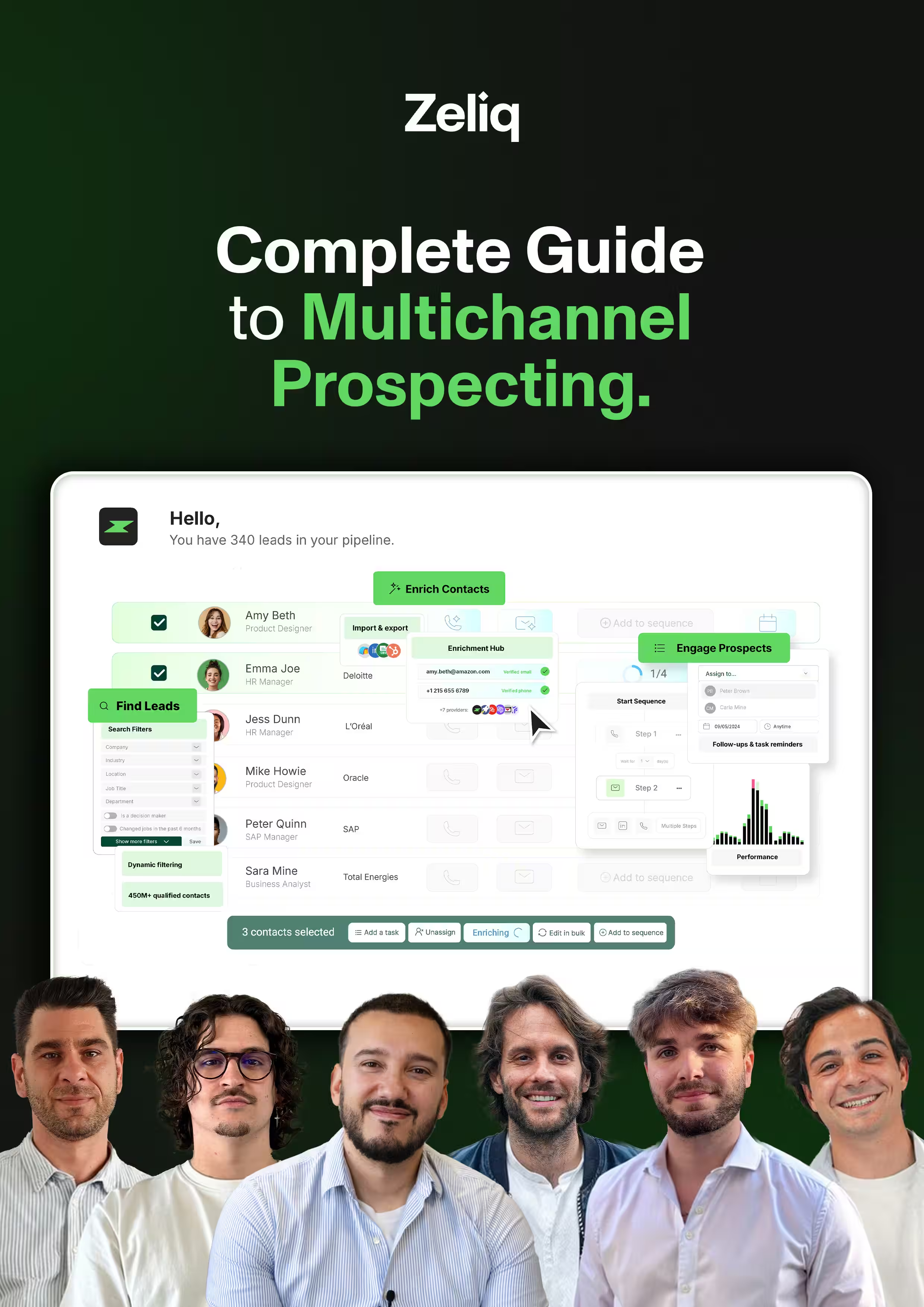
Zeliq combines a 450 million B2B contact database, waterfall enrichment with integrated email verification, API-first architecture, and multichannel sequences in one interface. Powers AI SDR workflows (Artisan Ava, 11x Alice, Amplemarket) with verified data at 85-95% match rate. GDPR-native suppression.
9. Common mistakes
Mistake 1: Replace all humans before validation. AI SDR needs 3-6 months tuning; replacing humans too early = pipeline collapse.
Mistake 2: AI SDR on bad data. AI amplifies noise. Clean + verified enrichment first.
Mistake 3: Deploy to complex enterprise ICP. AI SDRs win on stable templatable; complex multi-stakeholder = human SDR territory.
Mistake 4: Ignore deliverability at AI volume. 500 emails/day/mailbox without warmup + rotation = spam classifier flags.
Mistake 5: No feedback loop. AI SDRs stay at launch quality without conversation outcomes training the model.
10. Frequently asked questions
AI SDR vs AI sales assistant, what’s the difference?
AI SDR owns the entire outbound workflow autonomously (sourcing + enrichment + outreach + reply handling + meeting booking) 24/7 without human intervention between stages; AI sales assistant augments human SDR by generating openers, surfacing insights, automating admin, but human drives each decision. Trade-offs: (1) AI SDR advantages: 24/7 operation across time zones, 2-4× volume of human SDR, 10-40% cost of fully-loaded human SDR. Best when ICP is stable + templatable. (2) AI SDR disadvantages: requires 3-6 months tuning + mature deliverability + stable data quality; underperforms on complex multi-stakeholder enterprise deals; locks workflow into AI’s model with limited human nuance per touch. (3) AI sales assistant advantages: augments human judgment, works with existing CRM + stack, lower risk during transition, keeps SDR relationship-building capacity. (4) AI sales assistant disadvantages: capped at human SDR volume (AI only augments, doesn’t scale touch count), full-SDR salary still required, less dramatic cost reduction. Decision rule: if your ICP is stable + templatable + volume-first + mature deliverability = AI SDR wins long-term. If complex multi-stakeholder + niche + relationship-based = AI sales assistant augmenting human SDR wins. Hybrid pattern (most mature teams): AI SDR for volume top-of-funnel + human SDR for complex escalations + AE handoff. Match tool category to motion; don’t buy AI SDR expecting human SDR workflow.
How does AI SDR cost compare to human SDR?
AI SDR costs $9-37k/year all-in vs human SDR $70-113k/year fully loaded, delivering 2-4× meeting output at 10-40% of human cost = 5-20× cost-per-meeting improvement on stable ICPs when properly deployed. Breakdown of human SDR cost: base salary $45-65k + benefits/taxes 30-40% loaded = $14-26k + tools (CRM, database, sequencer, dialer) $6-12k + management/training overhead $5-10k = $70-113k/year fully loaded. Breakdown of AI SDR cost: platform subscription $500-2,500/month = $6-30k/year + data layer (if separate) $1.8-4.8k/year + deliverability infrastructure (if separate) $1.2-2.4k/year = $9-37k/year all-in. Output comparison: human SDR 50-100 touches/day + 2-5% reply rate = 5-15 meetings/month; fully autonomous AI SDR 200-500 touches/day + 2-5% reply rate = 10-40 meetings/month. Cost-per-meeting: human SDR $75-100k/year ÷ 60-180 meetings/year = $400-$1,700 per meeting; AI SDR $9-37k/year ÷ 120-480 meetings/year = $20-$300 per meeting. 5-20× improvement in cost-per-meeting on stable ICPs. Caveats: AI SDR output assumes proper deployment (3-6 months tuning + clean data + deliverability discipline); teams treating AI SDR as plug-and-play see 30-50% of potential output. Enterprise multi-stakeholder deals or niche ICPs where human nuance matters: human SDR often still wins on actual revenue despite higher cost-per-meeting. Measure revenue-per-dollar-invested not just cost-per-meeting.
What is the best AI SDR platform in 2026?
Artisan Ava is positioned as “only AI SDR owning entire workflow end-to-end” per vendor claim with 250M+ contacts and 90%+ customers running autonomously; 11x.ai Alice runs full autonomous digital worker across GTM; AiSDR, Jason AI, and Amplemarket Duo Copilot are strong alternatives, selection depends on autonomy level + geography + existing data layer. Positioning: (1) Artisan Ava: deepest end-to-end autonomy. Sourcing + enrichment + multichannel + replies + booking. Best for teams ready for Level 4 full autonomy. $500-2,000/month typical. (2) 11x.ai Alice: autonomous digital worker. Research + emails + sequences + meetings. Multi-persona platform (Alice for SDR, Mike for AE support). Similar enterprise pricing. (3) AiSDR: end-to-end platform. Mid-market pricing. (4) Amplemarket Duo Copilot: 3-agent architecture (Signal + Research + Sequence) with human-approval loop. Mid-autonomy Level 2-3. $300-500+/user. (5) Reply AI: multichannel sequencer with AI SDR features. $99/user Pro tier. (6) Apollo AI: AI-added to Apollo platform. Level 1-2 autonomy. $49-149/user. (7) Clay: workflow-first with AI SDR capabilities when composed. Growth $495/month unlimited seats. (8) Nooks: signal-triggered AI SDR. (9) Jason AI: emerging platform. (10) Zeliq: AI-ready data layer feeding other AI SDRs with verified contacts at 85-95% match rate; its own multichannel sequencer handles execution. Selection drivers: (a) autonomy level preference (full vs assisted), (b) existing data layer (ZoomInfo + Artisan vs standalone), (c) geography (US-first → Artisan/11x, EMEA → Cognism + Zeliq combo), (d) team size (SMB → Apollo AI, mid-market → Amplemarket/Zeliq, enterprise → Artisan/11x). Pilot one platform for 3 months, measure actual output vs baseline, decide based on data.
11. Conclusion: 3 actions to run
Classify ICP within 7 days. Stable templatable + volume-first = AI SDR candidate; complex multi-stakeholder = human SDR territory.
Pilot one AI SDR within 15 days. 20-30% top-of-funnel volume on single ICP segment. 90-day baseline → measurement.
Decide expansion within 30 days post-pilot. ROI > 1.5× human cost-per-meeting = expand; below = diagnose data + deliverability + ICP.
Verified data layer powering AI SDR workflows at 85-95% match rate
Zeliq combines 450 million B2B contacts, waterfall enrichment with integrated verification, API-first architecture, and multichannel sequences in one interface. Powers AI SDR workflows with verified data for consistent output quality. GDPR-native suppression.
Try for freeAnd if you want verified data powering AI SDR workflows at 85-95% match rate with multichannel sequences bundled, try Zeliq for free: sourcing, waterfall enrichment, verification, and multichannel sequences in one interface, no credit card required.