

An AI sales assistant is a software layer that reduces SDR and AE administrative burden, surfaces coaching insights from recorded calls, generates personalized outreach at scale, scores and qualifies leads using real-time intent signals, and automates repetitive CRM updates and follow-ups, deployed as either a standalone product (Apollo AI, Salesforce Einstein, HubSpot Breeze) or an embedded layer inside existing sales platforms (Gong, Chorus, Clari). In 2026, McKinsey reports AI in sales can increase leads and appointments by up to 50% per aggregated SERP commentary verified September 2026, and Salesforce State of Sales shows 9 in 10 sales teams use AI agents or expect to within 2 years. This article maps the 5 core use cases, 10 leading tools, implementation framework, cost benchmarks, compliance, and 3 FAQ.
For a Head of Sales, RevOps engineer, SDR lead, or founder evaluating AI sales assistants, this article gives the use-case framework and the vendor grid.
On the agenda:
- What an AI sales assistant actually does
- Use case 1: lead scoring + qualification with intent data
- Use case 2: personalized communication at scale
- Use case 3: forecasting + pipeline visibility
- Use case 4: automated admin (follow-ups, CRM updates, meeting prep)
- Use case 5: coaching + call analysis
- 10 leading AI sales assistants compared
- The business impact: McKinsey +50% leads
- Cost benchmarks by use case
- Compliance: GDPR, CAN-SPAM, AI governance
- 3 FAQ (standalone vs embedded, ROI, implementation)
Key takeaways:
- Definition: AI layer reducing admin + surfacing insights + automating repetitive tasks
- 5 core use cases: lead scoring, personalized outreach, forecasting, admin automation, coaching
- 10 leading tools: Apollo AI, Gong, Chorus, Clari, Salesforce Einstein, HubSpot Breeze, ZoomInfo Copilot, Mutiny, 6sense, Zeliq
- Business impact: McKinsey +50% leads/appointments per aggregated SERP
- Deployment: standalone product or embedded in existing platform
- Cost per SDR: $50-$500/user/month depending on use case + platform
- Compliance: AI governance disclosure + FTC CAN-SPAM + GDPR (CNIL 2025 €486M)
- Deployment pattern 2026: 9 in 10 sales teams use AI agents or expect within 2 years per Salesforce State of Sales
1. What an AI sales assistant actually does
AI sales assistants reduce the gap between what SDRs and AEs should do and what they have time for. Typical functions:
- Pull CRM history + recent news + stakeholder context into pre-call briefs
- Transcribe + analyze sales calls for coaching patterns
- Score inbound leads automatically using firmographic + behavioral + intent data
- Generate personalized email openers at scale
- Update CRM fields after calls or email interactions
- Flag at-risk deals based on conversation patterns
- Autonomously research net-new accounts matching ICP
- Monitor intent signals (funding, hiring, tech switches) and route to sales
Modern platforms deliver subsets of these functions. No single AI sales assistant delivers all 8 end-to-end.
For broader intent context see B2B contact data.
2. Use case 1: lead scoring + qualification with intent data
Problem solved: SDRs waste time on low-fit leads; qualifying every inbound manually doesn’t scale.
AI assistant role: score leads automatically using ICP fit + behavior + real-time intent signals, surface top-scored leads as priority queue.
Tools strong on this use case: 6sense (predictive intent + account scoring), ZoomInfo Copilot (intent + CRM integration), HubSpot Breeze (CRM-native scoring), Salesforce Einstein (predictive scoring).
Impact: 2-3× faster SDR qualification throughput + 20-30% higher sequence reply rate on top-scored leads.
3. Use case 2: personalized communication at scale
Problem solved: generic templates reply rate 3-4%; manual personalization limits volume to 50-100 touches/day per SDR.
AI assistant role: generate personalized openers referencing specific signals (funding, hire, tech switch, LinkedIn post), scale to 200-500 touches/day without quality loss.
Tools strong on this use case: Apollo AI, Reply AI, Amplemarket AI, Artisan (AI executes cadence autonomously).
Impact: signal-based personalization lifts reply rate from 3.4% average to 18% top-quartile per aggregated SERP (5× improvement).
See cold email best practices.
4. Use case 3: forecasting + pipeline visibility
Problem solved: AE deal forecasts rely on gut feel; revenue leaders can’t predict quarterly numbers accurately.
AI assistant role: analyze deal patterns from conversation intelligence + CRM activity + historical close rates to generate statistical forecasts.
Tools strong on this use case: Clari (revenue intelligence category leader post Salesloft acquisition 2024), Gong (deal insights), Salesforce Einstein forecasting.
Impact: forecast accuracy improvement 20-40% + earlier deal risk detection.
5. Use case 4: automated admin (follow-ups, CRM updates, meeting prep)
Problem solved: SDRs and AEs spend 30-40% of time on CRM updates + follow-ups + prep rather than selling.
AI assistant role: auto-update CRM fields from call transcripts, auto-schedule follow-ups based on call outcomes, generate pre-meeting briefs pulling CRM history + news + LinkedIn.
Tools strong on this use case: Gong (post-call CRM auto-update), Chorus, Mutiny, HubSpot Breeze, Salesloft.
Impact: 10-15 hours/week saved per rep redirected to selling conversations.
6. Use case 5: coaching + call analysis
Problem solved: sales managers can’t listen to every call; coaching happens too late or on wrong patterns.
AI assistant role: transcribe + analyze every call, surface coaching moments (talk ratio, question count, objection handling), identify cross-deal patterns (what won deals did differently).
Tools strong on this use case: Gong (category leader), Chorus (ZoomInfo-owned), Sybill (AI deal intelligence).
Impact: new SDR ramp time 30-50% faster + conversion rate 15-25% improvement on coached cohorts.
7. 10 leading AI sales assistants compared
Positioning verified September 2026 via aggregated SERP:
| Tool | Primary use case | Deployment |
|---|---|---|
| Apollo AI | Prospecting + personalization | Standalone platform |
| Gong | Coaching + call analysis + deal insights | Standalone (CRM-integrated) |
| Chorus | Coaching + conversation intelligence | ZoomInfo-owned, bundled |
| Clari | Forecasting + revenue intelligence | Standalone + Salesloft (acquired 2024) |
| Salesforce Einstein | Scoring + predictions | Embedded in Salesforce |
| HubSpot Breeze | Scoring + email generation + enrichment | Embedded in HubSpot |
| ZoomInfo Copilot | Intent signals + ranked actions | Embedded in ZoomInfo + CRM |
| Mutiny | Personalization + account intelligence | Standalone |
| 6sense | Intent + predictive ABM | Standalone |
| Zeliq | Waterfall + verified data for AI workflows | Standalone platform with AI integrations |
Multiple tools often combined (Apollo for prospecting + Gong for coaching + Clari for forecasting).
8. The business impact: McKinsey +50% leads
Per aggregated SERP commentary verified September 2026, McKinsey reports AI in sales can increase leads and appointments by up to 50% when deployed properly. Salesforce 2026 State of Sales shows 9 in 10 sales teams already use AI agents or expect to within 2 years, with 94% of sales leaders saying agents are essential to growth.
Caveats on the +50% headline: - “Up to” is upper bound; typical lift 15-30% - Requires proper deployment (training, data quality, integration) - Full impact typically takes 6-12 months post-implementation
Teams that treat AI assistants as plug-and-play miss most of the lift. Teams that invest in proper rollout + training see consistent lift.
9. Cost benchmarks by use case
Concrete math at typical pricing verified September 2026:
Lead scoring + qualification: $50-$300/user/month (HubSpot Breeze, Salesforce Einstein) or $100-$250/user allocated (ZoomInfo Copilot, 6sense).
Personalized outreach at scale: $100-$400/user/month (Apollo AI, Reply AI) or $200-$500/user (Artisan, Amplemarket AI).
Forecasting + pipeline visibility: $100-$300/user/month (Clari, Salesforce Einstein forecasting).
Admin automation: $50-$200/user/month (Gong, Chorus, HubSpot Breeze).
Coaching + call analysis: $100-$250/user/month (Gong, Chorus, Sybill).
All-in-one bundled (covering 2-3 use cases): $150-$400/user/month (Apollo, Zeliq, HubSpot Sales Hub + Breeze).
Full enterprise AI stack: $500-$1,000+/user/month combining 3-4 specialized tools.
10. Compliance: GDPR, CAN-SPAM, AI governance
EU GDPR: automated decision-making affecting individuals requires disclosure + opt-out option in some jurisdictions. Lead scoring + routing typically stays under disclosure threshold; AI-generated emails must still include compliant opt-out. CNIL 2025 sanctions hit €486M total.
US CAN-SPAM: FTC compliance guide requires accurate subject line + valid physical address + functional opt-out + honor opt-out within 10 business days.
AI Act (EU): emerging regulation on high-risk AI systems. Sales AI assistants typically classified as limited-risk requiring transparency; monitor for 2026-2027 updates.
California CCPA/CPRA: AI automated decision-making disclosure requirements evolving.
11. Common mistakes
Mistake 1: Plug-and-play AI without training. AI needs CRM data + feedback loops + calibration to deliver on McKinsey +50% claim.
Mistake 2: Buying 5 AI tools. Integration debt consumes most of the value. 2-3 tools covering top use cases.
Mistake 3: AI replacing SDRs prematurely. AI augments; replacing before validation = pipeline collapse.
Mistake 4: Ignoring deliverability. AI-generated emails at volume need warmup + rotation (see cold email best practices).
Mistake 5: Skipping compliance review. AI governance evolving fast; retrofit painful.
Zeliq and AI sales assistant workflows
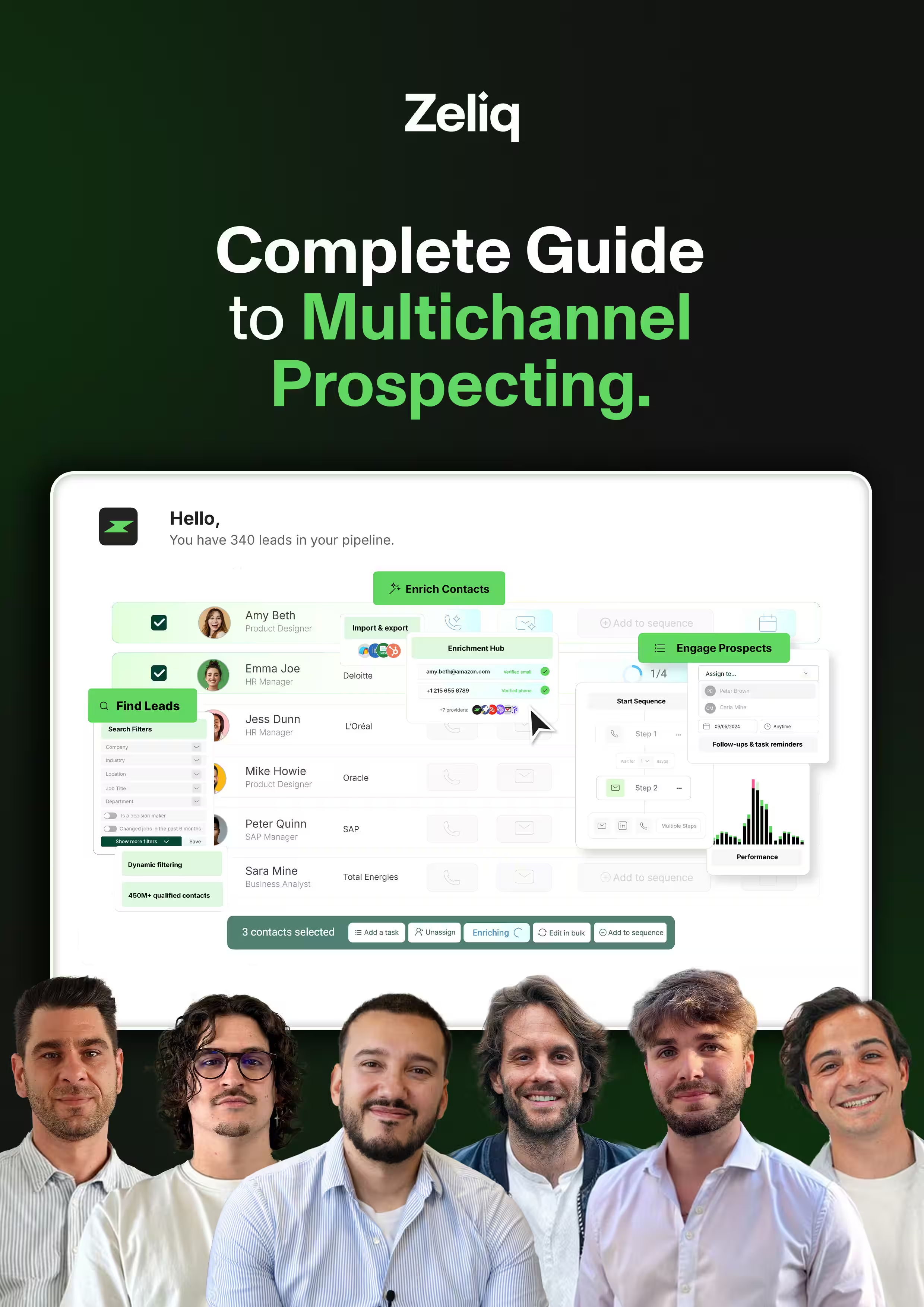
Zeliq combines a 450 million B2B contact database, waterfall enrichment with integrated email verification, API-first architecture, and multichannel sequences in one interface. Powers AI sales assistant workflows with verified data at 85-95% match rate. GDPR-native suppression.
12. Frequently asked questions
Standalone AI sales assistant vs embedded in existing platform, which should I choose?
Standalone AI assistants (Apollo AI, Gong, Clari, Artisan) deliver deeper per-use-case capability and work across CRM ecosystems; embedded AI (Salesforce Einstein, HubSpot Breeze) delivers tighter CRM integration with lower switching cost but shallower feature depth; most mature stacks run both: embedded for CRM-native workflows, standalone for specialized depth. Trade-offs: (1) Standalone advantages: category leaders invest more R&D per use case (Gong on conversation intelligence, Apollo on prospecting AI, Clari on forecasting). Deeper feature depth, faster iteration. Multi-CRM compatibility (works with HubSpot CRM + Salesforce). (2) Standalone disadvantages: integration overhead (bidirectional CRM sync + field mapping + conflict resolution), separate pricing from CRM, more vendor relationships. (3) Embedded AI advantages: tight CRM integration by definition, included in CRM subscription or bundled add-on, single vendor relationship. (4) Embedded AI disadvantages: shallower depth per use case (Einstein forecasting less deep than Clari, Breeze scoring less deep than 6sense), locked into CRM ecosystem. (5) Hybrid pattern (most mature teams): embedded AI for CRM-native workflows (scoring, routing, basic personalization) + standalone AI for specialized depth (Gong for coaching, Clari for forecasting, 6sense for intent). Decision rule: if < 10 SDRs, embedded wins (simpler); 10-50 SDRs mixed; 50+ SDRs standalone wins for specialized capabilities. Always verify “AI” claims via demo on your real data; marketing descriptions far outpace actual capabilities in many 2026 products.
What ROI should I expect from AI sales assistant deployment?
Realistic ROI: 15-30% lift on target metric (leads, meetings, pipeline, forecast accuracy) within 6-12 months of proper deployment; McKinsey’s “up to 50%” headline is upper bound requiring investment in training, data quality, and workflow integration. ROI measurement by use case: (1) Lead scoring: 20-30% faster SDR qualification + 20-30% higher sequence reply rate on top-scored. ROI positive within 3 months. (2) Personalized outreach at scale: 2-3× volume at same per-touch quality + 50% reply rate lift on signal-based openers. ROI positive within 2-3 months. (3) Forecasting: 20-40% forecast accuracy improvement. ROI measured in avoided missed quarters + credibility with board. (4) Admin automation: 10-15 hours/week saved per rep × 5-50 reps × $30-50/hour = $7,500-$75,000/month equivalent capacity. ROI positive within 1-2 months typically. (5) Coaching + call analysis: 30-50% faster new rep ramp + 15-25% conversion rate improvement on coached cohorts. ROI positive within 6 months. Prerequisites for hitting these numbers: (a) CRM data quality (bad data = AI amplifies noise), (b) proper rollout + rep training, (c) feedback loops (reps provide quality signal to improve AI output), (d) deliverability guardrails if AI generates emails at scale. Teams that treat AI as plug-and-play see 50-70% of the potential lift. Teams that invest 3-6 months in proper rollout see full lift. Measurement: baseline 90 days pre-AI, measure 90 days post-AI, attribute lift to AI vs other variables. Softer ROI signals: SDR retention (better tools reduce churn), time-to-productivity for new reps, cross-team coordination improvements.
How long does AI sales assistant implementation take?
30-60 days for embedded AI inside existing CRM, 60-90 days for standalone AI deployment, 90-180 days for enterprise multi-tool AI stack with coaching + forecasting + prospecting all deployed. Timeline breakdown: (1) Embedded AI (HubSpot Breeze, Salesforce Einstein): day 1 enabled in CRM admin; week 1 configuration (which fields feed scoring, which workflows trigger); week 2-3 pilot on test cohort; week 4-6 full rollout. Short because CRM integration pre-existing. (2) Standalone AI (Apollo AI, Gong, Clari): week 1-2 procurement + CRM integration setup; week 3-4 data flow configuration + field mapping; week 5-6 pilot on test cohort; week 7-10 full rollout + training; week 11-12 iteration based on early results. (3) Enterprise multi-tool stack: month 1-2 procurement + security review + integration planning across 3-4 AI tools; month 3-4 integration + data flow + workflow design; month 5-6 pilot per tool + training; month 7-9 full rollout + cross-tool coordination. Key dependencies and delays: (a) CRM data quality: AI amplifies garbage; clean CRM first adds 30-60 days if data is bad. (b) Change management: SDRs/AEs often resist AI tools; training + evangelism required (budget 20-30% of implementation time). (c) Compliance review: enterprise security + legal review can add 30-60 days. (d) Integration debug: multi-tool stacks require 5-15 hours/month of ongoing maintenance after rollout. Fastest path to value: embedded AI first (fastest ROI), then layer standalone depth on top of specific use cases. Common failure: enterprise multi-tool stack bought simultaneously + deployed without staged rollout = typically only 30-40% delivers value in first 12 months.
13. Conclusion: 3 actions to run
Identify top 2 use cases within 7 days. Lead scoring, personalization, forecasting, admin automation, or coaching? Match tool to use case.
Pilot embedded AI first within 15 days. HubSpot Breeze if on HubSpot, Salesforce Einstein if on Salesforce. Measure baseline → impact.
Layer standalone AI within 30-90 days. Once embedded delivers, add Gong (coaching), Clari (forecasting), or Apollo AI (prospecting) for depth.
Verified data layer powering AI sales assistant workflows at 85-95% match rate
Zeliq combines 450 million B2B contacts, waterfall enrichment with integrated verification, API-first architecture, and multichannel sequences in one platform. AI workflows run on verified data for consistent output quality. GDPR-native suppression.
Try for freeAnd if you want verified data powering AI sales assistant workflows at 85-95% match rate, try Zeliq for free: sourcing, waterfall enrichment, verification, and multichannel sequences in one interface, no credit card required.