

Lead enrichment tools are software applications that add verified contact and company fields (email, phone, title, seniority, firmographics, tech stack, signals) to raw B2B lead records, sorted by their underlying verification methodology (SMTP-only, pattern-matching, multi-source waterfall, human-verified) which is the single biggest driver of match rate variance. In 2026, single-source databases return 70-80% email coverage and 30-60% phone coverage on typical B2B ICPs, while managed multi-source waterfall reaches 98% verified email and 85% direct dial per aggregated SERP benchmarks (verified September 2026), a spread that makes verification method the primary buying criterion. This article maps the 4 verification methods, the 8 leading vendors, cost benchmarks, selection framework, and 3 FAQ.
For an SDR lead, RevOps engineer, growth manager, or founder selecting a lead enrichment tool, this article gives the verification method framework and the vendor grid.
On the agenda:
- What lead enrichment tools do (verification at the core)
- The 4 verification methods (SMTP, pattern-match, waterfall, human)
- 8 leading vendors sorted by verification method
- Real-time vs batch enrichment patterns
- Cost per verified contact by method
- Integration depth into CRM
- Compliance: GDPR, CAN-SPAM, CCPA
- 3 FAQ (which method, cost, refresh)
Key takeaways:
- Definition: adds verified contact fields to raw lead records
- 4 verification methods: SMTP-only, pattern-match, multi-source waterfall, human-verified
- Match rate: single-source 70-80% email / 30-60% phone; waterfall 98% email / 85% phone
- 8 leading vendors: Apollo, ZoomInfo, Cognism, Lusha, UpLead, SalesIntel, Clay, Zeliq
- Cost per verified contact: $0.05-0.50 depending on method and volume
- Waterfall trade-off: 1.3-1.8× unit cost but +20-40 percentage points coverage
- Compliance: FTC CAN-SPAM US, GDPR (CNIL 2025 €486M enforcement) EU
- Buying gate: verification method matters more than published database size
1. What lead enrichment tools do
Raw B2B lead records come with holes: name and company but no email, LinkedIn URL but no phone, business card scan with partial data. Lead enrichment tools fill these holes by matching partial identifiers against external data sources and adding verified fields.
Fields commonly enriched: - Verified email + email status (valid, catch_all, invalid) - Direct phone (mobile or line) - Job title + seniority + department - Company firmographics (headcount, revenue, industry, tech stack) - Behavioral signals (recent hire, funding, tech switch)
The value driver is not raw coverage; it is match rate on your specific ICP, and match rate is dominated by the vendor’s verification methodology.
2. The 4 verification methods
Four distinct verification approaches, with distinct match rate and cost profiles.
Method 1, SMTP-only verification: pings the destination mail server to check if the email accepts messages. Fast, cheap, scales infinitely. Catches hard bounces but misses catch-all domains and format-guess errors. Coverage 60-75% typical.
Method 2, Pattern-matching + SMTP: generates likely emails from name + company_domain patterns (firstname.lastname@company.com, jsmith@company.com, etc.), then SMTP-verifies each candidate. Adds coverage on domains where no verified email exists in the database. Coverage 70-85%.
Method 3, Multi-source waterfall: chains 3-4 vendor databases so a miss on vendor A cascades to B, C, D. Each vendor fills gaps in the previous. Coverage 90-98% on verified emails, 70-85% on phones per aggregated SERP benchmarks (September 2026 verified).
Method 4, Human-verified: a data operations team physically verifies each record on a rolling basis. Highest confidence per record, lowest scale, highest cost. Coverage typically 60-80% (limited by how much a human team can process), but per-record accuracy 95%+.
The choice determines everything downstream: bounce rate, reply rate, cost per usable contact, engineering effort.
3. 8 leading vendors sorted by verification method
SMTP-only / pattern-match
Apollo: 275M+ contacts, pattern-match + SMTP. Paid plans start $49/user/month billed annually per Apollo public pricing verified September 2026. Best for mid-market self-serve.
UpLead: 160M+ leads, real-time SMTP verification with 95% accuracy guarantee per vendor claim. Best for small teams prioritizing per-export accuracy.
Multi-source waterfall
Clay: workflow-composable waterfall across 100+ providers. Free plan (100 Data Credits + 500 Actions), Launch $185/month, Growth $495/month per Clay public pricing verified September 2026. Best for teams with technical RevOps composing custom pipelines.
Zeliq: 450M B2B contacts, waterfall built into single API endpoint (no vendor orchestration required), integrated email verification, multichannel sequences bundled. Best for European SDR teams at mid-market pricing.
Enterprise database + integration
ZoomInfo: 500M+ contacts, deepest US firmographic. Enterprise annual pricing typically $15k-100k+/year. Best for US enterprise sales teams.
Cognism: EMEA-native, GDPR-compliant. Diamond Data 98% phone verification per vendor claim. Enterprise pricing. Best for EMEA-focused teams.
Lusha: 100M+ contacts, phone-first, Chrome extension for LinkedIn. Free tier (5 credits/month). Best for phone-heavy outbound.
Human-verified
SalesIntel: human-verified database. Smaller volume, higher per-record confidence. Best for teams where record-level accuracy matters more than list breadth.
For a deeper vendor comparison and selection framework, see B2B contact data.
4. Real-time vs batch enrichment
Enrichment runs on two clocks:
Real-time: triggered at contact creation (form submission, product signup, manual CRM add). Latency budget 500ms to 3 seconds. Feeds immediate downstream actions (lead scoring, routing).
Batch: scheduled (daily, weekly, monthly). Async processing over minutes to hours. Feeds CRM cleanup, ABM list prep, quarterly refresh.
Mature setups run both: real-time on new records, batch monthly on the existing base for freshness. See cold email best practices for the downstream sequence design.
5. Cost per verified contact by method
Concrete ranges at mid-market vendor pricing verified September 2026:
- SMTP-only: $0.005-0.05 per verified email. Cheapest, thinnest coverage.
- Pattern-match + SMTP: $0.10-0.30 per verified contact. Mid-tier coverage.
- Multi-source waterfall: $0.20-0.50 per verified contact. Highest coverage, highest cost per call, but often lowest cost per usable contact because match rate compensates.
- Human-verified: $0.30-1.00+ per verified contact. Premium confidence, premium price.
Cost driver comparison: waterfall costs 2-3× SMTP-only unit rate but delivers +20-40 percentage points more matches, which for teams above 5,000 enrichments/month means lower cost per usable contact despite higher per-call spend.
6. Integration depth into CRM
Enrichment tools plug into CRMs at varying depth. Key tiers:
- Tier 1: CSV export from enrichment tool → manual import to CRM
- Tier 2: manual sync button in enrichment tool
- Tier 3: scheduled batch bidirectional sync with field mapping
- Tier 4: real-time webhook-driven bidirectional sync with conflict resolution
Native CRM add-ons (HubSpot Breeze Intelligence for HubSpot, some AppExchange tools for Salesforce) default to Tier 4. Standalone platforms range widely; verify with vendor demo before commit.
7. Compliance: GDPR, CAN-SPAM, CCPA
EU GDPR: legitimate interest per ICP + opt-out + suppression + 3-year retention. CNIL 2025 sanctions hit €486M total (vs €55M in 2024), including SOLOCAL Marketing Services at €900k for prospecting without sufficient legal basis. Choose GDPR-native vendors for EMEA ICPs.
US CAN-SPAM: FTC compliance guide requires accurate subject line + valid physical address + functional opt-out + honor opt-out within 10 business days.
California CCPA/CPRA: right to know, delete, opt-out. B2B partial exemption but disclosures still expected.
Zeliq and multi-source waterfall enrichment
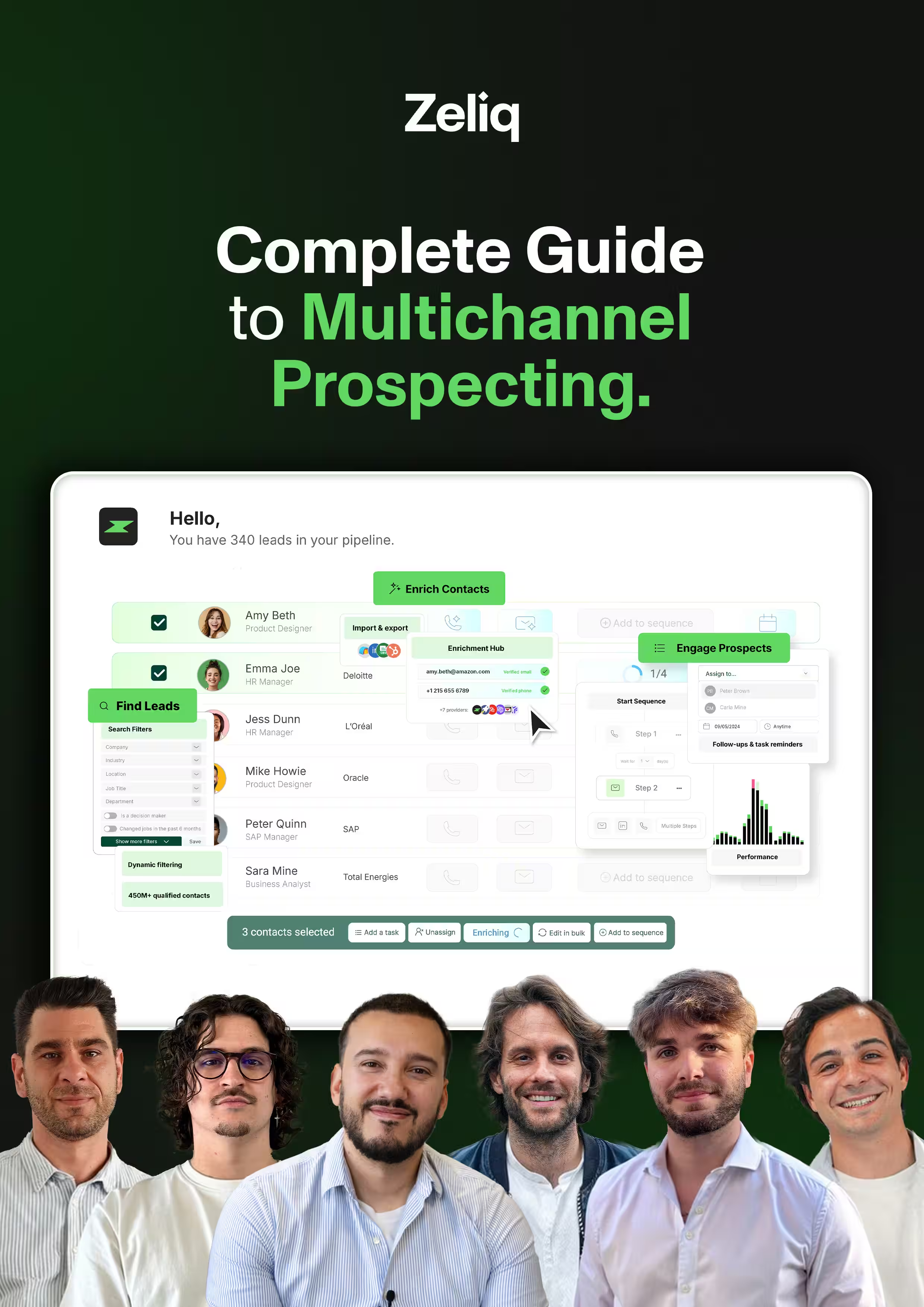
Zeliq combines a 450 million B2B contact database, waterfall enrichment across multiple providers with integrated email verification, and multichannel sequences in one interface. Waterfall coverage 90%+ email match rate, integrated CRM sync at Tier 3-4 depth (HubSpot, Salesforce, Pipedrive). GDPR-native suppression, European positioning.
8. Common mistakes
Mistake 1: Choosing on database size claim alone. 700M-contact database with 55% match rate loses to 200M with 85% match rate on your ICP.
Mistake 2: Not verifying method vs your ICP. SMTP-only works on US enterprise; pattern-match + waterfall needed for EMEA and APAC.
Mistake 3: Single-vendor lock-in above 5,000 enrichments/month. Waterfall compensates gaps.
Mistake 4: Skipping the free tier test. Every serious vendor offers free tier or trial for 500-contact validation.
Mistake 5: Ignoring integration depth. Tier 1 CSV export delivers 5-10× less value than Tier 4 real-time bidirectional.
9. Frequently asked questions
Which verification method should I choose for my ICP?
SMTP-only fits below 500 contacts/month or when your ICP is US enterprise on well-known domains; pattern-match + SMTP fits mid-market self-serve up to 5,000/month; multi-source waterfall becomes essential above 5,000/month or on EMEA/APAC ICPs; human-verified fits teams where per-record accuracy matters more than volume. Trade-offs by method: (1) SMTP-only: cheapest ($0.005-0.05/verified email), fastest, but limited to emails that already exist in the vendor’s database. Coverage 60-75% typical. Best for small volume + US enterprise. (2) Pattern-match + SMTP: generates likely emails from name + domain patterns, verifies each. Adds 10-15 percentage points coverage vs SMTP-only. Best for teams below 5,000/month on standard ICPs. (3) Multi-source waterfall: chains 3-4 vendor databases. Coverage 90-98% email, 70-85% phone. Best above 5,000/month or on broad ICPs. (4) Human-verified: physical operations team checks each record. Highest per-record confidence 95%+ but lower scale. Best for enterprise deal teams where accuracy on 100 high-value contacts matters more than 10,000 casual ones. Practical test: 500 in-ICP contacts through the vendor, cross-verify each returned email against an independent SMTP tool. Anything below 60% match rate signals wrong method for your ICP. Waterfall available as service (Zeliq built-in) or DIY orchestration (2-3 weeks engineering + ongoing maintenance).
What is the total cost of a lead enrichment tool for a mid-market team?
$200-$1,000 per SDR per month at mid-market pricing, dropping to $150-$400 with all-in-one platforms that bundle enrichment + verification + sequencer. Cost breakdown: (1) Standalone enrichment tool (Apollo, Cognism, Lusha, Zeliq): $150-500/user/month covering database + enrichment + typically verification. (2) Waterfall workflow platform (Clay): $185/month Launch base, $495/month Growth base, unlimited seats, usage-based credits scale with workflow complexity. (3) Verification tool if not bundled: $0-50/user/month. (4) Integration cost: 5-15 hours/month for stitched stacks, near zero for all-in-one. Fully-loaded RevOps hourly cost $30-40 = $150-450/month/team of hidden integration cost. Team scaling at 5 SDRs: stitched $2,000-$4,000/month direct + $450-$750 integration, total $2,450-$4,750/month. All-in-one $1,000-$2,500/month direct + near-zero integration, total $1,000-$2,700/month. Consolidation savings 30-50% at 5+ SDRs. Above 10 SDRs, savings compound. Below 3 SDRs, free tiers of stitched tools can beat paid all-in-one. Also budget for CRM seats ($50-150/user), dialer if phone-heavy ($30-80/user), and 10-20% overage buffer for credit-based enrichment plans.
How often should I refresh enriched lead data?
Every 3 months for lists in active outbound, every 6 months for nurture-mode lists, every 12 months for dormant lists, the 2-3% monthly B2B data decay compounds to 24-36% wrong records per year. Aggregated industry benchmarks in the SERP top 10 converge on 2-3% monthly decay: professionals change roles at 13-23% annual voluntary turnover, companies get acquired or restructured, email formats change, phones get reassigned. On a 10,000-contact base clean 12 months ago, ~2,400-3,600 records are wrong. Practical cadence: (1) real-time re-enrichment triggered on bounce or auto-reply indicating role change, (2) quarterly batch re-enrichment of contacts with no engagement in last 90 days, (3) annual full-base re-enrichment. Cost per refresh cycle: $0.05-0.30 per contact depending on vendor and method. On a 10,000-contact base at $0.15/contact, $1,500 for full refresh, offset by 2-4 weeks of protected sending reputation + 2× reply rate improvement + reduced SDR frustration. Track last_enriched_at timestamp on every CRM record and alert when it crosses 6 months. Vendors that publish their refresh methodology (frequency + verification technique) win over vendors that only publish coverage claims: ZoomInfo publicizes 70M+ records refreshed per week per vendor claim, others range monthly to quarterly.
10. Conclusion: 3 actions to run
Identify your ICP geography and volume within 7 days. US enterprise low-volume → SMTP-only or pattern-match. EMEA or high-volume → waterfall.
Test 2-3 vendors on 500 in-ICP contacts within 15 days. Free tiers or trials. Cross-verify each returned email against independent SMTP. Compare on your real ground truth.
Set up real-time + batch enrichment within 30 days. Real-time on new CRM records, batch monthly on records untouched > 6 months. Track
last_enriched_atwith alerts.
Multi-source waterfall enrichment with integrated verification and sequences bundled
Zeliq combines 450 million B2B contacts, waterfall enrichment with integrated verification, and multichannel sequences in one interface. 90%+ email match rate on ICPs where single-source vendors cap at 65-75%. GDPR-native suppression.
Try for freeAnd if you want multi-source waterfall enrichment without orchestrating 3-4 vendor APIs yourself, try Zeliq for free: sourcing, waterfall enrichment, verification, and multichannel sequences in a single platform, no credit card required.