

A lead list is a curated collection of B2B contacts assembled for a single outreach campaign, typically 100-500 records per campaign per aggregated SERP benchmarks (verified September 2026), containing verified email, direct phone, title, seniority, company firmographics, and often signal tags like recent hire or funding round. In 2026, the highest-performing lead lists follow a repeatable 6-step workflow (define ICP, source contacts, stack filters and signals, enrich, verify, sync to CRM) and prioritize quality over quantity, because a 200-record verified in-ICP list outperforms a 5,000-record unverified scatter every time. This article walks through the 6-step workflow, the quality benchmarks, cost math, refresh cadence, compliance, and 3 FAQ.
For an SDR, RevOps engineer, growth manager, or founder building a lead list for a specific campaign, this article gives the exact workflow and the decision points.
On the agenda:
- What a lead list is (single-campaign definition)
- Step 1: define the Ideal Customer Profile
- Step 2: source contacts from LinkedIn, databases, associations
- Step 3: stack filters and buying signals
- Step 4: enrich with waterfall multi-provider
- Step 5: verify emails before send
- Step 6: sync to CRM with campaign tag
- Quality benchmark: 100-500 records per campaign
- Compliance: GDPR, CAN-SPAM, CCPA
- 3 FAQ (size per campaign, refresh cadence, build vs buy)
Key takeaways:
- Definition: curated B2B contacts for a single campaign
- Typical size: 100-500 records per campaign per aggregated SERP benchmarks
- 6-step workflow: ICP → source → stack signals → enrich → verify → CRM sync
- Waterfall enrichment: 85-95% match rate vs 50-70% single-vendor
- Data decay: ~2.1-3% per month, drives refresh cadence
- Compliance: FTC CAN-SPAM US, GDPR (CNIL 2025 €486M enforcement) EU
- Verification mandatory: unverified lists bounce 15-30%, wrecking sending reputation
- Quality benchmark: 200 verified in-ICP > 5,000 unverified scatter
1. What a lead list is
A lead list is the working unit of outbound sales: a curated batch of contacts assembled for a specific campaign with a specific message and specific expected outcome. Unlike a broad customer database (which serves many campaigns), a lead list is single-purpose and time-bounded.
Typical structure: - 100-500 records per campaign per aggregated SERP benchmarks (September 2026 verified) - 6-8 fields per record (name + title + company + verified email + phone + LinkedIn + signal tags) - Freshness < 30 days ideally - Deduplication against CRM to avoid double-sending
For a broader guide on lead sourcing and CRM management, see the B2B contact data overview.
2. Step 1: define the Ideal Customer Profile
The mistake teams make: buy a list first, then try to segment. The correct order is opposite: define ICP first, then source against it.
Method: pick your 10 best current customers by revenue, retention, or NPS. For each, capture: - Industry (SIC or NAICS) - Employee count bracket - Annual revenue bracket - Region and country - Buying decision-maker title - Tech stack signals - Trigger event that started the sale
Look for commonalities. Three or more shared attributes across your top 10 define your ICP.
The ICP definition takes 3-5 hours the first time. It saves 3-6 months of wasted outbound to wrong-fit prospects. Once documented, reuse for every lead list you build.
3. Step 2: source contacts
Three sourcing paths, each with distinct trade-offs.
LinkedIn Sales Navigator: graph-based search on the LinkedIn professional network. Best for narrow niche ICPs where firmographic data alone is not enough. Advanced tier $167/seat/month per LinkedIn public pricing verified September 2026. Combine boolean operators with filters: title contains X AND industry equals Y AND company employee count between 100 and 500 AND geography North America.
B2B database vendors: broad ICP search across millions of contacts. ZoomInfo (500M+ vendor claim), Apollo (275M+ vendor claim), Cognism (EMEA-strong GDPR-native), Zeliq (450M with waterfall built-in). Best for high-volume outbound and ABM account lists.
Industry associations and directories: opt-in professional communities. High quality when your ICP maps to a professional community (SHRM for HR, AMA for marketing).
Most professional workflows combine two: Sales Nav for graph precision + a database for volume and enrichment.
4. Step 3: stack filters and buying signals
Demographic targeting (title + industry + size + geography) is table stakes. Signal stacking adds a second layer: which of the in-ICP accounts is currently in-market?
Order of filter stacking: 1. Universe: all companies in your addressable market 2. Firmographic filter: industry + size + geography 3. Technographic filter: tech stack signals (uses your integration partner, uses a competitor) 4. Behavioral filter: recent hire in target function, hiring surges, tech switches 5. Contextual filter: funding round in last 90 days, executive change, PR announcement
Each layer cuts the list and sharpens it. Starting universe of 50,000 companies → firmographic filter → 5,000 → technographic → 2,000 → behavioral → 400 → contextual → 100-200 high-priority accounts.
Signal-layered lists lift reply rate 3-4× vs demographic-only per aggregated SERP benchmarks.
5. Step 4: enrich with waterfall multi-provider
Single-vendor enrichment tops out at 55-70% match rate on typical B2B ICPs per aggregated SERP benchmarks. Waterfall enrichment (chaining 3-4 vendors so a miss on vendor A cascades to B, C, D) reaches 85-95% aggregate match.
Fields to enrich: - Verified email + email_status - Direct phone (or line phone) - LinkedIn URL (if sourced from a database instead of Sales Nav) - Job title + seniority + department - Company firmographics (headcount, revenue, industry, tech stack)
DIY waterfall requires 2-3 weeks engineering to orchestrate 3-4 vendor APIs plus 5-10 hours/month maintenance. Waterfall-native platforms (Zeliq and similar) provide it as a single-endpoint service in 3-5 days integration.
6. Step 5: verify emails before send
Never send to a lead list without verification. Two sub-steps:
SMTP verification on 100% of emails via NeverBounce, MillionVerifier, ZeroBounce, or your enrichment vendor’s built-in verifier. Filters catch-all domains, disposable addresses, and hard-bounce candidates.
Suppression list check: cross-reference against your unsubscribe list AND the vendor’s suppression list. Prevents sending to contacts who exercised opt-out.
Bounce rate target after verification: 1-3%. Anything higher damages sending domain reputation for 2-4 weeks. See cold email best practices for deliverability guardrails downstream.
7. Step 6: sync to CRM with campaign tag
The end state: enriched, verified records land in the CRM with a campaign tag so pipeline attribution stays clean.
Fields to sync: - Standard contact fields (name, title, email, phone) - Campaign attribution tag (e.g., list_2026_Q4_series_b_saas) - last_enriched_at timestamp for future refresh alerts - Sequence status (will populate as the sequence runs)
Native CRM integrations of major prospecting tools cover HubSpot CRM, Salesforce, Pipedrive. Bulk import via CSV works as fallback. Deduplication against existing CRM records prevents double-sequencing.
8. Quality benchmark: 100-500 records per campaign
Aggregated SERP benchmarks in 2026 converge on 100-500 records as the optimal size for a single cold outreach campaign. Reasons:
- Below 100: not enough volume to hit reply-rate statistical significance
- Above 500: personalization quality drops (SDR can’t spend enough time per record); domain reputation risk from higher-volume sending
Two lists compared: - List A: 5,000 records, unverified, 40% out of ICP - List B: 200 records, verified, 100% in ICP, signal-layered
Expected outcomes on identical outreach: - List A: 5,000 sent → 20% bounce (1,000) → 2,000 opens → 40 replies → 8 meetings - List B: 200 sent → 2% bounce (4) → 100 opens → 30 replies → 10 meetings
List B produces more meetings with 25× less sending volume and protects the domain. Quality-first is compounding math.
Zeliq and single-campaign lead list building
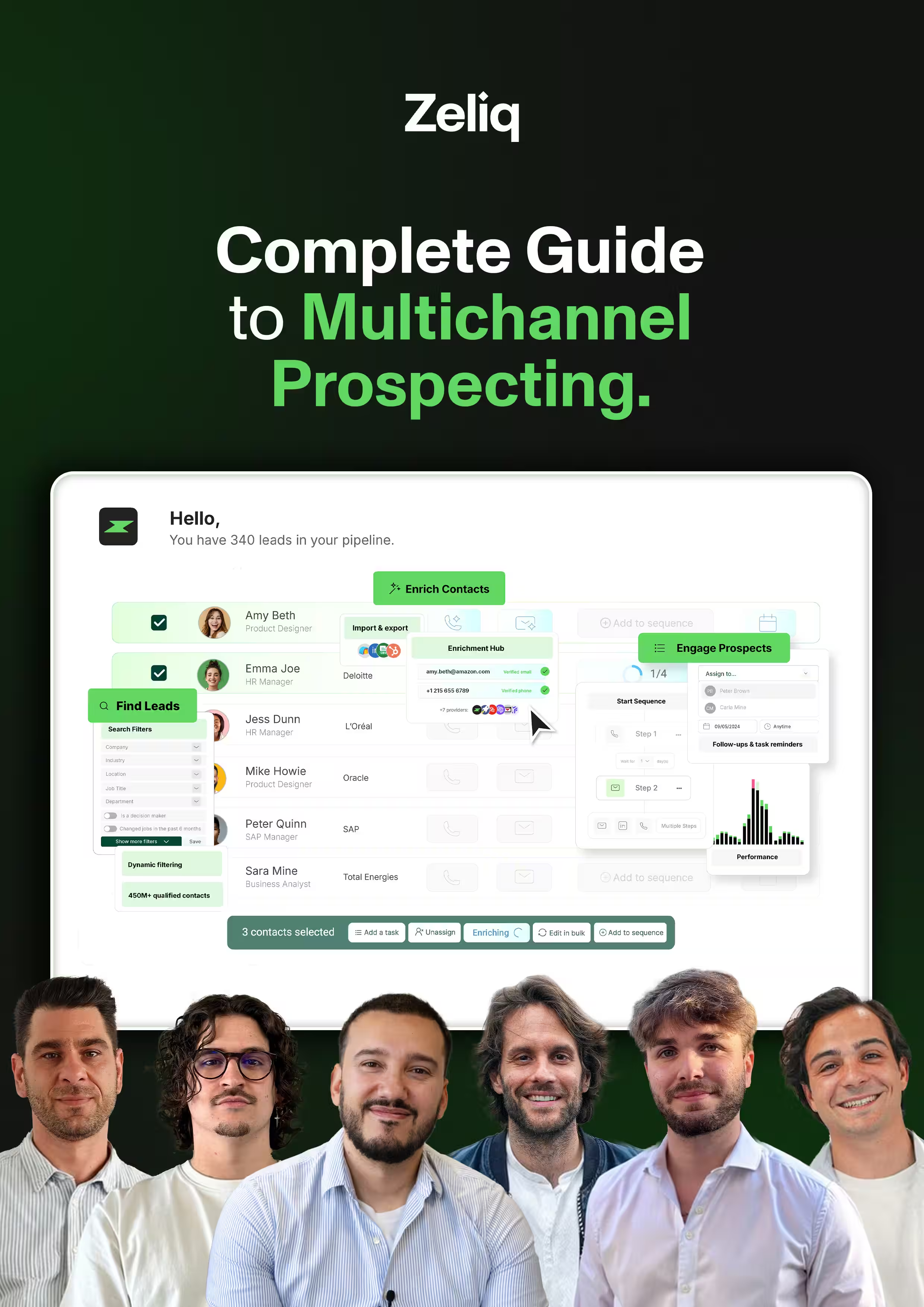
Zeliq combines a 450 million B2B contact database, waterfall enrichment across multiple sources with integrated email verification, and multichannel sequences in one interface. Build a 100-500 record lead list from ICP filters, waterfall-enrich, verify, sync to CRM with campaign tag, all without hopping between tools. GDPR-native suppression list.
9. Compliance: CAN-SPAM, GDPR, CCPA
US CAN-SPAM: FTC compliance guide requires accurate subject line + valid physical address + functional opt-out + honor opt-out within 10 business days.
EU GDPR: legitimate interest per ICP + opt-out + suppression + 3-year retention. CNIL 2025 sanctions hit €486M total (vs €55M in 2024), including SOLOCAL Marketing Services at €900k. Choose GDPR-native vendors for EMEA ICPs.
California CCPA/CPRA: right to know, delete, opt-out. B2B partial exemption but disclosures still expected.
10. Common mistakes
Mistake 1: Sourcing before defining ICP. 40-60% of the list ends up out of ICP.
Mistake 2: Building too big lists. 5,000-record lists dilute personalization and damage sending reputation.
Mistake 3: Skipping verification. 15-30% bounce = 2-4 weeks reputational damage.
Mistake 4: No campaign tag. Pipeline attribution breaks; team can’t measure ROI per campaign.
Mistake 5: One list forever. Data decays 2-3% monthly; refresh every 3-6 months minimum.
11. Frequently asked questions
How big should a single lead list be?
100-500 records per campaign per aggregated SERP benchmarks in 2026, sized to allow SDR personalization time without diluting the domain sending reputation from over-volume. The lower bound (100) exists because below that number, reply-rate signal is too noisy to measure statistically. The upper bound (500) exists because SDR personalization time per record drops below the level needed to write a message that actually converts, and because sending 500+ emails from a single domain per campaign risks flagging by Gmail/Outlook spam filters. Practical sizing: (1) very narrow ICP (< 1,000 total accounts in your addressable market): 50-150 records per campaign, deep personalization, highest reply rates 15-25%. (2) Standard ICP (1,000-10,000 accounts addressable): 200-400 records per campaign, moderate personalization, reply rates 8-15%. (3) Broad ICP (> 10,000 accounts): 400-500 records per campaign, template-based personalization with signal tokens, reply rates 5-10%. For teams sending > 500 records/campaign, split into multiple smaller lists tagged by persona or trigger signal, run them staggered to avoid domain flags. Never send > 1,000 emails per day from a single domain address without domain warm-up. Also cap campaigns per week per SDR: 2-4 campaigns of 200-400 records each, not 10 campaigns of 50 records, because switching costs drain SDR productivity.
How often should I refresh a lead list?
Every 3 months for lists in active campaigns, every 6 months for nurture-mode lists, every 12 months for dormant lists, the 2.1-3% monthly B2B data decay compounds to 22-30% wrong records per year. Aggregated industry benchmarks in the SERP top 10 converge on 2-3% monthly decay: professionals change roles at 13-23% annual voluntary turnover, companies get acquired or restructured, email formats change, phones get reassigned. On a 500-contact campaign list clean 6 months ago, ~60-90 records are already wrong. Practical refresh: (1) real-time re-enrichment triggered on bounce or auto-reply indicating role change, (2) quarterly batch re-enrichment of any list that will be reused in a new campaign, (3) delete lists older than 12 months and rebuild fresh from the current ICP. Cost per refresh cycle: $0.05-0.30 per contact depending on vendor and volume. On a 500-contact list at $0.15/contact, $75 for full refresh, offset by 2-4 weeks of protected sending reputation + reply rate lift. Track last_enriched_at timestamp on every record and set an alert when it crosses 90 days for active-campaign lists.
Build a lead list in-house or buy a pre-built one?
Build in-house for narrow ICPs (< 5,000 addressable accounts) or when you have strict compliance requirements; buy or subscribe for broad ICPs at scale (> 5,000 accounts) or when speed-to-first-campaign matters more than sourcing control. Build in-house cost math: LinkedIn Sales Navigator ($167/seat/month) + SDR sourcing time (30-45 seconds per contact) + enrichment API allocation ($0.10-0.30 per verified contact) + verification. Fully-loaded cost per 300-contact list: ~$300-500 in-house. Time-to-list: 4-8 hours SDR work. Advantages: full control over ICP fit, defensible legitimate interest documentation for GDPR. Buy or subscribe cost math: mid-market platform (Apollo, Zeliq, or similar) at $200-500/seat/month covering unlimited list-building within credit allocation. Fully-loaded cost per 300-contact list: ~$150-300 (allocated share of monthly subscription). Time-to-list: 1-2 hours. Advantages: speed, waterfall coverage built-in, integration with sequencer. Break-even: below 2 campaigns per month, in-house with Sales Nav is cheaper; above 2 campaigns per month, subscription platform pays off in speed and coverage. Hybrid pattern common in mature teams: Sales Nav for high-value narrow lists (executive prospecting), platform for high-volume campaigns.
12. Conclusion: 3 actions to run
Document your ICP within 7 days. Pick your 10 best customers, capture 7 attributes each, identify 3+ commonalities. Reuse across every lead list.
Build one 200-record test list within 15 days. Follow the 6-step workflow: ICP → source → stack signals → enrich → verify → CRM sync. Measure reply rate and cost per booked meeting.
Set refresh cadence within 30 days. Alert on
last_enriched_at > 90 daysfor active lists. Quarterly batch re-enrichment on any list scheduled for reuse.
Build 100-500 record lead lists with waterfall enrichment and sequences included
Zeliq combines 450 million B2B contacts, waterfall enrichment with integrated verification, and multichannel sequences in one interface. Build the list, ship it to the CRM, run the sequence, all without four separate tools. GDPR-native suppression.
Try for freeAnd if you want to build campaign-sized lead lists with waterfall enrichment and multichannel sequences in a single interface, try Zeliq for free: sourcing, enrichment, verification, and outreach without four subscriptions, no credit card required.