

Data enrichment is the process of adding to an existing contact or company complementary information — email, phone, position, company size, tech stack, buying signals — via external databases. In B2B, it transforms a simple list of LinkedIn names or an incomplete CRM into an actionable dataset for sales prospecting. Unlike broader B2B lead generation which creates new contacts, enrichment completes contacts already known. A typical enriched CRM doubles its outbound conversion rate through 90%+ valid emails and fine segmentation. This article details the 5 types of B2B enrichment, the waterfall approach (multi-vendor cascade), 6 market tools, GDPR compliance, and 3 FAQ.
For an SDR, RevOps, growth manager, or Head of Sales looking to reliable-ify data before prospecting campaigns, this article covers mechanisms, tools, and pitfalls.
On the agenda:
- What is B2B data enrichment
- The 5 enrichment types (email, phone, firmographic, technographic, signals)
- The waterfall approach (multi-vendor cascade)
- Real-time vs batch enrichment
- 6 market tools compared (positioning, not price)
- GDPR compliance and Legitimate Interest
- Use case: preparing a B2B cold email campaign
- 3 FAQ (data freshness, cost per contact, ROI)
Key takeaways:
- Definition: complete an existing contact/company with external information
- Main types: pro email, direct phone, firmographic, technographic, buying signals
- Waterfall: query multiple vendors in cascade to maximize match rate
- Typical match rate: 60-70% single-vendor, 85-95% waterfall 3-4 sources
- Real-time: enrichment at CRM add moment
- Batch: massive enrichment of existing base (10,000 - 1M contacts)
- GDPR: legal basis « legitimate interest » with mandatory opt-out
- Data freshness: 3-6 months for email/position, 6-12 months for firmographic
1. What is B2B data enrichment
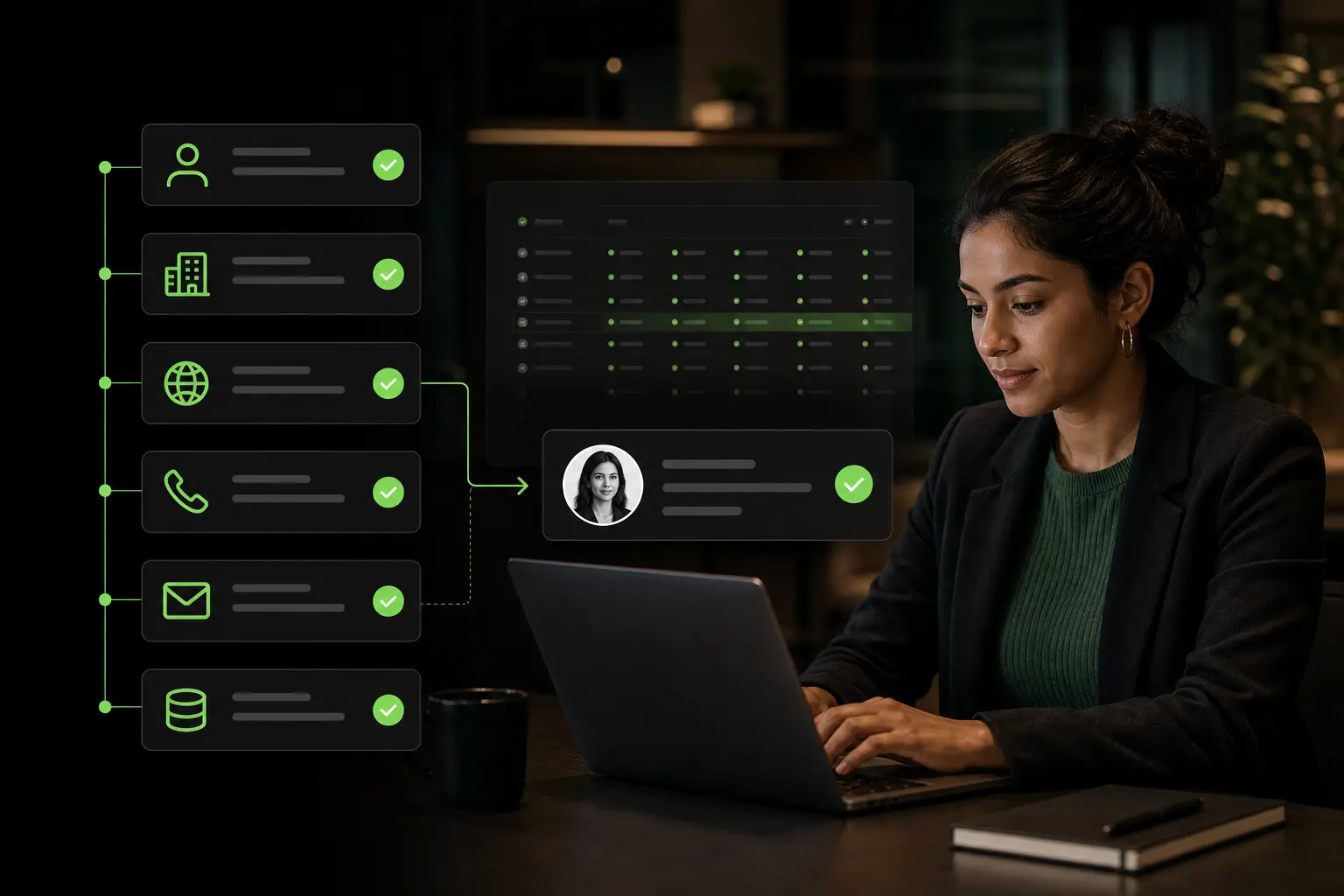
Data enrichment takes as input a partially identified contact (e.g., « Marie Dupont, VP Marketing, Acme Corp ») and automatically adds missing information: professional email, direct phone, LinkedIn URL, company employee count, industry, revenue, tech stack used, recent hiring signals.
Without enrichment, an SDR spends 30-40% of their time searching for email addresses and phone numbers instead of selling. With automated enrichment, this time drops to 5-10%.
Enrichment vs lead generation
- Generation: create new contacts from an ICP (e.g., « French fintech CTO 50-200 employees »)
- Enrichment: add data to contacts already present in a CRM or list
In practice, modern tools do both in a single interface: generate a lead from a LinkedIn ICP, enrich automatically with email + phone, then export to CRM.
Data sources
Vendors aggregate data from multiple sources: public websites (About, Careers), LinkedIn profiles scraped (in legal zones), public databases (INSEE, SIREN, Companies House), third-party aggregators (Clearbit, ZoomInfo, Lusha, Cognism), behavioral signals (site visits, whitepaper downloads).
2. The 5 enrichment types
Type 1: email enrichment
Find a contact’s professional email from name + company. Combines pattern matching (firstname.lastname@domain.com) + historical databases + real-time SMTP verification.
Typical match rate: 40-60% single-vendor, 80-90% in waterfall 3-4 vendors.
Type 2: phone enrichment
Find direct mobile phone or direct line. More difficult as data more fragmented and GDPR-sensitive.
Typical match rate: 20-40% in France (lower than US where LinkedIn exposes more data).
Type 3: firmographic enrichment
Complete company information: size (employee count, brackets 1-10, 11-50, etc.), revenue, industry (NAICS, SIC), country, years of existence, status (private, public).
Typical match rate: 90-95% on companies > 20 employees.
Type 4: technographic enrichment
Detect the tech stack used by a company: CRM (Salesforce vs HubSpot CRM), marketing tools, languages, cloud hosting. Useful to target prospects using a competitor or compatible with your solution.
Sources: JS/HTML tag detection on website, job postings mentioning technologies, public integrations.
Type 5: buying signals (intent data)
Detect behavioral signals indicating a buying phase: new funding round, sudden hiring (« +5 SDRs in 30 days »), CTO change, whitepaper downloads on your category, event participations.
Match rate variable, depends heavily on source depth (enriched signals like 6sense, Bombora are premium).
3. The waterfall approach
Principle
Query multiple vendors in cascade instead of one. If vendor A doesn’t find the email, try B, then C, then D. Contact enriched as soon as one vendor matches.
Result: aggregated match rate 85-95% instead of 40-60% single-vendor.
Concrete example
Typical email waterfall: 1. Vendor A (proprietary database) → match 55% 2. Vendor B (secondary database) → additional match 20% 3. Vendor C (pattern matching + SMTP) → additional match 15% 4. Total: ~90%
Cost vs quality
Waterfall increases cost per contact (each vendor charges per request) but reduces bounce rate and improves conversion. On volume, bounce reduction protects domain reputation and widely compensates the overspend.
Downstream verification
Each email found must be SMTP-verified in real-time before exposure. An email found but that bounces destroys domain reputation in cold email. Serious tools integrate verification directly into pipeline.
4. Real-time vs batch
Real-time enrichment
Triggered on contact addition to CRM or a web form. Uses enrichment tool’s API, response in 500ms - 2s. Useful for: - Inbound: enrich a lead filling a form to assign to right SDR - Manual CRM add: SDR adds a LinkedIn prospect, all fields auto-fill
Batch enrichment
Massive enrichment of an existing base (10,000 to 1M contacts). Asynchronous processing in 1-24 hours depending on volume. Useful for: - CRM migration - Annual base cleanup - Preparing a massive outbound campaign - Enrichment of a list imported from an event
5. 6 market tools
Positioning comparison (no pricing mentioned, pricing evolves regularly).
Clearbit (acquired by HubSpot)
Renowned for firmographic richness and native HubSpot integration. Strong on US companies, weaker in Europe.
ZoomInfo
Largest US volume database (250M+ contacts). Enterprise positioning, long sales cycle, annual contract.
Lusha
Focus direct phones, Chrome extension for LinkedIn. Strong in France and Europe. Simple interface.
Cognism
European, focus GDPR compliance with « GDPR compliant » certified base. Strong on EMEA phones.
Apollo.io
Combines lead generation + enrichment + sequences. 275M+ contact base, all-in-one positioning.
Zeliq
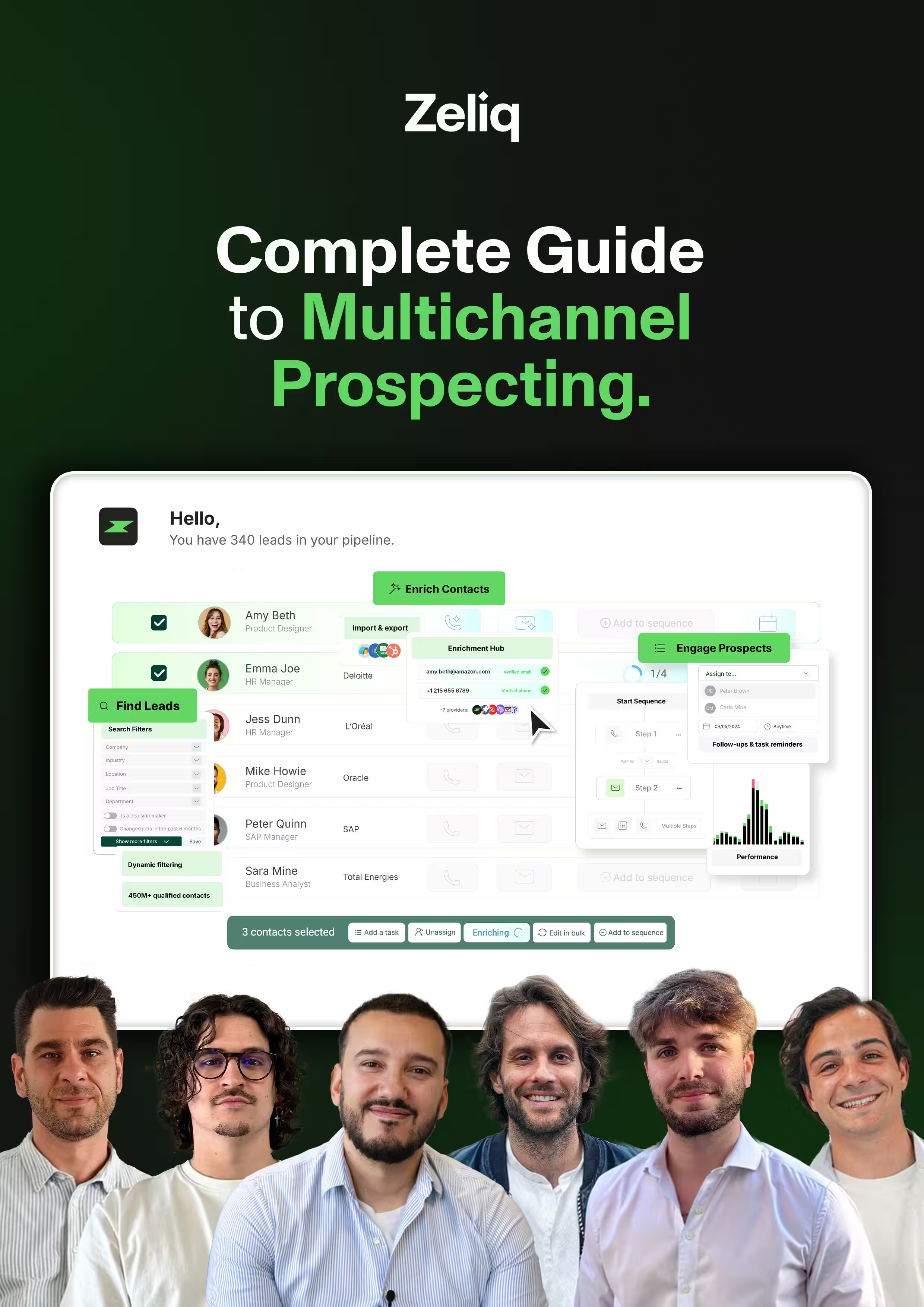
450 million B2B contact base, integrated multi-vendor waterfall enrichment, native email verification, multichannel sequences. Positioned for European SDR teams seeking sourcing + enrichment + outreach in a unified interface. See B2B contact data.
Choice grid
- US volume + enterprise budget → ZoomInfo
- HubSpot ecosystem → Clearbit
- France/Europe phones → Lusha or Cognism
- All-in-one SDR + SMB budget → Apollo.io or Zeliq
- Strict GDPR focus → Cognism or Zeliq (Europe-based, GDPR by design)
6. GDPR compliance
Legal basis: legitimate interest
B2B enrichment in Europe relies on the « legitimate interest » legal basis (article 6-1-f GDPR), justified by the purpose of legitimate commercial prospecting. Constraint: mandatory opt-out — every prospecting email must allow future contact refusal.
Pro vs personal data
A professional email marie@acme.com is considered pro-personal data: subject to GDPR but with a lighter regime. A personal email marie.dupont@gmail.com is more sensitive and avoided in B2B.
GDPR-compliant vendors
Cognism, Zeliq, and a few others have implemented « suppression list » processes: people who have opposed processing are excluded from the base. Verify this point before any vendor choice for Europe.
Retention period
GDPR recommends 3 years post-last-contact for prospects. A healthy CRM automatically purges inactive contacts > 3 years.
7. Use case: prepare a B2B cold email campaign
Typical sequence of a B2B SDR team in Europe:
- Define the ICP: e.g., « VP Sales, SaaS B2B, 50-500 employees, France + UK + DACH ».
- Generate 5,000 leads via sourcing tool (LinkedIn Sales Nav or Apollo/Zeliq).
- Enrich in waterfall: email + phone via 3-4 vendors.
- Verify emails SMTP in real-time → target bounce rate < 3%.
- Segment: by persona, industry, size, tech stack.
- Send in multichannel sequence (email + LinkedIn + phone).
- Track in CRM with statuses (bounced, opened, replied, meeting booked).
Without enrichment, this sequence takes 60-80 SDR hours to manually find emails. With automated enrichment, 2-3 hours.
Zeliq and integrated waterfall enrichment
Zeliq combines a 450 million B2B contact database, multi-vendor waterfall enrichment, integrated email verification, and multichannel sequences in a unified interface. Aggregated match rate 85-95%, bounce rate 1-3%, European GDPR-compliant positioning.
8. Classic mistakes
Mistake 1: single-vendor enrichment
Limiting to a single vendor = match rate 40-60% = 40-60% of base unusable. Always in waterfall.
Mistake 2: no downstream verification
Enrich without SMTP verifying = 15-30% bounce = destruction of domain reputation in 2-3 campaigns.
Mistake 3: no periodic purge
An email found 12 months ago has 30% risk of being obsolete (position change, company). Re-enrich base every 6-12 months.
Mistake 4: forgetting opt-out
GDPR requires each email to offer unsubscribe. Absence = CNIL sanction risk (up to 4% of global revenue).
9. Frequently asked questions
How often should a contact base be re-enriched?
Every 6-12 months for position and email information, every 12-24 months for firmographic data. B2B data naturally degrades: about 30% of professionals change positions each year (source ThinkAdvisor, Society for Human Resource Management), companies pivot, merge, or disappear. An email marie@acme.com found 12 months ago has about 30% chance of being obsolete (Marie changed company, Acme was acquired). Without re-enrichment, your base loses 3-5% of its quality each month. Best practice: re-enrich contacts with no activity (open, reply) for 6 months; re-enrich the entire base once/year; enrich in real-time any new CRM add. Cost of a re-enrichment cycle: depends on volume and vendor, count $0.05 to $0.20 per contact depending on data richness. Positive ROI as soon as you plan an outbound campaign on the re-enriched base: reduced bounce rate, more accurate personalization, doubled reply rate.
How to measure the ROI of an enrichment tool?
Calculate cost per meeting generated with and without enrichment, on a 3-6 month sample. Formula: (tool cost + SDR time saved × hourly cost) / number of meetings booked = cost per meeting. Without enrichment, an SDR spends 30-40% of their time manually searching emails and phones. On an SDR at $60,000 fully loaded, this represents $18,000 - $24,000/year of lost time. An enrichment tool at $200-500/month is amortized as soon as it frees 30% of SDR time (savings $500-800/month net). Indirect ROI: reduced bounce rate protects domain reputation (impossible to quantify in dollars but avoids costly blacklists), fine personalization increases reply rate 30-50%. Beware of vanity metrics: « 500,000 contacts enriched » means nothing; what counts is number of meetings booked attributable to the enriched base. Track in CRM the « source of enrichment » field on each deal to precisely attribute.
Is B2B data enrichment GDPR compliant?
Yes, under strict conditions: « legitimate interest » legal basis, mandatory opt-out on each email, respect for suppression lists of people having exercised their opposition right. Article 6-1-f of GDPR recognizes commercial prospecting as legitimate interest, notably in B2B where professional emails are considered « pro-personal data » with a lighter regime. Three practical requirements: (1) each prospecting email must contain a functional unsubscribe link and a contact address to exercise GDPR rights (access, rectification, opposition, erasure); (2) the enrichment vendor must maintain a « suppression list » of people having opposed and exclude these contacts from the base; (3) limited retention period: 3 years post-last-contact with the prospect per CNIL recommendation. Vendors positioned « GDPR compliant » like Cognism, Zeliq, or Kaspr have systematically implemented these processes, considerably reducing legal risk for the client. Non-compliant US vendors (bases scraped without consent, no suppression list) expose the client to CNIL sanctions (up to 4% global revenue). Mandatorily verify the mention « GDPR compliant by design » and request the suppression policy before any purchase for Europe.
10. Conclusion: 3 actions to run
Audit your CRM base within 7 days. Count contacts without valid email or phone. If > 30% missing fields, priority to re-enrichment.
Select a tool within 15 days by testing 2-3 vendors in waterfall. Compare match rate on a 500 identical contact sample.
Set up an automatic enrichment cycle within 30 days. Real-time enrichment of new entrants + batch re-enrichment every 6 months of inactives.
Enrich your B2B base in waterfall with integrated email verification
Zeliq combines 450 million B2B contacts, multi-vendor waterfall enrichment with integrated email verification, and multichannel sequences. Match rate 85-95%, bounce 1-3%, GDPR by design. Account created in 2 minutes.
Try for freeAnd if you want to enrich your B2B base in waterfall with integrated email verification without juggling 4 tools, try Zeliq for free: sourcing, enrichment, and sequences in one interface, no credit card required.