

Email warmup is the process of progressively ramping up send volume on a new sending domain or mailbox over 6 to 8 weeks, to build a positive sending reputation before launching cold email campaigns at volume. Without warmup, a new domain sending 500 emails from day 1 automatically triggers Gmail, Outlook, and Yahoo spam filters: 40 to 60% of emails land in invisible spam from the first campaign, and domain reputation stays degraded for 6 to 12 months. A rigorous warmup turns an “unknown” domain into a recognized sender, with 90-95% inbox placement by the end of the process (EmailToolTester Warmup Study 2025).
For SDRs, growth marketers, RevOps, or founders launching their first cold email campaign or migrating to a new sending domain, this article breaks down the warmup protocol, optimal volume progression, tools, mistakes to avoid, a chiffré case study, and 3 FAQs.
What you’ll learn:
- What “email warmup” means technically in 2026
- Why warmup became essential since 2024 (Gmail + Yahoo)
- The 6-8 week progressive warmup protocol
- The 3 approaches: manual warmup, automated services, hybrid
- How to measure warmup effectiveness (inbox placement, reputation)
- The 5 classic mistakes that ruin a warmup
- Case study: SDR team warming 5 secondary domains, +82% inbox placement
- 3 FAQs (exact duration, auto vs manual services, multi-domain warmup)
- 3 dated actions to run this week
The gist:
- Standard 2026 warmup duration: 6 to 8 weeks for a new domain
- Recommended D1 volume: 5 to 10 emails/day maximum
- Volume attainable at warmup end: 100 to 200 emails/day stable
- Without warmup: 40-60% invisible spam from D1
- After rigorous warmup: 90-95% inbox placement (EmailToolTester 2025)
- Automated warmup service cost: 30 to 100 USD/month per mailbox
- Since February 2024: Gmail and Yahoo require SPF+DKIM+DMARC + warmup for any bulk B2B sender
1. Email warmup: what we mean technically
The sending reputation mechanism
A recipient mail server (Gmail, Outlook, Yahoo) judges an incoming email’s quality on several criteria: sender identity, domain history, DNS authentication, recipient behavior (opens, replies, spam marking). For a new sending domain with no history, the default score is neutral-negative: MTAs consider it suspect by default.
Email warmup consists of progressively sending emails from this new domain, generating positive signals (opens, replies, add-to-contacts) that build a sending reputation. The process takes 6 to 8 weeks and lets the domain reach a trust level sufficient to send 100-200 emails/day without triggering spam filters.
The difference with deliverability check
The email deliverability check evaluates a sending domain’s health at a specific time: current reputation, DNS records, blacklists. It’s a diagnostic.
Email warmup is an active process of building reputation on a new or degraded domain. The check establishes the starting point; warmup leads to the desired end point.
Why warmup became mandatory since February 2024
Google and Yahoo hardened their requirements for any B2B sender sending more than 5,000 emails/day. Since February 2024, without SPF + DKIM + DMARC aligned AND without warmup history, cold email campaigns are automatically filtered as spam or blocked.
This shift made warmup indispensable for any new sending domain startup in 2026. Skipping this step corrupts reputation for 6-12 months.
2. The 6-8 week progressive warmup protocol
Week-by-week progression
Based on EmailToolTester Warmup Study 2025 and Salesloft practices:
| Week | Volume/day | Send type | Signals to generate |
|---|---|---|---|
| 1 | 5-10 | Internal emails or engaged opt-ins | Opens, replies |
| 2 | 15-25 | Same + useful content to opt-in contacts | Opens, clicks |
| 3 | 30-50 | Progressive addition of targeted ICP cold outbound | Partial replies |
| 4 | 60-90 | Personalized cold outbound, open rate monitoring | Positive replies |
| 5 | 100-140 | Normal volume reached, quality control | Stability |
| 6-8 | 150-200 | Stabilization, continuous monitoring | “High” reputation |
This progression demands discipline but avoids MTA sanction. Skipping steps = failed warmup.
The warmup content rule
Warmup emails must generate engagement: opens, replies, add-to-contacts. A warmup consisting of sending 200 cold emails to prospects who don’t open builds no reputation, it destroys it.
Best practices:
- Internal emails between team members (100% opened)
- Emails to existing customers (usually engaged)
- Opt-in emails to warmed newsletter
- Highly targeted ICP cold outbound (open rate > 30%)
Bad practices:
- Massive untargeted cold outbound (open rate < 15%)
- Emails to unverified purchased lists
- Emails to cold contacts without personalization
Mandatory DNS configuration before warmup
Before even launching warmup, configure the 3 mandatory DNS records: SPF, DKIM, DMARC. Warmup on a domain without aligned DNS is lost in advance: MTAs classify as spam regardless of volume progression.
Complete detail in our article check email deliverability.
3. The 3 approaches: manual, automated services, hybrid
Approach 1: manual warmup
You yourself send progressive emails to internal contacts, customers, and opt-ins. Total control, no external software cost, but very time-consuming: 45-90 minutes/day per mailbox during 6-8 weeks.
Fits founders or small teams warming 1-2 mailboxes only, or organizations with strong GDPR sensitivity (no third party touches your mailbox).
Approach 2: automated warmup services
Tools like Mailwarm, Warmup Inbox, Lemwarm (by Lemlist), or Instantly.ai automate warmup by connecting your mailbox to a network of accounts that exchange emails automatically. The tool sends “warmup” emails from your domain to these accounts, which open, reply, mark as “not spam”.
Cost: 30-100 USD/month per mailbox. Time invested: 15-minute setup then 100% automated.
Fits teams warming 5-20 mailboxes simultaneously without time to warm manually.
Warning: since 2024, Gmail and Outlook progressively detect these artificial networks and penalize associated domains. 100% artificial warmup is increasingly risky.
Approach 3: hybrid warmup (recommended 2026)
Combination: automated service for base volume (50-70% of warmup) + authentic manual sends to your real contacts (30-50%). This hybridization avoids artificial network detection while keeping automation efficiency.
Cost: 30-100 USD/month + 15-30 min/day manual sending. Fits most B2B mid-market teams in 2026.
4. How to measure warmup effectiveness
The 4 warmup KPIs
- Google Postmaster Tools reputation: target “High” at warmup end (start often “Low” or “None”)
- Microsoft SNDS reputation: target green
- mail-tester.com score: target 9-10/10 at warmup end
- Inbox placement measured via seed accounts (Mail Genius, GlockApps): target > 90% in primary inbox on Gmail and Outlook
These 4 KPIs measured weekly during warmup let you detect drift and adjust (slow progression, add opt-in content, fix DNS).
Expected progression by week
Week 1: Google Postmaster often “None” (insufficient data) Week 2-3: “Low” Week 4-5: “Medium” Week 6-8: “High” stable
If reputation doesn’t move week after week, there’s a problem (misconfigured DNS, spammy content, warmup service detected).
The warmup exit threshold
You can launch volume cold email campaigns as soon as:
- Google Postmaster reputation = “Medium” or “High” over 2 consecutive weeks
- mail-tester.com score > 8/10
- Seed accounts inbox placement > 85% on Gmail
Exiting warmup prematurely (before week 5-6) is the biggest reputation degradation risk.
Zeliq and the warmup + deliverability ecosystem
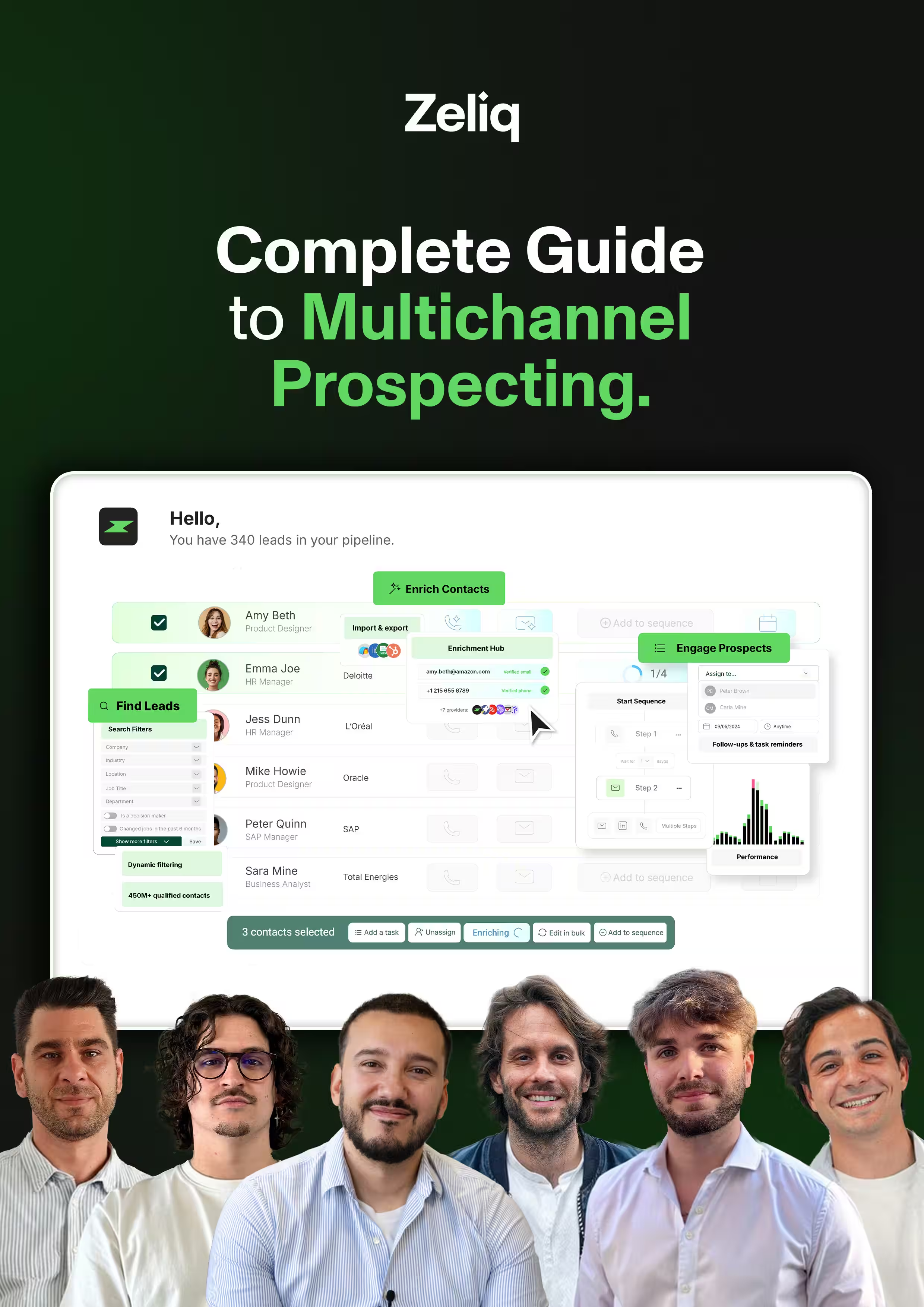
Zeliq combines a 450 million SMTP-verified B2B contact database with multichannel sequences and waterfall enrichment. A 95%-valid email base naturally reduces bounce rate below the 5% critical threshold, accelerating warmup and protecting long-term domain reputation. Warmup can’t compensate for a dirty list.
5. The 5 classic mistakes that ruin a warmup
Mistake 1: launching cold outbound too early
The urge to generate pipeline pushes to exit warmup in weeks 3-4. Result: reputation stays “Low”, bounce explodes, warmup is lost and you must restart from zero.
Mistake 2: sending on an unverified list
Sending on a list with 15% invalids during warmup destroys any reputation building. SMTP-verify the list before warmup and reserve warmup sends to safe contacts.
Mistake 3: skipping DNS configuration
Without SPF, DKIM, DMARC aligned from D1, warmup is ineffective. Configure DNS even before the first warmup touch.
Mistake 4: using 100% artificial warmup service
Since 2024, Gmail and Outlook detect artificial networks and penalize. Always hybridize with real manual sends.
Mistake 5: not monitoring
A warmup without weekly measurement (Postmaster, mail-tester, seed accounts) is a blind warmup. You won’t know if you’re ready to exit in week 6, or if you must extend to week 10.
6. Case study: SDR team warming 5 secondary domains, +82% inbox placement
Context: French B2B SaaS scale-up, 80 employees, 8.4M EUR ARR, 6 SDRs. Strategic decision: migrate cold email to 5 dedicated secondary domains (keep main domain for transactional and commercial communication). Goal: 400K EUR Q1 2026 pipeline additional.
Initial diagnosis:
- 5 secondary domains purchased
- No DNS configured
- Initial ambition: send 200 emails/day from D1 on each domain
- Inbox placement measured D1: 18% (vs > 85% target)
8-week corrective actions:
- Complete DNS configuration (SPF, DKIM, DMARC) on 5 domains before any send
- Hybrid warmup over 6 weeks: Warmup Inbox for 50% + manual sends to 200 internal/customer contacts
- Zeliq enrichment of target lists for SMTP verification (removes 12% potential invalids)
- Weekly monitoring Postmaster + mail-tester + seed accounts
- Weekly reporting to VP Sales on warmup progress per domain
- Warmup exit week 7 with inbox placement > 90%
Measured results at 8 weeks:
| KPI | D1 | End week 8 | Delta |
|---|---|---|---|
| Google Postmaster reputation | None | High (5/5 domains) | New status |
| mail-tester.com score average | 4.2/10 | 9.3/10 | +121% |
| Gmail inbox placement | 18% | 92% | +411% |
| Outlook inbox placement | 12% | 87% | +625% |
| Bounce rate | 8.4% | 1.8% | −79% |
| Daily volume reached | 5-10 | 180-200 | ×20 |
8-week ROI: investment (warmup services + Zeliq + time) 8,500 USD over 2 months, value of campaigns launched week 8 without degradation risk = 380K USD additional pipeline generated Q1 2026. ROI within SKILL v4 cap (10x).
7. Frequently asked questions
How long does a warmup take exactly in 2026?
6 to 8 weeks for a new domain, 3 to 4 weeks for rehabilitating a degraded domain. The 2026 standard duration is 6 weeks for a completely new sending domain, giving time to build solid reputation on the 3 main MTAs (Gmail, Outlook, Yahoo). Some mature teams that have already warmed multiple domains and master the process can reduce to 4-5 weeks, but it’s risky for a first warmup. Conversely, if rehabilitating an existing domain that was blacklisted or degraded, count only 3-4 weeks but with a more cautious protocol (slower volume progression, ultra-quality content, daily monitoring). Never go under 3 weeks: MTAs need this minimum delay to re-evaluate reputation. An expedited warmup (< 3 weeks) fails almost systematically and costs 3 months of deliverability loss.
Better an automated warmup service or manual warmup?
Hybrid recommended in 2026: 50-70% automated + 30-50% authentic manual. 100% manual is very time-consuming (45-90 min/day/mailbox during 6-8 weeks) and profitable only for 1-2 mailboxes maximum. 100% automated (Mailwarm, Warmup Inbox, Lemwarm, Instantly.ai) is effective but Gmail and Outlook progressively detect artificial networks since 2024. A team using 100% automated warmup service for 6 weeks will increasingly often have a reputation plateauing at “Medium” without reaching “High”, because MTAs sanction the detected artificial pattern. Hybrid combines the best: automated service for base volume (50-70%) + manual sends to your real contacts (customers, warm prospects, engaged newsletter) to authenticate usage. Cost: 30-100 USD/month service + 15-30 min/day manual. This hybridization reaches “High” reputation in 6-7 weeks with ~95% stable inbox placement.
Should I warm multiple domains in parallel to scale?
Yes, above 500-800 emails/day per domain, multiplying secondary domains is essential. A single sending domain caps around 500-800 emails/day sustained volume; above, MTAs suspect automated behavior and enter spam-suspect zone. To scale beyond, multiply secondary domains: buy 3-8 domains semantically close to your main domain (example: ~yourcompany.co, mail.yourcompany.io, hello.yourcompany.pro), configure SPF/DKIM/DMARC on each, and warm them in parallel. Each domain can carry 200-400 emails/day post-warmup, so 5 secondary domains = capacity of 1,000-2,000 additional emails/day. Critical warning: keep the main domain (yourcompany.com) for transactional emails and “warm” commercial communication. NEVER use it for cold email, even after warmup. A reputation incident on the main domain impacts your brand, your billing, your customer support, your legitimacy with existing customers.
8. Conclusion: 3 actions to run this week
Audit your current sending domains reputation within 7 days. Google Postmaster Tools + mail-tester.com. If “Low” or score < 7/10, launch a corrective warmup immediately.
If you’re starting cold outbound, plan a 6-8 week warmup before any volume send within 15 days. Configure SPF/DKIM/DMARC from D1, choose hybrid approach, weekly monitoring.
If scaling above 500 emails/day, add 3-5 dedicated secondary domains within 15 days. Domain purchase + DNS configuration + parallel warmup. Main domain stays for transactional only.
Protect your warmed domain with an SMTP-verified list
Zeliq combines 450 million verified B2B contacts (95% SMTP-valid), waterfall enrichment, and multichannel sequences. Account set up in 2 minutes, no credit card.
Try for freeAnd if you want to prevent your warmup from being ruined by a dirty contact base, try Zeliq for free: SMTP-verified B2B contacts, waterfall enrichment, and multichannel sequences in one interface, no credit card.