

A B2B buying signal is an observable event indicating a target account is entering a potential commercial consideration window: funding round, hiring of a key executive, technology change, geographic expansion, strategic announcement. Sales teams that exploit these signals systematically achieve reply rates 3 to 5× higher on cold outbound and shorten their sales cycle by 20-35%. Unlike a broad B2B lead generation approach targeting all ICP accounts equally, buying signal detection prioritizes accounts in an action window. This article details the 8 major buying signals in 2026, their sources, methodology to exploit them in an SDR workflow, and 3 FAQ.
For SDRs, revenue leaders, growth marketers, or executives structuring an ABM or intent-based approach, this article covers the 8 signals, their sources, and a reproducible exploitation protocol.
On the agenda:
- What a truly actionable buying signal is in 2026
- The 8 major buying signals and their predictive power
- Data sources for each signal
- How to integrate signals into SDR workflow
- The action window: reactivity timing
- Classic mistakes in signal exploitation
- Specialized tools (intent data platforms, custom alerts)
- Comparative test method between signal sources
- 3 FAQ (check frequency, ROI, ethics)
Key takeaways:
- 8 major signals: funding round, new leadership, office opening, tech change, hiring spike, published RFP, press mention, decision-maker publication
- Impact on cold outbound: 3-5× reply rate vs unsignaled approach
- Optimal action window: 14-30 days after signal detection (beyond, urgency fades)
- Useful free sources: LinkedIn (hires, publications), Google Alerts, company sites
- Recommended paid sources: Bombora, Zeliq intent, Cognism, Apollo intent data
- Classic mistake: detecting signals but not prioritizing them in SDR cadence (60-80% impact loss)
- Recommended tracking tool: CRM integration with automated alerts + weekly signal dashboard
1. What a buying signal really is in 2026
Operational definition
A buying signal is an observable event meeting 3 criteria: - External: from a public or semi-public source (not internal behavioral signal in your tool) - Recent: detected in last 14-30 days - Predictive: historically associated with a rise in purchase probability for your product category
A signal meeting all 3 criteria deserves priority commercial action. A signal missing a criterion is noise.
Signals vs firmographic data
Distinguish: - Firmographics (size, industry, geography): static, describe the company - Technographies (SaaS tools used): semi-static, describe the stack - Buying signals: dynamic, indicate action window
The 3 combine: a buying signal on an off-ICP account remains poorly actionable; an ICP account without signal can wait.
Why 2026 is a particular context
Three factors make signal exploitation more critical today:
- Cold outbound saturation: decision-makers receive 20-40 solicitations per day, attention window narrows
- Extended B2B cycles: +30% since 2020, early entry into consideration is decisive
- Expanded buying committees: 6-10 stakeholders per decision, detecting the trigger allows entry before RFP
2. The 8 major buying signals
Signal 1: funding round
A company that just raised has budget, growth pressure, and often new structural priorities (team to recruit, tools to deploy, market to conquer).
Predictive power: very high (top 3 of signals). Action window: 30-90 days after public announcement.
Signal 2: new leadership (CEO, CRO, VP Sales, VP Marketing, CFO)
A new leader arrives with budgets, priorities, and desire to prove themselves quickly. New CROs/VP Sales often tour the outbound market in the first 60-90 days.
Predictive power: high on target roles. Window: 30-90 days after announcement.
Signal 3: new office opening or geographic expansion
Signals a need for local recruitment, adapted tools, potentially local partners or suppliers.
Predictive power: medium to high depending on product fit. Window: 60-120 days.
Signal 4: detected technology change
Company adopts or drops a tool in your category or adjacent category. Detectable via technographies (BuiltWith, Wappalyzer, HG Insights).
Predictive power: very high if tool adjacent to yours. Window: immediate (2-4 weeks).
Signal 5: hiring wave in a specific function
10+ hires over 60 days in one function (e.g., Growth, Product, Engineering) signals strategic acceleration. Detectable via LinkedIn announcements or job platforms.
Predictive power: high for tools helping the growing function. Window: 30-90 days.
Signal 6: published RFP or tender
Strong but late signal: at this stage, the prospect has already defined its spec, often with a vendor of preference in mind. Useful to be shortlisted, less to be decisive.
Predictive power: very high but short window (7-30 days).
Signal 7: press mention or strategic announcement
Public announcement of a strategic direction: new product, pivot, acquisition, partnership. Often accompanies needs in tools or services.
Predictive power: medium. Window: 30-60 days.
Signal 8: content publication by a decision-maker
A LinkedIn article, blog post, interview by a target decision-maker on a topic related to your product category signals interest or conscious problem.
Predictive power: medium but very targeted. Window: 7-30 days (react fast).
3. Data sources for each signal
Free sources
- LinkedIn: hires (« started a new position »), decision-maker publications, office openings, promotions
- Google Alerts: configurable by company, topic, executive; daily email
- Company sites and press pages: releases, announcements
- Crunchbase free: tech startup funding
- PitchBook media: press coverage of raises and acquisitions
Specialized paid sources
- Bombora Company Surge: aggregated intent data, ~1000-3000 tracked topics, enterprise custom pricing
- G2 Buyer Intent: search/comparison signals on G2.com
- Cognism Intent: Bombora integration + proprietary signals
- Zeliq Intent Signals: real-time signals integrated to sourcing + sequences platform
- Demandbase, 6sense: enterprise ABM platforms with intent data
- HG Insights, BuiltWith: technographies (stack change)
Sector-specific sources
Depending on your market: Doctolib for healthcare, ANRU for urban, official ministry releases for public sector.
4. Integrate signals into SDR workflow
The typical workflow
Step 1: automated detection (Google Alerts + LinkedIn Sales Nav + intent tool). Step 2: consolidation in weekly dashboard (Sheet, Airtable, custom CRM). Step 3: prioritization of signaled accounts in the week’s SDR queue. Step 4: cadence adapted to the signal (hook explicitly references the signal). Step 5: measurement of signaled vs unsignaled conversion.
Message adaptation
A cold email on a « funding round » signaled account must factually reference the signal in the opener: « Saw your funding announcement Tuesday, a topic specific to your growth phase. » A generic message wastes the signal’s power.
Prioritization in cadence
Signaled accounts: tightened cadence (12 touches over 21 days), maximum personalization effort. Unsignaled but ICP-fit accounts: standard cadence (10 touches over 30 days). Off-ICP accounts even signaled: to discard (signal doesn’t compensate poor fit).
5. Action window: reactivity timing
The 14-30 day principle
A detected signal typically triggers a 14-30 day action window during which the company is still in open consideration. Beyond, the decision may have been made, budget allocated, or urgency faded.
2026 statistic: cold outreach in the 0-14 day window after signal has 3-5× higher reply rate than same message sent 60+ days after.
Windows by signal type
| Signal | Optimal window |
|---|---|
| Funding round | 30-90 days (long as budget deployed) |
| New leadership | 30-90 days (exploration period) |
| Office opening | 60-120 days (recruitment ongoing) |
| Tech change | 14-30 days (decision in progress) |
| Hiring waves | 30-90 days |
| RFP | 7-30 days (formal deadline) |
| Press mention | 14-30 days (attention fades fast) |
| Decision-maker publication | 7-14 days (short engagement window) |
Alert automation
Configure alerts to arrive in CRM or dedicated tool (Slack channel, dashboard) within 24 hours after signal publication. A signal detected 30 days after emission = window already half consumed.
6. Classic mistakes
Mistake 1: detect without prioritizing
Many teams accumulate signals in a database without surfacing them in the daily SDR queue. Result: ignored signals, 60-80% impact loss.
Mistake 2: signal without reference in message
A generic cold email to a « funding round » signaled account wastes the signal. The message must explicitly reference the event in opener.
Mistake 3: signal off-ICP
A signal on an account that doesn’t match ICP fit doesn’t compensate poor fit. Prioritize signals on already-ICP accounts.
Mistake 4: over-multiplication of sources
10+ alert sources create noise and fatigue. 3-5 well-chosen sources cover 80% of actionable signals.
Mistake 5: no attribution measurement
Without « signal source → signed deal » tracking, impossible to know which sources produce ROI. Configure a CRM field « signal source » on each opportunity.
Zeliq and real-time buying signals
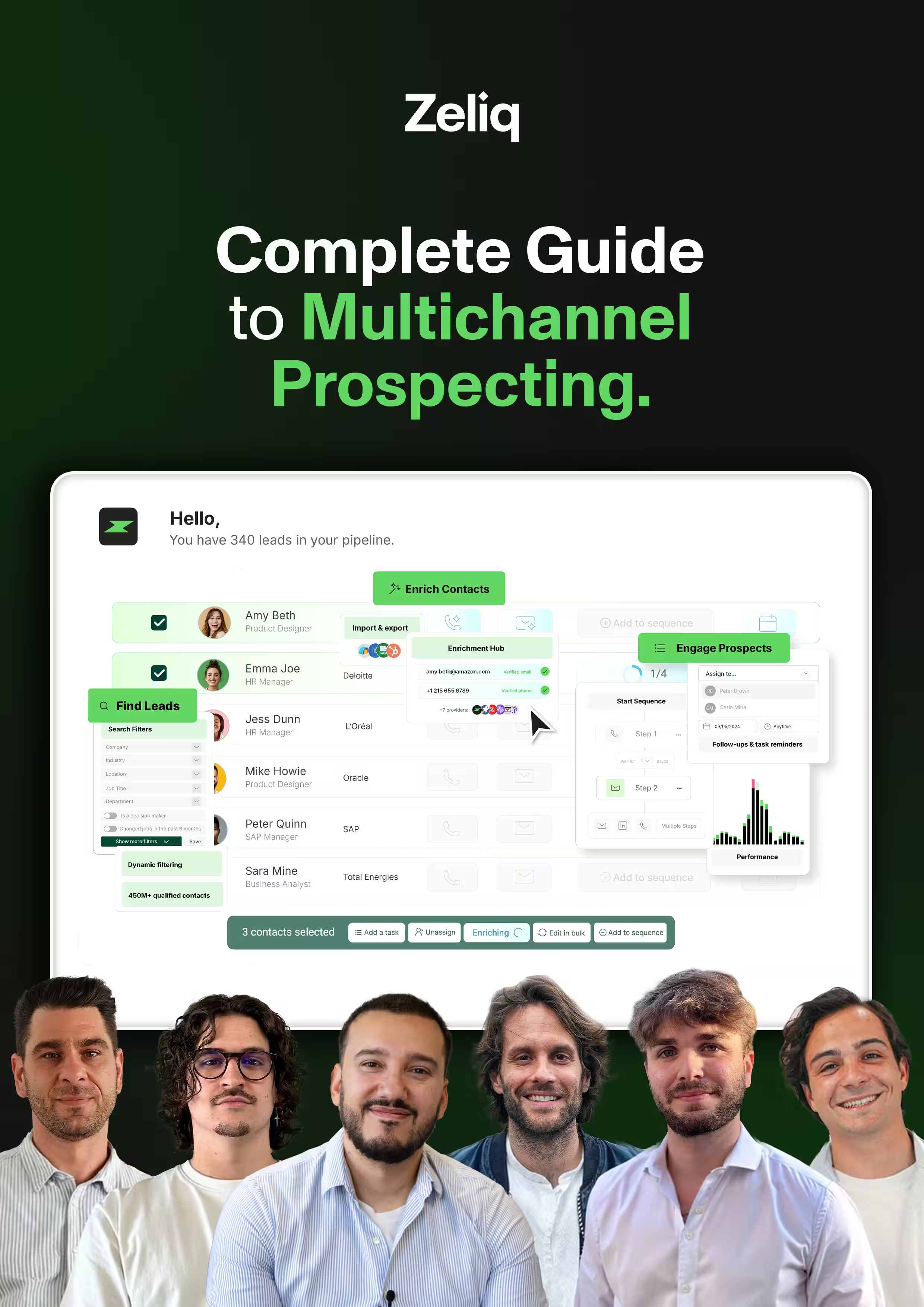
Zeliq combines a 450 million B2B contact database with waterfall enrichment, multichannel sequences, and real-time intent signals (funding, hiring, role change, publications) integrated in the same interface. Signaled accounts automatically surface in the daily SDR queue, eliminating the manual consolidation step.
7. Specialized intent data tools
Bombora Company Surge
Historical B2B intent data reference. Aggregates search behaviors on thousands of media/blog partner sites. Reports companies that « surge » (active research) on targeted topics.
Price: enterprise custom (typically $25-60K/year minimum).
G2 Buyer Intent
Search signals on G2.com: companies viewing your category, comparing vs your competitors, reading your reviews. Price: $30-100K/year based on volume.
6sense and Demandbase
Complete enterprise ABM platforms integrating intent data + fit scoring + campaign orchestration. Price: $60-200K/year.
Accessible alternatives
Zeliq, Cognism, Apollo integrate their own intent data in paid plans (typically 500-3000 signals/month depending on plan). Cost included in base subscription $80-200/user/month. Good compromise for SMB/mid-market teams vs enterprise platforms.
8. Comparative test method between sources
To avoid default choices based on notoriety:
Step 1: select 20-30 accounts actually signed in the last 6 months of your pipeline.
Step 2: retro-analyze signals that should have triggered 30-90 days before signature (funding announced before, CRO change before, etc.).
Step 3: test each candidate source by simulating: would it have caught the signal on time?
Step 4: calculate capture rate (signals detected / theoretical count) per source.
Step 5: choose 2-3 complementary sources rather than a single one (no source catches 100% of signals).
This method avoids the illusion of the « best » universal source.
9. Frequently asked questions
How often should buying signals be checked?
Daily for automated alerts, weekly for review and SDR prioritization. Optimal workflow rests on 2 rhythms. Daily rhythm: automated alerts (Google Alerts, LinkedIn Sales Nav notifications, Zeliq/Bombora dashboards) arrive in a dedicated Slack channel or email as soon as the signal is detected. An outbound-dedicated SDR checks this list 10-15 minutes each morning. Weekly rhythm: team review on Monday to consolidate the 30-80 signals detected during the week, prioritize the 15-25 accounts to work on priority, adapt cadences accordingly. Lower frequencies (bi-weekly or monthly) miss the action window: a signal detected 30 days after emission has already lost half its value. Higher frequencies (each hour) create attention fatigue without conversion gain. The daily 10-15 min check + weekly 30-45 min review is the sweet spot documented by mature teams. Tip: block recurring calendar slots to create the ritual, otherwise checking gets dropped at the first activity spike.
What ROI to expect from investing in a paid intent data tool?
3-5× the reply rate on signaled accounts vs classic cold, generally justifying the investment above 5 active SDRs and 200+ strategic accounts. On documented 2025-2026 benchmarks, a classic cold email hits 2-5% reply rate in B2B mid-market; the same message sent to a signaled account within 30 days hits 8-18%. This 3-5× multiplication translates to reduced volume needed to reach same meeting count and improved prospect fit (who has more contextual reason to be interested). Profitability: an intent tool at $25-60K/year becomes profitable as soon as the team generates 50-100 additional meetings per year attributable to signals, typically from 5 active ABM SDRs. Below, free tools (LinkedIn Sales Nav + Google Alerts + Crunchbase) suffice with acceptable ROI even if catching fewer signals. Frequent trap: buying Bombora or 6sense for 2-3 SDR non-ABM teams = over-investment not reaching profitability threshold. Recommendation: start free, measure meetings attributed to free signals over 3 months, decide based on observed volume.
Is it ethical and legal to exploit B2B buying signals?
Yes for public signals (funding, announced hiring, publication), with precautions for proprietary intent data-type signals requiring strict GDPR compliance. Signals from public sources (public LinkedIn, press releases, company sites, Crunchbase) are freely usable for B2B prospecting. No legal or ethical limitation to factually reference a public announcement in a cold email. Aggregated intent data signals (Bombora, G2, ABM platforms) rest on anonymized and company-level aggregated behavioral data (no individual identification). They are GDPR-compliant via vendor contractual mechanisms (partner network opt-in, anonymization). For European B2B prospecting, verify the intent data vendor documents its GDPR compliance (DPA available, clear legal basis, opt-out mechanism). Bombora, Cognism, and Zeliq all provide this documentation. Watch two gray zones: (1) intent data aggregated then re-attributed to nominatively named individuals = GDPR risk, to avoid; (2) intent data acquired via browser extension installed by user without full consent = risk. Recommendation: stay on account-level intent data (not individual), document legal basis (legitimate interest for B2B prospecting), enable immediate opt-out.
10. Conclusion: 3 actions to run
Configure 3 free signal sources within 7 days: Google Alerts on 20 strategic accounts + LinkedIn Sales Nav role-change alerts + Crunchbase for tech startups. 30-day test to evaluate coverage.
Institute weekly signal review ritual within 15 days: 30-45 min every Monday team to prioritize 15-25 signaled accounts in the SDR queue. Without this ritual, detected signals remain unexploited.
Measure signal → deal attribution within 30 days: add a CRM field « signal source » on each created opportunity. After 90 days, calculate ROI per source to arbitrate paid investment.
Prioritize signaled accounts with integrated buying signals
Zeliq combines 450 million B2B contacts, waterfall enrichment, multichannel sequences, and real-time buying signals (funding, hiring, publication) in a single interface. Without stacking intent tools. Account created in 2 minutes.
Try for freeAnd if you want to consolidate your buying signal sources in one interface connected to your sequences, try Zeliq for free: sourcing 450 million contacts, waterfall email and phone, integrated intent signals, no credit card required.