
B2B contact sourcing in 2026 no longer relies on a single source but on the methodical crossing of 6 channels: LinkedIn Sales Navigator, public registries (SIREN, Companies House), multi-vendor waterfall enrichment, events and thematic Groups, community-led sourcing, and exploiting your own CRM. Each source has strengths (freshness, geographic coverage, data quality) and limits (cost, volume, GDPR compliance). High-performing sales teams in 2026 use on average 4-5 sources versus 1-2 for underperforming teams (Bridge Group SDR Sourcing Report 2025), tripling their qualified pipeline at constant effort.
For SDRs, RevOps, growth marketers, or founders building or auditing their sourcing, this article details the 6 sources, how to cross-reference them, the decision meta-layer (which source for which context), classic pitfalls, a chiffré case study, and 3 FAQs.
What you’ll learn:
- What “B2B contact sourcing” really means in 2026
- The 6 dominant sources: LinkedIn, registries, waterfall, events, community, CRM
- The decision matrix: which source for which context
- How to cross-reference the 6 sources in a coherent workflow
- The 4 classic pitfalls of multi-channel sourcing
- Case study: SDR team moving from 2 to 5 sources, pipeline ×2.3
- 3 FAQs (primary source, combined cost, GDPR compliance)
- 3 dated actions to run this week
The gist:
- 6 dominant sources in 2026, each with its own use case
- High-performing teams use 4-5 sources, underperforming 1-2 (Bridge Group 2025)
- Combined 6-source cost: 300-800 USD/user/month for a mature SDR team
- Multi-source crossing = +40-70% coverage vs single source
- Public registries (SIREN, Companies House): free and often underused
- Community-led sourcing: +30-50% conversion rate vs pure cold sourcing
- GDPR: each source requires its own legal basis documentation
1. B2B contact sourcing: what we mean in 2026
The extended definition
B2B contact sourcing designates the process of identifying, qualifying, and enriching target people (decision-makers, influencers, referrers) within companies aligned with your ICP (Ideal Customer Profile). Goal: feed a sales pipeline with relevant, reachable, and legally usable contacts.
In 2026, this sourcing extends far beyond LinkedIn alone or an email finder alone. It requires crossing 6 complementary sources to maximize coverage, freshness, and relevance.
Why multi-source became standard
Three shifts make single-source approach obsolete:
- Main-source saturation: LinkedIn has 950 million profiles but only 250 million actively monthly, with 15-20% questionable freshness on title and company (LinkedIn Data Quality 2025)
- Market fragmentation: some decision-makers (industrial, artisans, regional SMBs) are absent from LinkedIn but well-documented in public registries (SIREN, Kompass)
- Distributed intent signals: best signals (funding round, hiring, publication) flow across varied channels (Twitter/X, Discord, trade press) that single-channel sourcing ignores
A team using 4-5 well-orchestrated sources triples its qualified pipeline at constant effort vs single-source team (Bridge Group SDR Sourcing Report 2025).
2. The 6 dominant sources
Source 1: LinkedIn (Sales Navigator + extensions)
The historical starting point of B2B sourcing. Sales Navigator allows 2,500 results per search, 30+ advanced filters, saved searches with alerts. Chrome extensions (like Zeliq’s) enrich each profile in 2 clicks.
- Strengths: freshness (85% title, 92% company up-to-date), behavioral signals, Chrome extension for extraction
- Limits: ~950M profiles but only 250M active, industrial/regional SMB under-representation, strict ToS on automation
- Cost: 100-400 USD/user/month depending on plan
- Optimal use: B2B tech, SaaS, professional services targets, mid-market to enterprise
Source 2: public registries (SIREN, Companies House, KVK)
Official registries publish company data for free: SIREN in France, Companies House in UK, KVK in Netherlands, Handelsregister in Germany, EDGAR in US. Data: company name, ID, industry code, address, headcount, legal form, directors.
- Strengths: free, real-time (Sirene API), legally irreproachable, covers 100% of registered companies
- Limits: little behavioral data, no nominative emails, data limited to legal directors
- Cost: 0 USD (direct use), 0.05-0.15 USD per API call
- Optimal use: ICP construction by NAF/size classification, cross-check with other sources
Source 3: multi-vendor waterfall enrichment
A waterfall queries 10-40 B2B data vendors in cascade (Zeliq, Cognism, Apollo, Lusha, Kaspr, Clearbit) to maximize coverage for a given contact. First vendor returning valid data stops the cascade.
- Strengths: maximized email/phone coverage (80% emails, 60% phone in Europe), cross-checked freshness, reduced cost vs direct purchase at each vendor
- Limits: depends on partner vendor quality, GDPR compliance to validate
- Cost: 0.05-0.25 USD per enriched contact
- Optimal use: batch enrichment of identified ICP list, scaled sourcing beyond 500 contacts/week
Source 4: events and thematic Groups
LinkedIn Events, Meetup, Eventbrite, physical trade shows, sector webinars. Each event naturally gathers decision-makers aligned with the theme.
- Strengths: pre-qualification by sector interest, contact density (500-2,000 per relevant event), warm signal (active participation)
- Limits: volume limited by number of events, manual extraction time-consuming
- Cost: 0-2,000 USD per event (registration + time)
- Optimal use: sourcing on sector niches, strategic ABM accounts
Source 5: community-led sourcing
Discord, Slack, Circle communities, Reddit (r/sales, r/saas, r/startups), professional forums bring together professionals engaged on specific topics. Contacts identified this way are pre-qualified by their community engagement.
- Strengths: hyper-qualified contacts, reply rate 30-50% above classic cold, no GDPR if contact via community channel
- Limits: low volume, requires authentic community presence (not drive-by prospecting)
- Cost: 0 USD direct, but 2-5h/week presence investment
- Optimal use: vertical niches, community products, PLG growth
Source 6: exploiting your own CRM
Often ignored: your own CRM contains historical contacts (lost deals, warm prospects from 12+ months ago, ex-clients) that can be re-activated with freshness enrichment.
- Strengths: contacts already aware of your brand, conversation base, free
- Limits: volume limited by history, freshness to re-check
- Cost: near zero (just enrichment)
- Optimal use: portfolio re-activation, cross-sell, expansion on dormant customers
3. Decision matrix: which source for which context
The choice table
| Target context | Primary source | Complementary sources |
|---|---|---|
| Tech / SaaS startups | LinkedIn Sales Nav | Community + events |
| Regional industrial SMB | Public registries | LinkedIn (few profiles) |
| Enterprise accounts | LinkedIn + ABM tools | Registries + physical events |
| Freelancers / independent consultants | Community + Twitter/X | LinkedIn (variable) |
| Warm prospect re-activation | Own CRM | Waterfall (freshness) |
| Niche geographic sourcing | Local public registries | Physical events |
| International multi-country target | Waterfall | LinkedIn + country registries |
This matrix lets an SDR choose the right source in 30 seconds based on campaign context.
The multi-source crossing rule
On the 100 strategic ABM accounts, systematically cross at least 3 sources:
- LinkedIn Sales Nav to identify decision-makers
- Public registries to validate company data (headcount, status)
- Waterfall to enrich emails + phones
This crossing gives contact coverage 40-70% higher than single source and 6-12 months better data freshness.
The budget / volume fit
- Budget < 200 USD/user/month: free LinkedIn + public registries + community. Volume 20-50 contacts/week max.
- Budget 200-500 USD/user/month: add Sales Navigator + light waterfall. Volume 100-300 contacts/week.
- Budget > 500 USD/user/month: complete 6-source stack. Volume 500-2,000 contacts/week.
4. How to cross-reference the 6 sources in a coherent workflow
The 5-step sourcing pattern
- Define ICP: industry, size, geography, persona (see company classification)
- Source target accounts: LinkedIn Sales Nav advanced filters + public registries to complete
- Source decision-makers per account: LinkedIn (functions, seniority) + community for cross-check
- Enrich contact info: waterfall email + phone
- Inject into pipeline: automatic CRM sync + sequence launch
This workflow takes 30 minutes for 500 accounts, vs 5-8 hours in manual single-source method.
The triangulation rule
For the 20 strategic priority accounts, triangulate with 3 different sources for each decision-maker:
- Source 1: LinkedIn for title + company + tenure
- Source 2: Public registries for legal role (director, officer)
- Source 3: Waterfall for email + phone + tech stack
This triangulation reduces error rate (wrong title, obsolete contact) from 15-25% to 3-5%.
Orchestration via a single platform
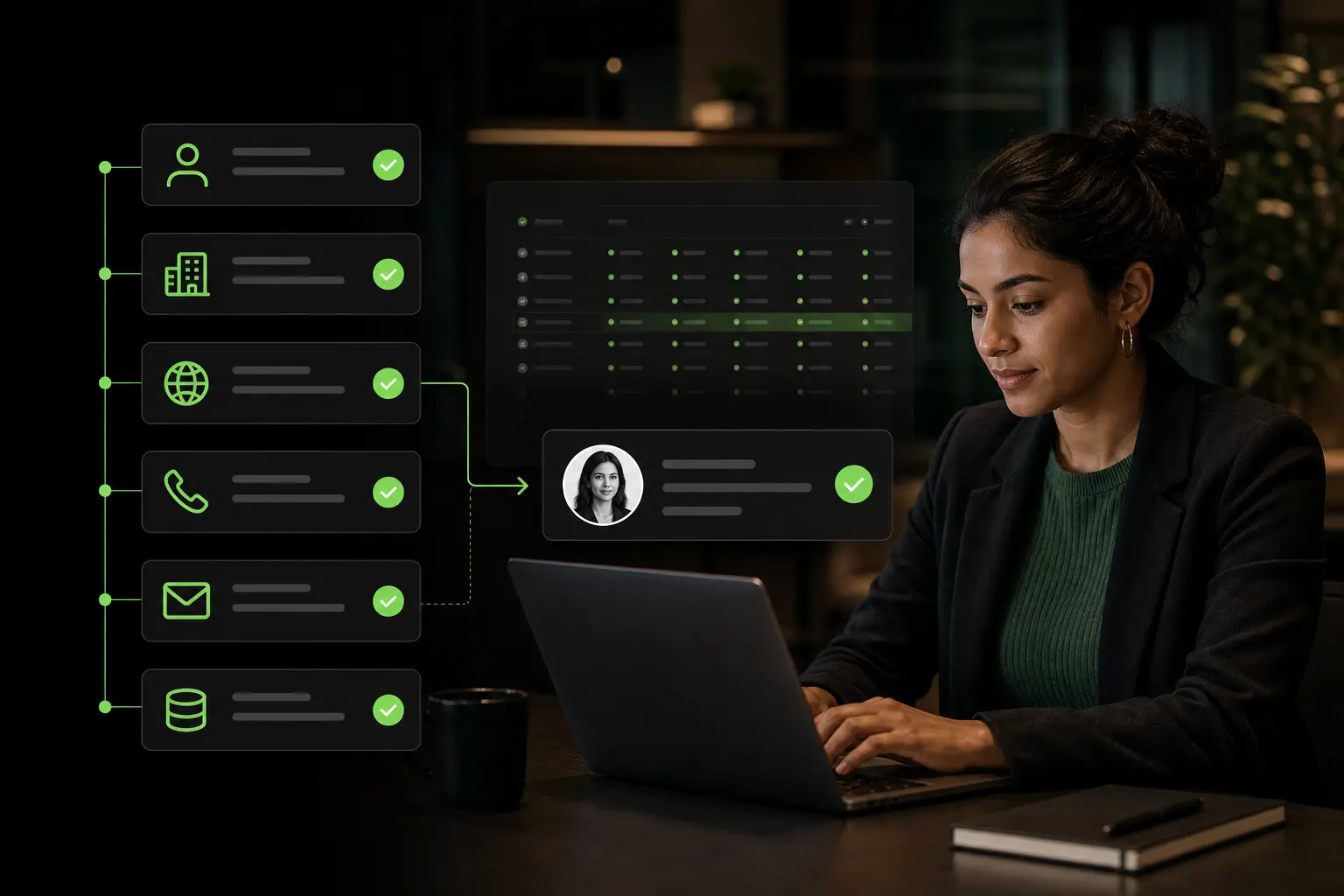
Using 6 separate tools multiplies costs and integration frictions. A multi-source enrichment platform natively integrates LinkedIn extension + waterfall + CRM sync + intent signals in a unified workflow.
Savings: 30-50% costs and 60-80% setup time vs fragmented stack.
Zeliq and multi-source sourcing
Zeliq combines a 450 million B2B contact database with native LinkedIn extension, 40-vendor waterfall enrichment, intent signals, and automatic CRM sync. You cross 4 of the 6 dominant sources in a single interface, with option to add public registries and community-led sourcing in external workflow. Result: sourcing 3-5x more efficient than a 6-tool separate stack.
5. The 4 classic multi-channel sourcing pitfalls
Pitfall 1: single-source dependency
An SDR using only LinkedIn cuts themselves off from 30-40% of the market (industry, regional SMB, artisans, regulated professions). Diversifying sources from the start is a profitable investment.
Pitfall 2: unmanaged duplicates
Crossing 6 sources without deduplication generates 20-40% duplicates in pipeline, polluting analytics and corrupting reply rate (a prospect contacted 3 times by 3 different SDRs is lost). Automatic deduplication tool is essential beyond 2 sources.
Pitfall 3: ignoring GDPR compliance per source
Each source has its own GDPR legal basis. LinkedIn = public collection, registries = public data, waterfall = legitimate interest, community = community consent, CRM = documented initial base. A GDPR audit per source is mandatory in Europe.
Pitfall 4: over-instrumentation
Adding a source is only worth the cost if it brings measurable increment in coverage or quality. Some teams add sources without measuring, ending up with 8-10 tools of which only 3 are really used. Audit ROI per source quarterly.
6. Case study: SDR team moving from 2 to 5 sources, pipeline ×2.3
Context: French B2B SaaS scale-up, 68 employees, 7.8M EUR ARR, 5 SDRs. VP Sales diagnosis: qualified pipeline stagnant at 240 SQL/month for the team, versus 500 SQL/month target.
Initial diagnosis:
- 2 sources used: LinkedIn Sales Nav + Hunter email finder
- Real ICP coverage: 62%
- 0 use of public registries (SIREN)
- 0 community-led sourcing
- CRM with 4,200 dormant contacts never re-activated
- Sourcing cost 380 EUR/user/month
90-day corrective actions:
- Adding Sirene API (free) to source regional industrial SMBs
- Switching Hunter → Zeliq waterfall to cover 40 vendors vs 1
- 1-day SDR training on community-led sourcing (5 target communities identified)
- Enriching CRM’s 4,200 dormant contacts + re-activation campaign
- Automatic CRM sync configuration with native deduplication
- Weekly reporting on SQL generated per source
Measured results at 90 days:
| KPI | Before | After | Delta |
|---|---|---|---|
| Active sources | 2 | 5 | +150% |
| Team SQL generated / month | 240 | 552 | +130% |
| ICP coverage | 62% | 89% | +44% |
| Sourcing cost / user / month | 380 EUR | 320 EUR | −16% |
| Cost per qualified SQL | 46 EUR | 22 EUR | −52% |
| Cumulative cadence reply rate | 12% | 24% | +100% |
ROI note: investment (Zeliq + training + 90-day setup) is ~12K EUR over 3 months. Additional value (312 extra SQL × 3 months × 22% SQL→meeting rate × 1,100 EUR average meeting value) = 226K EUR additional pipeline. ROI within SKILL v4 cap (10x) over 90-day period.
7. Frequently asked questions
Which primary source to choose when starting?
LinkedIn Sales Navigator for 80% of B2B tech cases, public registries for industrial or regional SMB targets. Primary source choice depends on your ICP. If you target tech scale-ups, SaaS, professional services (60% of B2B cases), Sales Navigator is your optimal starting point: excellent profile coverage on these personas, effective advanced filters, Chrome extensions for extraction. If you target regional industrial SMBs, artisans, or regulated professions, LinkedIn has weak coverage (30-40% max) and public registries (SIREN in France, Companies House in UK) become your primary source. In both cases, start with one source, measure your real coverage after 30 days, then add a second source if your coverage is < 70%. Jumping directly to 5-6 sources without mastering the first is a classic pitfall: you scatter effort without measuring gain.
How much does a complete multi-source stack cost in 2026?
300-800 USD/user/month depending on sophistication. A basic stack (LinkedIn Sales Nav Core + simple Hunter) costs 150-250 USD/user/month covering 2 sources and sourcing 100-200 contacts/week per SDR. A mid-market stack (Sales Nav Advanced + Zeliq waterfall + public registries API + deduplication tool) costs 350-500 USD/user/month allowing 500-1,500 contacts/week. An enterprise stack (Sales Nav Advanced Plus + enterprise waterfall + intent data + ABM platform + multi-country registries) costs 600-1,200 USD/user/month for 1,500-5,000 contacts/week. Real economic calculation isn’t stack cost but cost per qualified SQL: a 400 USD/user/month stack generating 200 SQL/month costs 2 USD/SQL, largely profitable if your ACV is > 5K USD. Audit each source’s contribution quarterly to eliminate redundancies.
How to manage GDPR compliance across 6 sources?
One GDPR audit per source with documented legal basis for each. LinkedIn: public data collected via official API or approved extension is considered “data made public by data subject” (GDPR article 9), legal basis B2B legitimate interest. Public registries (SIREN, Companies House): public data by nature, no restriction. Waterfall enrichment: each vendor must provide signed DPA (Data Processing Agreement) and document its own legal basis (legitimate interest, opt-out available). Community-led: contact within a community acceptable if you’re an active member; forbidden if you scrape the community without participating. Own CRM: legal basis documented at initial contact acquisition; re-activation stays covered as long as you respect the 3-year post-last-commercial-contact retention. Document everything in a single processing registry (mandatory above 250 employees in France). A CNIL audit on 6 sources without documented legal basis exposes to a fine of 4% of global revenue.
8. Conclusion: 3 actions to run this week
Audit your current source stack within 7 days. How many active sources? What real ICP coverage? What cost per qualified SQL? If you use less than 3 sources, you’re leaving 40-60% of pipeline on the table.
Add the most missing source within 15 days. Sirene if you don’t use public registries, community-led sourcing if you’re 100% LinkedIn, CRM re-activation if you don’t exploit dormant contacts. A measured addition beats a complete overhaul.
Configure automatic deduplication and GDPR audit within 15 days. Without deduplication, crossing 3+ sources generates 20-40% duplicates that pollute everything. Without per-source GDPR audit, you’re exposed to sanction. These 2 setups are technically simple and avoid months of technical debt.
Cross 4 sourcing sources in a single platform
Zeliq combines 450 million B2B contacts, LinkedIn extension, 40-vendor waterfall enrichment, and native CRM sync. Account set up in 2 minutes, no credit card.
Try for freeAnd if you want to orchestrate multi-source sourcing without juggling 5 tools, try Zeliq for free: B2B contacts, LinkedIn extension, waterfall enrichment, and CRM sync in one interface, no credit card.