
Business email addresses are the backbone of B2B prospecting. Unlike personal Gmail or Yahoo accounts, a professional email tied to a company domain signals legitimacy, deliverability, and a real commercial relationship. In B2B outreach, the quality of your contact list starts with the quality of the email addresses in it.
But finding verified business email addresses at scale is not straightforward. Company websites rarely publish individual employee emails. LinkedIn shows profiles but hides contact information behind its own paywall. Manual research is slow and does not scale. And a purchased list from an unknown vendor is as likely to produce bounces and spam complaints as it is to produce replies.
This guide covers every practical method to find business email addresses, how to verify them before sending, how to recognize the common corporate email formats, how to stay compliant, and which tools do the job best in 2026.
What Makes a Business Email Address Different
A business email address follows the pattern firstname.lastname@company.com or a variation of it, tied to the company’s own domain rather than a generic provider. It signals:
- Organizational legitimacy: the person works at the company they say they work at
- Role relevance: the address is often tied to a specific job function
- Higher deliverability potential: company domains have dedicated email infrastructure with proper authentication (SPF, DKIM, DMARC)
- Commercial intent context: reaching someone at their work address is appropriate for B2B outreach; their personal address is not
For B2B prospecting teams, the distinction matters because deliverability and relevance both depend on hitting the right address. A bounce on a cold campaign damages your sender reputation. A message that lands in someone’s personal inbox feels intrusive and is less likely to convert.
The Common Business Email Address Formats
Before searching for an email, it helps to know the patterns companies use. Most corporate email formats follow one of these structures:
| Format | Example |
|---|---|
| firstname.lastname | john.smith@company.com |
| firstnamelastname | johnsmith@company.com |
| firstname | john@company.com |
| f.lastname | j.smith@company.com |
| flastname | jsmith@company.com |
| firstname_lastname | john_smith@company.com |
The most common pattern across mid-size and large companies is firstname.lastname@domain.com. At smaller companies, firstname@domain.com is frequent. You can often determine a company’s pattern by finding one confirmed email (from a press release, LinkedIn profile, or company website) and applying the same format to other contacts at the same organization.
Pattern testing is not guessing. An email guessed from a pattern still needs to be verified before sending.
How to Find Business Email Addresses: 7 Methods
1. Email Finder Tools (Fastest and Most Scalable)
Email finder platforms are purpose-built to locate and verify professional email addresses at scale. They combine data aggregation from public sources, domain crawling, pattern inference, and real-time verification into a single interface.
How they work: - You enter a person’s name and company domain (or find them directly from LinkedIn) - The tool searches its database and applies pattern inference - It runs a real-time verification check to confirm the address is active before returning it
Leading email finder tools in 2026 include Hunter.io, Snov.io, Prospeo, FullEnrich, and Zeliq. The differentiators between them are data coverage by geography, phone number availability, CRM integration depth, and compliance features for GDPR-regulated markets.
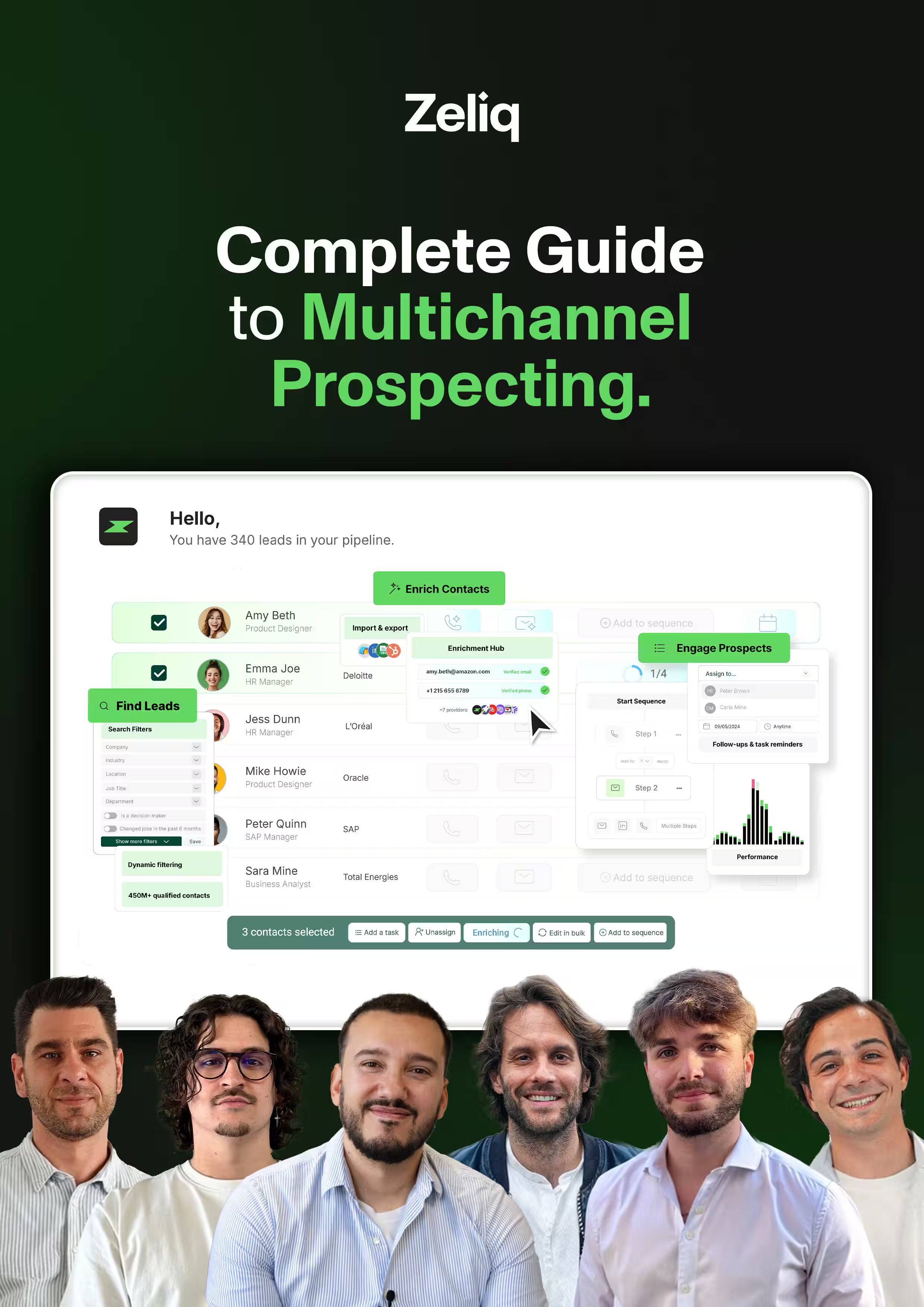
Zeliq’s email finder surfaces verified emails and phone numbers for contacts across your ICP, directly from the prospecting interface, without switching between tools.
2. LinkedIn (Manual and Tool-Assisted)
LinkedIn is the most comprehensive professional directory in the world, but it deliberately hides contact information to monetize it through Sales Navigator. You have two options:
Manual: Some professionals include their business email in their LinkedIn “Contact info” section. Check there first before turning to external tools.
Tool-assisted: Browser extensions like Zeliq’s LinkedIn extension surface verified emails and phone numbers directly from LinkedIn profiles as you browse, without having to export or cross-reference manually.
LinkedIn as a sourcing channel is effective for targeted outreach to specific named individuals. It does not scale well for building large lists without tooling support.
3. Company Websites and Press Releases
Many companies publish contact emails in: - “About” or “Team” pages for smaller companies - Press contacts and media kits for PR-related outreach - Press releases where a spokesperson’s email is listed - Blog author bios on content-heavy sites
This method is slow and incomplete for prospecting at scale, but it is useful for confirming email patterns or finding specific executive contacts who are not easily found through other channels.
4. Email Pattern Inference
Once you know how a company formats its emails (see above), you can infer the email for any employee whose name you know. The process:
- Find one confirmed email for the company (from their website, a press release, or a data tool)
- Identify the pattern (firstname.lastname, f.lastname, etc.)
- Apply the same pattern to other contacts at the organization
- Verify the inferred email before sending
Pattern inference works well for mid-size and large companies with consistent domain structures. It fails for companies with multiple domains (subsidiaries, regional entities) or for individuals with unusual name formats.
5. Google Search Operators
Advanced Google searches can surface emails that are publicly indexed. Useful operators:
- "@company.com" "firstname lastname" finds pages where both the domain and the name appear together
- site:company.com email OR contact surfaces contact pages directly on the company’s site
- filetype:pdf "firstname lastname" "company.com" finds PDF documents that may contain email addresses
This is a manual method with unpredictable results. It works occasionally for finding executive emails or conference speaker contacts, but it is not reliable for building lists.
6. B2B Data Providers
B2B databases maintain large repositories of verified contact data, updated regularly through web crawling, user submissions, and third-party partnerships. The advantage over individual email finders is scale: you can build a filtered list of hundreds of contacts that match your ICP, complete with verified emails, in minutes rather than hours.
Quality varies significantly between providers. Key evaluation criteria: verification rate, data freshness, coverage in your target markets, GDPR compliance for European contacts, and CRM integration quality.
7. Enrichment from Existing Data
If you have a list of names, companies, or LinkedIn URLs, data enrichment tools can append verified email addresses (and phone numbers) to your existing records. This is useful when:
- You have a list of event attendees or webinar registrants with name but no email
- Your CRM contains contacts that pre-date your data enrichment process
- You have a lead list from a partner or marketing campaign that is missing contact details
Zeliq’s data enrichment appends verified emails and phones to contact lists in bulk, including from LinkedIn URLs or basic firmographic data.
How to Verify Business Email Addresses
Never send to an unverified list. Bounce rates above 2-3% damage your sender reputation and can get your domain blacklisted. Verification is not optional.
Email verification checks:
- Syntax check: is the address formatted correctly?
- Domain check: does the domain exist and have valid MX records (mail exchange records)?
- Mailbox check: does the specific mailbox exist on the server?
- Catch-all detection: some domains accept all emails regardless of whether the mailbox exists, making it impossible to verify individual addresses
Most email finder tools include real-time verification as part of the lookup. If you are verifying a list you sourced separately, dedicated verification tools (NeverBounce, ZeroBounce, Kickbox) can clean it before you send.
Accept and risk indicators to know: - Valid: confirmed active mailbox, safe to send - Catch-all / Accept-all: domain accepts all mail, individual address unconfirmed, higher risk - Invalid: mailbox does not exist, will hard bounce, do not send - Disposable: temporary email address, not a real business contact
How to Recognize a Reliable Business Email Address
Before adding a contact to a sequence, assess the email quality:
High confidence signals: - Matches the known domain format for the company - First and last name match the person’s LinkedIn profile - Verified by an email finder tool with “valid” status - Domain has proper authentication (you can check SPF and DMARC records)
Lower confidence signals: - Generic role-based address (info@, contact@, sales@) rather than a named individual - Catch-all domain where individual verification is impossible - Domain is a subsidiary or acquired entity with inconsistent naming conventions - Email appears to be a shared team inbox
For cold outreach, named individual emails always outperform generic role-based addresses. Messages sent to contact@company.com are rarely read by a decision-maker.
Using Business Email Addresses in B2B Prospecting
Finding the email is the start, not the finish. The commercial value of a business email address depends on how it is used in a structured outreach motion.
Build Sequences, Not One-Offs
A single email rarely converts a cold contact. Multi-step sequences with varied touchpoints (email, LinkedIn, phone) across two to three weeks produce significantly higher response rates than a single send. Design your sequence before you send the first email, with a clear plan for how many touches, in what order, and what escalation looks like at each non-response.
Zeliq’s multichannel sequencing lets you build and run these sequences alongside your contact data in a single workflow.
Personalize at the Segment Level
True personalization at scale is not feasible for every contact. The practical alternative is segment-level personalization: crafting templates that speak directly to a specific role, industry, company size, or trigger event. An email that references the typical challenges of a VP of Sales at a 200-person SaaS company reads as relevant without requiring individual research on every contact.
Monitor Deliverability Continuously
Deliverability is not a set-and-forget concern. Track: - Open rates: below 30-40% on a warm list suggests deliverability or subject line problems - Bounce rates: above 2% requires list cleaning before continuing - Spam complaint rates: above 0.1% signals a list quality or messaging problem - Unsubscribe rates: high unsubscribes indicate the audience is wrong or the message is not relevant
Sending to bad lists damages the domain reputation that all your future emails depend on. Clean the list before every major send.
Business Email and Compliance: What to Know
GDPR (European Union)
Under GDPR, processing personal data including professional email addresses requires a legitimate interest or explicit consent. For B2B cold email to professional addresses, most EU data protection authorities accept legitimate interest as a lawful basis, provided: - The contact is reached at their professional address on a topic relevant to their professional role - The email includes an easy and clear way to opt out - You do not store or use the data beyond the stated purpose
Do not use EU personal email addresses for unsolicited commercial outreach. Stick to professional addresses and document your legitimate interest reasoning.
CAN-SPAM (United States)
CAN-SPAM requirements for commercial email include: - A physical mailing address in every email - A clear and working unsubscribe mechanism - No deceptive subject lines or sender information - Honor unsubscribe requests within 10 business days
CAN-SPAM applies to commercial messages, not transactional ones. Cold B2B prospecting emails are commercial messages.
CASL (Canada)
CASL is stricter than CAN-SPAM and generally requires express or implied consent before sending commercial email. Implied consent applies when the recipient has an existing business relationship with the sender. Cold outreach to contacts you have no prior relationship with requires careful handling under CASL.
Common Mistakes When Working with Business Email Addresses
Sending to unverified lists. A 5% bounce rate on a cold campaign can blacklist your sending domain within days. Verify before every send.
Using generic role-based addresses for outreach. info@company.com routes to a shared inbox managed by an admin. Your prospecting message will not reach the decision-maker.
Neglecting email authentication. If your sending domain does not have SPF, DKIM, and DMARC properly configured, your emails are more likely to land in spam regardless of list quality. Set up authentication before scaling outreach.
Buying unverified lists from unknown vendors. Purchased lists without clear sourcing, verification status, or opt-out compliance records are a liability. They produce high bounce rates, spam complaints, and potential regulatory exposure.
Treating email as the only channel. Business email addresses are one input into a multichannel sequence. The best results come from combining email with LinkedIn touches and, where appropriate, phone calls, not from email alone.
Find, verify, and outreach to business email contacts in one platform, with built-in multichannel sequences.
Try Zeliq for free