

A sales lead database is a searchable B2B repository of contact and company records (typically 100M-500M+ profiles) that sales teams query to build target lists, enrich CRM records, and feed multichannel outbound sequences. In 2026, Salesforce’s State of Sales reports that 9 in 10 sales teams already use AI agents or expect to within two years, with 94% of sales leaders saying agents are essential to growth, which is driving lead database vendors to bundle intent signals and workflow automation alongside raw contact data. This article maps the 8 leading vendors, the SDR workflow the database feeds, cost benchmarks, selection framework by team size and geography, compliance, and 3 FAQ.
For a Head of Sales, SDR lead, RevOps engineer, or founder selecting a sales lead database for the team, this article gives the vendor grid, the workflow map, and the cost math.
On the agenda:
- What a sales lead database delivers
- 8 leading vendors compared (coverage, geography, pricing)
- The SDR workflow the database feeds
- Coverage vs verification: database size is not quality
- Cost per SDR per month at typical volumes
- The 2026 shift: AI agents on top of the database layer
- Compliance: GDPR, CAN-SPAM, CCPA
- Selection framework
- 3 FAQ (database size vs accuracy, self-serve vs enterprise, refresh)
Key takeaways:
- Definition: searchable B2B contact + company repository for sales outreach
- 8 leading vendors: Apollo, ZoomInfo, Cognism, Lusha, UpLead, SalesIntel, Clearbit, Zeliq
- Volume claims: 100M-500M+ per vendor (verify before believing)
- Verification rate matters more than volume: 65-90% real match rate vs 95%+ published
- SDR workflow: search → export → enrich → verify → sequence → CRM sync
- Cost per SDR: $49-$400/month at mid-market pricing (Apollo starts $49/user, Sales Nav $99.99-$167)
- 2026 AI trend: 94% of sales leaders say agents essential to growth (Salesforce State of Sales)
- Compliance: FTC CAN-SPAM US, GDPR (CNIL 2025 €486M enforcement) EU
1. What a sales lead database delivers
A modern sales lead database packages three data layers:
Contact records: name, title, seniority, department, verified email, direct phone, LinkedIn URL, work history.
Company records: name, domain, industry, headcount, revenue, HQ, funding rounds, tech stack.
Behavioral signals: recent hires, funding announcements, tech switches, executive changes (in vendors that offer signals natively or via integration).
Volume claims range 100M to 700M+ across the top vendors. The volume number is marketing-first; what matters for pipeline outcomes is verification rate on your specific ICP.
2. 8 leading vendors compared
Positioning only; pricing figures cited only when publicly verified September 2026.
Apollo
Mid-market all-in-one. 275M+ contacts, 73M+ companies per vendor claim. Paid plans start at $49/user/month billed annually per Apollo’s public pricing. Includes database + sequencer + basic dialer in a single subscription.
Best for: mid-market self-serve teams testing broad prospecting.
ZoomInfo
Enterprise category leader. 500M+ contact records per vendor claim. Custom annual pricing typically $15k-$100k+. Deepest US firmographic and org-chart data.
Best for: US enterprise sales teams with meaningful sales tool budget.
Cognism
GDPR-native EMEA specialist. Diamond Data phone verification 98% per vendor claim. Custom annual pricing.
Best for: EMEA-focused teams with strict GDPR compliance requirements.
Lusha
Phone-first mid-market. 100M+ contacts per vendor claim. Chrome extension for LinkedIn workflows. Free tier (5 credits/month).
Best for: teams heavy on outbound calling.
UpLead
Real-time verification. 160M+ leads per vendor claim with 95% data accuracy guarantee. 50+ search filters including intent data.
Best for: small teams prioritizing per-export accuracy over volume.
SalesIntel
Human-verified data model. Smaller volume, higher verification confidence per vendor claim.
Best for: teams where record-level accuracy matters more than list breadth.
LinkedIn Sales Navigator
Graph-based sourcing on LinkedIn’s professional network. Advanced tier at $167/month per seat with 3,000 data credits/month + phone enrichment + job change signals per LinkedIn public pricing verified September 2026.
Best for: any B2B team; typically paired with a data database for full workflow.
Zeliq
450M B2B contact base with waterfall enrichment built into a single API endpoint (no orchestration of 3-4 vendors required), integrated email verification, multichannel sequences. European positioning, GDPR-native.
Best for: European SDR teams wanting waterfall + sequences bundled at mid-market pricing.
3. The SDR workflow the database feeds
A sales lead database is not the end goal; it is the input for a 6-stage SDR workflow:
- Search: query the database with ICP filters (title + industry + size + geography).
- Export: pull the shortlist into a CRM or a list-management tool.
- Enrich: fill any missing fields (email + phone + LinkedIn URL).
- Verify: SMTP-verify emails before send; check suppression list.
- Sequence: run multichannel outbound (email + LinkedIn + phone). See multichannel prospecting guide.
- Sync: push results (bounces, opens, replies, meetings booked) back to the CRM.
Without stages 4-6, the database is a fancy address book. The pipeline outcome comes from the workflow around it.
4. Coverage vs verification: database size is not quality
Vendor marketing frames coverage claims (275M+, 500M+, 700M+) as the primary quality signal. Independent-style tests in the SERP top 10 consistently find a large gap between coverage claim and verified match rate:
- Coverage claim: 95%+ typical
- Real verified match rate: 65-90% single-vendor, 90-95% waterfall
Meaning: a database claiming 500M contacts may only return 65% verified matches on your specific ICP. The 35% miss burns SDR hours on bad-data outreach.
Recommendation: never trust published coverage claims. Run a reproducible test: 500 in-ICP contacts through the vendor, count records where the returned email verifies as valid against an independent SMTP verifier. That is your ground truth.
5. Cost per SDR per month
Concrete math at typical mid-market pricing verified September 2026:
Entry-level self-serve: - Apollo Basic: $49/user/month billed annually - Lusha Pro: $99-149/user/month - LinkedIn Sales Nav Core: $99.99/user/month - Combined stack (Apollo + Sales Nav Core): ~$149/user/month
Mid-market: - Apollo Professional: $79-149/user/month - LinkedIn Sales Nav Advanced: $167/user/month - Enrichment add-on: $100-200/user/month - Combined stack: ~$346-516/user/month
Enterprise: - ZoomInfo or Cognism enterprise seat: $200-500/user/month allocated - Sales Nav Advanced: $167/user/month - Intent tool (Bombora, 6sense): $50-150/user/month allocated - Sequencer + dialer add-ons: $100-250/user/month - Combined stack: ~$517-1,067/user/month
All-in-one alternative: - Zeliq or Apollo all-in-one: $150-400/user/month covering database + enrichment + verification + sequencer - LinkedIn Sales Nav: $99-167/user/month - Combined stack: ~$249-567/user/month
Team scaling (5 SDRs): all-in-one saves $1,000-$2,500/month vs stitched at mid-market.
6. The 2026 shift: AI agents on top of the database
Per Salesforce’s 2026 State of Sales report cited in SERP aggregated commentary: 9 in 10 sales teams already use AI agents or expect to within two years, with 94% of sales leaders saying agents are essential to growth.
Practical implication for lead databases: vendors are bundling AI agent capabilities (autonomous prospecting, workflow automation, deal risk detection) on top of raw contact data. The database is becoming the foundation layer for AI-driven workflows rather than a standalone product.
This shift favors platforms that unify database + enrichment + sequencing + AI agent orchestration over point tools. Best-of-breed database vendors are racing to bundle downstream AI capabilities to stay relevant.
Zeliq and the AI-ready sales lead database
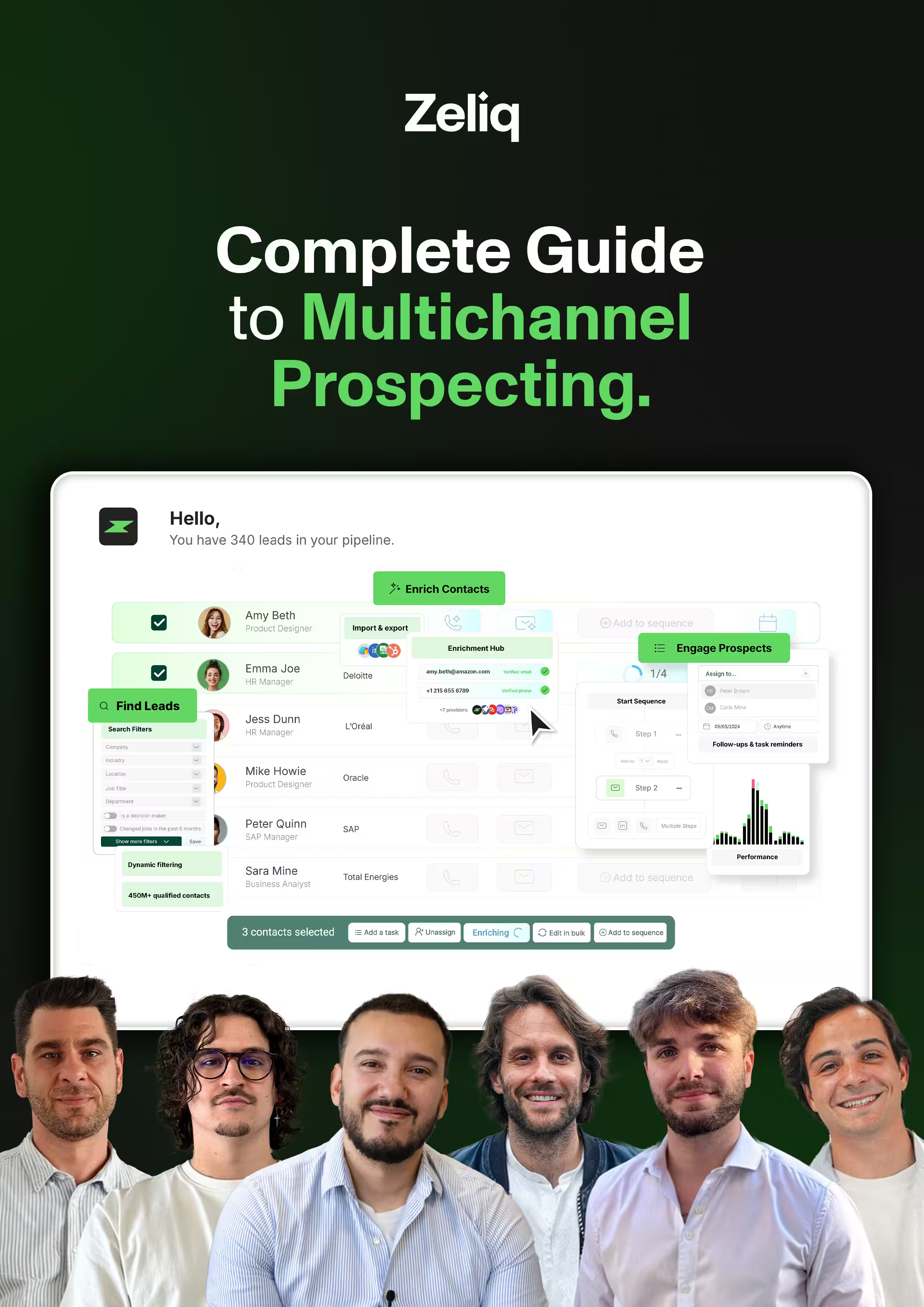
Zeliq combines a 450 million B2B contact database, waterfall enrichment across multiple sources with integrated email verification, and multichannel sequences in one interface. Foundation for AI-driven prospecting workflows without stitching four vendors. GDPR-native suppression list, European positioning.
7. Compliance: GDPR, CAN-SPAM, CCPA
US CAN-SPAM: FTC compliance guide requires accurate subject line + valid physical address + functional opt-out + honor opt-out within 10 business days.
EU GDPR: legitimate interest per ICP + opt-out + suppression + 3-year retention. CNIL 2025 sanctions hit €486M total (vs €55M in 2024), including SOLOCAL Marketing Services at €900k. Choose GDPR-native vendors for EMEA ICPs.
California CCPA/CPRA: right to know, delete, opt-out for California residents. B2B has partial exemption but disclosures still expected.
8. Selection framework
Three questions to select a vendor:
Question 1, ICP geography: US-heavy (ZoomInfo, Apollo), EMEA-heavy (Cognism, Zeliq), APAC (case-by-case).
Question 2, Team size and stack maturity: solo or < 3 SDRs → free tiers + Sales Nav; 3-10 SDRs → all-in-one platform; 10+ SDRs → best-of-breed with enterprise database.
Question 3, Budget model: monthly self-serve vs annual enterprise. Test month-to-month before annual.
Common failure: skipping the 500-contact reproducible accuracy test before signing annual. Every serious vendor offers free tier or trial for this test.
9. Common mistakes
Mistake 1: Picking on volume claim alone. 700M sounds better than 200M but real match rate on your ICP matters more.
Mistake 2: Skipping the free tier test. Every vendor offers one. Not testing = flying blind.
Mistake 3: Single-vendor lock-in above 5,000 enrichments/month. Waterfall compensates gap in coverage.
Mistake 4: No refresh cadence. Static databases decay 2-3% per month.
Mistake 5: Ignoring integration cost. Cheap tool + 3 weeks engineering = not cheap.
10. Frequently asked questions
Database size vs accuracy, which matters more when choosing a vendor?
Accuracy on your specific ICP matters materially more than raw database size, a 200M-record database with 85% verified match rate on your ICP beats a 700M-record database with 55% verified match rate every time. Vendor marketing frames volume as the primary quality signal because it is easier to publish a big number than a defensible accuracy claim. Independent-style testing in the SERP top 10 consistently shows the gap: vendor coverage claims cluster at 95%+ published, while measured verified match rates land 65-90% single-vendor depending on geography and ICP fit. Meaning: a smaller database that has invested in verification methodology and ICP-relevant data acquisition beats a bigger database with weaker verification on your target market. Practical test: run 500 in-ICP contacts through the vendor, cross-verify each returned email via a separate SMTP tool (NeverBounce, MillionVerifier, ZeroBounce), count email_verified = valid, divide by 500 = your real ground truth. Anything below 60% single-vendor signals wrong vendor for your ICP; 85-95% is possible with waterfall multi-source. Additional accuracy signal beyond verification rate: title freshness (cross-check 50 random verified contacts vs current LinkedIn; 15%+ title mismatch = poor freshness) and phone accuracy separately (typically 30-60% of email accuracy, US > EU > APAC).
Self-serve monthly vs enterprise annual, which pricing model fits my team?
Self-serve monthly wins below 5 SDRs and when testing new market or ICP; enterprise annual wins above 10 SDRs with stable ICP and 12-month volume commitment, saving 30-50% on unit cost but locking in. Trade-offs by team size: (1) Solo or 1-3 SDRs: self-serve free tiers or entry-level monthly ($49-149/user/month) work well. Total tool cost stays under $500/month for the team. Cancel anytime if the tool underperforms. (2) 3-10 SDRs: mixed model works. Self-serve monthly for enrichment + sequencer, annual for database if the vendor offers meaningful savings ($99/month vs $79/month annual). Total cost $2,000-$5,000/month for the team. (3) 10-30 SDRs: annual enterprise typically saves 30-40% on unit cost. Contract negotiation possible on seat count, credit volume, and multi-year discount. Total cost $5,000-$20,000+/month for the team. (4) 30+ SDRs: annual enterprise dominates because volume discounts compound. Custom contract terms including SLA, dedicated success manager, and priority support. Common failure: signing annual before validating the vendor on 1-3 months of real usage. Every serious vendor offers month-to-month trial or free tier for validation. Rule of thumb: run 500 in-ICP contacts through the vendor first, measure verified match rate, project 3-month pipeline value at target volume, then decide annual vs monthly. Annual saves 30-50% but locks you in; earn the lock-in with validated performance.
How often should I refresh a sales lead database extract?
Every 3 months for lists in active outbound, every 6 months for nurture-mode lists, every 12 months for dormant/long-tail lists, the 2-3% monthly database decay compounds to 24-36% wrong records per year. Aggregated industry benchmarks in the SERP top 10 converge on 2-3% monthly B2B contact data decay: people change roles at 13-23% annual voluntary turnover rate depending on measurement methodology, companies get acquired or restructured, email formats change, phones get reassigned. On a 10,000-contact list extracted 12 months ago, ~2,400-3,600 records are now wrong. Practical refresh cadence: (1) real-time re-enrichment triggered on bounce or auto-reply indicating role change, (2) quarterly batch re-enrichment of contacts with no engagement in the last 90 days, (3) annual full-base re-enrichment. Cost per cycle: $0.05-0.30 per contact depending on volume and vendor. On a 10,000-contact list at $0.15/contact, $1,500 for full refresh, offset by 2-4 weeks of protected sending reputation + 2× reply rate improvement. Track last_enriched_at timestamp and alert when it crosses 6 months. Vendors that publish their refresh methodology (frequency + verification technique) win over vendors that only publish coverage claims: ZoomInfo publicizes 70M+ records/week refresh, other vendors range monthly to quarterly. Slower refresh = more decay by the time you extract.
11. Conclusion: 3 actions to run
Shortlist 3 vendors within 7 days. Based on ICP geography, team size, and budget model. Free tier or trial available on all major vendors.
Run the reproducible 500-contact test within 15 days. Same sample through 3 vendors, measure verified email match rate against independent SMTP verification. Trust your ground-truth number over vendor benchmarks.
Test month-to-month before annual within 30 days. Validate the vendor on 1-3 months of real usage. Annual saves 30-50% but locks in; earn the lock-in with validated performance.
One sales lead database with waterfall enrichment and multichannel sequences built in
Zeliq combines 450 million B2B contacts, waterfall enrichment across multiple sources with integrated verification, and multichannel sequences in one interface. GDPR-native suppression, European positioning. Free trial credits included.
Try for freeAnd if you want a sales lead database bundled with waterfall enrichment and multichannel sequences, try Zeliq for free: sourcing, enrichment, verification, and outreach in one interface, no credit card required.