

Sales intelligence software combines four data layers (contact data, firmographic and technographic company data, buyer intent signals, and conversation intelligence) into unified platforms that help sales teams identify prospects, prioritize accounts, personalize outreach, and inspect deal risk. In 2026, mature sales intelligence stacks combine at least three of these four layers, delivering 2-4× higher conversion versus contact-data-only tools per aggregated SERP benchmarks (verified September 2026). This article maps the 4 layers, the 8 leading platforms, the selection framework by team need, ROI benchmarks, compliance, and 3 FAQ.
For a Head of Sales, RevOps engineer, growth manager, or founder assembling a sales intelligence stack from scratch or consolidating an existing one, this article gives the layer map, the tool comparison, and the numbers.
On the agenda:
- What sales intelligence software delivers (4 data layers)
- 8 leading platforms compared by primary strength
- Layer 1: contact data (who to reach)
- Layer 2: firmographic + technographic (account context)
- Layer 3: buyer intent signals (when to reach)
- Layer 4: conversation intelligence (how deals are progressing)
- All-in-one vs best-of-breed selection framework
- Cost benchmarks per SDR and per team
- Compliance: GDPR, CAN-SPAM, CCPA
- 3 FAQ (all-in-one vs stack, ROI measurement, build order)
Key takeaways:
- 4 layers: contact data, firmographic/technographic, buyer intent, conversation intelligence
- 8 leading platforms: ZoomInfo, Apollo, Cognism, 6sense, LinkedIn Sales Navigator, Gong, Sybill, Zeliq
- Conversion lift: 2-4× vs contact-data-only stacks
- Cost per SDR: $370-800/month at mid-market vendor pricing
- Data decay: 2.1-3% per month, driving continuous refresh
- Waterfall enrichment: 90%+ vs 50-62% single-source
- Compliance: FTC CAN-SPAM US, GDPR (CNIL 2025 €486M enforcement) EU
1. What sales intelligence software delivers
Sales intelligence goes beyond contact data. Where a database vendor provides who to reach, a sales intelligence platform additionally answers: what does their company look like, when are they in-market, and how are current deals progressing.
The four data layers:
Layer 1, Contact data: names, titles, seniority, department, verified email, direct phone, LinkedIn URL. The base layer.
Layer 2, Firmographic and technographic: employee count, revenue, industry, HQ, funding, tech stack, growth trends. Puts each contact in context.
Layer 3, Buyer intent signals: category-relevant research, content downloads, funding announcements, hiring surges, tech switches, executive changes. Reveals when accounts are in-market.
Layer 4, Conversation intelligence: transcription and analysis of sales calls to identify deal risks, coach reps, and surface patterns across won and lost deals.
Modern platforms deliver at least three of the four; category leaders deliver all four in unified interfaces.
2. 8 leading platforms compared by primary strength
Positioning only, no pricing figures below (which shift too fast). Verified September 2026 via aggregated SERP.
ZoomInfo
Contact data + firmographic + intent (Bombora-powered). Enterprise pricing, US-dominant coverage (500M+ contacts per vendor claim). Deepest US enterprise sales intelligence.
Apollo
Contact data + firmographic + basic intent + sequencer. All-in-one mid-market at self-serve pricing. 275M+ contacts per vendor claim.
Cognism
Contact data + firmographic + intent (Bombora integration). GDPR-native, EMEA-strong. Diamond Data phone verification 98% per vendor claim.
6sense
Intent + predictive + ABM orchestration. Category leader for account-based marketing. Enterprise pricing.
LinkedIn Sales Navigator
Relationship intelligence on LinkedIn graph. Job change alerts, TeamLink connections, InMail. Core plan $99.99/seat/month, Advanced $169/seat/month per LinkedIn public pricing verified September 2026.
Gong
Conversation intelligence + deal inspection + coaching. Category leader for revenue operations visibility. Enterprise pricing.
Sybill
AI-driven deal intelligence and sales execution. Newer entrant with strong AI conversation analysis.
Zeliq
Contact data (450M B2B contacts) + firmographic + waterfall enrichment + integrated verification + multichannel sequences. European positioning, GDPR-native. See B2B contact data for the deeper vendor comparison.
3. Layer 1: contact data (who to reach)
The base layer. Sources: LinkedIn, Chamber of Commerce, government filings, and third-party databases. Fields: name, title, seniority, department, verified email, direct phone.
Match rate benchmarks (aggregated SERP verified September 2026): - Single-vendor: 55-70% - Waterfall 3-4 vendors: 85-95%
Data decay: 2-3% per month. Refresh cycles matter as much as initial coverage.
4. Layer 2: firmographic and technographic (account context)
Firmographic: employee count, revenue, industry, HQ, funding rounds, growth stage. Technographic: what tech stack the company uses (CRM, marketing automation, analytics, dev tools).
Match rate: 90-95% for firmographic (easier to keep current), variable for technographic depending on detection method (JS/HTML tag scanning vs job posting text mining).
Use case: filter target lists to accounts using a specific competitor’s tool (switch opportunity) or using a compatible stack (integration opportunity).
5. Layer 3: buyer intent signals (when to reach)
Intent data reveals which accounts are currently researching your category or exhibiting buying-phase behavior.
Common signal sources: - Bombora, 6sense: content consumption across 5,000+ B2B sites - LinkedIn Sales Navigator: job change alerts and TeamLink activity - Crunchbase, PitchBook: funding announcements - Job boards (Indeed, LinkedIn Jobs): hiring surges by function - BuiltWith, Wappalyzer: tech switch detections
Signal freshness matters: signals older than 30-90 days lose actionability. Pair signals with demographic ICP; signal + ICP fit = highest-priority queue.
Impact: signal-layered outreach lifts reply rate 3-4× vs demographic-only per aggregated SERP benchmarks.
6. Layer 4: conversation intelligence (deals in flight)
Conversation intelligence records and analyzes sales calls to surface: - Deal risk patterns (competitor mentions, budget objections) - Rep coaching moments (talk ratio, question count, silence) - Cross-deal pattern detection (what won deals said differently than lost)
Category leaders: Gong, Sybill, Chorus. Category is more mature than intent, less mature than contact data.
For SDRs specifically, conversation intelligence matters less than for AEs (call volume higher, individual call value lower).
7. All-in-one vs best-of-breed selection
Two paths for assembling the stack:
All-in-one: single vendor covering 3-4 layers. Examples: Apollo (contact + firmographic + basic intent + sequencer), Zeliq (contact + firmographic + waterfall + sequencer). Cheaper subscription, one API surface, less integration debug.
Best-of-breed: category leader per layer. Examples: ZoomInfo (contact + firmographic) + 6sense (intent) + Gong (conversation intelligence). Deepest capability per layer, higher total cost, more integration.
Best-of-breed wins below 3 SDRs where free tiers stack cheaply. All-in-one wins above 3-5 SDRs where consolidation savings compound across seats.
8. Cost benchmarks per SDR and per team
Concrete math at mid-market vendor pricing:
Best-of-breed stack: - Contact + firmographic (ZoomInfo, Cognism): $200-500/SDR/month - Intent (Bombora, 6sense): $50-150/SDR/month allocated - Conversation intelligence (Gong): $100-200/SDR/month - LinkedIn Sales Nav: $169/SDR/month - Total: $519-1,019/SDR/month
All-in-one: - All-in-one platform (Apollo, Zeliq): $150-400/SDR/month - LinkedIn Sales Nav: $99-169/SDR/month (Core or Advanced) - Conversation intelligence add-on if needed: $100-200/SDR/month - Total: $249-769/SDR/month
Team scaling (10 SDRs): best-of-breed $5,190-$10,190/month vs all-in-one $2,490-$7,690/month. Savings $2,700-$2,500/month at typical team sizes.
9. Compliance: GDPR, CAN-SPAM, CCPA
US CAN-SPAM: FTC compliance guide requires accurate subject line + valid physical address + functional opt-out + honor opt-out within 10 business days.
EU GDPR: legitimate interest per ICP + opt-out + suppression + 3-year retention. CNIL 2025 sanctions hit €486M total (vs €55M in 2024), including SOLOCAL Marketing Services at €900k. Choose GDPR-native vendors for EMEA ICPs.
California CCPA/CPRA: right to know, delete, opt-out for California residents. B2B has partial exemption but disclosures still expected.
10. Common mistakes
Mistake 1: Buying without a clear layer priority. Teams stack all four layers without knowing which is the bottleneck for their pipeline.
Mistake 2: Skipping layer 3 (intent). Contact + firmographic alone caps conversion at demographic-only rate. Signal layer is the 3-4× multiplier.
Mistake 3: Single-vendor lock-in above 5,000 enrichments/month. Above that volume, waterfall coverage matters more than any single vendor’s ceiling.
Mistake 4: Ignoring integration cost. Cheap tools + 3-week integration = not cheap.
Mistake 5: No refresh cadence. Data decays 2-3% monthly; static databases lose 24-36% quality/year.
Zeliq and sales intelligence layers
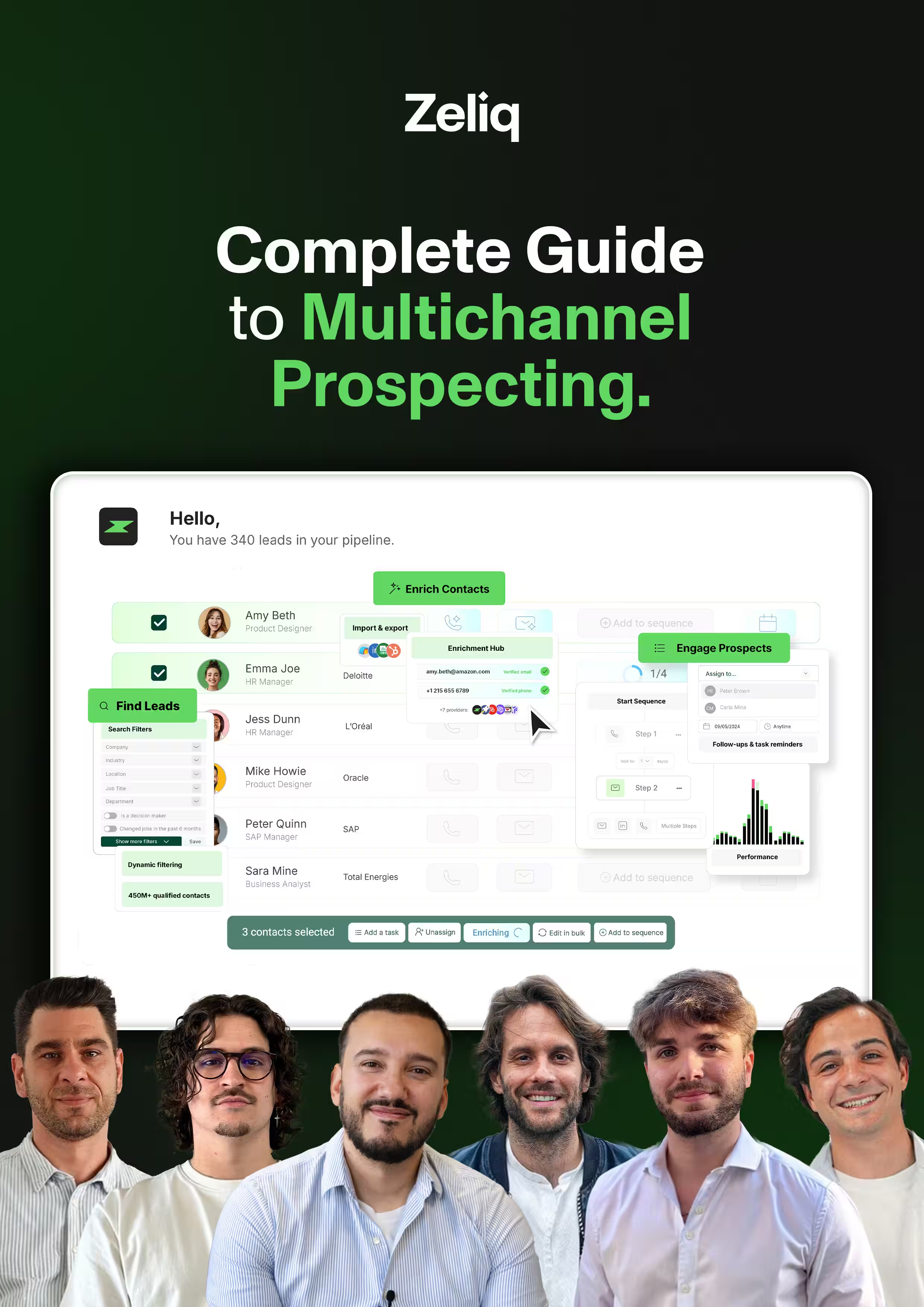
Zeliq combines contact data (450 million B2B contacts), firmographic + technographic enrichment, waterfall across multiple providers with integrated verification, and multichannel sequences in one interface. Three layers unified without stitching four vendors. GDPR-native suppression list, European positioning.
11. Frequently asked questions
All-in-one vs best-of-breed sales intelligence, which should I buy?
All-in-one wins for teams of 3-10 SDRs at mid-market ICPs where consolidation savings compound across seats; best-of-breed wins for enterprise teams above 10 SDRs where category-leader capability per layer matters more than tool count, and for solo operators below 3 SDRs where free tiers stack cheaply. Trade-offs by team size: (1) Solo operator or < 3 SDRs: best-of-breed with free tiers (Apollo free 900 credits/year + Bombora free tier + free CRM) beats paid all-in-one. Total cost $0-100/month vs $200-400/month all-in-one. (2) 3-10 SDRs: all-in-one platform bundles 3-4 layers ($150-400/seat), avoids stitching, saves 5-10 hours/SDR/month on integration. Total stack cost $2,000-$4,000/month for 5-SDR team vs $5,000-$8,000 stitched. (3) 10-30 SDRs: mixed model works, all-in-one for contact + firmographic + sequencer, best-of-breed for conversation intelligence (Gong) and predictive ABM (6sense) as separate layers. (4) 30+ SDRs: best-of-breed dominates because category-leader depth per layer produces measurable pipeline lift. Signal to switch from all-in-one to best-of-breed: your team hits a capability ceiling (e.g., all-in-one’s intent layer is too shallow for your ABM motion, or its conversation intelligence is limited to basic transcripts vs Gong’s cross-deal analysis).
How to measure ROI of a sales intelligence tool?
Measure pipeline generated attributable to the tool over a 3-6 month baseline, subtract the previous baseline, and divide by tool cost, positive ROI within 3 months indicates a keeper. Concrete method: (1) baseline pipeline generated per SDR per month for 90 days before tool adoption, (2) implement tool, (3) measure pipeline per SDR per month for 90 days after, (4) subtract baseline from post to get attributable lift, (5) multiply by SDR count and 12 months for annual value, (6) divide by annual tool cost. Break-even threshold: ROI > 1× within 3 months = keep, ROI < 0.5× within 6 months = drop. Example math on a 5-SDR team: tool costs $2,500/month = $30,000/year, produces 2 additional meetings per SDR per month = 10 meetings/month × 20% close rate × $15,000 average deal = $30,000/month attributable pipeline, or $360,000/year. ROI = 12×. Attribution watchout: don’t credit sales intelligence for pipeline that would have closed anyway. Use control cohorts (some SDRs get the tool, some don’t) for cleaner attribution. Softer ROI signals to consider alongside pipeline: SDR retention (better tools reduce churn), time-to-productivity for new SDRs (better tools shorten ramp), and cross-team lift when marketing uses the same intent signals to shape campaigns. These softer signals often add 20-40% to the direct pipeline ROI.
Build order for a sales intelligence stack?
Contact data first (Layer 1), then intent signals (Layer 3), then firmographic/technographic (Layer 2), then conversation intelligence (Layer 4), because each layer amplifies value when the previous is in place. Layer 1 (contact data) is foundational: without verified email and phone, no downstream layer can send outreach. Prioritize a broad database (ZoomInfo, Cognism, Apollo, Zeliq) with waterfall coverage or an all-in-one that includes waterfall. Layer 3 (intent) next, not Layer 2, because intent signals produce the largest single-layer conversion lift (3-4× on top of demographic targeting per aggregated SERP benchmarks). Bombora, 6sense, or LinkedIn Sales Nav alerts as entry point. Layer 2 (firmographic/technographic) third: enhances personalization and segmentation but does not by itself drive conversion the way intent does. Many all-in-one platforms bundle Layer 1 + Layer 2 so this may already be in place. Layer 4 (conversation intelligence) last: AEs benefit more than SDRs, and the investment justifies itself once deals are already flowing. Common mistake: skipping Layer 3 because it feels less concrete than firmographic. Layer 3 is where the compounding lift lives. Timing: expect 2-4 weeks to fully deploy Layer 1, 4-8 weeks to integrate Layer 3 with routing rules, 2-4 weeks for Layer 2 filters, 8-12 weeks for Layer 4 to produce actionable coaching data.
12. Conclusion: 3 actions to run
Audit your current layer coverage within 7 days. List which of the 4 layers you have and how well each performs. Missing layer 3 (intent) is the single most-common gap.
Test one intent tool within 15 days. LinkedIn Sales Nav alerts (if you already have Sales Nav) or a Bombora / 6sense free trial. Measure reply rate lift on 100 signal-scored contacts vs 100 demographic-only.
Reassess all-in-one vs stack within 30 days. Above 3 SDRs, all-in-one typically saves 30-40% on tool budget while eliminating integration debug.
Three sales intelligence layers unified without stitching four vendors
Zeliq combines contact data, firmographic enrichment, waterfall across multiple providers, integrated verification, and multichannel sequences in one interface. GDPR-native suppression, European positioning. Free trial credits included.
Try for freeAnd if you want three sales intelligence layers unified in a single interface with waterfall enrichment and multichannel sequences bundled, try Zeliq for free: sourcing, enrichment, verification, and outreach without four separate subscriptions, no credit card required.