

Contact data enrichment is the operational layer that adds verified email, direct phone, title, seniority, department, LinkedIn URL, firmographics, and buying signals to raw B2B contact records so downstream workflows (lead scoring, CRM routing, outreach personalization, ABM targeting) can run on complete inputs instead of guesses. In 2026, mature teams treat contact data enrichment as continuous rather than one-shot, driven by B2B contact data decay of roughly 2.1% per month per aggregated industry benchmarks. This article maps the 4 downstream workflows enrichment feeds, the 3 tool categories, the ROI math, compliance, and 3 FAQ.
For a RevOps engineer, Head of Sales, growth manager, or founder building enrichment into an outbound motion, this article gives the workflow map, the tool selection framework, and the numbers.
On the agenda:
- What contact data enrichment does (workflow layer role)
- The 4 downstream workflows it feeds
- The 3 tool categories (CRM-first, broad database, workflow-composable)
- Real-time vs batch enrichment
- Waterfall enrichment: 55-70% → 85-95% match lift
- Cost per enriched contact (mid-market ranges)
- Compliance: GDPR, CAN-SPAM, CCPA
- The 2026 shift toward agentic AI in enrichment
- 3 FAQ (build vs buy, refresh cadence, real-time vs batch)
Key takeaways:
- Definition: adds verified email, phone, title, firmographic to raw contacts so downstream sales/marketing runs on complete inputs
- 4 downstream workflows: lead scoring, CRM routing, outreach personalization, ABM targeting
- Match rate: 55-70% single-vendor, 85-95% waterfall 3-4 vendors
- Data decay: ~2.1% per month, driving continuous refresh
- Cost per contact: $0.05-0.50 depending on volume and depth
- Compliance: FTC CAN-SPAM US, GDPR (CNIL 2025 sanctions reached €486M) EU
- 2026 trend: Gartner projected 40% of enterprise applications embedding task-specific AI agents by end of 2026, with enrichment a prime target
1. What contact data enrichment does
Raw B2B contact records come with holes. LinkedIn profiles have no email. Form submissions have email but no phone or title. Business card scans have partial names and no company detail. Contact data enrichment closes these holes by matching partial identifiers against external databases and adding verified fields.
The output is a workable record: name, title, seniority, department, verified email with status, direct phone, LinkedIn URL, firmographic context (company size, industry, revenue, tech stack), and often behavioral signals (recent hire, funding round, tech switch).
Without enrichment, downstream workflows produce noise. With enrichment, the same workflows produce pipeline.
2. The 4 downstream workflows enrichment feeds
Contact data enrichment is not the goal; it is the input for four operational workflows.
Workflow 1, Lead scoring: score inbound leads on ICP fit + intent. Enrichment provides the ICP fit inputs (title, seniority, department, company size, industry). Without enrichment, scoring runs on form-submitted data only, ignoring 60-80% of what matters.
Workflow 2, CRM routing: assign each new lead to the right SDR territory or account team. Enrichment provides the routing keys (geography, employee count, industry, tech stack). Wrong routing = leads sitting untouched for days, then chased by the wrong owner.
Workflow 3, Outreach personalization: sequences that mention title, department, tech stack, or funding stage convert 3-4× more than generic sequences. Enrichment provides the personalization tokens.
Workflow 4, ABM targeting: account-based marketing needs a complete map of decision-makers per target account. Enrichment identifies the 5-10 relevant people at each account and their relationships.
The value of enrichment scales with the maturity of these downstream workflows. A team without lead scoring gains modestly from enrichment; a team with scoring, routing, personalization, and ABM gains 5-10× because every workflow amplifies.
3. The 3 tool categories
Contact data enrichment tools cluster into three categories with distinct fit patterns.
Category 1, CRM-first enrichment: HubSpot Enrichment, Clearbit-in-HubSpot, Leadspace, Knock AI. Best when the CRM is HubSpot or Salesforce and you want enrichment happening natively at record creation. Lowest integration friction, moderate coverage.
Category 2, Broad database: ZoomInfo (420M+ contacts per vendor claim), Cognism (EMEA-strong, phone-verified), Apollo (275M+ contacts per vendor claim), Zeliq (450M B2B contacts with waterfall enrichment built-in). Best when broad ICP coverage matters more than deep CRM integration. Higher coverage, moderate integration effort.
Category 3, Workflow-composable: Clay (workflow-first, 100+ providers stitched), Openprise. Best when a technical RevOps team wants fine-grained control over enrichment steps and can compose custom pipelines. Highest ceiling, steepest learning curve.
Most mature teams end at hybrid: broad database as anchor + CRM-native for real-time enrichment + workflow tool for edge cases. See B2B contact data for the vendor comparison in depth.
4. Real-time vs batch enrichment
Enrichment runs on two clocks:
Real-time: triggered at contact creation (form submission, product signup, manual CRM add). Latency budget 500ms to 3 seconds. Feeds lead scoring and routing that happen immediately.
Batch: scheduled (daily/weekly/monthly). Async processing over minutes to hours. Feeds CRM cleanup, ABM list preparation, quarterly refresh cycles.
Mature setups use both. Real-time on new records for immediate routing; batch monthly on the existing base for freshness.
5. Waterfall enrichment: the 55-70% → 85-95% lift
Single-vendor enrichment tops out at 55-70% match rate on typical B2B ICPs. Waterfall enrichment (chaining 3-4 vendors so a miss on vendor A cascades to B, C, D) reaches 85-95% aggregate match.
The math: waterfall costs 1.3-1.8× per matched contact but delivers 30-40 percentage points more coverage. On volumes above 5,000 enrichments/month, waterfall’s higher match rate more than compensates for the cost premium.
DIY waterfall requires 2-3 weeks engineering to orchestrate 3-4 vendor APIs, plus ongoing maintenance. Waterfall-native platforms (Zeliq and similar) provide it as a single-endpoint service in 3-5 days of integration.
6. Cost per enriched contact
Concrete ranges by plan tier at mid-market vendor pricing:
- Pay-as-you-go / free tier: $0.20-0.50 per verified contact
- Starter monthly ($100-500/month): $0.15-0.30 per contact
- Growth monthly ($500-2,000/month): $0.10-0.20 per contact
- Enterprise annual ($20k+/year): $0.05-0.10 per contact
Waterfall multiplies unit cost 1.3-1.8× but delivers 30-40 points more match. Effective cost per usable verified contact often stays similar to single-vendor despite the higher unit cost, because waterfall recovers matches that single-vendor loses.
Beyond direct enrichment cost, factor in downstream stack cost: verification (bundled or $0-50/month), sequencer ($100-300/month/seat), CRM seat ($50-150/seat), integration debug (5-15 hours/month for stitched stacks, near zero for all-in-one platforms).
7. Compliance: GDPR, CAN-SPAM, CCPA
EU GDPR: enrichment feeds outreach; outreach must document legitimate interest per ICP + provide opt-out + honor suppression within 30 days + respect 3-year post-last-contact retention. CNIL 2025 sanctions hit €486 million total (vs €55M in 2024), including SOLOCAL Marketing Services at €900,000 for prospecting without sufficient legal basis. Vendor selection matters: GDPR-native vendors (Cognism, Zeliq, and a few others) maintain suppression list APIs and can produce DPAs on request.
US CAN-SPAM: FTC compliance guide requires accurate subject line + valid physical address + functional opt-out + honor opt-out within 10 business days.
California CCPA/CPRA: right to know, delete, opt-out for California residents. B2B professional contacts have partial exemption but campaigns targeting California should include disclosures.
The pattern that scales: use GDPR-native vendors for EMEA ICPs, document legitimate interest per segment, honor opt-out promptly, keep a suppression list you actually check pre-send.
Zeliq and continuous contact data enrichment
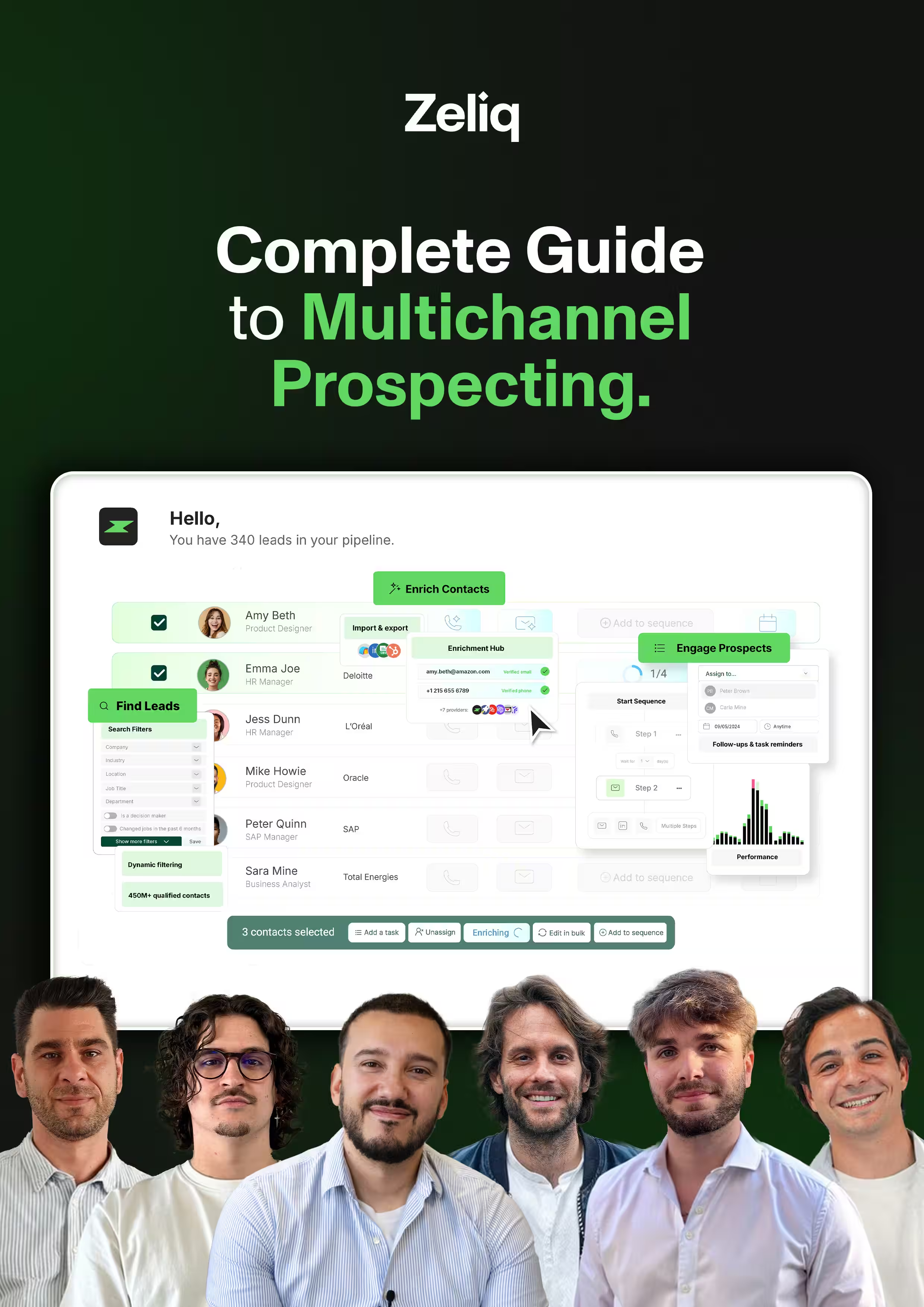
Zeliq combines a 450 million B2B contact database, waterfall enrichment across multiple data sources with integrated email verification, and multichannel sequences in one interface. Real-time enrichment on record creation, batch cleanup on schedule, GDPR-native suppression list, European positioning. One tool for the enrichment and outreach layer.
8. The 2026 shift toward agentic AI in enrichment
Gartner projected in 2025 that 40% of enterprise applications would embed task-specific AI agents by end of 2026 (up from < 5% in 2025), per aggregated industry commentary indexed in the SERP top 10. Contact data enrichment is a prime target for this shift because the workflow is well-defined and repeatable.
Practical implication: enrichment tasks are increasingly absorbed into broader autonomous workflows (AI agents that source, enrich, sequence, and route without human intervention) instead of handled by standalone enrichment tools. This favors platforms that unify enrichment with adjacent layers over point tools.
The shift is not fully mature. In 2026, most teams still run enrichment as a discrete step; but the trajectory is toward embedding it inside sourcing → sequencing agents. See multichannel prospecting guide for the sequence layer.
9. Common mistakes
Mistake 1: One-time enrichment, no refresh cycle. At ~2.1% monthly decay, a base enriched a year ago has 22.5% wrong records. Set a refresh cadence.
Mistake 2: Enriching without downstream workflows. Enrichment adds no value without lead scoring, routing, personalization, or ABM consuming the enriched fields. Build downstream first, enrichment second.
Mistake 3: Single-vendor lock-in above 5,000 contacts/month. Above that volume, waterfall’s higher match rate compounds into real pipeline. Single-vendor caps at 55-70% match = 30-45% of contacts unusable.
Mistake 4: Skipping verification. Enriched but unverified emails still bounce 10-20%. Always verify before send.
Mistake 5: No GDPR suppression check. Verified contact + on-suppression-list = CAN-SPAM/GDPR violation. Query suppression before every send.
10. Frequently asked questions
Build enrichment in-house or buy a vendor?
Below 10,000 enrichments per year, vendor is usually cheaper because engineering time isn’t free; above 50,000 per year with an in-house data team, DIY starts to make sense; the 10-50k middle band depends on team priorities. DIY math: raw enrichment API credits at $0.05-0.20 per contact + engineering time to build the pipeline. Base pipeline (single-vendor + verification + caching) takes 1-2 weeks of one engineer. Adding waterfall, monitoring, error handling, and GDPR suppression: another 2-3 weeks. Ongoing maintenance: 5-10 hours/month. At 10,000 contacts/year, DIY total cost is ~$3,000 credits + $8,000 engineering initial + $6,000/year maintenance = ~$17,000 first year, ~$9,000/year steady state. Vendor platform (waterfall-as-a-service like Zeliq): $500-2,000/month all-in = $6,000-24,000/year, but zero engineering time and time-to-value 3-5 days instead of 5-8 weeks. Below 10,000/year: vendor cheaper. Above 50,000/year: DIY viable if engineering slack + custom logic needed. Middle band 10-50k: depends on team makeup, most SDR teams pick vendor for speed, RevOps teams with in-house data engineers sometimes pick DIY for control.
How often should I refresh enriched contact data?
Every 6-12 months for email and title fields, every 12-24 months for firmographic data, real-time for high-value opportunity contacts, per aggregated industry benchmarks converging on 2.1% monthly decay. B2B contact data degrades naturally: professionals change roles at ~13-23% annual voluntary turnover rate depending on measurement methodology, companies merge or restructure, email formats change. Without refresh, your base loses 3-5% quality each month. Practical cadence: (1) real-time enrichment on any new record entering the CRM, (2) every 6 months, re-enrich contacts with no activity (open, reply, meeting) in the last 6 months, (3) every 12 months, re-enrich the entire base, (4) for active opportunity contacts, re-enrich before every major outreach (kickoff meeting, renewal, upsell). Cost of a refresh cycle: $0.05-0.30 per contact depending on volume and vendor. On a 10,000-contact base at $0.15/contact, $1,500 for a full refresh, offset by 2× reply rate improvement + protected sending reputation + reduced SDR frustration from bad-data outreach. Track last_enriched_at timestamp and alert when it crosses 6 months.
Real-time vs batch enrichment, which pattern fits my workflow?
Real-time fits when enrichment drives an immediate downstream action (lead scoring, routing, welcome sequence), batch fits when enrichment feeds a periodic workflow (CRM cleanup, ABM list build, quarterly refresh), and most mature teams run both in parallel. Real-time use cases: (1) new inbound form submission → enrichment → routing to correct SDR by geography or industry within 5 seconds, (2) product signup → enrichment → welcome sequence tailored to persona, (3) new CRM record → enrichment → lead score computed immediately. Latency budget: 500ms to 3 seconds user-facing, or 5-30 seconds async. Batch use cases: (1) monthly CRM cleanup: enrich records with last_enriched_at > 6 months, (2) ABM list build for next quarter: enrich a 500-account list ahead of campaign, (3) migration: enrich a legacy 50,000-record base after CRM migration. Latency budget: minutes to hours, async processing. Cost pattern: real-time typically costs slightly more per call (individual API requests) vs batch (bulk endpoint discounts), but the operational value of real-time enrichment often justifies the premium. Most mature setups: real-time on new records, batch monthly on the existing base for freshness. If you can only pick one to start: real-time on inbound (highest ROI for pipeline velocity).
11. Conclusion: 3 actions to run
Map your downstream enrichment workflows within 7 days. List which of the 4 workflows (lead scoring, routing, personalization, ABM) you actually run. If fewer than 2, build those before investing more in enrichment.
Measure your current match rate within 15 days. 500-contact ICP sample through your existing enrichment, count
email_verified = valid. Anything below 60% single-vendor or 85% waterfall means wrong vendor for your geography.Set up refresh cadence within 30 days. Alert on
last_enriched_at > 6 months. Schedule quarterly batch enrichment on inactive segments. Real-time on new inbound.
Real-time and batch enrichment with waterfall built-in, sequences included
Zeliq combines 450 million B2B contacts, waterfall enrichment with integrated verification, and multichannel sequences in one interface. Real-time on new records, batch on schedule. GDPR-native suppression list, European positioning.
Try for freeAnd if you want a single tool for continuous contact data enrichment + verification + multichannel sequences without stitching 3-4 vendors, try Zeliq for free: sourcing, enrichment, verification, and outreach in one interface, no credit card required.