

Sales lead lists are curated collections of B2B contacts assembled for sales outreach, sourced through first-party capture (form fills, webinar signups, content downloads), third-party B2B databases, or a mix, and structured around a documented Ideal Customer Profile that maps to the team’s best 10 customers. In 2026, the shift toward signal-based prospecting means the highest-performing sales lead lists combine verified contact data with buying intent signals, delivering 3-4× higher reply rates than static demographic-only lists per aggregated SERP benchmarks (verified September 2026). This article walks through the ICP reverse-engineering method, first-party vs third-party sourcing trade-offs, the quality-over-quantity math, refresh cadence (3-6 months), compliance guardrails, and 3 FAQ.
For a Head of Sales, SDR lead, RevOps engineer, or founder building a sales lead list workflow from scratch, this article gives the ICP method, the sourcing mix, and the quality benchmarks that matter.
On the agenda:
- What a sales lead list is (definition + core fields)
- Step 1: reverse-engineer your ICP from best 10 customers
- Step 2: choose first-party, third-party, or hybrid sourcing
- Step 3: layer intent signals on top of demographics
- Step 4: verify before send
- Step 5: refresh every 3-6 months
- Quality benchmarks: 100 targeted vs 10,000 scattered
- Compliance: CAN-SPAM, GDPR, CCPA
- 3 FAQ (ICP first vs list first, signal-based ROI, refresh cadence)
Key takeaways:
- Definition: curated B2B contacts for sales outreach, sourced from first-party + third-party
- ICP-first: reverse-engineer from best 10 customers before any list building
- Sourcing mix: first-party high intent low volume + third-party high volume moderate intent
- Signal integration: adds 3-4× reply rate lift vs demographic-only per aggregated SERP
- Verification mandatory: unverified lists bounce 15-30% and destroy sending reputation
- Refresh cadence: 3-6 months per aggregated benchmarks (~2.1% monthly data decay)
- Quality > quantity: 100 in-ICP contacts outperform 10,000 scattered
- Compliance: FTC CAN-SPAM US, GDPR (CNIL 2025 €486M enforcement) EU
1. What a sales lead list is
A sales lead list is a curated collection of B2B contacts assembled for outbound. At minimum it holds identity + reachability. In practice, professional lists carry 6-8 fields that let SDR sequences personalize without extra research:
- First name, last name
- Job title, seniority, department
- Company name, domain, employee count, industry
- Verified email +
email_status - Direct phone (or line phone)
- LinkedIn URL
- Firmographic tags (revenue bracket, funding, tech stack)
- Signal tags (recent hire, funding round, tech switch)
The distinction between an amateur list and a professional one is not row count but field discipline. A 500-record list with 8 clean fields outperforms a 10,000-record list with only name + email.
For a deeper dive on cleaning existing contact records, see the B2B contact data guide.
2. Step 1: reverse-engineer your ICP from best 10 customers
The mistake teams make: buy a list first, then try to segment. The correct order is opposite: define ICP first, then source against it.
Method: pick your 10 best current customers by revenue, retention, or NPS. For each, capture: - Industry (SIC or NAICS) - Employee count bracket - Annual revenue bracket - Region and country - Buying decision-maker title - Tech stack signals (what they use) - Trigger event that started the sale (funding, new hire, tech switch)
Look for commonalities. Three or more shared attributes across your top 10 define your ICP. Anything with only one or two shared attributes is a persona, not an ICP.
This method takes 3-5 hours the first time. It saves 3-6 months of wasted outbound to wrong-fit prospects.
3. Step 2: first-party, third-party, or hybrid sourcing
Three sourcing paths, each with distinct trade-offs.
First-party sourcing: leads generated through your own marketing (webinar signups, content downloads, demo requests, waitlist opt-ins). High intent because prospects self-selected in. Low volume relative to demand. Best used as the anchor around which third-party sourcing wraps.
Third-party sourcing: contacts purchased or subscribed from a B2B database vendor (ZoomInfo, Cognism, Apollo, Zeliq, and others). High volume and configurable to any ICP. Moderate intent because contacts did not self-select for your offer. Requires verification before send.
Hybrid sourcing: the pattern most mature teams settle at. First-party as high-priority anchor, third-party expanding coverage. Segment queues so SDRs work first-party first (highest intent), then third-party by tier.
Signal to choose each: if inbound volume is > 100 form fills/month, first-party can carry more; below 50/month, third-party is essential to feed the pipe.
4. Step 3: layer intent signals on top of demographics
Demographic targeting (title + industry + size + geography) is table stakes in 2026. Signal-based prospecting adds a second layer: which of these in-ICP accounts is currently in-market?
Common signals: - Recent funding round (Series A-D) - Hiring surges in the target function (e.g., “+5 SDRs in 30 days” suggests scale phase) - Tech switch detected (moved from competitor to open slot) - Content downloads on your category from the account’s IP - Executive change (new CFO, new VP Sales) - Public statement or PR aligning with your category
Layering signals on top of demographic ICP lifts reply rate 3-4× per aggregated SERP benchmarks. The mechanism: personalization becomes automatic (your opener mentions the signal), and timing aligns with the account’s buying window.
5. Step 4: verify before send
Never send to a list without verification. Two sub-steps:
SMTP verification on 100% of emails: NeverBounce, MillionVerifier, ZeroBounce, or built-in verification of your enrichment vendor. Removes hard-bounce candidates.
Suppression list check: cross-reference against your unsubscribe list AND the vendor’s suppression list. Prevents sending to opt-out contacts.
Bounce rate target after verification: 1-3%. Anything higher damages sending domain reputation for 2-4 weeks. See cold email best practices for deliverability guardrails downstream.
6. Step 5: refresh every 3-6 months
B2B contact data decays at ~2.1% per month (~22.5% per year) per aggregated industry benchmarks. Practical refresh cadence:
- Every 3 months: for active-campaign lists (high dollar cost per bad send)
- Every 6 months: for nurture-mode lists
- Every 12 months: for dormant/long-tail lists
Cost of a refresh cycle: $0.05-0.30 per contact depending on vendor and volume. On a 5,000-contact list, that’s $250-$1,500, offset by 2-4 weeks of protected deliverability + 2× reply rate improvement.
7. Quality > quantity: the math
Two lists compared: - List A: 10,000 contacts, unverified, 40% out of ICP, average freshness 12 months - List B: 500 contacts, verified, 100% in ICP, freshness < 3 months
Expected outcomes on identical outreach: - List A: 10,000 sent → 25% bounce (2,500) → 4,000 opens → 60 replies → 12 meetings - List B: 500 sent → 2% bounce (10) → 250 opens → 40 replies → 12 meetings
Same meeting output, wildly different sending reputation impact. List A wrecks the domain; List B protects it.
Quality-first is not a slogan; it is compounding math. Every scaled campaign after List A gets suppressed by damaged reputation; every campaign after List B lands in inbox.
Zeliq and quality-first sales lead lists
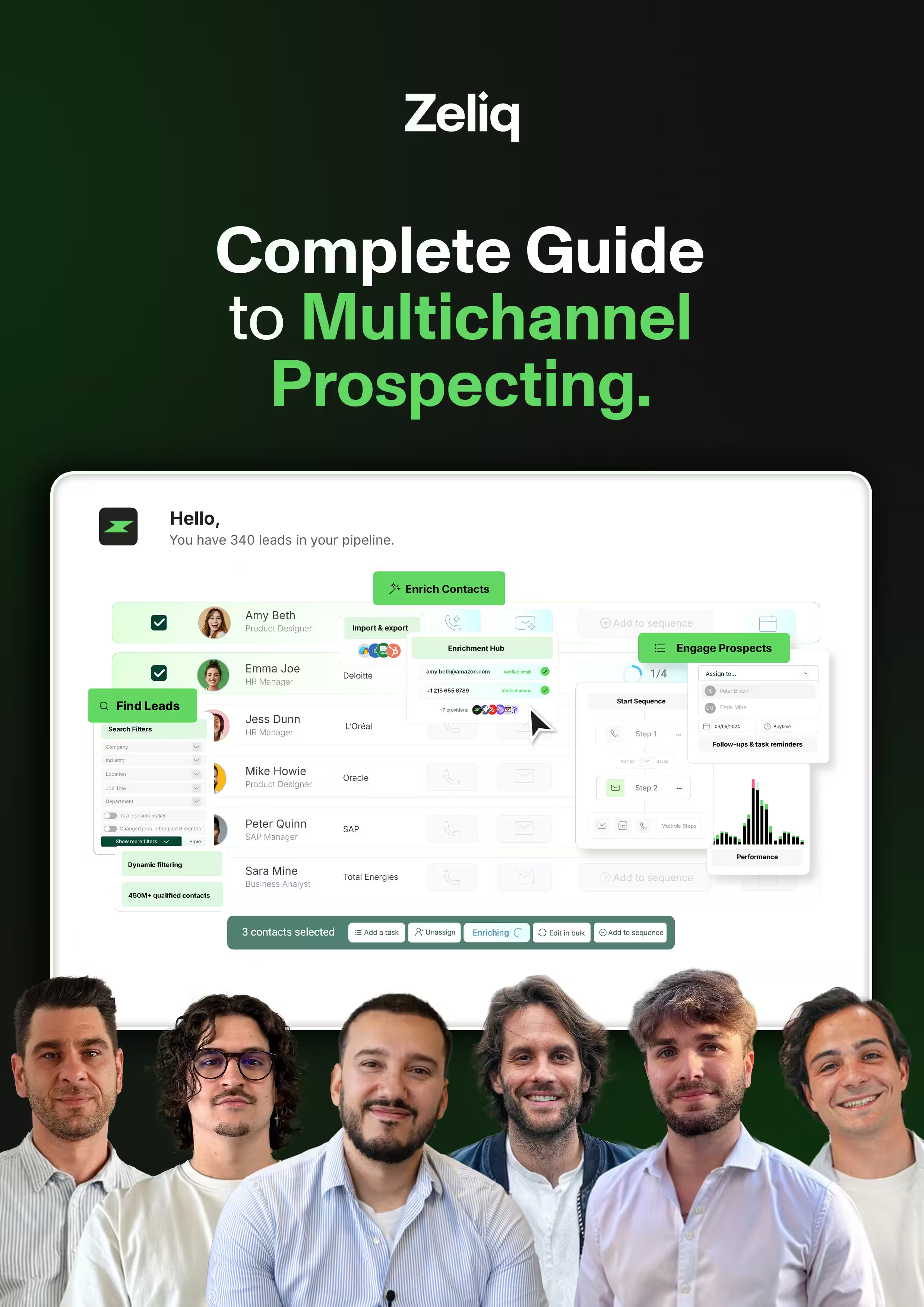
Zeliq combines a 450 million B2B contact database, waterfall enrichment across multiple sources with integrated email verification, and multichannel sequences in one interface. Build ICP-precise sales lead lists, ship verified contacts to the CRM, run the outbound sequence, all without hopping between tools. GDPR-native suppression list.
8. Compliance: CAN-SPAM, GDPR, CCPA
US CAN-SPAM: FTC compliance guide requires accurate subject line + valid physical address in signature + functional opt-out + honor opt-out within 10 business days.
EU GDPR: legitimate interest basis + documented per ICP + opt-out + 3-year retention post-last-contact. CNIL 2025 sanctions reached €486M total (vs €55M in 2024), including SOLOCAL Marketing Services at €900k for prospecting without sufficient legal basis. Choose GDPR-native vendors for EMEA ICPs.
California CCPA/CPRA: right to know, delete, opt-out for California residents. B2B has partial exemption but disclosures still expected.
9. Common mistakes
Mistake 1: Sourcing before defining ICP. Result: 40-60% of the list is out of ICP, converting at random.
Mistake 2: Ignoring signals. Demographic-only targeting caps reply rate around 3-5%. Signal-layered lists reach 8-15%.
Mistake 3: No verification before send. 15-30% bounce = 2-4 weeks reputational damage.
Mistake 4: One-time list build without refresh plan. Data decays; a list untouched for 12 months has 22.5% wrong records.
Mistake 5: Vanity volume metrics. “We built a 50,000-contact list!” says nothing about pipeline outcome. Measure meetings booked from the list.
10. Frequently asked questions
ICP-first vs list-first, which order should I follow?
ICP-first, always: reverse-engineer from your best 10 current customers before touching any sourcing tool, then build lists against the ICP; teams that source first waste 3-6 months of outbound on wrong-fit prospects. The ICP-first method takes 3-5 hours the first time: pick your 10 best customers by revenue, retention, or NPS, capture their industry + size + revenue + region + decision-maker title + tech stack + trigger event, then look for commonalities across three or more attributes. That is your ICP. Anything with only one or two shared attributes is a persona, not an ICP. Once documented, source contacts matching the ICP with tight filters (title contains X, industry Y, employee count 100-500, geography US East Coast). The alternative (list-first) works like this: buy a big list, then try to segment. Result: 40-60% of the list is out of ICP, and the team burns SDR hours on random targets. Time to first booked meeting from an ICP-first list averages 30-60 days shorter than a list-first workflow, per aggregated industry commentary. Cost: ICP-first requires more upfront thinking; list-first feels faster because sourcing starts in day 1, but produces worse pipeline math across quarter 1.
Do signal-based sales lead lists really convert 3-4× better?
Yes, when signals are current and align with the offer: aggregated SERP benchmarks in 2026 consistently show 8-15% reply rate on signal-layered lists vs 3-5% on demographic-only lists, a 2.5-4× lift, provided the signals are within a 30-90 day action window. The mechanism: signals give SDR openers something concrete to personalize around (“I saw you announced Series B last week, congrats, you likely need to scale outbound to hit growth targets”), which lifts open rates 20-30% and reply rates 2.5-4×. Common signal sources: funding announcements (Crunchbase, PitchBook public data), hiring surges (LinkedIn, job boards), tech switches (BuiltWith, Wappalyzer detection), executive changes (LinkedIn job change alerts), content downloads on your category (first-party or third-party intent tools). Signal freshness matters: a Series B announced 6 months ago has already triggered its scaling investments; a Series B announced 3 weeks ago is in active buying phase. Filter signals older than 90 days. Also filter false positives: not every funded company will buy in your category; overlay demographic ICP first, then signals, not signals first. Cost consideration: intent signal data adds $0-$30k/year depending on vendor scale (from LinkedIn Sales Navigator alerts included in seat cost, up to Bombora enterprise). ROI positive as soon as 2-3 additional meetings/month per SDR are booked from signal-layered outreach.
How often should I refresh a sales lead list?
Every 3 months for lists in active outbound, every 6 months for nurture-mode lists, every 12 months for dormant lists, the 2.1% monthly data decay compounds to 22.5% per year, so no list should go untouched more than 18 months. B2B contact data degrades naturally: professionals change roles at 13-23% annual voluntary turnover rate (Mercer and aggregated HR platform data), companies get acquired or restructured, email formats change, phones get reassigned. On a 10,000-contact list clean 12 months ago, ~2,250 records are wrong. Practical cadence: (1) real-time re-enrichment triggered on bounce or auto-reply indicating role change, (2) quarterly batch re-enrichment of contacts with no engagement in the last 90 days, (3) annual full-base re-enrichment. Cost per cycle: $0.05-0.30 per contact depending on vendor. On a 5,000-contact list at $0.15/contact, $750 for a full refresh, offset by 2-4 weeks of protected deliverability + 2× reply rate improvement + reduced SDR frustration. Track last_enriched_at timestamp on every record and set an alert when it crosses 6 months. Teams that skip refresh compound two problems: bad-data outreach damages domain reputation (2-4 weeks of degraded deliverability after a single bad batch), AND missed timing on prospects who changed roles or companies (a promoted VP Sales who is now CRO at a bigger company is a warmer lead than the original title, but only if you re-enrich).
11. Conclusion: 3 actions to run
Document your ICP within 7 days. Pick your 10 best customers, capture 7 attributes each, identify 3+ commonalities. This is your ICP.
Audit sourcing mix within 15 days. How much of current outreach is first-party (high intent) vs third-party (high volume)? If < 20% first-party, invest more in inbound funnels.
Set refresh cadence within 30 days. Every 3 months for active lists, alert on
last_enriched_at > 6 months, schedule quarterly batch enrichment.
Build ICP-precise sales lead lists with waterfall enrichment and signal layers
Zeliq combines 450 million B2B contacts, waterfall enrichment with integrated verification, and multichannel sequences in one interface. GDPR-native suppression, European positioning. Free trial credits included.
Try for freeAnd if you want to build ICP-precise sales lead lists with waterfall enrichment and signal layers in a single interface, try Zeliq for free: sourcing, enrichment, verification, and multichannel sequences without stitching 4 tools, no credit card required.