

B2B data providers are vendors selling verified B2B contact and company data (names, titles, emails, phones, firmographics, tech stack, buying signals) that sales and RevOps teams use to build target lists, enrich CRM records, and power outbound sequences. In 2026, waterfall enrichment across multiple providers reaches 90%+ match rate compared to 50-62% for single-source databases per aggregated SERP benchmarks (verified September 2026), which made multi-source stacking the default buying pattern between 2024 and 2026. This article maps the 8 leading providers, their geographic strengths, accuracy realities, the waterfall trend, cost benchmarks, and 3 FAQ.
For a Head of Sales, RevOps engineer, growth manager, or founder selecting one or more B2B data providers, this article gives the vendor grid, the accuracy caveats, and the selection framework.
On the agenda:
- What B2B data providers deliver (contact + company + signals)
- 8 leading vendors compared (coverage, geography, pricing model)
- Vendor accuracy claims vs independent-test reality
- Waterfall enrichment: 90%+ multi-source vs 50-62% single-source
- Data decay and refresh cadence
- Cost benchmarks by team size
- Compliance: GDPR, CAN-SPAM, CCPA
- Selection framework (ICP geography, volume, budget)
- 3 FAQ (accuracy testing, single vs waterfall, cost per contact)
Key takeaways:
- 8 leading providers: ZoomInfo, Cognism, Apollo, Lusha, UpLead, SalesIntel, Clearbit (HubSpot), Zeliq
- Coverage varies by region: ZoomInfo US-strong (500M contacts vendor claim), Cognism EMEA-strong (Diamond Data 98% phone verification), Zeliq 450M B2B contacts with waterfall built-in
- Accuracy reality: vendor claims cluster at 95%+; independent-style tests land 65-90% emails, 45-70% phones
- Waterfall shift: 90%+ match rate vs 50-62% single-source, +20-40 percentage points coverage
- Data decay: 2-3% per month, driving continuous refresh cycles
- Cost per verified contact: $0.05-0.50 depending on tier and volume
- Compliance: FTC CAN-SPAM US, GDPR (CNIL 2025 sanctions reached €486M) EU
1. What B2B data providers actually deliver
A modern B2B data provider stitches together three data layers:
Company data: firmographics (name, domain, industry, headcount, revenue), tech stack, HQ, funding rounds, hiring activity.
Contact data: name, job title, seniority, department, verified email with SMTP status, direct phone, LinkedIn URL, work history.
Signal data: intent signals (recent research on your category), job change alerts, funding announcements, tech switch detections.
Volume claims vary widely and are often marketing-first: ZoomInfo publishes 500M+ contacts, Apollo publishes 275M+ contacts across 73M+ companies, Cognism publishes ~200M with EMEA focus, Zeliq publishes 450M B2B contacts. Raw volume is not the quality signal that matters; verification rate and geographic fit for your ICP matter more.
2. 8 leading vendors compared
Positioning only, no pricing figures below (which move too fast). Data verified September 2026 via aggregated SERP.
ZoomInfo
Enterprise-tier, US-dominant. 500M+ contact records per vendor claim, deepest US firmographic and org chart depth. Data refresh cycles publicized at 70M+ records/week. Annual enterprise commits.
Best for: US enterprise sales teams with $50k+ annual sales tool budget.
Cognism
European-tier, GDPR-native. Diamond Data tier delivers 98% phone verification accuracy per vendor benchmarks. Strong on UK, France, DACH, Nordics.
Best for: EMEA-focused sales teams with strict GDPR compliance requirements.
Apollo
Self-serve mid-market. 275M+ contacts and 73M+ companies per vendor claim. Free tier available (900 credits/year). North American tech + SaaS deepest coverage.
Best for: mid-market self-serve teams testing before enterprise commits.
Lusha
Phone-first vendor. 100M+ contacts per vendor claim. Chrome extension companion for LinkedIn workflows. Free tier (5 credits/month).
Best for: teams heavy on outbound calling, mid-market self-serve.
UpLead
Real-time verification at export with 95% accuracy guarantee per vendor claim. Individual and small-team pricing.
Best for: small teams prioritizing per-export accuracy.
SalesIntel
Human-verified data model. Smaller volume than ZoomInfo but higher verification confidence per vendor claim.
Best for: teams where individual record accuracy matters more than volume.
Clearbit (HubSpot)
Firmographic depth + HubSpot native integration. US-strong, moderate EMEA. Real-time API + weekly batch.
Best for: HubSpot ecosystem sales teams needing firmographic enrichment.
Zeliq
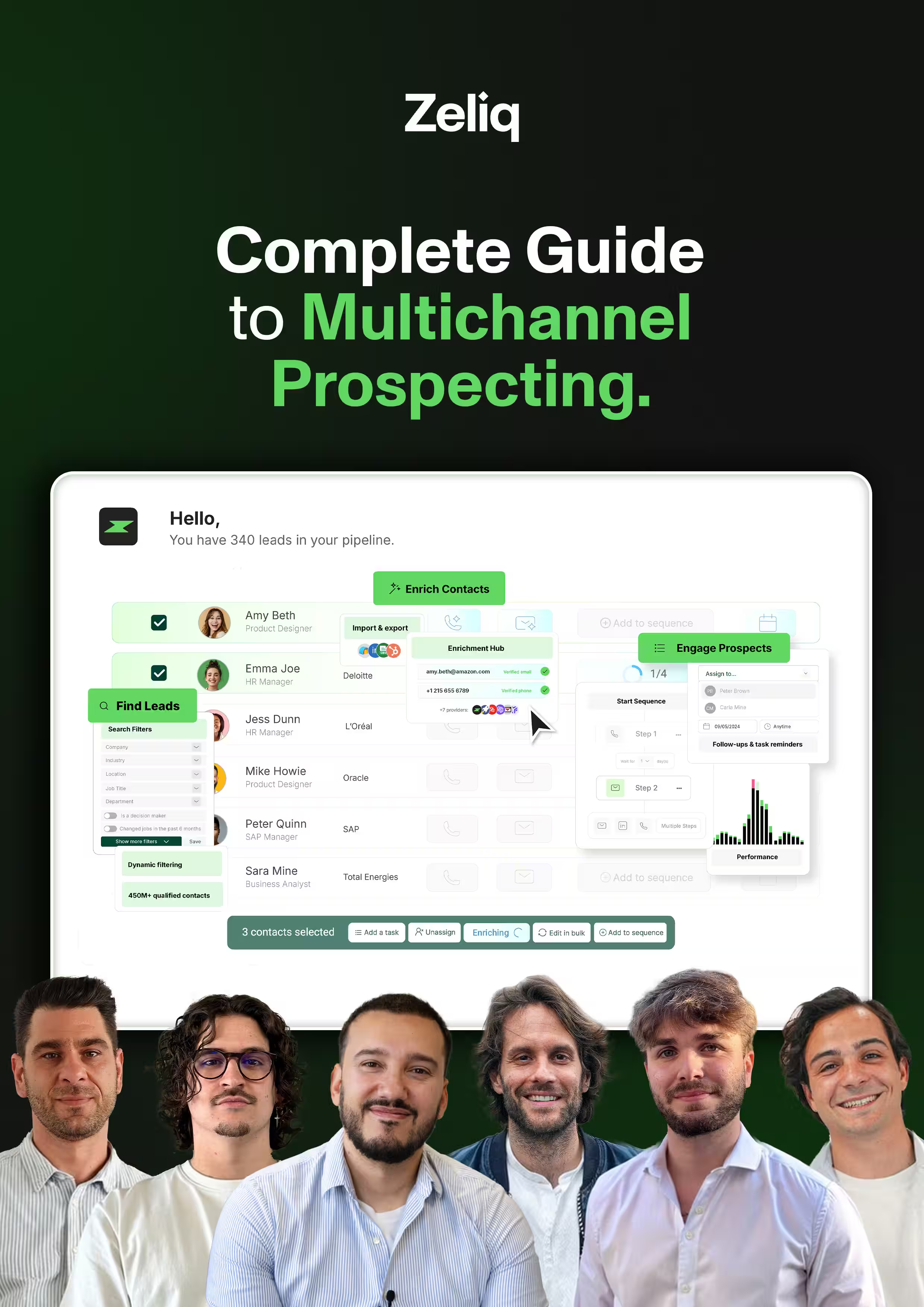
450M B2B contact base, waterfall enrichment built into a single API endpoint (no orchestration of 3-4 vendors required), integrated email verification, multichannel sequences as follow-on. European positioning, GDPR by design, native suppression endpoint.
Best for: European SDR teams wanting waterfall + sequences bundled at mid-market pricing.
3. Vendor accuracy claims vs independent-test reality
Vendor marketing claims cluster at 95%+ accuracy. Independent-style tests published in the SERP top 10 consistently land in more modest ranges:
- Email accuracy: 65-90% single-source, 90-95% waterfall multi-source
- Phone accuracy: 45-70% single-source (US higher, EMEA lower), 70-85% waterfall
- Firmographic accuracy: 90-95% (this is easier data to keep current)
- Title accuracy: 60-80% because 13-23% of professionals change roles each year
The gap between “95% published” and “65-90% measured” comes from three sources: (1) vendors count matched records without distinguishing verified from pattern-guess, (2) freshness lags between vendor refresh and independent test date, (3) accuracy varies by ICP geography and vertical, and vendor benchmarks pick their strongest segment.
Recommendation: never trust published accuracy claims. Run the reproducible test described in section 8.
4. Waterfall enrichment: the multi-source shift
Between 2024 and 2026, multi-source waterfall enrichment became the default buying pattern. The math per aggregated SERP benchmarks:
- Single-source database: 50-62% verified match rate
- Waterfall 3-4 sources: 90%+ match rate
- Coverage lift: +20-40 percentage points
The mechanism: waterfall queries vendor A first, if no verified match falls through to B, then C, then D. Each vendor’s coverage gap is filled by the next in the chain.
DIY waterfall requires 2-3 weeks of engineering to orchestrate 3-4 vendor APIs, plus 5-10 hours/month of maintenance. Waterfall-native platforms (Zeliq and similar) provide it as a single-endpoint service in 3-5 days of integration. See B2B contact data for the deeper vendor comparison.
5. Data decay and refresh cadence
Static databases decay at 2-3% per month per aggregated industry benchmarks (matches the 22.5-30%/year turnover pattern documented across the SERP top 10). Meaning: any B2B database that was clean 12 months ago has 24-36% wrong records today.
Modern vendors use AI verification and refresh cycles running 70M+ records per week (per ZoomInfo’s public claim) to keep data current. Smaller vendors refresh monthly or quarterly, which creates a freshness gap visible in accuracy tests.
Practical implication: buy from vendors with published refresh cadence + verification methodology, not just from vendors with the biggest published volume.
6. Cost per verified contact
Concrete ranges by plan tier at mid-market vendor pricing (September 2026 verified):
- Free tier: $0 base cost, 20-100 verified contacts/month included
- Starter monthly ($100-500): $0.15-0.30 per verified contact
- Growth monthly ($500-2,000): $0.10-0.20 per verified contact
- Enterprise annual ($20k+/year): $0.05-0.10 per verified contact
Waterfall multiplies unit cost 1.3-1.8× but delivers 30-40 points more match. Effective cost per usable verified contact often stays similar or lower with waterfall because the additional matches recover contacts that single-vendor loses.
Beyond direct cost, factor in downstream stack cost: verification ($0-50/month bundled or standalone), sequencer ($100-300/month/seat), CRM ($50-150/seat), integration debug (5-15 hours/month for stitched stacks).
Zeliq and multi-source data provider access
Zeliq combines a 450 million B2B contact database, waterfall enrichment across multiple data sources with integrated email verification, and multichannel sequences in one interface. One subscription replaces 3-4 provider APIs, cutting stack cost 30-40% and integration debug hours. GDPR-native suppression list, European positioning.
7. Compliance: GDPR, CAN-SPAM, CCPA
EU GDPR: B2B cold email uses “legitimate interest” basis. Requires documented interest per ICP + opt-out + active suppression + 3-year retention post-last-contact. CNIL 2025 sanctions reached €486M total (vs €55M in 2024), including SOLOCAL Marketing Services at €900k for prospecting emails without sufficient legal basis. Vendor choice materially affects risk exposure.
US CAN-SPAM: FTC compliance guide requires accurate subject line + valid physical address + functional opt-out + honor opt-out within 10 business days.
California CCPA/CPRA: right to know, delete, opt-out for California residents. B2B professional contacts have partial exemption but disclosures still expected.
For EMEA-heavy ICPs, prefer GDPR-native vendors (Cognism, Zeliq, and a few others) that maintain suppression list APIs and produce DPAs on request.
8. Selection framework and reproducible test
Before committing to any vendor, run this 5-step reproducible test:
Step 1: build a 500-contact sample matching your ICP (title, industry, geography, size).
Step 2: enrich the same sample through 2-3 candidate vendors (free tiers or trials).
Step 3: for each vendor, count records where email_status == "verified" after independent SMTP verification. This is your real match rate.
Step 4: cross-check 50 random verified contacts against current LinkedIn to measure title freshness (a 15%+ mismatch rate indicates poor freshness).
Step 5: compute cost per usable verified contact by multiplying credits used × per-credit rate divided by verified records.
Anything below 60% single-vendor or 85% waterfall in your test signals a poor fit for your ICP. Ignore vendor’s own benchmarks; trust your ground-truth test.
9. Common mistakes
Mistake 1: Choosing by published volume alone. 700M vendor claim sounds better than 200M, but if their US enterprise coverage is thin and your ICP is US enterprise, the smaller vendor with 200M focused wins.
Mistake 2: Skipping the reproducible test. Every serious vendor offers free tier or trial. Not testing = flying blind.
Mistake 3: Single-vendor lock-in above 5,000 contacts/month. At that volume, waterfall’s higher match rate compounds into real pipeline.
Mistake 4: Ignoring integration cost. Cheap tool + 3 weeks engineering = not cheap. Native CRM integrations matter.
Mistake 5: Committing to annual before validating. Annual saves 30-50% but locks you in. Test 1-3 months month-to-month first.
10. Frequently asked questions
How do I measure a B2B data provider’s real accuracy?
Run 500 in-ICP contacts through the vendor and measure verified email match rate against independent SMTP verification, anything below 60% single-vendor or 85% waterfall is a poor fit, regardless of published claims. Vendor benchmarks typically cite “records touched” which conflates verified matches with pattern guesses. Real accuracy measurement: (1) build a 500-contact sample tightly matching your ICP (title + industry + geography + size), (2) enrich each through the vendor’s endpoint, (3) send each returned email through a separate SMTP verifier (NeverBounce, MillionVerifier, ZeroBounce), (4) count contacts where the vendor returned an email that verifies as valid, (5) divide by 500 = your real verified match rate. Expected outcomes by category: US enterprise ICPs on ZoomInfo/Apollo ~65-75%, EMEA ICPs on Cognism/Zeliq ~70-80%, APAC single-vendor 30-50%, waterfall (Zeliq built-in or manually orchestrated 3-4 vendors) 85-95%. Measure phone match rate separately: it typically runs 30-60% of email match rate due to fragmentation and privacy laws (US > EU > APAC). If a vendor refuses to let you test on their free tier, that’s a red flag; quality-confident vendors welcome measurement. Beyond accuracy, measure freshness: cross-check 50 random verified contacts against current LinkedIn. A 15%+ title mismatch rate means poor freshness, regardless of vendor’s refresh cadence claims.
Single-vendor vs multi-source waterfall, which should I buy?
Single-vendor works below 5,000 enrichments per month or when one vendor’s coverage aligns tightly with your ICP; waterfall (3-4 vendors) becomes essential above 5,000/month and lifts match rate from 50-62% to 90%+ per aggregated SERP benchmarks. The mechanism: waterfall queries vendor A first, if no verified match falls through to B, then C, then D. Each vendor fills gaps in the previous ones. Cost trade-off: waterfall costs 1.3-1.8× per matched contact but delivers +20-40 percentage points of coverage, so cost-per-verified-contact typically stays flat or improves despite the higher per-call spend. Build vs buy waterfall: DIY orchestration of 3-4 vendor APIs takes 2-3 weeks engineering + 5-10 hours/month maintenance, worth it above 50k enrichments/year with an in-house data team. Waterfall-as-a-service platforms (Zeliq and similar) offer it as a single API in 3-5 days integration, better for teams below 50k/year or without engineering slack. Signal to switch to waterfall: your team is running above 5,000 enrichments/month AND single-vendor match rate is below 70% (leaving 30%+ of contacts unusable). Below 200 enrichments/month, single-vendor is fine and probably cheaper. Between 200-5,000/month is a judgment call driven by ICP geography (broader geography = more benefit from waterfall) and team engineering capacity.
What is the total cost per verified contact from a B2B data provider?
$0.05-0.50 per verified contact depending on plan tier and volume commitment, with per-verified-contact costs dropping sharply above 50,000/year in enterprise annual contracts. Cost breakdown: (1) Free tiers of paid vendors (Apollo, Lusha, Zeliq): $0 base but limited to 50-500 verified contacts/month, effectively free for testing but not scalable. (2) Starter monthly $100-500: $0.15-0.30 per verified contact, best for solo operators and small teams under 500 contacts/month. (3) Growth monthly $500-2,000: $0.10-0.20 per contact, sweet spot for 500-5,000 contacts/month per team. (4) Enterprise annual $20k+/year: $0.05-0.10 per contact, best above 5,000 contacts/month with commitment. Waterfall multipliers add 30-80% to unit cost but the match rate lift often makes cost-per-usable-contact similar or better than single-vendor. Beyond direct cost, factor these hidden expenses: (a) engineering time to build integrations (2-3 weeks for single vendor, 4-6 weeks for waterfall from scratch), (b) monitoring and error handling (~10-15 hours/month), (c) vendor lock-in cost when switching. Vendor-agnostic waterfall API layers (like Zeliq’s) trade slightly higher per-call cost for zero engineering + integration burden, typically breaking even at 10,000-50,000 verified contacts per year. Below that volume, waterfall-native platform is cheaper; above 50,000/year, DIY waterfall starts to pay off if engineering resources exist.
11. Conclusion: 3 actions to run
Shortlist 3 vendors within 7 days. Based on your ICP geography (US vs EMEA vs global), volume needs, and CRM stack. Free tier or trial available on all major vendors.
Run the reproducible 500-contact test within 15 days. Same sample through 3 vendors, measure verified email match rate against independent SMTP verification. Compare on your real ICP, not vendor benchmarks.
Sign month-to-month before annual within 30 days. Validate the vendor on 1-3 months of real usage before committing to annual pricing. Annual saves 30-50% but locks in; earn the lock-in first.
Multi-source waterfall access through a single subscription
Zeliq combines 450 million B2B contacts, waterfall enrichment across multiple providers with integrated verification, and multichannel sequences in one interface. GDPR-native suppression, European positioning. Free trial credits included.
Try for freeAnd if you want multi-source waterfall coverage without orchestrating 3-4 vendor APIs yourself, try Zeliq for free: sourcing, waterfall enrichment, verification, and multichannel sequences in a single platform, no credit card required.