

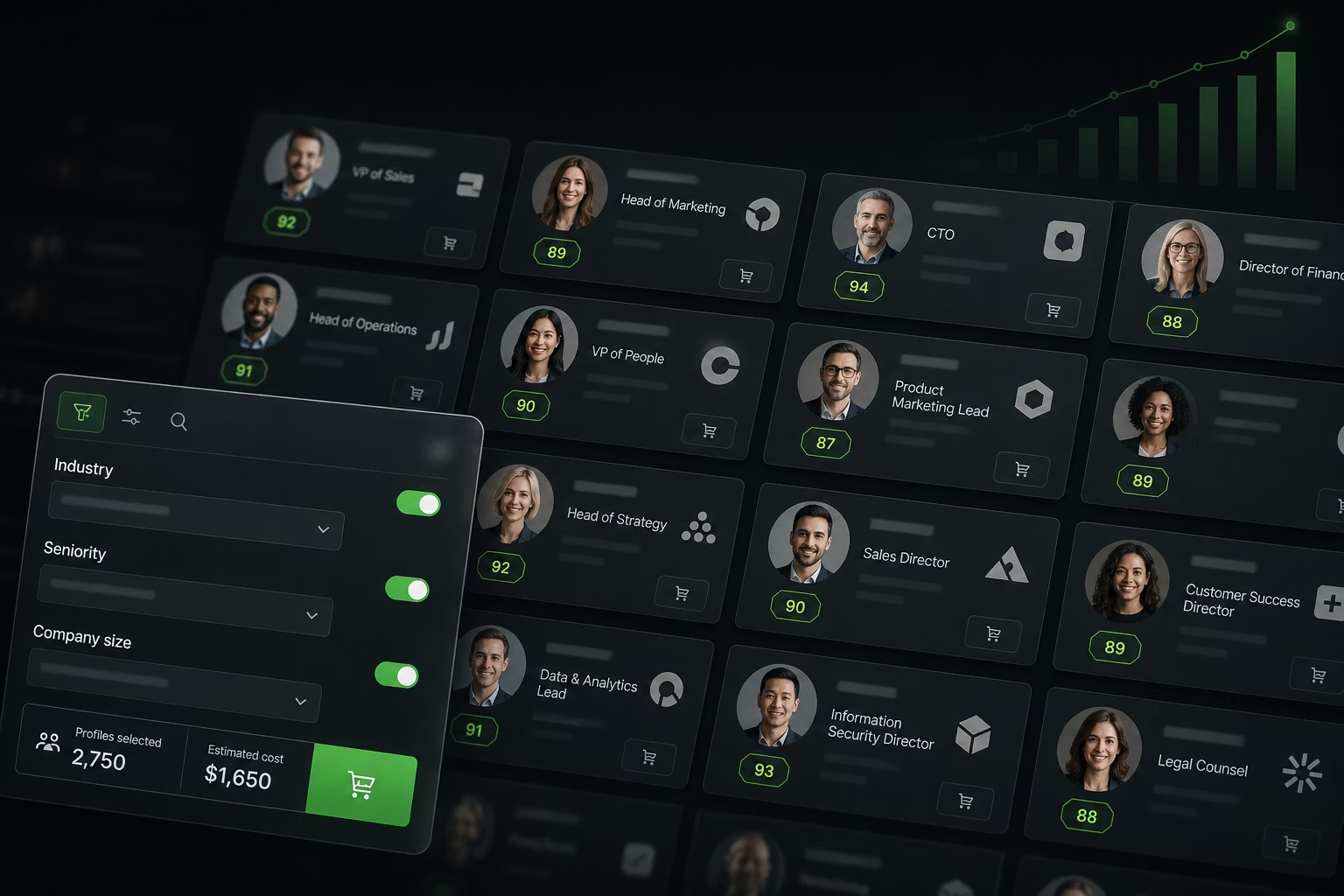

Buying B2B leads means acquiring from an external supplier a list of qualified contacts matching your ICP, with verified coordinates (email, direct phone) and firmographic data (size, sector, geography). Per Forrester B2B Data Quality Benchmark 2025, 63% of US and European B2B sales teams complement their internal sourcing with bought leads or an enrichment-platform subscription, with a median budget of $22,000/year per 10-person sales team.
But buying leads in 2026 looks nothing like the static Excel files sold by the hundred in 2010. The market has pivoted to on-demand SaaS enrichment platforms (Zeliq, Apollo, Cognism, ZoomInfo, Lusha) that combine ICP-filter search, real-time verified contacts and built-in CCPA/GDPR compliance. This guide compares purchasing models (one-shot file, platform subscription, pay-as-you-go), details 2026 pricing, quality criteria, the legal framework, and walks through a worked example on an SDR team.
At a glance:
- Strict definition and distinction from lead generation
- The 3 lead-purchasing models in 2026
- Median pricing by model and segment
- Quality criteria: validity rate, freshness, compliance
- Legal framework: CCPA, GDPR, legitimate interest
- Worked example: 12-person SDR team
- 3 FAQs and 3 dated actions
Key takeaways:
- 63% of US/EU B2B teams buy or subscribe to an external source (Forrester 2025).
- Median price per verified enriched B2B contact: $0.10 to $0.55/contact depending on source and volume.
- Acceptable 30-day validity rate: 70-85% on compliance-first platforms.
- US CCPA and EU GDPR allow buying B2B leads under documented legitimate-interest conditions.
1. Strict definition: buying leads vs lead generation
Buying leads is the external acquisition of a pre-qualified contact list on firmographic criteria (size, sector, geography) and sometimes behavioral signals (intent data, buying signals). The supplier sourced, verified, and enriched the contacts before sale.
Distinguish rigorously from:
- Lead generation (lead gen): producing leads through inbound campaigns (SEO, ads, content marketing, webinars). The company generates its own leads via marketing.
- Internal outbound prospecting: an SDR manually identifies target accounts and contacts via LinkedIn Sales Navigator, with no external purchase.
- B2B affiliate marketing: an external partner sends traffic or leads against performance compensation (see our affiliate marketing guide).
The three approaches are complementary. The 2026 rule in mature outbound teams: 40-60% of leads come from external purchase/enrichment, the rest from manual sourcing + inbound. 100% dependence on external purchase is a warning signal (risk concentration, fragile model).
2. The 3 lead-purchasing models in 2026
Model 1 — One-shot file (going extinct).
Sale of a static Excel/CSV file with 500 to 50,000 contacts, delivered once. Dominant model until 2015, marginal in 2026. Price: $0.18 to $0.95/contact depending on vertical and volume. Limits: no updates, validity rate drops 30% over 12 months (contact turnover), CCPA/GDPR compliance falls on the buyer. Still used by some outsourced-prospecting agencies to quickly ramp a client.
Model 2 — Enrichment-platform subscription.
Unlimited access to a B2B database (300M to 1.8 billion contacts) via a SaaS platform, with ICP-filter search and on-demand export. Dominant model in 2026. Pricing: monthly or annual subscription, often per user seat. Price: $49 to $1,500/month depending on plan and coverage. Platforms: Zeliq, Apollo, ZoomInfo, Cognism, Lusha, RocketReach. The recommended solution for modern sales teams.
Model 3 — Pay-as-you-go credits.
Purchase of credits used per enriched contact, with no fixed subscription. Price: $0.03 to $0.55/credit depending on volume bought. Hybrid model between file and subscription, suited to occasional usage or teams that want to test before committing. All modern platforms offer a PAYG tier alongside subscriptions.
Synthesis comparison:
| Model | Median price | Freshness | Compliance | Typical use case |
|---|---|---|---|---|
| One-shot file | $0.18-0.95/contact | Static (D0) | Buyer’s burden | Punctual campaign |
| Platform subscription | $49-1,500/month | Real-time | Native | Continuous outbound team |
| Pay-as-you-go | $0.03-0.55/credit | Real-time | Native | Test or variable usage |
3. 2026 pricing by model and segment
Entry-level enrichment platforms (solo SDR):
| Platform | Entry price | Monthly volume included | Coverage |
|---|---|---|---|
| Zeliq | $59/month | 200 contacts + unlimited search | 1.8B contacts (US + EU) |
| Apollo | $49/month | 1,200 contacts | 275M contacts |
| Cognism | $1,500/month minimum | Plan-dependent | 70M EU GDPR-first contacts |
| Lusha | $39/month | 480 contacts | 100M+ EU/US contacts |
| RocketReach | $80/month | 170 contacts | 700M contacts |
Mid-market platforms (10-30 SDR team):
Typical annual budget: $14,000 to $70,000. At these rates, you typically get 10-30 multi-user seats, native CRM integration (Salesforce, HubSpot), bulk API enrichment, and access to intent signals.
Enterprise platforms (50+ SDR team or enterprise ABM):
Typical annual budget: $70,000 to $300,000. Includes unlimited base access, premium API, advanced intent data, dedicated support, contractual SLAs.
2026 unit economics:
- Cost per verified enriched contact on subscription: $0.02 to $0.14/contact (mid-market team)
- Cost per enriched contact via pay-as-you-go: $0.03 to $0.55/credit
- Cost per contact via vintage one-shot file: $0.18 to $0.95/contact
The price spread between models is massive: the same contact can cost 4× less on a platform subscription than on a one-shot file, with higher quality.
4. Quality criteria: validity rate, freshness, compliance
Criterion 1 — 30-day validity rate.
The percentage of emails or phones that remain valid 30 days after purchase. 2026 benchmarks (Forrester B2B Data Quality 2025):
| Platform | Measured 30-day validity | Self-declared 30-day validity |
|---|---|---|
| Zeliq | 84% | 84% |
| Cognism | 81% | 87% |
| Apollo | 72% | 84% |
| ZoomInfo | 68% | 95% |
| Wiza | 74% | 78% |
Above 75% = good. Below 60% = run away. On monthly volume >1,000 contacts, request an independent benchmark or a 100-contact sample test before signing.
Criterion 2 — Freshness.
Average delay between a contact’s last verification and its use. On subscription platforms: re-verification at each export (real-time). On one-shot files: freshness = D0 then linear degradation of 2-3% per month. A file bought in January 2025 has lost 24-36% of its validity by January 2026.
Criterion 3 — Documented compliance.
“Compliance-first” platforms provide: - DPA (Data Processing Agreement) signable - Processing register viewable - Automatic opt-out platform-side - Documented retention policy (typically 3 years without active contact)
2026 compliance-first platforms: Zeliq, Cognism, Dropcontact, Kaspr. Apollo and ZoomInfo offer operational compliance but less native-first.
Criterion 4 — Multi-level enrichment.
Beyond email, the best sources provide: direct phone, LinkedIn URL, technographics (CRM, ERP, BI), intent data, buying signals (funding, hires, M&A). A “multi-level enriched” contact is worth 3-5× more than an email-only contact in final conversion rate.
5. Legal framework: CCPA, GDPR, legitimate interest
Buying B2B leads in the US and Europe is governed by:
- US CCPA / CPRA (California Consumer Privacy Act, applied to California residents even if buyer is outside CA)
- EU GDPR (Article 6.1.f on legitimate interest)
- EU ePrivacy directive (cookies and email marketing)
- CAN-SPAM Act (US) for commercial email rules
EU regulators (e.g., CNIL in France) clarified in 2024 that B2B lead buying and use for prospecting are lawful under legitimate interest, subject to three cumulative conditions:
- The contacted person is in a professional function related to the offered solution (an HR director can be contacted on an HR tool, not on a commercial tool)
- The first email contains a clear mention of the data source and a direct opt-out (functional unsubscribe link)
- The data retention duration is limited (regulators recommend 3 years maximum without active contact)
Buyer-specific obligations:
- Sign a DPA with the lead supplier (platform or file vendor)
- Maintain an internal processing register referencing the acquisition source
- Provide a simple opposition mechanism (unsubscribe link, form)
- Document the legal basis invoked (legitimate interest for B2B, consent for B2C)
Regulatory penalties for non-compliance (2024 updates):
- Public warning: for first non-severe violation
- Financial penalty: up to $20M USD or 4% of global revenue under GDPR, $7,500 per intentional violation under CCPA
- Cease-and-desist order: can paralyze ongoing commercial operations
The 2026 empirical rule: if your lead supplier refuses to sign a DPA or doesn’t document their processing register, switch suppliers.
Zeliq and compliant B2B lead buying
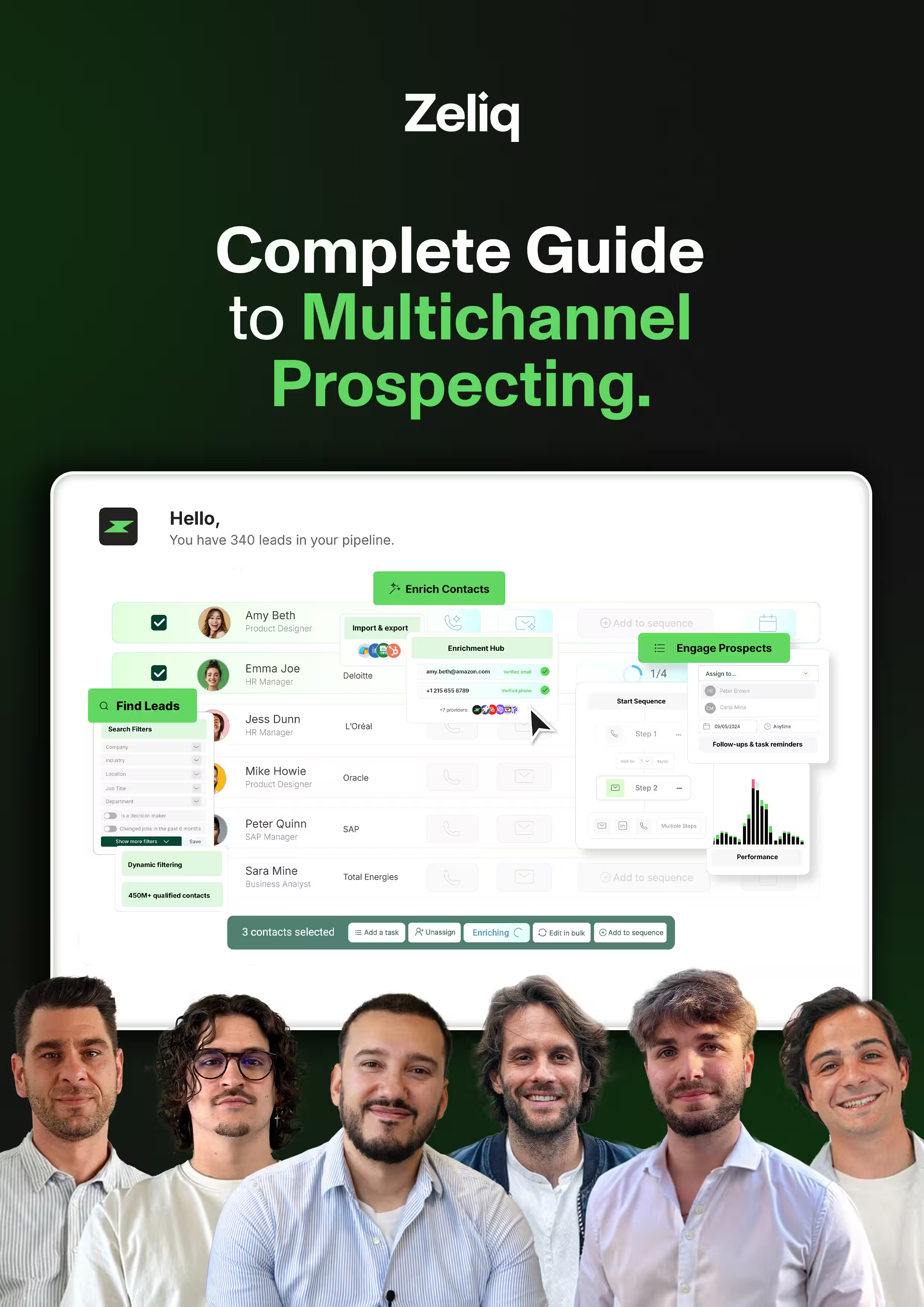
Buying B2B leads in 2026 without an integrated platform forces juggling source (file or platform), verification (email verifier), enrichment (phone, LinkedIn), compliance (DPA, opt-out) and sequencing (Outreach, Salesloft). Zeliq centralizes these five functions: 450 million verified B2B contacts, cascade enrichment, native GDPR/CCPA compliance (signed DPA, automatic opt-out, processing register), and multichannel sequences to engage your prospects immediately after acquisition. All in a single interface, no stacking four tools.
See how Zeliq centralizes purchase, enrichment, compliance and engagement
6. Worked example: 12-person SDR team
Context. A US B2B SaaS scale-up (115 employees, $8.4M ARR) structures its outbound team with 12 SDRs. Target: industrial SMBs with $5-50M revenue, machining sector, US mid-market.
Monthly needs:
- 800 enriched B2B contacts per SDR per month
- 30-day validity verification >75%
- Documented compliance (recent internal audit)
- Native Salesforce integration
- Multichannel sequences to engage contacts
Team monthly volume: 12 × 800 = 9,600 contacts/month, or 115,200/year.
Option A — One-shot file (vintage model)
- Quarterly purchase of 28,800 contacts at $0.50/contact (negotiated volume) = $14,400/quarter = $57,600/year
- External SMTP verifier cost: $0.03/contact × 115,200 = $3,456/year
- Internal compliance cost (audit + DPA + custom opt-out): $10,000/year
- No included sequencer (Salesloft at 12 × $50 × 12 = $7,200/year)
- Total annual: $78,256
- 30-day validity: ~55% on average (post-delivery degradation)
Option B — Compliance-first platform subscription (Zeliq)
- 12 Zeliq Pro seats at $99/month = $14,256/year (unlimited search + 200 credits/month included)
- Additional credits to reach 800/month/SDR: ~9,600 × 12 × $0.07 marginal = ~$8,064/year
- Multichannel sequencing included (no additional Salesloft cost)
- Native compliance (signed DPA, automatic opt-out)
- Total annual: $22,320
- 30-day validity: 84% measured
12-month synthesis:
| KPI | Option A (file) | Option B (Zeliq) | Gap |
|---|---|---|---|
| Total annual cost | $78,256 | $22,320 | −71% |
| 30-day validity | 55% | 84% | +29 pts |
| Sequencer included | No | Yes | — |
| Native compliance | No | Yes | — |
| Monthly SDR setup time | 2h | 10 min | −92% |
Conversion estimate on 9,600 contacts/month:
- Option A at 55% validity: 5,280 usable contacts → 264 meetings/month (5% meeting rate) → 50 closed-won/year (19% conversion)
- Option B at 84% validity: 8,064 usable contacts → 403 meetings/month → 76 closed-won/year
- ARR difference: 26 extra closed-won × $15,800 average ticket = +$410,800 ARR/year
Net ROI Option B vs Option A: $410,800 additional ARR for $55,936 saved on stack cost = +$466,736 net annual differential favoring platform subscription.
7. Frequently asked questions
Is buying B2B leads actually legal in 2026?
Yes, under strict conditions. EU regulators clarified in 2024 that buying B2B leads (emails and phones of people in a professional function) is lawful under legitimate interest (GDPR Article 6.1.f), provided that (1) the contacted person is in a function consistent with the offer, (2) the first email contains a clear mention of the data source and a direct opt-out, (3) the retention duration is limited (3 years maximum without active contact). Buying B2C leads (consumers) without explicit consent is prohibited under both GDPR and CCPA. “Compliance-first” platforms (Zeliq, Cognism, Dropcontact, Kaspr) provide the contractual and technical tools to respect these obligations: signable DPA, processing register, automatic opt-out. A lead supplier refusing to provide a DPA is a serious warning signal.
How much does an enriched B2B contact cost in 2026?
Unit cost depends on the purchase model and volume. On platform subscription (Zeliq, Apollo, Cognism, ZoomInfo), the average cost per verified enriched contact sits between $0.02 and $0.14. On pay-as-you-go, between $0.03 and $0.55/credit depending on platform. On vintage one-shot file, between $0.18 and $0.95/contact. Three variables drive it: (1) geographic coverage (EU often more expensive than US on some platforms), (2) enrichment depth (email + phone + LinkedIn + technographics costs more than email alone), (3) annual volume negotiated (-30 to -50% on >$100k annual commitment). The 2026 rule for a B2B sales team: target $0.06 to $0.17/verified enriched contact as the optimal ROI zone.
How do I vet a lead supplier before signing?
Five recommended steps: (1) Request a 100-contact test sample on your actual ICP. Measure bounce rate at D+30. If >25%, run. (2) Request the DPA and processing register before signing. Refusal or delay = warning. (3) Check verified reviews on G2, Capterra, TrustRadius (at least 50 reviews with score > 4.2/5). (4) Test CRM integration over 30 days. If auto-push to Salesforce or HubSpot takes more than 4 hours of setup, the time-ROI is compromised. (5) Audit geographic coverage on 50 ICP accounts you know. Calculate match rate. Below 60%, the database doesn’t cover your market.
Conclusion: 3 actions to take this week (June 2026)
Audit your current lead-buying stack by Friday. List all active tools, subscriptions and files. Calculate total annual cost and cost per verified enriched contact. Above $0.17/contact, you’re overpaying for the quality obtained.
Verify your primary supplier’s compliance before June 12. Signed DPA, processing register, automatic opt-out, documented retention policy. Without these 4 elements, you’re exposed to regulatory sanction in case of complaint.
Test a compliance-first platform over 30 days by June 18. Request a 100-ICP-contact test sample, measure D+30 bounce rate and CRM integration. If validity exceeds 75%, switching to a platform subscription typically cuts your total cost by 3× and improves conversion by 25-50%.
Buy GDPR-compliant B2B leads
Zeliq combines verified contacts, enrichment and multichannel sequences in a single platform. Account created in 2 minutes, no credit card.
Book a demoAnd if you want lead buying to move from operational cost to measurable, compliant pipeline lever, try Zeliq for free and centralize source, enrichment and engagement in a single platform.
Sources
- Forrester, “B2B Data Quality Benchmark 2025”
- Forrester, “Sales Engagement Benchmark 2025”
- McKinsey, “B2B Sales Pulse 2025”
- Gartner, “Sales Effectiveness Benchmark 2025”
- CNIL, “B2B Prospecting Guidelines”
- FTC, “CAN-SPAM Act Compliance Guide”
- California OAG, “CCPA Enforcement 2024”
- G2, “B2B Data Provider Reviews 2025”
- LeanData, “SDR Productivity Report 2025”
- Bridge Group, “SaaS Sales Tool Benchmark 2025”
Table of contents
Placeholder Title
Table of contents
Placeholder Title
Placeholder Title

.webp)