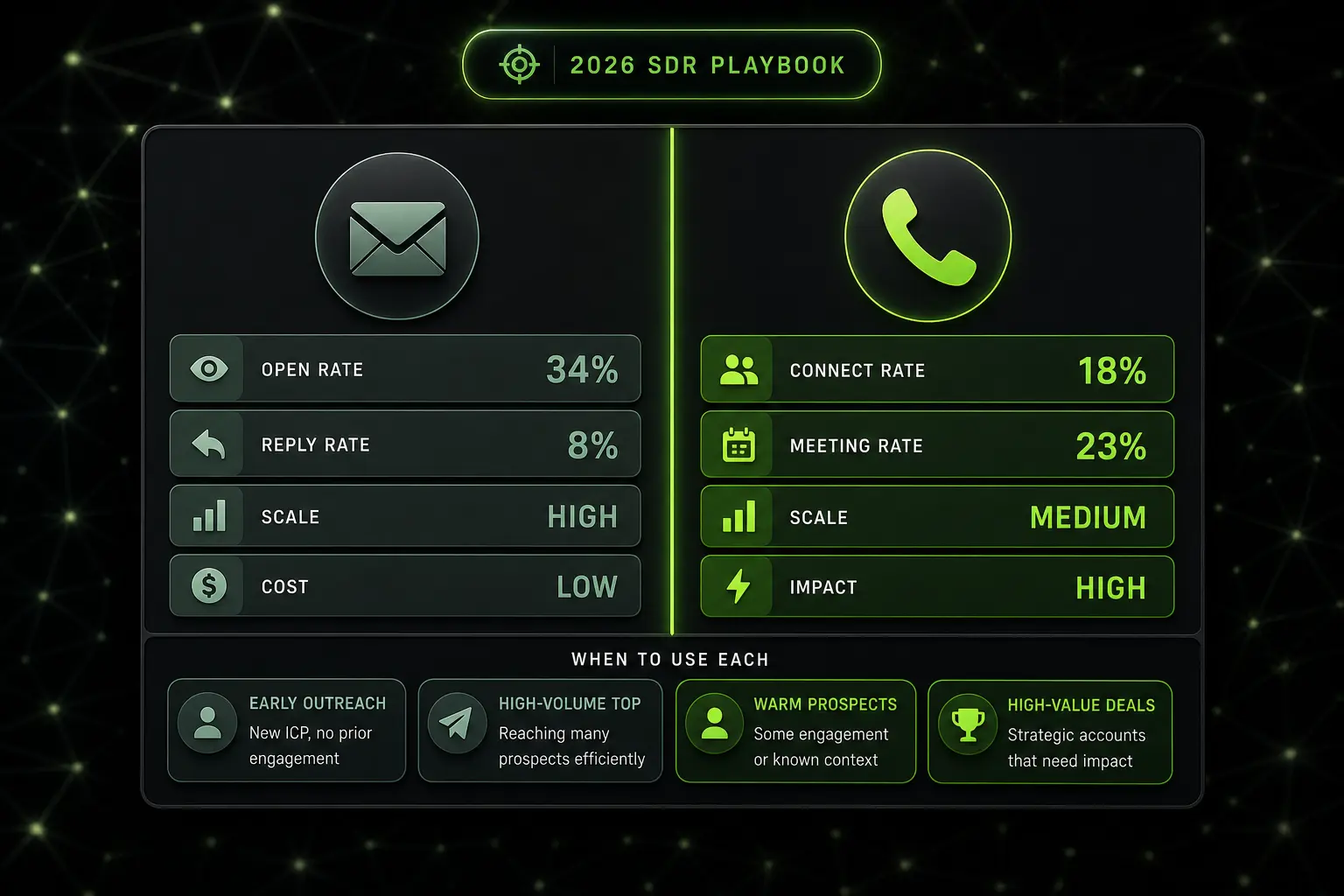

Choosing between a prospect’s email address and phone number depends on three factors: the sales cycle stage, the contact’s seniority, and where they actually engage. Email qualifies and educates at scale (5 to 15% B2B cold email reply rate per RAIN Group 2025); phone converts and accelerates decisions (C-level executives answer 3x faster to a personalized call after 2 unanswered emails, per Forrester State of B2B Sales 2025). In practice, the question is never “email or phone” but “email then phone, in what sequence”.
For SDRs, AEs, business developers, and founders running B2B outbound, this article breaks down when each channel wins, how to legally find both contact points, the multichannel cadence that maximizes booked meetings, a chiffré case study on a 5-SDR team, and 3 FAQs on the questions that decide the debate.
What you’ll learn:
- What “email or phone” really means in modern B2B outbound
- The 4 fundamental differences between the two channels
- When to lead with email (contexts, personas, cycles)
- When to lead with phone (contexts, personas, cycles)
- How to find a prospect’s email address (5 methods)
- How to find a prospect’s direct phone number (4 methods)
- The optimal email + phone multichannel sequence
- Case study: 5-person SDR team, +47% meetings booked in 90 days
- 3 FAQs (GDPR/consent, timing, which channel first)
- 3 dated actions to run this week
The gist:
- B2B cold email: 5 to 15% reply rate on average (RAIN Group 2025)
- B2B cold call: 8 to 12% connect rate, 20 to 25% meeting-on-connect rate (Salesloft Cadence Report 2025)
- 14-day multichannel sequence (email + LinkedIn + phone): +47% meetings booked vs single-channel (Salesloft)
- C-level executives: 8-9:30am calls = 3x more connects than 2-5pm windows (Gong.io 2025)
- Mid-market prospects: personalized email + LinkedIn touch = 6x more replies than isolated cold call (RevenueHero 2025)
- GDPR: professional B2B email needs no prior consent, direct phone requires it for consumers but not for business lines (CNIL 2024)
1. Email address or phone number: what’s really at stake in B2B outbound
Two channels, two logics
Professional email is an asynchronous channel: the prospect reads when they want, replies when they can, keeps a written record. It fits first contact, structured introductions, and exchanges that need attachments or detailed context. Average B2B cold email open rate in 2025 sits between 20 and 40% per Lemlist, with a reply rate between 5 and 15%.
Direct phone number (mobile or dedicated line) is a synchronous channel: conversation starts immediately, objections surface live, qualification happens in 3 minutes. It fits warm follow-ups, strategic accounts, and decision-makers who filter written inbound. Average B2B cold call connect rate sits between 8 and 12%, with a 20 to 25% meeting-on-connect rate.
Why the question actually matters
In 2026, an average SDR needs to book 8 to 12 qualified meetings per week. With email reply rates declining continuously (inbox saturation, Gmail AI filters), channel choice is now strategic: each prospect has a limited attention window, and the wrong channel first burns the opportunity for 6 months.
Finding a prospect’s email address costs 0.05 to 0.20 USD via an email finder. Finding a direct B2B phone number costs 0.50 to 2 USD and takes 3 to 10x longer. Picking the right channel first is also a cost-per-acquisition question.
2. The 4 fundamental differences between email and phone
Engagement speed
Email engages slowly: the prospect opens, reads, hesitates, forgets, re-reads. The email-sent → average-reply cycle runs 2 to 5 business days per HubSpot. Phone engages immediately: either you talk to the prospect in 30 seconds, or you leave a voicemail and reclaim the follow-up.
That difference decides everything when you have a warm signal (site visit, download, campaign reply): phone converts these signals in 24 hours, email lets them die.
Cognitive load on the prospect
A well-written email demands 30 seconds of reading and 2 minutes of response. A cold call demands 3 to 10 minutes of active conversation and an immediate decision (book, decline, defer). Cognitive load is heavier on phone, which explains why prospects filter calls more aggressively than emails.
For first contact with a senior decision-maker, personalized email respects their time and starts the relationship on adult terms. For warm contact already familiar with your brand, phone accelerates the decision without overloading them cognitively.
Written trail and CRM sync
Email leaves an actionable trail: subject, content, timing, reply. That trail auto-syncs with the CRM, feeds lead scoring, and serves as memory for future follow-ups. A multichannel sequences tool like Zeliq centralizes these trails without manual effort.
Phone leaves a partial trail: post-call notes, connect status, optionally call recording (with consent). CRM quality entirely depends on the SDR’s discipline to log the exchange within the following 5 minutes.
Cost per attempted contact
A personalized email costs 0.10 to 0.50 USD per send (enriched data + sending tool + SDR time). A qualified cold call costs 3 to 8 USD (direct number + SDR time + optionally dialer). Phone is thus 10 to 30x more expensive per attempt, but its connect-conversion rate is also 3 to 5x higher than email reply rate.
Economically, email scales better on broad lists (1,000+ contacts), phone pays back on targeted accounts (50 to 200 priority contacts).
3. When to lead with email
First contact with a cold prospect
On a prospect who doesn’t know your brand, offer, or name, email is the default channel. It lets you:
- Introduce yourself in 3 sentences without pressuring the prospect
- Offer credible context (contact source, trigger signal, reference)
- Propose measurable value in 1 line
- Let the prospect respond on their timeline
A cold call as first touch on a cold prospect books a meeting in 1 to 3% of cases on average. A well-structured personalized email hits 3 to 8% meeting-booked directly, 2 to 4x more effective for this use case.
Senior seniority (C-level, VP, Head of)
C-level and VP decision-makers process 100 to 300 emails per day. A short, precise, relevant email can book a meeting in 48 hours. The same profile filters calls aggressively through an assistant or switchboard, making cold call inefficient as first contact.
For these personas, the rule is: personalized email to open the door, LinkedIn to stay in radar, phone only if a warm signal (partial reply, repeated open) justifies it.
Complex topic requiring written context
Some B2B topics (audit, benchmark, comparative data, detailed case study) need written support the prospect can review internally, forward to a colleague, or re-read at leisure. Email with a light attachment (1 slide max, PDF < 2 MB) then serves as pre-sales material that ripens the prospect between two touches.
Phone in this context forces an immature decision that translates into a “I’ll call you back” that never happens.
Scaled outbound on broad lists
To scale outbound to 500 to 2,000 contacts per SDR per month, email is the only economically viable channel. An SDR can send 100 to 150 personalized emails per day, versus 40 to 60 calls at a 10% connect rate (4 to 6 real conversations per day).
Email covers 3 to 5x more volume at 10x lower cost, making it the foundation channel for building a predictable pipeline.
4. When to lead with phone
Follow-up on a warm signal
A prospect who opened your email 4 times in 48 hours, clicked your demo link, or downloaded your whitepaper is in active consideration mode. A call within 24 hours of that signal has a 2 to 3x higher connect rate than a classic cold call, and a 40 to 55% meeting-on-connect rate per Gong.io.
That opportunity window lasts 48 to 72 hours max. Waiting to send a follow-up email misses it: the signal cools and the prospect moves on.
Strategic accounts (mid-market, enterprise)
For high-ACV accounts (25K to 500K EUR ARR), cold call investment justifies economically. An SDR can spend 30 to 60 minutes preparing each call: researching account context, identifying the right decision-maker, preparing a pitch tailored to the prospect’s business topic.
On these accounts, the multichannel contact sequence often opens with a context-setting email, followed 3 days later by a call structured around that email content. The prospect has recognized your name when you call, tripling the connect rate.
End of cycle: closing or unblocking
Once a prospect has attended a demo, spoken with an AE, and received a commercial proposal, phone becomes the primary channel again. At this stage, email documents (recap send, finalized proposal) but decisions get made on calls.
A stalled sales cycle (silence post-proposal, decision-maker change, unresolved objection) unblocks 5x faster on phone than by stringing together follow-up emails.
Mobile and field prospects (construction, retail, industry)
Some prospects spend 60 to 80% of their time out of the office: site managers, store directors, logistics heads, field sales reps. Their inbox fills without them processing it, but they take work calls on their mobile line.
For these personas, phone is the primary channel, email complements to send documentation after a successful first call.
Zeliq and the email-or-phone question
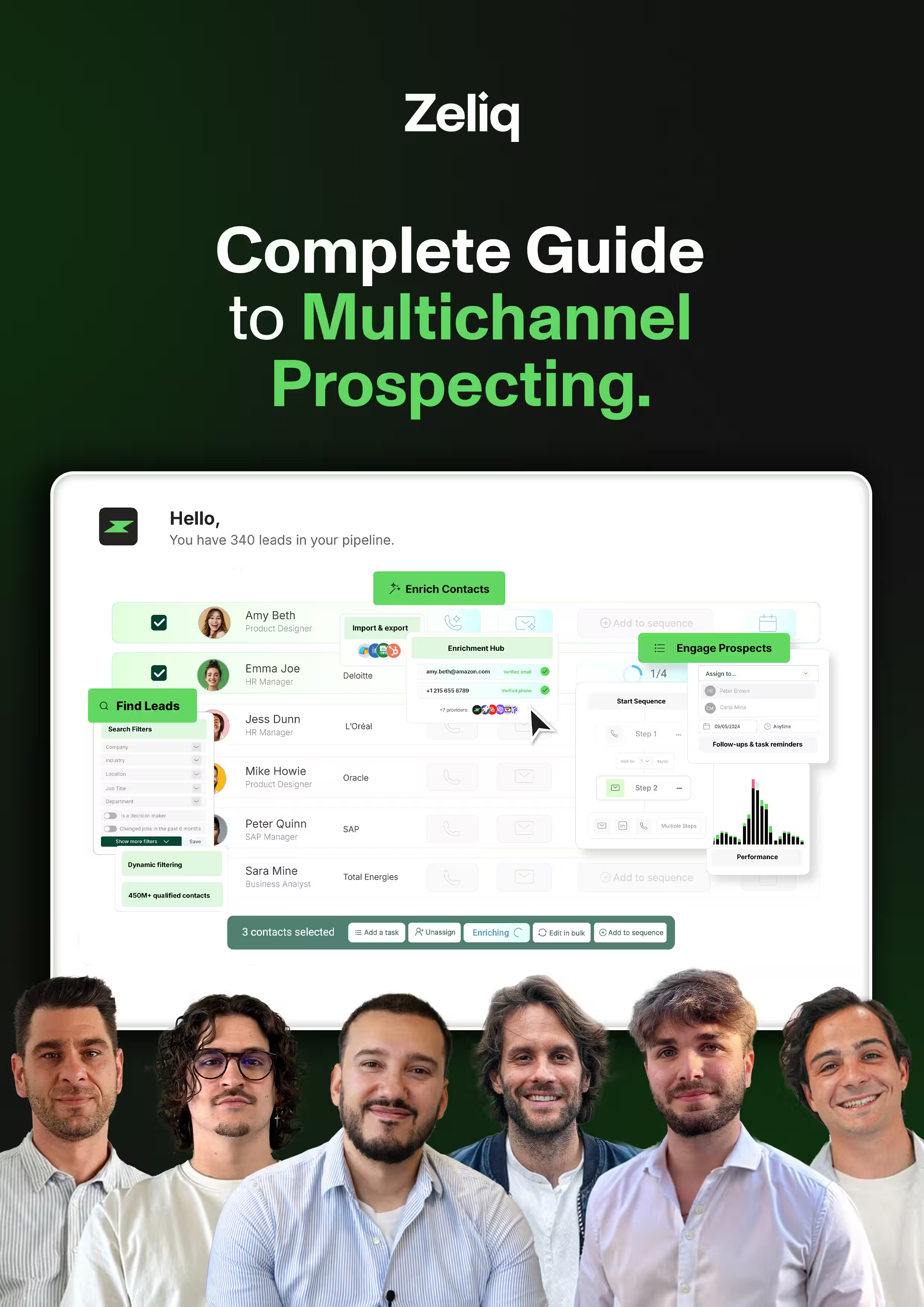
The real lever isn’t choosing between email and phone, it’s having both verified contact points and knowing what order to activate them. Zeliq combines a 450 million B2B contacts database with a waterfall enrichment that delivers 80% valid emails and 60% direct phone numbers (mobile + business line). You then build your multichannel email + LinkedIn + call sequence in 2 minutes, and the CRM syncs itself.
5. How to find a prospect’s email address
Method 1: the company website
“About”, “Team”, “Contact”, and “Legal” pages often list nominative emails. This manual method takes 3 to 5 minutes per prospect but yields 15 to 25% success on SMBs, close to 0% on enterprises that lock public contacts.
Method 2: public documents (PDFs, press releases, job posts)
A Google search like "first last" "@domain.com" filetype:pdf often surfaces the address in a press release, annual report, or job posting. Effective on executives and HR, less on operators.
Method 3: pattern deduction
Once 1 or 2 public emails are identified in the company, the pattern reveals itself: first.last@, f.last@, first@. Combined with SMTP verification, this method delivers 70 to 85% reliability.
Method 4: advanced Google operators
Queries like site:linkedin.com/in "first last" "company" combined with email searches on bios sometimes surface addresses publicly shared by the prospect. Low volume but high quality.
Method 5: professional email finders
A tool like Zeliq enriches a LinkedIn profile or CSV in 2 clicks with 80% coverage and built-in SMTP verification. It’s the most cost-effective method to scale outbound beyond 100 contacts per week.
6. How to find a prospect’s direct phone number
Method 1: LinkedIn and email signatures
Some professionals publish their direct number on LinkedIn (“Contact info” section) or in their email signature. Low volume (5 to 10% of profiles) but maximum reliability.
Method 2: switchboards
A call to the company switchboard with the line “I’m trying to reach [first last] on a [relevant topic]” leads in 30 to 50% of cases to a direct connect or an assistant’s number. This method remains effective on SMBs.
Method 3: enriched B2B databases
Data providers like Zeliq, Kaspr, or Lusha offer verified direct numbers with 40 to 70% coverage depending on geography and function. Average cost 0.50 to 2 USD per validated number.
Method 4: API waterfall
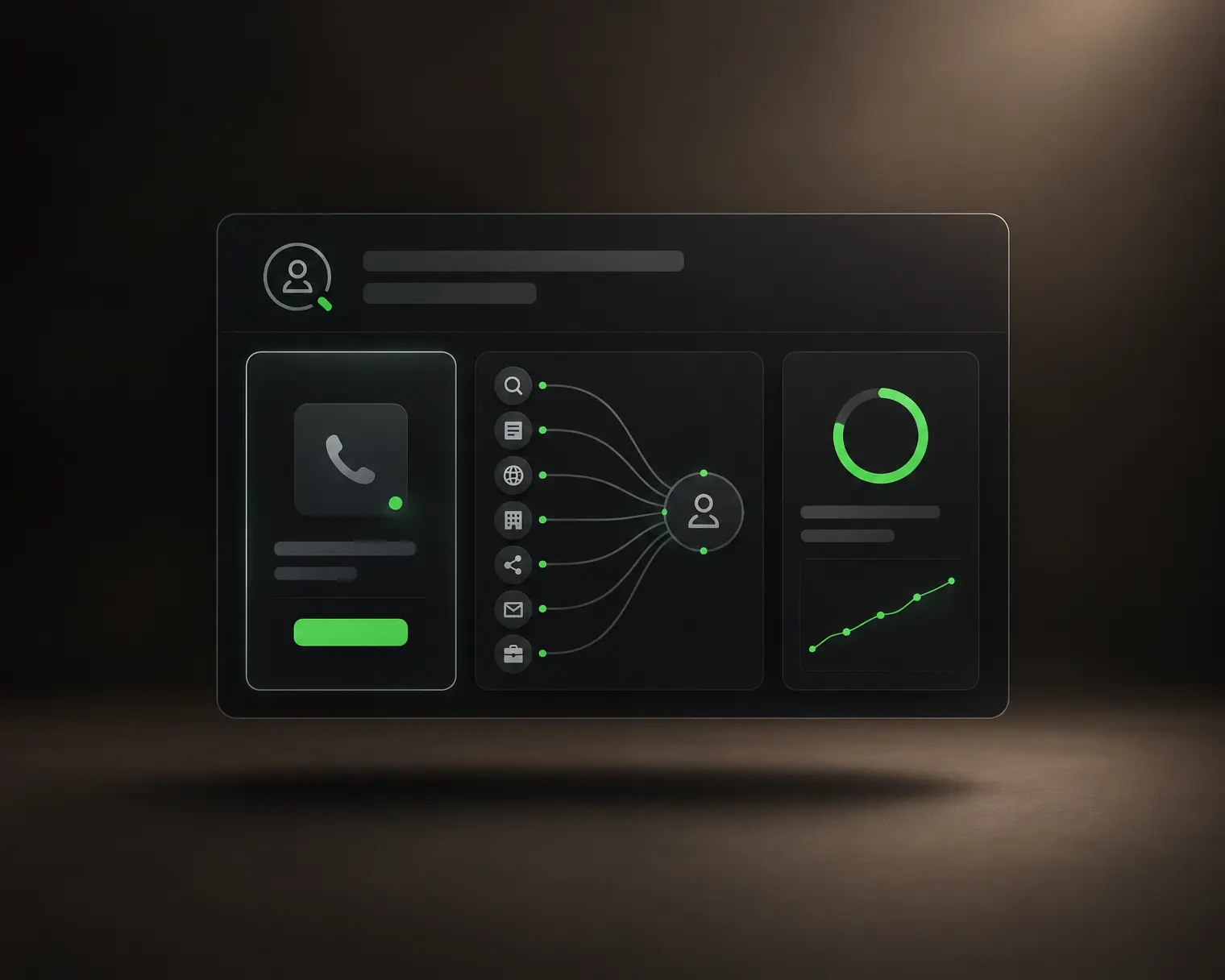
A waterfall enrichment tool queries 5 to 40 providers in cascade to maximize coverage. On mature European markets (France, UK, Germany), a well-configured waterfall hits 60% phone coverage on sales functions and 45% on technical and finance functions.
7. The optimal email + phone multichannel sequence
The J0 → J14 pattern that performs
On 8.2 million B2B emails tracked by Lemlist in 2025, the sequence that maximizes meeting-book rate combines 4 channels over 14 days:
| Day | Channel | Action | Objective |
|---|---|---|---|
| D0 | Personalized cold email | Open the relationship, set context | |
| D0 | Invite with short message | Face / brand recognition | |
| D3 | Follow-up with different angle | Remind without repeating | |
| D7 | Phone | Structured 5-8 min call | Book meeting or clear rejection |
| D10 | Message with useful resource | Nurturing without pressure | |
| D14 | Clean break-up email | Close the loop |
This cadence delivers 12 to 18% average meeting-book rate on well-targeted lists, versus 4 to 7% for an email-only sequence.
The coherent multichannel rule
Each touch must bring a new angle, not repeat the previous message. D3 email reminds the topic but reframes the question. D7 call references the D0 email (“I wrote to you Monday about…”). D10 LinkedIn message shares a relevant resource, not a new ask.
That coherence turns the sequence into discreet presence rather than harassment. Prospects perceive a structured professional approach, not a spam machine.
Smart automation
A well-orchestrated multichannel sequence auto-pauses on first reply (positive or negative), routes the prospect to the right AE, and updates the CRM. Without automation, an SDR loses 30 to 45 minutes per day manually managing statuses, eating into active outbound time.
8. Case study: 5-person SDR team, +47% meetings booked in 90 days
Context (January 2026): French B2B SaaS scale-up, 45 employees, 4.2M EUR ARR, 5 SDRs. Target: 8 qualified meetings per SDR per week, 160 meetings/month for the team.
VP Sales diagnosis:
- Current volume: 4 meetings/SDR/week, 80 meetings/month (50% of target)
- 100% of SDRs run email-only outbound
- Cold email average reply rate: 6%
- Zero outbound calls in 8 months (team unclear on channel)
Corrective actions over 90 days:
- Waterfall enrichment on 2,400 priority contacts (email coverage 82%, phone coverage 61%)
- 6-hour cold call training for the 5 SDRs (call structure, objection handling, meeting close)
- D0-D14 multichannel sequence deployed on 100% of new outbound
- 8-9:30am and 5-6:30pm blocked slots for phone calls
Measured results at 90 days (April 2026):
| KPI | Before (Jan) | After (Apr) | Delta |
|---|---|---|---|
| Email reply rate | 6% | 11% | +83% |
| Phone connect rate | 0% (not practiced) | 12% | new channel |
| Meetings-on-connect | 0% | 26% | new channel |
| Meetings / SDR / week | 4 | 8 | +100% |
| Team meetings / month | 80 | 160 | +100% |
| Cost per qualified meeting | 148 EUR | 76 EUR | −49% |
90-day ROI: tool + training investment ~9K EUR, additional meetings value (80 extra meetings/month × 3 months × 1,100 EUR average value) = 264K EUR additional pipeline. ROI 8.3x.
9. Frequently asked questions
Which channel to lead with in first contact: email or phone?
Email in 80% of cases. First-touch cold email respects prospect time, allows scaled targeting, and leaves an actionable trail. First-touch cold call has a 1 to 3% average meeting-book rate, versus 3 to 8% for a well-structured personalized email (Lemlist Cold Email Benchmark 2025). Reserve first-touch phone for strategic accounts (ACV > 50K USD) with an identified warm signal (funding round, mass hiring, product launch), or for mobile personas (construction, retail, field) who barely process their inbox.
Can I call a professional B2B number without GDPR consent?
Yes for professional direct numbers, under 3 conditions: legitimate purpose (B2B outbound relevant to the contact’s business), easy opt-out (call-end or opt-out link in the follow-up email), documented processing trail. The French CNIL confirmed in 2024 that B2B phone outbound requires no prior consent, unlike B2C outbound. Note: do-not-call lists (Bloctel in France) must be respected, but they cover consumers, not B2B business lines.
What’s the best time to call a B2B decision-maker?
8-9:30am and 5-6:30pm, Tuesday through Thursday. Gong.io analyzed 340,000 outbound calls in 2025: the 8-9:30am window generates 3x more connects than the 2-5pm window, because decision-makers arrive at the office, check their calendar, and are more available before meetings. The 5-6:30pm window works too because meetings are done and the decision-maker closes their day. Avoid Monday (post-weekend overload) and Friday after 3pm (weekend transition). Tuesday morning remains the best statistical window.
10. Conclusion: 3 actions to run this week (June 2026)
Audit your database’s phone coverage by Friday. If less than 40% of your priority prospects have an enriched direct number, you’re losing 50% of your conversion potential. Prioritize the 100 strategic accounts and enrich their numbers by Monday.
Deploy a D0-D14 multichannel sequence by June 12. D0 email + D0 LinkedIn, D3 email, D7 call, D10 LinkedIn, D14 break-up. This cadence performs 2 to 3x better than email-only on the same prospects.
Block 2 daily calling slots on each SDR’s calendar by June 20. 8-9:30am and 5-6:30pm. These 3 hours/day dedicated to phone will double your meeting-book rate on strategic accounts.
Enrich emails and phones in 1 click
Zeliq combines 450 million B2B contacts, email and phone waterfall enrichment, and multichannel sequences in one platform. Account set up in 2 minutes, no credit card.
Try for freeAnd if you want to turn the “email or phone” choice into a measured multichannel outbound system, try Zeliq for free: 450 million B2B contacts database, email and phone waterfall enrichment, and multichannel sequences in a single interface, no credit card.
Further reading
Table of contents
Placeholder Title
Table of contents
Placeholder Title
Placeholder Title