
A B2B email list loses between 22 and 30% of its value every year, with no action on your part. Contacts change roles, switch companies, close accounts, update their preferences. A list of 10,000 contacts assembled in January is worth only 7,500 usable contacts by December, even if you send nothing. It is the least-discussed invariant of the craft: with no active maintenance, a list self-destructs.
And the problem does not stop there. Since February 2024, Gmail and Yahoo refuse senders >5,000/day that have not properly configured SPF, DKIM and DMARC. Apple Mail Privacy Protection has made open rate nearly unusable as a quality metric. The GDPR and CAN-SPAM require a lawful basis, recipient disclosure, and an opt-out mechanism. Building and maintaining a B2B email list in 2026 is no longer just collection work: it is data engineering, compliance, and continuous hygiene.
This guide explains how to build a quality B2B email list, how to segment it to multiply click-through rates, how to keep it clean over time, how to comply with European and US legal frameworks, and how to measure the ROI of a list hygiene effort.
What you’ll find:
- What a B2B email list is and the distinction from a consumer distribution list
- The sources for building a qualified list
- Segmentation: firmographic, technographic, intent and lifecycle
- Verification and hygiene: tools, frequency and cost
- The legal framework: GDPR, CAN-SPAM, CASL, PECR
- The worked example: unverified list vs clean, segmented list
What is a B2B email list
A B2B email list is a structured set of professional email addresses used to address a message to a group of qualified contacts. It differs from a simple B2C distribution list on three counts:
- The email address is professional (tied to a company domain, not a gmail.com or yahoo.com mailbox)
- The contact is identified in context (company, role, sector)
- The use is framed: commercial prospecting, industry newsletter, customer communication, events
The most important nuance is the difference between a subscriber list (who voluntarily opted in to your communications) and a prospecting list (contacts you target without their prior knowledge, on the legitimate-interest basis in B2B).
| Criterion | Subscriber list | B2B prospecting list |
|---|---|---|
| Origin | Voluntary opt-in (form, download) | ICP definition, data purchase or enrichment |
| Recipient expectation | Expects your communication | Does not expect you |
| GDPR lawful basis | Explicit consent | Legitimate interest + disclosure + opt-out |
| Typical volume | Several thousand to several hundred thousand | A few hundred to a few tens of thousands per segment |
| Average open rate | 25-40% | 30-55% (without MPP, biased with it) |
| GDPR risk | Low if opt-in is traced | Medium, requires rigor |
The two families follow distinct rules and should not be mixed. Sending a newsletter written for subscribers to a cold prospecting list guarantees spam complaints and a drop in deliverability.
The structural decay of a B2B list: 22-30% per year
The most decisive figure to integrate into any email list strategy is the annual decay rate. Multiple marketing studies published over the past decade converge on a 22 to 30% per year range. Concretely:
- ~10% of professionals change roles or companies each year (LinkedIn Workforce Confidence data)
- ~5-8% change email address within the same company (domain refresh, merger, format change)
- ~3-5% have their account deactivated (departure, restructuring)
- ~5% add stricter spam protection or request unsubscription
On a 10,000-contact list, that means 2,250 to 3,000 addresses becoming unusable or obsolete over 12 months. With no action, your list loses a quarter of its value every year. With annual verification, you limit the loss to 5-10%. With quarterly verification, decay becomes marginal.
That is also why buying a B2B list is rarely a good idea: beyond compliance questions, list quality degrades from the first month after delivery.
The sources for building a qualified email list
A qualified B2B list is built from four main families of sources, to combine depending on your target.
1. Defining the ICP (Ideal Customer Profile)
Before any collection, the work starts with the precise definition of your Ideal Customer Profile. Without a clear ICP, you build a vague list that does not convert. The ICP combines:
- Firmographic criteria: industry (NAICS, SIC code), size (headcount, revenue), geography, legal structure
- Technographic criteria: technology stack used (CRM, marketing automation, ERP, industry tools)
- Behavioral criteria: intent signals (active hiring, funding round, product launch, site visits)
- Human criteria: decision-maker role, seniority, team (IT, Marketing, Sales, etc.)
A well-defined ICP is the difference between a list of 10,000 vague contacts and 2,000 contacts that truly match your solution.
2. B2B data providers
B2B data provider tools aggregate hundreds of millions of professional contacts and let you filter by your ICP. Market leaders:
| Tool | Coverage | Indicative price | Notable point |
|---|---|---|---|
| ZoomInfo | ~150M B2B contacts | $15,000-50,000/year | Enterprise reference, deep in the US |
| Apollo.io | ~275M contacts | $49-119/user/month | Good price-quality, intent included |
| Cognism | ~70M contacts | Custom quote | Strong EMEA coverage, GDPR-compliant |
| Lusha | ~150M contacts | $36-89/user/month | Chrome extension, freemium |
| RocketReach | ~700M profiles | $48-249/month | Multi-source cross-reference |
| Zeliq | ~450M contacts | Quote | Waterfall enrichment 40+ providers |
These tools let you build a targeted B2B list at scale, provided you filter seriously and verify addresses on output.
3. Enriching existing leads
You already have a list of accounts or contacts, but it is incomplete? Enrichment consists of automatically completing missing information (email, phone, role, company size) by cross-referencing with third-party databases. Standard tools: Clearbit, Hunter, Lusha, Apollo Enrich, Zeliq.
Waterfall enrichment queries several providers in sequence to maximize coverage: if provider A does not have the email, you query B, then C, until an acceptable match rate. This approach maximizes coverage on less-known targets (specialized SMBs, niche markets).
4. Opt-in collection through marketing
To build a subscriber list (not prospecting), opt-in sources remain the most durable value:
- Lead magnets: PDF guides, studies, downloadable templates in exchange for an email
- Webinars: registration against email, extremely qualified audience
- Industry newsletters: if you are a relevant content publisher
- Events: trade show badges (with explicit opt-in), conferences, workshops
- Contact forms: pricing pages, contact, demo request
This list is worth more than any purchase or output-side enrichment, because the contacts expect your messages.
Build a reliable, compliant B2B list
Zeliq combines 450M+ professional contacts with waterfall enrichment and a sending infrastructure built for deliverability. Explore the B2B lead database.
Segmentation: firmographic, technographic, intent, lifecycle
A single unsegmented list sends the same message to everyone and no one feels concerned. Segmentation breaks the list into homogeneous subsets to deliver a relevant message to each.
Documented benchmarks on segmented vs unsegmented campaigns:
- +14 to +20% open rate on segmented lists
- +60 to +100% click rate (the biggest gap)
- +50% conversion rate on landing pages
The four most effective segmentation axes in B2B:
Firmographic segmentation
Splits by company characteristics: industry, size (headcount or revenue), geography, structure (SMB, mid-market, enterprise). It is the simplest and most widely used split. A CFO of a 50-person SMB and a CFO of a 5,000-person enterprise do not share the same stakes. Writing them the same misses both.
Technographic segmentation
Splits by technology stack used by the company. A tool integrated with HubSpot speaks differently to a Salesforce prospect than to a HubSpot prospect. Technographic data providers (BuiltWith, Datanyze, HG Insights, Bombora) automatically identify the tools used by each company. It is the most powerful axis for SaaS publishers.
Intent segmentation
Splits by behavioral signals: repeat site visits, content downloads, active hiring on related roles, recent funding, press mention. An account with an intent signal converts 3 to 5 times better than a cold-targeted account. Tools: 6sense, Demandbase, Bombora, Apollo, Zeliq integrations.
Lifecycle stage segmentation
Splits by buying-cycle stage: cold prospect, engaged lead, open opportunity, active customer, former customer. Each stage calls for a radically different message. A cold prospect gets an opening message; an active customer gets an upsell or a product newsletter.
The combination of the four axes (e.g., a CFO at a US mid-market 100-500-employee company using Salesforce that just raised a Series A) produces very precise segments with conversion rates that can reach 10-15% on small volumes.
Verification and hygiene: practice and tools
Without verification, a list produces bounces. And bounces, above 5%, trigger Gmail and Yahoo spam filters, degrade your Sender Score, and send you to spam even for valid contacts. Verification is not an optional step: it is a mandatory prerequisite to any volume send.
Verification tools
| Tool | Indicative price | Notable point |
|---|---|---|
| NeverBounce | $0.003-0.008/email | US reference, many CRM integrations |
| ZeroBounce | $0.004-0.008/email | Fast API, detailed scoring |
| Kickbox | $0.01/email | Good support, certified |
| Hunter Verifier | $0.005-0.01/email | Integrated with other Hunter functions |
| Bouncer | $0.003-0.007/email | More volume-oriented |
| Emailable | $0.007-0.008/email | Simple UX |
| Mailgun Email Validations | From $0.008/email | Integrated with Mailgun infra |
For 10,000 emails to verify, expect $30-80, a negligible cost compared to the cost of deliverability damage from bounces.
Verification frequency
- Before any volume send on a list not touched in over 30 days
- Quarterly on active lists, to identify new unsubscribes and deactivated mailboxes
- Annually on low-use lists (dormant customers, old prospects)
Hygiene indicators to monitor
- Bounce rate: target <2%, alert above 3%, stop above 5%
- Spam complaint rate: target <0.1%, alert above 0.3%
- Unsubscribe rate: target <0.5%, alert above 1%
- Sender Score (Validity): target >80, alert below 70
The 2026 legal framework: GDPR, CAN-SPAM, CASL, PECR
Building and using a B2B email list requires respecting several regulatory frameworks depending on recipient geography.
GDPR (EU) and B2B legitimate interest
The GDPR applies the moment an email address identifies a person, including in a B2B context. For B2B commercial prospecting, the usual lawful basis is legitimate interest, under three conditions:
- Relevance: the contact is targeted in their professional role, not as an individual
- Disclosure: the person is informed of the use of their data from the first contact
- Right to object: an unsubscribe or objection mechanism is offered and honored without delay
The French CNIL and equivalent European authorities (ICO in the UK, AEPD in Spain, etc.) actively enforce. Sanctions can reach 4% of global revenue or 20 million euros (whichever is higher).
CAN-SPAM Act (United States)
The CAN-SPAM Act applies to commercial emails sent to US recipients. It requires:
- Clear sender identification (address, name)
- Non-misleading subject (content must match)
- Physical postal address in the email footer
- Operational opt-out mechanism within 10 days
Fines can reach $51,744 per non-compliant email (FTC 2024 update). Many European senders ignore that CAN-SPAM applies the moment they contact a US recipient.
CASL (Canada) and PECR (United Kingdom)
CASL (Canada) is one of the strictest commercial-email laws in the world: it requires documented explicit or implied opt-in, and fines can reach 10 million Canadian dollars per infraction.
PECR (UK) complements UK GDPR for electronic communications, with specific rules on marketing emails and the Telephone Preference Service.
Compliance best practices
- Document the source of each contact in your CRM (origin, date, lawful basis)
- Immediately honor any unsubscribe or objection request
- Systematically include an unsubscribe link and a physical sender address
- Audit quarterly your list to identify unsubscribing or inactive contacts
- Document the DPIA (Data Protection Impact Assessment) if you process more than a few thousand contacts
Worked example: ROI of a list hygiene effort
A US B2B mid-market company has a list of 20,000 contacts that is 18 months old, with no verification or segmentation. It considers a clean-up effort.
Cost of the audit and hygiene
- List verification (NeverBounce, 20,000 emails at $0.005): ~$100
- Segmentation and CRM tool (HubSpot Marketing Hub, 3 months): ~$1,800
- Marketing/Sales Ops internal time (1 day × 4 weeks × $700/day): $2,800
- External consultant for ICP and segmentation framing (2 days): $3,000
- Total: ~$7,700
Measurable before/after results
| Metric | Before audit | After audit |
|---|---|---|
| Effective list size | 20,000 | 14,000 (30% removed: bounces, duplicates, unsubscribes) |
| Bounce rate | 8% | 1.5% |
| Open rate | 18% | 32% (+78% thanks to segmentation) |
| Click rate | 1.2% | 2.8% (+133%) |
| Sequence reply rate | 1.5% | 4.2% |
Business impact over 12 months
- Qualified reply volume before: 14,000 × 12 sends × 1.5% = 2,520
- Volume after: 14,000 × 12 sends × 4.2% = 7,056
- Additional replies: 4,536
- Reply → meeting conversion: 30% = 1,360 additional meetings
- Meeting → customer conversion: 10% = 136 additional customers
- Average ACV: $7,000 = $952,000 in additional revenue
Net ROI: $952,000 - $7,700 = $944,300, a 122x ROI over 12 months.
These numbers depend obviously on your market and sales cycle, but the order of magnitude is documented recurringly: list hygiene and segmentation produce multiplicative effects on send performance, because they touch every indicator at once (deliverability, open, click, conversion).
The mistakes that destroy a list
Five mistakes come up constantly and durably damage a list.
1. Buying a list without verification. Purchased lists often contain 20 to 40% obsolete addresses. Sending to them leads straight to domain blacklisting.
2. Confusing subscriber list and prospecting list. Sending a newsletter to contacts who did not opt in triggers massive spam complaints and damages deliverability for 6 to 12 months.
3. Ignoring decay. A list assembled 2 years ago contains 40-50% addresses now useless. Without periodic cleanup, you pay the send cost without benefit.
4. Over-mailing the list. Sending more than 2 times per week in B2B degrades engagement and increases unsubscribes. Prefer 1 to 2 targeted, relevant sends.
5. Not honoring unsubscribes. Beyond legal risk, not promptly honoring an unsubscribe generates spam complaints very costly for sender reputation.
How Zeliq builds and maintains your B2B lists
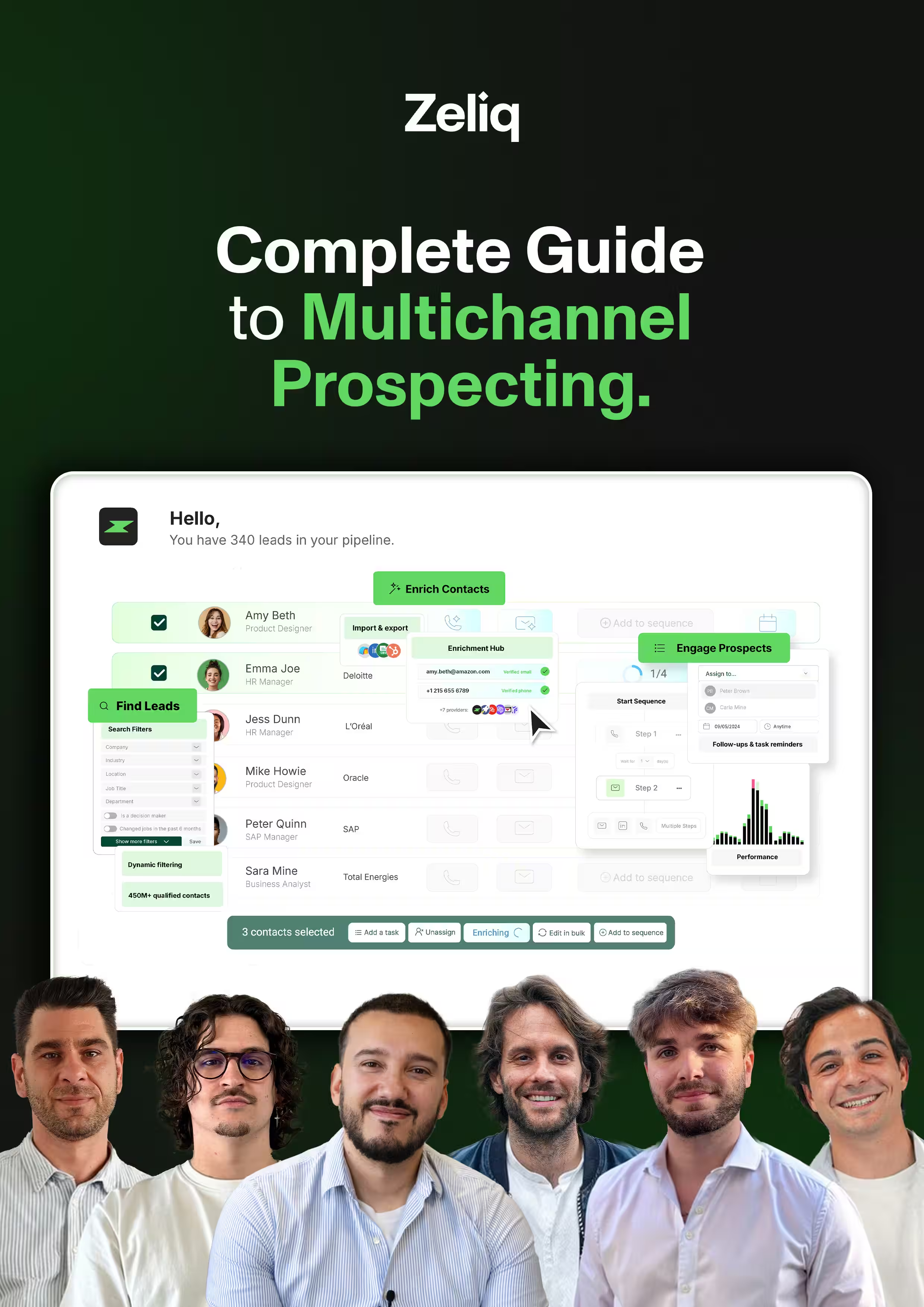
Zeliq covers the full lifecycle of a B2B email list. The platform starts from a database of more than 450 million professional contacts that you filter by your ICP criteria (firmographic, technographic, intent), retrieves contact details through waterfall enrichment querying more than 40 data providers, verifies addresses before any send, and orchestrates multichannel sequences (email + LinkedIn) with open, click and reply tracking. For a Business Developer or a Marketing Ops, that is the elimination of the “patchwork of tools” (database + enrichment + verification + sending) in a single platform, with sender score preserved. See also our guide on B2B data enrichment and multichannel prospecting.
Targeted, verified, compliant B2B lists
Zeliq builds your lists from 450M+ contacts, with built-in enrichment and verification. Account created in 2 minutes, no credit card.
Try for freeHow long does a B2B email list stay valid?
A B2B email list loses between 22 and 30% of its value per year without active maintenance, due to professional turnover (~10% of contacts change roles annually), corporate domain changes (~5-8%), deactivations (~3-5%) and unsubscribes (~5%). With quarterly verification and inactive cleanup, this decay can stay below 10%. That is why buying a list without a maintenance plan is rarely profitable: it starts degrading the day it is delivered.
What is the best B2B email verification tool?
The 2026 market references are NeverBounce ($0.003-0.008/email), ZeroBounce ($0.004-0.008), Kickbox ($0.01) and Hunter Verifier ($0.005-0.01). For occasional use on a few thousand addresses, these tools are equivalent in quality; for high volume, NeverBounce and Bouncer offer the most competitive prices. Integrated prospecting platforms (Apollo, Zeliq, Cognism) often include their own verification layer, avoiding the need for a separate tool.
Is a purchased email list GDPR-compliant?
It strictly depends on how the list was built. A list purchased from a serious provider that built its database on documented legitimate interest (Cognism, ZoomInfo, Apollo in most cases) is legal in B2B, provided you inform recipients of the use of their data from the first contact and immediately honor objection requests. A list bought from an unverified broker with no traceable origin exposes to CNIL sanctions reaching 4% of global revenue. The pragmatic rule: systematically require your provider to document the lawful basis and origin of the data.
Zeliq and compliant B2B mailing lists
Building a GDPR-compliant B2B mailing list requires a verified source and a documented opt-out mechanism. Zeliq combines 450 million verified B2B contacts, native GDPR compliance (DPA, automatic opt-out) and multichannel sequences in a single platform. Your lists stay legal while volumes scale.
Conclusion: three actions for a high-performing email list this week
A B2B email list is a living asset that demands hygiene, segmentation and compliance. Three concrete actions.
- Verify your current list: run it through NeverBounce or equivalent to identify obsolete addresses. On a list older than 6 months, expect 15-25% addresses to remove.
- Segment on at least 2 axes: firmographic (size + sector) at minimum, ideally crossed with a technographic or intent axis. Segmentation alone often doubles the click rate.
- Document the lawful basis of each contact source in your CRM. It is legal protection and a discipline that forces rigor in list building.
To drive everything (building + enrichment + verification + sending) in a single platform, see Zeliq pricing.
And if you want to build GDPR-compliant verified B2B mailing lists at scale, try Zeliq for free and access 450 million enriched contacts from day one.