
LinkedIn brings together nearly 1 billion professional profiles worldwide, including about 210 million in the United States in 2026. For a B2B salesperson, it is the most exhaustive database ever assembled. Yet, the moment it comes to getting the direct phone number of a prospect identified on LinkedIn, nearly every SDR runs into the same wall: the number is almost never displayed.
The cause is statistical. According to several converging studies on B2B databases, fewer than 5% of LinkedIn members list their phone number in their profile, and the vast majority of those who do only make it visible to first-degree connections. Counting on LinkedIn as a direct source of numbers is a dead end. You need a method.
This guide explains how to get a prospect’s phone number from their LinkedIn profile in 2026: what the platform allows and what it prohibits (scraping in particular), the available enrichment tools, their real coverage rate, the GDPR and TCPA legal framework, and a worked example on the impact of a verified direct number vs a company switchboard in a cold-call effort.
What you’ll find:
- Why the phone number is so rare on LinkedIn
- What LinkedIn allows and prohibits (scraping)
- The clean method: LinkedIn as entry point + enrichment
- Tools comparison and real coverage rates
- The legal framework: GDPR, TCPA, DNC Registry
- The worked example: direct number vs switchboard on 1,000 calls
Key takeaways
- Fewer than 5% of LinkedIn members list their phone number in their profile, and visibility is often restricted to first-degree connections.
- LinkedIn explicitly prohibits data scraping, including for phone number retrieval, on pain of account restriction or deletion.
- The clean method: use LinkedIn as a prospect identification point, then enrich with a B2B tool that queries legitimate sources.
- The verified direct mobile number coverage rate of the main enrichment tools sits between 30 and 60% depending on target and provider.
- On 1,000 cold calls, moving from a switchboard list to verified direct mobile numbers doubles connect rate (from 8-12% to 18-22%) and triples meetings booked.
Why the phone number is so rare on LinkedIn
Several factors converge to explain phone-number scarcity on LinkedIn in 2026.
Platform culture. LinkedIn was never designed as a contact directory: it is a professional network where the default communication channel is the LinkedIn message. The phone number has long been perceived as private data, not to be exposed.
Solicitation saturation. As cold-call practice gained visibility, more members removed their numbers from profiles to avoid being harassed. The vicious cycle is well documented: the more we prospect by phone from LinkedIn, the more members protect their numbers.
Default privacy settings. Even when a member adds their number, LinkedIn by default makes it visible only to first-degree connections, which excludes most cold prospecting scenarios.
Professional vs personal nature. An experienced salesperson’s number is typically their work mobile, considered personal data under GDPR (and similar privacy frameworks), legally framed. Many members choose not to expose it publicly as a precaution.
Operational consequence: an SDR prospecting 100 B2B decision-makers on LinkedIn will only see the displayed number in 3 to 8 cases. Too few to structure a serious cold-call effort.
What LinkedIn allows and prohibits
LinkedIn’s position is clear and public on data collection: scraping is prohibited. This applies to phone numbers as to any other data displayed on the platform.
Prohibited scraping
Concretely, LinkedIn prohibits:
- The use of bots, crawlers or automated scripts that crawl profiles to harvest data
- The use of browser extensions that mass-copy profile information
- Storage in third-party databases of data extracted from LinkedIn
- Resale or transfer of scraped data
Sanctions are graduated: warning, temporary restriction, suspension, permanent deletion of the account involved. In 2022, LinkedIn won a high-profile case against hiQ Labs on the question, confirming its right to protect its data.
Many LinkedIn automation tools have been caught in this logic: HeyReach, Expandi, Waalaxy, Dripify all suffered user account restriction waves in 2026 per Northlight.ai’s Q1 2026 analysis (~40% of non-compliant user accounts restricted over the period).
What is allowed
Conversely, normal use of the platform remains free:
- Manually viewing a profile and noting publicly displayed information
- Importing a list of LinkedIn profiles (URL or Sales Navigator) into a third-party tool, provided that tool does not scrape but uses independent databases
- Connection requests and using LinkedIn messaging within daily limits
- Searching in Sales Navigator and exporting lists via native features
The line is clear: what is prohibited is automated harvesting. What is allowed is identification of the prospect via LinkedIn, then retrieving their contact details through legitimate third-party sources (B2B databases built independently of LinkedIn).
The clean method: LinkedIn as entry point + enrichment
This line defines the clean operational method in 2026. The typical workflow:
Step 1: prospect identification on LinkedIn
You use LinkedIn (or Sales Navigator if you have the subscription) to identify prospects matching your ICP (Ideal Customer Profile). You filter by role, sector, company size, geography, seniority.
Sales Navigator costs approximately $99-119/user/month and remains one of the best B2B identification tools on the market. For an SDR team prospecting targeted accounts, it is a profitable investment.
Step 2: enrichment via B2B tool
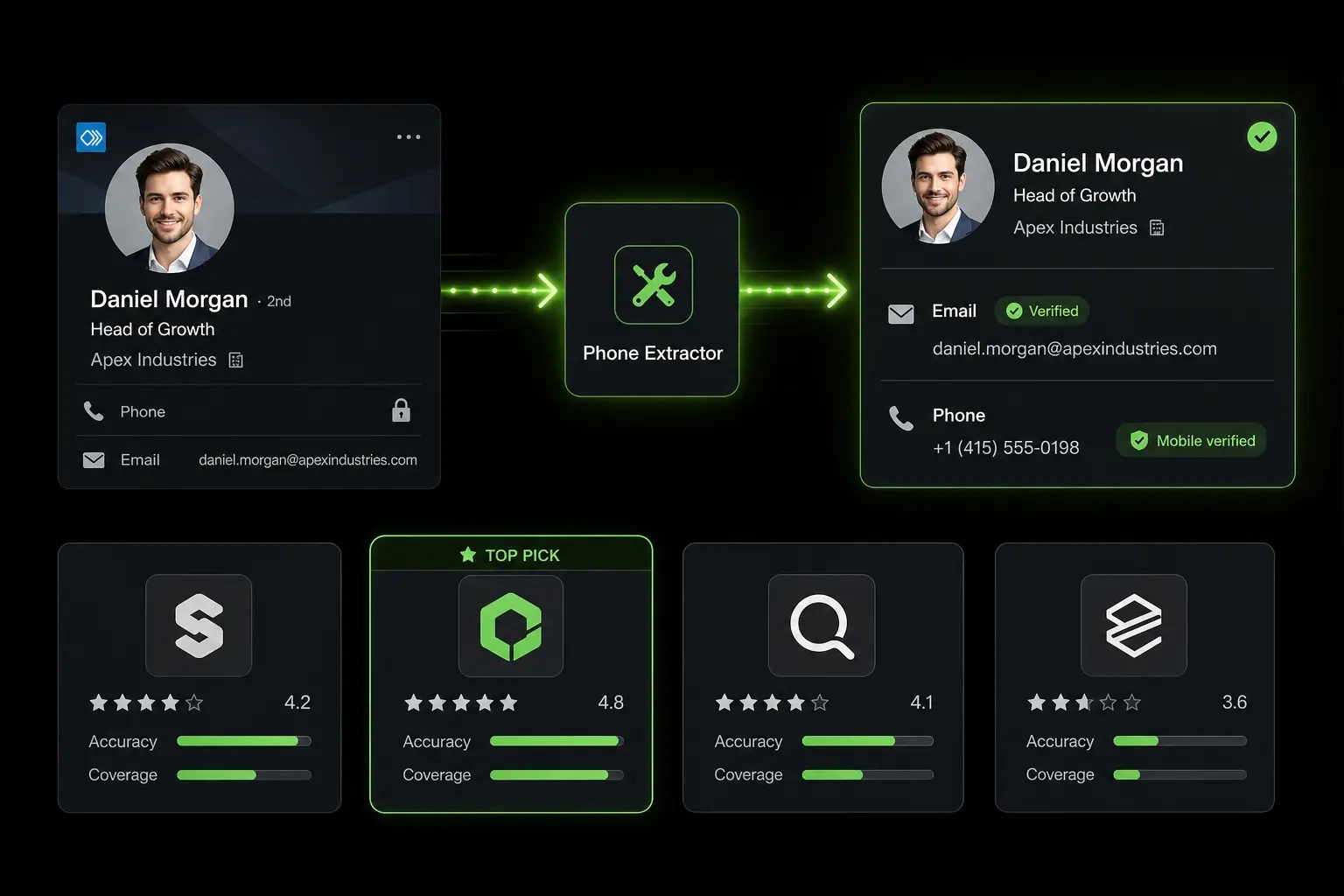
Once the list of LinkedIn profiles is built, you go through a B2B enrichment tool that retrieves each prospect’s direct phone number by querying its own databases (built independently of LinkedIn). The main market tools are detailed in the next section.
The typical operation: you provide the LinkedIn URL or name + company, the tool returns the verified direct mobile number (when available in the database). Coverage rate varies by tool and target.
Step 3: verification before calling
A best practice is to verify the number before calling, via a phone validation service. This reduces stale numbers (disconnected lines, ported out) and saves SDR time.
Step 4: call and follow-up
The number is dialed in a legitimate sales effort, with respect for privacy laws (recipient disclosure, opt-out). The call result is logged in the CRM to avoid recalling and to enable performance analysis.
Retrieve verified direct numbers at scale
Zeliq enriches each LinkedIn profile with its verified direct mobile number through waterfall enrichment querying more than 40 providers. Explore B2B data enrichment.
Tools comparison and real coverage rates
Several tools enable phone enrichment from a LinkedIn profile. Here are the 2026 market references.
| Tool | EU Coverage | US Coverage | Indicative price | Notable point |
|---|---|---|---|---|
| Cognism | Very strong (~70-80% DACH, UK) | Good | Quote | EMEA reference, documented GDPR compliance |
| ZoomInfo | Good | Excellent (~75%) | $15-50k/year | US reference, depth on large enterprises |
| Apollo.io | Medium-good | Good | $49-119/user/month | Good quality-price ratio, intent included |
| Lusha | Good | Good | $36-89/user/month | Native LinkedIn Chrome extension |
| RocketReach | Medium | Good | $48-249/month | Wide multi-source coverage |
| Hunter | Weak (email focus) | Weak | $49-499/month | Mostly email, few numbers |
| Zeliq | Strong EMEA (~60-70%) | Good | Quote | Waterfall enrichment 40+ providers |
The real coverage rate: what to know
Coverage rates announced by providers are often optimistic. On the field, real rates observed in 2026 on standard B2B targets:
- Verified direct mobile number: 30-50% of contacts on average (60-70% on well-covered targets)
- Company switchboard only: 20-30% of contacts (useful but ineffective for cold calls)
- No number available: 25-45% of contacts (depending on target)
In other words, on 1,000 prospects targeted via LinkedIn and enriched with a B2B tool, you typically obtain 300-500 verified direct numbers usable for cold calls. The rest must be contacted otherwise (email, LinkedIn).
Best practice: multi-provider waterfall
No tool has 100% coverage. Mature teams now use a waterfall logic: query the primary provider first, automatically switch to a second (then a third) for non-covered contacts. This approach increases total coverage by 15-25% on a given target.
It is exactly the waterfall enrichment principle platforms like Zeliq have industrialized: a single tool queries 40+ providers in sequence, without the user stacking subscriptions.
The legal framework: GDPR, TCPA, DNC Registry
Collecting and using a professional phone number from a LinkedIn profile requires respecting privacy frameworks.
In the US: TCPA and Do Not Call Registry
The Telephone Consumer Protection Act (TCPA) governs B2B telemarketing in the United States. Key points:
- Auto-dialers (Automatic Telephone Dialing Systems) require prior express consent for marketing calls to mobile numbers
- The National Do Not Call Registry lists numbers that may not be called for sales purposes
- B2B calls (one professional to another on a business line) sit in a separate category, but caution is warranted whenever a number could be a personal mobile
- Fines can reach $1,500 per non-compliant call (treble damages for willful violations)
In the EU: GDPR and ePrivacy
The GDPR applies the moment a number identifies a person, including in B2B context. Legitimate interest is the usual lawful basis for B2B prospecting, under three conditions:
- Relevance: contact is targeted in their professional role, not as an individual
- Disclosure: the person must be informed of the processing from the first contact
- Right to object: opt-out requests must be honored immediately
The French CNIL, UK ICO and equivalent authorities actively enforce. Sanctions can reach 4% of global revenue or 20 million euros (whichever is higher).
Compliance best practices
- Document the source of each number in the CRM (enrichment tool used, date, legitimate interest basis)
- Immediately honor any opt-out request (verbal during a call or written by email)
- Limit recalls to 2-3 attempts maximum if the person is unreachable, then abandon
- Respect reasonable hours (9 AM-7 PM on weekdays in the prospect’s timezone)
- Log each call in the CRM with result, date and time
- Audit quarterly the phone database to identify contacts to exclude
Worked example: direct number vs switchboard on 1,000 calls
A US SDR team of 3 prospects the Director of Sales US segment. Comparison over 1,000 placed calls.
Scenario A: company switchboard list only
- List: 1,000 switchboards found via company websites
- Connect rate (the right decision-maker picks up directly): 8% = 80 connects
- Meeting rate per connect: 15% = 12 meetings
- Time spent: ~50 hours (3 minutes per call on average, with gatekeeper)
- SDR cost: 50h × $40/h = $2,000
- Cost per meeting: $167
Scenario B: verified direct mobile numbers list (enriched via B2B tool)
- List: 1,000 direct mobile numbers obtained via enrichment
- Connect rate: 18% = 180 connects
- Meeting rate per connect: 25% (direct, qualified exchange) = 45 meetings
- Time spent: ~33 hours (2 minutes per call on average, no gatekeeper)
- SDR cost: 33h × $40/h = $1,320
- Enrichment cost (1,000 numbers × ~$0.35) = $350
- Total cost: $1,670
- Cost per meeting: $37
Differential: scenario B produces 3.75 times more meetings at a lower total cost. Cost per meeting drops from $167 to $37, a 4.5-fold improvement.
It is the most mechanical leverage in modern cold calling: before working voice, script or talk track, you work number quality. A verified direct number is worth, at equivalent SDR time, 3 to 4 times what a switchboard is worth.
How Zeliq retrieves verified direct numbers
Zeliq allows enriching a LinkedIn profile (or list) with the verified direct mobile number through waterfall enrichment querying more than 40 providers. The logic: query the primary provider first, switch to a second in case of absence, then a third, up to optimal match rate.
The result on a B2B US/EMEA target: typically 60-70% coverage of verified direct numbers, versus 30-50% for a single provider. Phone verification is integrated to eliminate stale numbers before export.
For a Business Developer or an SDR team wanting to maximize cold-call connect rate, it is the elimination of the most structuring bottleneck: number quality. See also our B2B lead database for upstream identification, and our guide on phone contact details for CRM management.
From LinkedIn profile to verified direct number
Zeliq enriches your LinkedIn prospects with verified direct numbers through 40+ providers. Account created in 2 minutes, no credit card.
Try for freeCan you find a phone number directly on LinkedIn?
Very rarely, and it is not a viable strategy. According to converging B2B database studies, fewer than 5% of LinkedIn members list their phone number in their profile, and most of those only make it visible to first-degree connections. For a scaled prospecting effort, counting on LinkedIn as a direct number source is a dead end. The operational method consists of using LinkedIn to identify the prospect, then going through a B2B enrichment tool (Cognism, Apollo, Zeliq, Lusha) that queries its own independent databases to retrieve the verified direct mobile number.
Is scraping LinkedIn for phone numbers legal?
No. LinkedIn explicitly prohibits data scraping in its terms of service. The platform detects automated behaviors (bots, browser extensions, crawlers) and sanctions with restriction, suspension or account deletion. In 2022, LinkedIn won a case against hiQ Labs confirming its right to protect its data. Beyond LinkedIn terms, privacy laws (GDPR in the EU, CCPA in California, others) strictly govern mass collection of personal data from an unauthorized source. Scraping to retrieve numbers is therefore both contractually prohibited by LinkedIn and legally risky under privacy laws. The clean path is to use a B2B enrichment tool that queries its own legally built databases, without scraping LinkedIn directly.
What’s the best tool to get a phone number from LinkedIn?
Depending on geographic target and budget, several tools are relevant. Cognism is the EMEA reference (very good France, DACH, UK coverage) with documented GDPR compliance. ZoomInfo is the US reference with exceptional depth on large enterprises. Apollo.io offers an excellent quality-price ratio ($49-119/user/month) for SMB to mid-market. Zeliq combines waterfall enrichment querying 40+ providers with a 60-70% coverage rate on EMEA targets and an integrated platform for the rest (multichannel sequences, verification, CRM sync). For a US team of 5-30 SDRs, the choice often plays out between ZoomInfo (pure enrichment, very clean database) and Apollo (enrichment + lighter integrated platform). For EU teams, Zeliq and Cognism are the strongest local references.
Zeliq and phones extracted from LinkedIn
Finding a direct phone from a LinkedIn profile requires a GDPR-compliant platform and a high match rate. Zeliq combines a native Chrome extension, phone verification and 450 million B2B contacts with verified direct phones. You extract the number and initiate the call in one click.
Conclusion: three actions to get your prospects’ direct numbers
The 2026 numbers show that number quality is the most mechanical lever in cold calling. Three concrete actions.
- Measure your current coverage rate: on your last 100 LinkedIn-targeted accounts, how many verified direct mobile numbers did you obtain? If under 30%, you are leaving connects on the table.
- Test 2 enrichment tools on a sample of 100 prospects in parallel. Compare real coverage rate, number quality (mobile vs switchboard) and price per number. It is the comparison investment that best monetizes your enrichment budget.
- Integrate enrichment into your cold-call sequence, rather than running it manually. An integrated platform (Zeliq, Apollo, Cognism + Salesloft) removes friction and speeds up the prospect → connect cycle.
To drive the whole thing (LinkedIn identification + enrichment + cold call + sequence) in a single platform, see Zeliq pricing.
And if you want to extract verified B2B phones directly from LinkedIn, try Zeliq for free and access 450 million GDPR-compliant contacts from day one.