

What Is a Lead? A Plain Definition and How It Differs From a Prospect
You hear the word “lead” a dozen times a day. Your marketing team reports lead counts, your sales team complains about lead quality, and your CRM has a field called “lead status.” Yet if someone asked you to define a lead precisely, you might pause. That hesitation is common, and it causes real damage. When marketing and sales mean different things by the word “lead,” they hand off the wrong contacts, waste hours, and lose deals nobody can explain.
This article fixes that. It gives you a clear definition of a lead, the difference between a lead, a prospect, a contact and a suspect, the main types of leads, and the pipeline vocabulary that surrounds them, all in plain language.
Here is what you will learn:
- What a lead actually is, and where the word comes from
- The vocabulary chain: suspect, lead, prospect, opportunity, customer
- The lead types: cold, warm, hot, inbound, outbound, MQL, SQL, PQL
- Where leads come from and how they move through their lifecycle
- Why a shared definition is the foundation of sales and marketing alignment
What is a lead? The core definition
A lead is a person or company that has shown some level of interest in what you sell. That interest can be small or large: downloading a guide, filling out a form, opening an email, requesting a demo, or dropping a business card at a trade show. What turns a contact into a lead is not that they exist, it is that they made a first move that connects them to your business.
Hold on to that nuance. A lead is not just any name in a database. It is an identified person or account, for whom you have at least one piece of contact data, and who has produced a signal of interest. No signal, no lead. You have a contact instead.
Where does the word “lead” come from?
In sales, a “lead” is literally a clue, a pointer that puts you on the trail of a potential deal. The word has been part of American sales language for decades, long before CRMs and marketing automation. A lead points you toward business that might exist. The plural, “leads,” became so standard that we now say “generate leads,” “qualify leads,” and “score leads” without thinking twice.
The term carries a built-in promise and a built-in limit. A lead is a possibility, not a certainty. That is exactly why the rest of the vocabulary exists: to describe how that possibility becomes real.
Marketing lead vs sales lead: one word, two meanings
Here is the first source of confusion. Marketing and sales both use the word “lead,” but they rarely mean the exact same thing.
To marketing, a lead is anyone who entered the contact database through a measurable action: a form submission, a newsletter signup, a content download. Marketing counts leads, nurtures them with content, and tracks cost per lead.
To sales, a lead often means a contact worth direct selling effort: a call, a personalized email, a follow-up. A salesperson is more likely to call something a “lead” once the contact is warm enough to start a real conversation.
Neither use is wrong. They describe two different points on the same journey. And that is precisely why a shared definition between the two teams matters, which we will come back to below.
The vocabulary chain: suspect, lead, prospect, opportunity, customer
The word “lead” only makes full sense inside the larger chain. A contact does not become a customer in one jump. They move through stages, and each stage has a name.
| Stage | Short definition | Typical signal |
|---|---|---|
| Suspect | A target that fits your ideal profile but does not know you yet | None, you identified them yourself |
| Lead | A contact who has shown a first sign of interest | Form, download, email open |
| Prospect | A qualified lead, with an identified need and budget | Sales conversation, positive reply |
| Opportunity | A prospect actively engaged in a buying process | Quote sent, negotiation underway |
| Customer | A closed opportunity, the contract is signed | Purchase order, payment |
This progression is the backbone of any B2B pipeline. The suspect sits at the top of the funnel, the customer at the bottom. Between them, the lead and the prospect stages are where most of the selling work happens.
One caveat: some teams merge or reorder these terms. That is fine, as long as everyone in the company uses the same grid. The exact words matter less than the shared understanding.
Lead vs prospect vs contact vs suspect
This is the most asked question, and the most useful one. Here is how to draw the lines.
A contact is the broadest category. It is any person whose details you hold, for any reason. A contact implies no interest and no qualification. Your entire address book is full of contacts.
A suspect is a contact who fits your target, your ICP or ideal customer profile, but has shown no interest yet. It is a target you chose, not a contact who came to you.
A lead is a contact who took a first step toward you. They know your brand, they interacted. Interest exists, but it has not been qualified yet.
A prospect is a lead that passed a filter. You confirmed a real need, a budget, and the right point of contact. A prospect is further along and more valuable than a lead.
The simple rule: a lead has shown interest, a prospect has been qualified. Not every lead becomes a prospect, but every prospect started as a lead. If you want the full mechanics of qualification, our dedicated article on qualified leads breaks down the MQL and SQL criteria in depth.
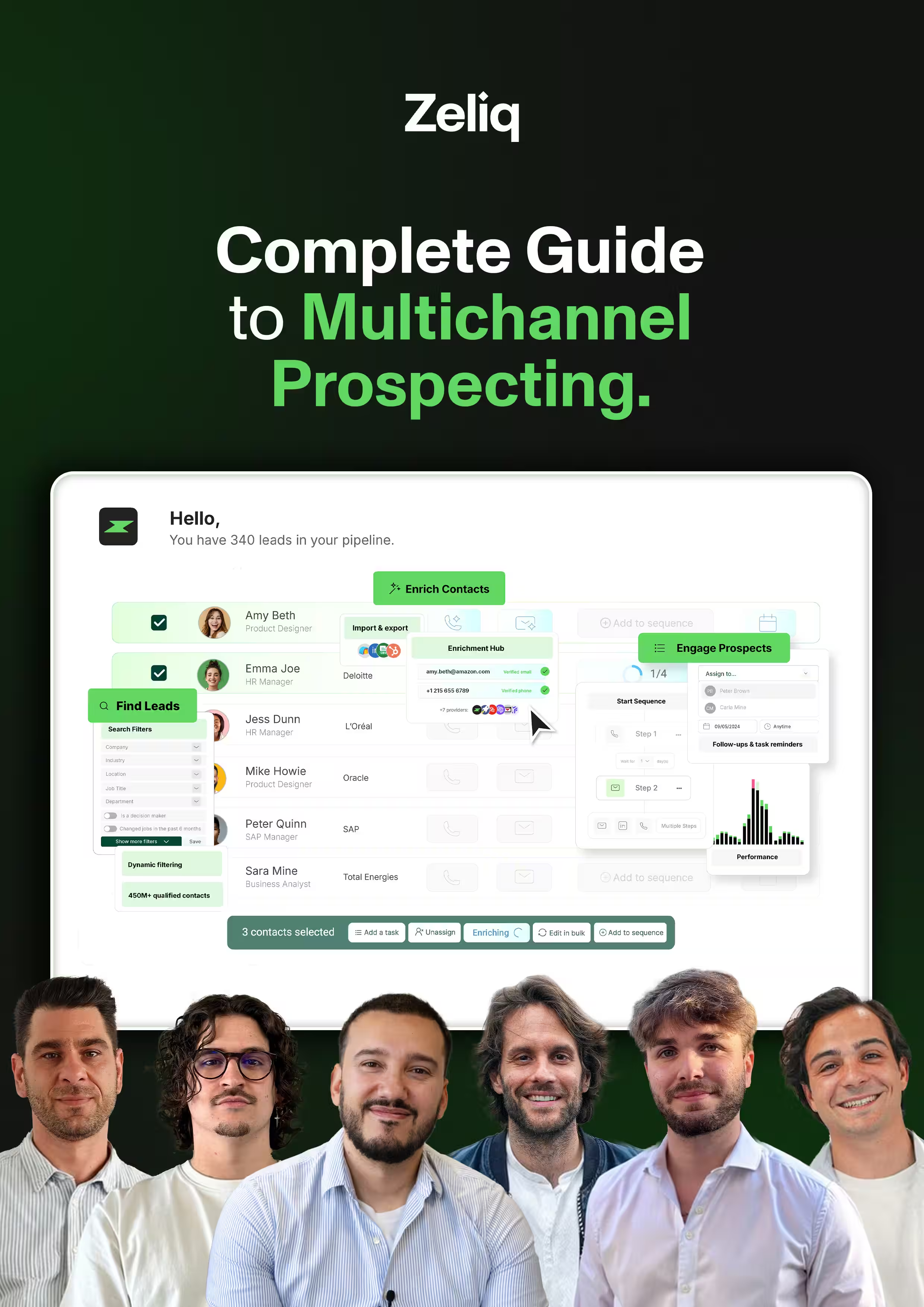
Spending hours re-checking cold contacts by hand? With Zeliq’s B2B lead database, you filter 450 million contacts by job title, industry, or buying signals, so you only work leads that genuinely match your target.
The main types of leads
Not all leads are alike. We classify them along several axes, and a single lead can belong to more than one category at once.
Cold, warm, hot: the lead’s temperature
This is the most intuitive classification. It describes the level of interest and readiness.
A cold lead barely knows your brand. Interest is minimal and the need is not expressed. A lot of work is needed before a sale is realistic.
A warm lead has interacted several times: opened your emails, visited multiple pages, maybe replied to a message. They know you and stay receptive.
A hot lead is ready to buy, or close to it. They requested a demo, a quote, or stated a clear intent. This is the lead to call first.
Inbound vs outbound: where the lead came from
An inbound lead came to you on their own. They found your content, site, or ad, and left their details. They started the relationship.
An outbound lead was contacted by you first. You identified them as a target and reached out, through cold email, a call, or a LinkedIn message. You started the relationship.
The two approaches complement each other. Inbound tends to produce warmer leads but in limited volume, while outbound lets you target the exact accounts you want, as multichannel prospecting shows by combining email, LinkedIn and calls.
MQL, SQL, PQL: qualified leads
These three acronyms describe leads that have passed a specific qualification step.
An MQL, Marketing Qualified Lead, is a lead that marketing judges engaged enough to pass to sales. It hit certain markers: pages visited, content downloaded, an engagement score reached.
An SQL, Sales Qualified Lead, is a lead that sales has validated in turn. The rep confirmed a real need, a budget, and a timeline. An SQL is further along than an MQL.
A PQL, Product Qualified Lead, is specific to free trial or freemium models. It is a lead who used the product and, through that usage, showed genuine buying intent.
These deserve a full article of their own, and we cover them in detail in our guide to qualified leads. Here, simply remember that an MQL, SQL or PQL is still a lead, just a lead with a level of qualification attached.
Where do leads come from? The main sources
A lead does not appear out of thin air. It always comes from an identifiable source, and knowing where your leads come from is essential to steer your lead generation.
Inbound sources cover everything that pulls the lead toward you: organic search, blog content, white papers, webinars, organic social, paid ad campaigns, and word of mouth. The common thread is that the lead makes the first move.
Outbound sources cover everything you initiate: cold email, cold calling, LinkedIn messages, trade shows, and targeted list building. Here, you go out and find the lead.
A solid practice is to always record the source of every lead in your CRM. That lets you measure which sources produce leads that actually convert into customers, not just leads by volume.
The lead lifecycle stage
A lead is not fixed. It evolves, and its status changes with every interaction. This is called the lifecycle, or lifecycle stage.
In practice, a lead moves forward, or backward, along the chain of suspect, lead, prospect, opportunity, customer. A cold lead can turn warm after a few exchanges, then hot after a demo. The reverse happens too: a hot lead who goes silent for weeks cools back down.
Most CRMs capture this with a “lifecycle stage” or “lead status” field. Keeping that field accurate is critical. It tells every team member where each contact stands and what to do next.
What is lead scoring?
Lead scoring is a method for automatically rating your leads so you know which ones to work first. Each lead gets a score that reflects their level of interest and their fit with your target.
The score draws on two families of criteria. First, fit: does the lead match your ICP by job title, company size, and industry. Second, behavior: how many emails they opened, how many pages they visited, whether they clicked, whether they replied.
The higher the score, the higher the priority. A tool like Zeliq’s lead scoring automatically ranks your leads by real engagement, so your reps call the right contacts at the right time, with no manual sorting.
Why the definition of a lead actually matters
It would be easy to treat this as a vocabulary debate that does not matter. It does.
When marketing and sales hold different definitions of a lead, marketing passes contacts that sales finds unusable, and sales ignores leads that marketing thought were ready. The result: lost leads, finger-pointing, and a cost per acquisition that climbs while nobody knows why.
The fix is called an SLA, a Service Level Agreement between marketing and sales. It is a written agreement that spells out what a lead is, what an MQL is, when marketing hands a lead to sales, and how fast sales must act on it.
A good SLA answers concrete questions: how many points make a lead an MQL, what information must travel with the handed-off lead, what happens when sales rejects an MQL as unqualified. Once those rules are set, the friction disappears and everyone knows their job.
That is why the definition of a lead is not a theory question. It is an operational prerequisite. For founders and early sales hires building their selling machine, clarifying this vocabulary is one of the first steps, as the page on the business developer role illustrates.
The most common vocabulary mistakes
A few confusions come up again and again. Knowing them keeps you from falling into the trap.
Mixing up lead and contact. Not every contact is a lead. A name bought from a list with no signal of interest is a contact, or at best a suspect, not a lead.
Mixing up lead and prospect. A lead has shown interest, a prospect has been qualified. Calling an unqualified lead a “prospect” gives a false sense of pipeline progress.
Calling an existing customer a “lead.” Once the contract is signed, the contact is a customer. Keeping them in the lead category distorts your conversion stats.
Counting leads without tracking their source. A lead with no recorded source tells you nothing about what is working in your generation.
Measuring lead volume instead of lead quality. A thousand cold leads are worth less than a hundred qualified ones. The right metric is not the number of leads, it is the rate at which they convert into customers.
What makes a good lead?
A good lead meets two conditions, not one. First, it matches your target. The job title, company size, and industry line up with your ideal customer profile. Second, it has real buying potential, meaning a need you can solve and, ideally, the means to act on it.
A lead that matches your target but has no need is just a well-identified suspect. A lead with a need but outside your target will cost you time later. The good lead is the intersection of both.
That is exactly what a structured generation and qualification process aims for: maximize the share of good leads in your pipeline, instead of piling up volume. Reliable data and sharp targeting upstream always beat a large pile of leads you have to rework.
Generate qualified B2B leads with Zeliq
Find, enrich and engage your prospects from one platform. Account created in 2 minutes, no credit card.
Book a demoKnowing what a lead is gives your team a shared language. A lead is a contact who has shown interest, distinct from a plain contact, a suspect, and a prospect. Today, take ten minutes to check that your team uses the same vocabulary and that your CRM reflects the chain of suspect, lead, prospect, opportunity, customer. That alignment is simple, free, and one of the highest-return moves you can make to smooth your pipeline. To go further, explore our plans and pricing and see how to centralize finding, enriching and engaging your leads.
And if you want to turn the definition of a lead into a measurable pipeline flow, try Zeliq for free and activate 450 million contacts qualified on buying signals.
Zeliq and lead → opportunity conversion
Defining a lead is one step; converting it into an opportunity is another. Zeliq combines 450 million B2B contacts with intent scoring and multichannel sequences to move from cold lead to qualified conversation. All in a single GDPR-first interface.