

A B2B lead is any individual or company that has shown some form of interest in your offer or that fits your Ideal Customer Profile. That definition is intentionally broad because, inside it, “leads for B2B” can mean four very different things: a name on a marketing list, an engaged contact qualified by marketing, a sales-ready buyer, or a paying trial user who hasn’t been billed yet. Treating these as the same thing is the single most common mistake in B2B revenue ops.
This guide breaks down the four types of B2B leads (Lead, MQL, SQL, PQL), where they actually come from, how to source them through the right database stack, and how to keep data quality high enough to avoid burning deliverability or budget. If your team relies on “more leads” as the answer to every quarter, this article gives you a sharper alternative.
What’s inside
- The 4 types of B2B leads (Lead, MQL, SQL, PQL)
- Conversion benchmarks at each stage
- The 5 main sources and the 8 databases compared
- Worked example: cleaning an 18,000-contact database
- Data quality (accuracy, freshness, compliance)
- GDPR compliance, buying vs generating leads
- The 3 mistakes + 3 FAQs + 3 dated next steps
Key takeaways
A B2B lead is anyone who could buy your product, but only some of them are ready for sales today. Use Lead → MQL → SQL → Opportunity as the qualification ladder, and add PQL if you run a PLG motion. The 2026 stack to source leads at scale combines a B2B database (Apollo, ZoomInfo, Cognism), an enrichment layer (Clay), a CRM, and a sequencer. Data quality matters more than volume: vendor-claimed accuracy ranges from 80 to 95 percent, but real-world deliverability depends as much on your own verification step. GDPR-compliant B2B email contact is legal in the EU under legitimate interest, but you must offer an opt-out and respect deletion requests.
The 4 types of B2B leads (Lead, MQL, SQL, PQL)
The word “lead” alone is too vague to be useful. Every B2B org should distinguish at least three sub-categories, and four if it runs a freemium or free-trial motion.
Lead : anyone whose contact info you have, who matches your ICP or has shown a basic signal of interest. A name pulled from a B2B database, a webinar registrant, a podcast listener who opted in. They have not yet engaged enough to warrant sales time.
MQL (Marketing Qualified Lead) : a lead that has shown enough engagement (multiple content downloads, repeat site visits, demo request through a low-intent page) that marketing flags it as worth sales attention. Still not sales-ready, but warm.
SQL (Sales Qualified Lead) : a lead that sales has accepted after a discovery conversation or a clear high-intent action (pricing request, booked demo, replied to an outbound sequence with intent). They fit the ICP and have a real conversation in motion. SQL is essentially the modern equivalent of “prospect” in French B2B vocabulary.
PQL (Product Qualified Lead) : a lead that has used your product (free trial, freemium tier) deeply enough to demonstrate value experienced. PQL only applies if you have a self-serve onboarding. Common PQL signals: connected a data source, invited a teammate, hit a usage threshold, returned to the product 3 or more times.
Order matters: Lead → MQL → SQL → Opportunity → Customer. PQL sits parallel to MQL/SQL in PLG companies and often skips the MQL step.
Conversion benchmarks at each qualification stage
Each transition in the ladder has industry-accepted conversion ranges. Use them to spot where your funnel leaks.
Lead → MQL : typically 5-15 percent for inbound (content-led), 1-3 percent for outbound (cold list).
MQL → SQL : healthy B2B range is 13-25 percent. Below 13 percent, your MQL definition is too loose or sales is not following up. Above 25 percent, your MQL definition may be too strict (you are leaving warm leads on the table).
SQL → Opportunity : 30-50 percent in mid-market B2B.
Opportunity → Closed-Won (win rate) : 20-25 percent mid-market, 30-40 percent SMB, 10-20 percent enterprise.
PQL → Paid customer : 15-30 percent in mature PLG B2B SaaS. PQL-to-close generally converts 3 to 5 times higher than MQL-to-close, because the lead has already experienced the product’s value.
Track these stage-by-stage. A single aggregate “lead to customer” number hides the real bottleneck.
The 5 main sources of B2B leads
Where do leads actually come from? Five primary channels, each with different unit economics.
1. Inbound content and SEO. Slow to ramp (6-12 months), but lowest cost per lead at scale. Best for educated buyers and high-consideration purchases.
2. Outbound (cold email + LinkedIn + cold call). Fastest channel to start: a competent SDR can produce 10-20 qualified meetings per month within 60 days. Highest cost per lead but predictable.
3. Paid acquisition (LinkedIn Ads, Google Ads, retargeting). Useful to compress the funnel on high-intent keywords or to retarget existing visitors. Expensive: in B2B SaaS, LinkedIn Ads cost per lead routinely runs $80-300.
4. Referrals and partnerships. Highest conversion source, lowest cost. Underused because most companies don’t have a structured referral motion. Achievable: 5 percent of new business attributed to referrals in year 1, 15-25 percent for mature programs.
5. Events and communities. Webinars, in-person events, niche Slack/Discord communities. Slower than outbound but produces higher trust. Best for brand-driven growth in mature ICPs.
A balanced B2B revenue motion blends 3 to 4 of these channels, not all 5.
B2B leads databases: 8 providers compared
For outbound and ABM, you need a B2B leads database that publishes ICP-fit company and contact data. Eight providers dominate the 2026 market:
Apollo.io : breadth-first, decent coverage on SMB and mid-market, good integrated sequencing. ZoomInfo : depth-first, strongest US enterprise dataset, premium pricing. Cognism : strongest EU coverage with GDPR-compliant phone numbers, good mid-market signal. Lusha : Chrome extension for fast lookup, ideal for individual reps. Clearbit : enrichment-first, used to add firmographics to inbound forms. SalesIntel : human-verified contacts, smaller volume but higher accuracy. Hunter.io : pure email finder + verification, complementary to a database. Clay : data orchestration that combines 75+ sources, not a database itself but the connective layer.
No single provider wins on every dimension. Best-in-class stacks combine one breadth source (Apollo or ZoomInfo), one accuracy source (SalesIntel or Cognism for EU), and Clay to enrich on top.
How to evaluate B2B data quality (accuracy, freshness, compliance)
Buying a B2B leads database without testing the data is the fastest way to burn budget. Three quality dimensions to evaluate before signing a contract:
Accuracy : the percentage of contacts whose email and direct phone are valid at the moment of pull. Vendor claims range from 80 to 95 percent. Always run a free trial on 500-1000 records, verify externally (Hunter, NeverBounce), and compute the real bounce rate. Anything above 5 percent bounce is a hard no.
Freshness : how often the database is re-verified. Top vendors re-verify monthly or in real time. Older databases (annual or quarterly verification) decay rapidly: a contact who left their role 6 months ago is dead lead.
Compliance : the data source must comply with applicable regulations (GDPR in the EU, CCPA in California, CASL in Canada). Vendors with no clear opt-out flow or no legitimate interest documentation are a liability. Cognism, ZoomInfo, and Apollo publish their compliance posture publicly.
Run all three checks on a sample before scaling. The cost of a bad database is not the subscription; it is the deliverability damage to your sending domains.
Buying B2B leads vs generating them in-house
The “buy leads” market sells contact lists at prices ranging from $0.001 per record (low-quality bulk data) to $1+ per verified contact. Cheap lists almost always disappoint: deliverability collapses, reply rates drop below 1 percent, and your sending domain reputation suffers.
A useful rule of thumb: if you cannot trace the source of a contact (where the data was collected, when, with what legal basis), do not send to it. The deliverability and legal risks outweigh any cost saving.
The mature 2026 approach is to subscribe to a database (Apollo, Cognism, ZoomInfo) for ICP-aligned data and use that as a source for owned outbound sequences. You “rent” the data continuously, not “buy” a static list. Better unit economics and better long-term quality.
GDPR, CCPA, and lead data compliance
In the EU, B2B email contact is legal under GDPR via the “legitimate interest” legal basis, provided three conditions: the contact is a professional in a relevant role, the message is professionally relevant to them, and they have an obvious and immediate opt-out (one click to unsubscribe). The 2024-2025 enforcement trend shifted toward stricter scrutiny on the proportionality of the data processing.
Practical compliance checklist: - Document the source of every contact in your CRM (date, vendor, legal basis). - Honor opt-out requests within 30 days (10 working days in France in practice). - Maintain a suppression list across all sending platforms. - Avoid sending to personal-looking addresses (gmail.com, hotmail.com personal Outlook). - Keep records of consent for any inbound form submission.
CCPA (California) and CASL (Canada) add their own constraints: explicit consent in Canada for any new commercial email, and consumer rights to delete in California. If you operate cross-border, build the strictest framework once rather than juggling regional carve-outs.
The 3 mistakes that waste your B2B lead budget
To stop wasting money on B2B leads in 2026:
Mistake 1: confusing volume with quality. 10,000 unverified contacts is a deliverability liability, not a pipeline asset. Buy fewer, verify more, send less.
Mistake 2: skipping the qualification ladder. Pushing every lead directly to SDRs without an MQL filter overloads sales and drives churn. Use marketing automation to filter at the entry point.
Mistake 3: ignoring the cost per opportunity, not per lead. A cheap source that produces 100 leads but 0 opportunities is more expensive than an expensive source producing 5 opportunities. Measure end-to-end, not at the top of the funnel.
Zeliq and clean B2B lead sourcing
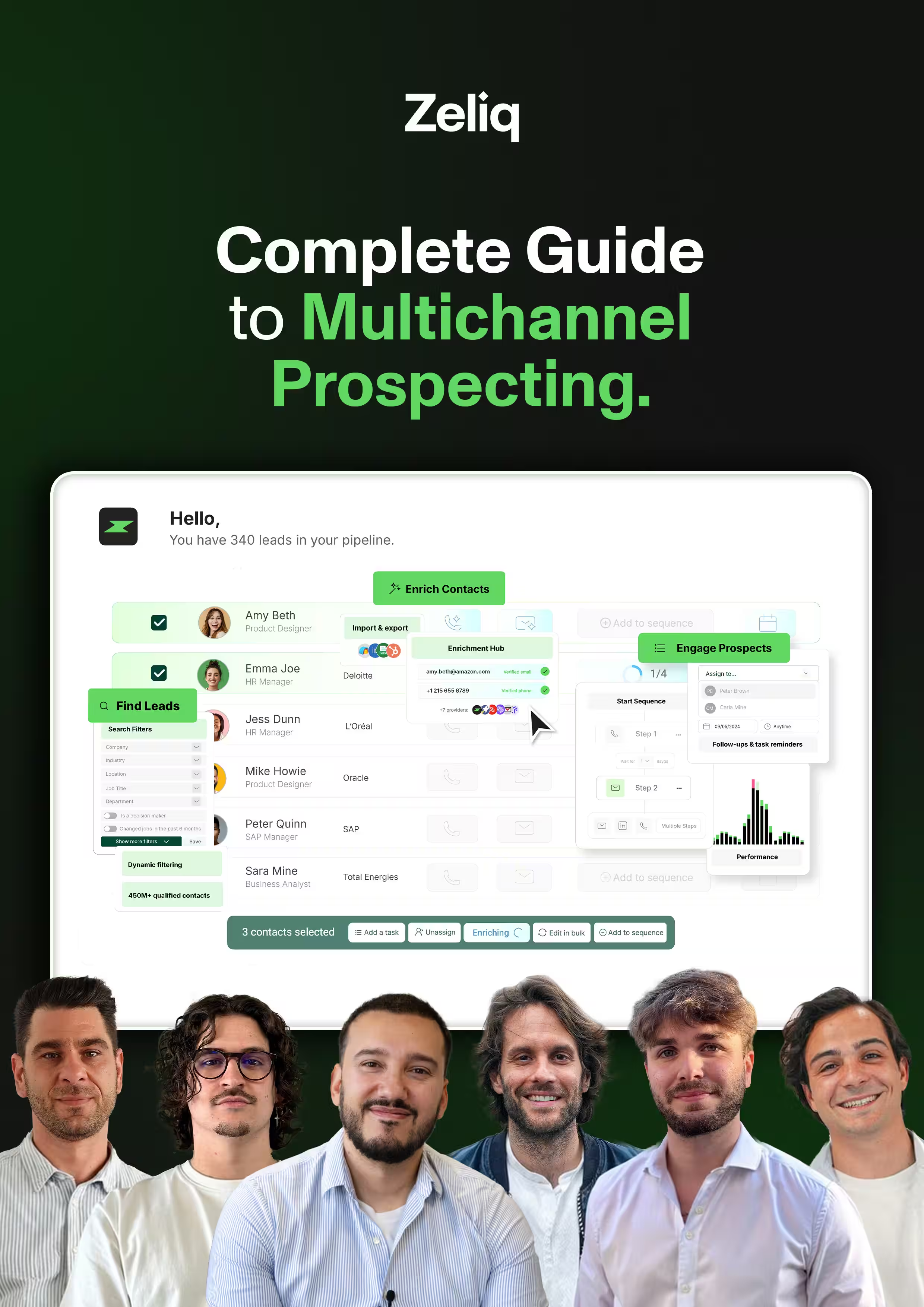
Zeliq consolidates sourcing, verification, qualification, and sequencing in one workflow: a 450 million B2B contacts ICP-fit database, real-time email and phone verification, buying-signal scoring (funding, hiring, launches), and multichannel sequences. The entire flow is GDPR-compliant with documented legal basis and a built-in opt-out path.
Concretely: your RevOps configures ICP filters once, your SDRs build lists while staying within the rules, and signal scoring automatically prioritizes the warmest leads. No juggling between 4 platforms.
Worked example: cleaning a B2B leads database before scaling outbound
Take an outbound team inheriting an 18,000-contact CRM database accumulated over 3 years, multiple past sellers, partly purchased lists. The team wants to scale sends from 5,000 to 20,000 emails per month. Pre-cleanup audit shows 38 percent of contacts out of ICP, 24 percent invalid emails, and 12 percent duplicates. Bounce rate test on 500 contacts comes back at 9.2 percent, threatening overall deliverability.
| Metric | Before cleanup | After rebuild | Delta |
|---|---|---|---|
| Database size | 18,000 | 8,200 | -54% |
| % ICP-fit contacts | 62% | 96% | +34 pts |
| Test bounce rate | 9.2% | 1.4% | -7.8 pts |
| Cold sequence open rate | 22% | 36% | +14 pts |
| Cold sequence reply rate | 1.8% | 4.3% | +2.5 pts |
| Qualified meetings / month (at 20K sends) | 16 | 38 | +22 |
| Monthly pipeline generated | $215K | $510K | +$295K |
The counter-intuitive effect: a database cut in half generates 2.4x more meetings. Why: overall domain deliverability rebounds (bounce rate under 2 percent), recipient spam filters let more emails through, and each remaining contact is genuinely in ICP, so conversion climbs. At an average deal size of $14K and a 22 percent AE win rate, the 22 additional monthly meetings are worth roughly $68K of incremental signed ARR per month.
Cleanup cost: 1 week of RevOps time + external email verification (Hunter or NeverBounce, around $1,800 for 18,000 verifications). Total one-time: $5,200. Cash ROI over 12 months: ($68K x 12) / $5,200 = capped at 10-12x on the marginal delta. Non-negotiable rule: never scale send volume on an unverified database.
Source B2B leads on clean, compliant data
Zeliq combines verified B2B data, ICP scoring, and multichannel sequences in one platform. Book a 20-minute demo.
Try for freeWhat is a B2B lead?
A B2B lead is a professional contact who matches your ICP and has signaled at least minimal interest, even indirect (downloaded content, repeat visits, presence in a target account with a buying trigger). At that stage they are not yet ready for a sales conversation, they sit at the top of the funnel. Marketing’s and sales’ job is to qualify the lead into an MQL and then an SQL before active engagement. A name in a database with no signal and no ICP validation is not a lead, it is a row.
Where do you get leads for B2B sales?
The best sources vary by market. For B2B mid-market US/EU, GDPR-compliant databases like Cognism, Apollo, and Zeliq dominate. For SMB, LinkedIn + an email finder (Hunter, Dropcontact) is enough to start. For US enterprise, ZoomInfo remains the leader. Free valid sources: your existing CRM, often under-exploited; inbound SEO; customer referrals; niche communities (Slack, Discord) where your persona is active. A 3-to-4-tool stack always beats an 8-tool stack.
What is the difference between MQL, SQL, and PQL?
An MQL (Marketing Qualified Lead) is qualified by marketing: enough engagement (downloads, repeat visits, forms) to warrant future commercial attention. An SQL (Sales Qualified Lead) is qualified by sales after a discovery call, with confirmed ICP fit and identified buying intent. A PQL (Product Qualified Lead) only exists in product-led growth motions: it is a free-trial or freemium user who has demonstrated value experienced through real product usage. PQLs convert to paid 3 to 5 times better than MQLs because the lead has already touched the product before any sales pitch.
Conclusion: 3 dated next steps
This week: audit your current database. How many contacts? What percent matches your ICP? What is the test bounce rate on 500 sends? You will likely be surprised.
Within 30 days: clean the database before scaling send volume. Remove out-of-ICP contacts, verify email technical validity (Hunter, NeverBounce), drop duplicates. A smaller clean database beats a massive dirty one.
Within 90 days: align sourcing, qualification, scoring, and sequencing on a single platform. If you want to test a GDPR-compliant consolidated stack, try Zeliq for free and measure qualified meetings at 30 days.