

Finding B2B leads in 2026 is not about scraping bigger lists. It is about identifying accounts that match your ICP, spotting a real buying signal (hiring, funding, product launch, leadership change), and reaching the right person on the right channel before the competition does. The teams winning today track signals, not volumes.
This guide walks through six methods to find qualified B2B leads (outbound email, LinkedIn, signal-based selling, content + SEO, referrals, events) and the eight tools that operationalize them. For each method, you get the realistic conversion benchmark and the situation it fits. Skip the “100 leads in a day” promises: the goal is qualified pipeline, not vanity volume.
What’s inside
- What a B2B lead actually is and how to qualify one
- Method 1: signal-based outbound (the 2026 standard)
- Method 2: cold email at scale (without the spam)
- Method 3: LinkedIn outreach and Sales Navigator
- Method 4: content + SEO inbound
- Method 5: referrals and customer advocacy
- Method 6: events, webinars, communities
- The 8 tools that cover the full lead-gen stack
- How to combine methods without diluting effort
- 3 mistakes to avoid
Key takeaways
A qualified B2B lead is a person inside an ICP-fit company, with decision power or influence on the buying process, who shows at least one buying signal. Methods to find them split into outbound (you reach out: email, phone, LinkedIn, signals), inbound (they come to you: content, SEO, events), and hybrid (referrals, communities). In 2026, the winning stack combines a B2B database plus an email finder plus a sequencing tool plus a CRM. Salesforce’s 2026 State of Sales reports that nine out of ten sales teams already use AI agents or plan to within two years, mainly to score and prioritize leads, not to spam.
What a B2B lead actually is and how to qualify one
A B2B lead is not a name on a list. It is a person, inside a target company, with at least three traits that make them worth your time: ICP fit (industry, headcount, geography, tech stack), buying authority or influence (decision-maker, champion, or budget owner), and a buying signal (recent funding, new role, hiring spree, tech change, complaint about an incumbent).
This three-factor definition matters because it kills the “more leads = more revenue” illusion. A list of 10,000 contacts with no ICP filter and no signal converts worse than 50 hand-picked accounts with a clear trigger. Your job, when looking to find leads, is not to inflate volume. It is to raise the conversion rate at each step of the funnel.
The accepted qualification ladder is: Lead → MQL (Marketing Qualified Lead, expressed interest through content) → SQL (Sales Qualified Lead, validated ICP fit plus engaged conversation) → Opportunity (clear need, budget, timeline). Most of the methods below help you produce MQLs or SQLs directly. The hard part is rarely volume; it is qualification.
Method 1: signal-based outbound (the 2026 standard)
Signal-based selling is the single biggest shift in B2B lead generation in 2026. Instead of working static lists (“all SaaS companies in France with 50-200 employees”), you wait for an account to emit a trigger and then strike while the iron is hot.
Useful signals in 2026 include: new funding round, recent VP Sales or VP Marketing hire, SDR or marketer job posting, public tech change (new CRM, new ATS), product launch, public complaint about a competitor on LinkedIn, expansion into a new market. Each signal narrows the moment when the account is most likely to listen.
The numbers behind this method are consistent across reports: a cold outreach calibrated on a clear signal converts 2 to 3 times better than the same outreach on a generic list. Tools like Apollo, Cognism, and Clay let you orchestrate signal capture, contact enrichment, and sequencing in one workflow. Done well, this is where most quota attainment now comes from.
Method 2: cold email at scale (without the spam)
Cold email is not dead. Mass-spamming the same template to 10,000 contacts is dead. A well-built cold email program in 2026 segments under 100 accounts per sequence, personalizes the first line with a real signal, and runs deliverability hygiene continuously (warmup, SPF/DKIM/DMARC, ramp-up).
Realistic 2026 benchmarks: 25-40 percent open rate, 3-7 percent reply rate on hyper-targeted sequences, 8-15 percent on signal-based ones. Anything significantly lower means a deliverability problem, a bad list, or a generic message. Tools like Lemlist, Smartlead, and Instantly handle the warmup and inbox rotation that keep your domain reputation intact.
The trap to avoid: paying per-seat for a sequencer and skimping on data quality upstream. Bad emails kill deliverability faster than any algorithm change. Verify every address before sending, never above 2 percent bounce rate.
Method 3: LinkedIn outreach and Sales Navigator
LinkedIn now hosts over one billion members, including most B2B decision-makers in mature markets. Sales Navigator gives you the search granularity to extract accounts and contacts by 25+ criteria, and the inbox to reach them directly.
Two complementary tactics work in 2026: the “warm path” (engage publicly with a prospect’s content for 1 to 2 weeks before sending a connection request, then DM after acceptance) and the “InMail with signal” (paid InMail tied to a specific trigger, no template). The warm path converts 3-5 times better than a cold DM, but takes longer.
For volume, automate carefully: stay under 100 connection requests per week, never spam comments, and personalize the first message. LinkedIn cracks down on bot-like behavior, and a banned account is hard to recover. Tools like LaGrowthMachine, Lemlist, and Waalaxy let you run multichannel sequences (email + LinkedIn) without crossing the line.
Method 4: content + SEO inbound
Inbound takes longer to pay back (6 to 12 months for SEO, 2 to 4 months for paid content distribution), but generates leads at a lower cost per lead than outbound at scale. HubSpot’s recurring benchmark estimates content marketing produces around 3x more leads than paid advertising at 62 percent lower cost per lead, when executed consistently.
The 2026 playbook: pick 30 to 50 high-intent keywords your ICP searches, publish in-depth content that answers them better than current SERP, and capture intent with lead magnets (calculators, templates, audits). The content needs to be genuinely useful, otherwise it ranks badly and converts worse.
For SEO leads, the unit economics matter more than the volume. A page that ranks for “B2B sales KPI” and brings 500 visits per month with 2 percent conversion produces 10 high-intent leads per month forever. Compounded over 24 months, that beats most outbound budgets.
Method 5: referrals and customer advocacy
Referrals remain the highest-converting source of B2B leads, period. Industry data consistently shows referral-sourced opportunities close at 2 to 4 times the rate of cold outbound, with shorter cycles and higher deal sizes. The reason is simple: trust transfers.
The problem: most companies don’t ask. A structured referral motion includes (1) identifying the 10-20 customers most likely to refer (high NPS, recent renewal, public advocate), (2) asking them at the right moment (post-go-live, post-win, post-renewal), and (3) making it easy (a short intro template, a clear ask).
To scale, instrument referral tracking inside your CRM and reward it (referral bonus, public recognition, exclusive access to product roadmap). A 5 percent referral attribution on new bookings is achievable in year one. Best-in-class B2B SaaS hit 15 to 25 percent.
Method 6: events, webinars, communities
Live formats (in-person events, webinars, niche Slack or Discord communities) build a level of trust that no cold email can match. Pharow’s public data shows their own webinars draw 100 to 200 registrants per session with around a 5 percent conversion to qualified meeting, every 6 weeks.
Three formats work well in 2026: thematic webinars on a problem you solve (45 minutes, expert guest, 15 minutes Q&A), invite-only roundtables (8 to 12 ICP buyers, no pitch), and community moderation (you run a small Slack of buyers in your segment). All three require consistency: one webinar is noise, twelve per year is a channel.
The trap: treating live events as a content channel only. The real value is the post-event motion (1-to-1 follow-up within 48 hours, recorded content distribution, intent scoring of who watched what). Without that motion, you produce content, not leads.
Zeliq and multichannel B2B lead generation
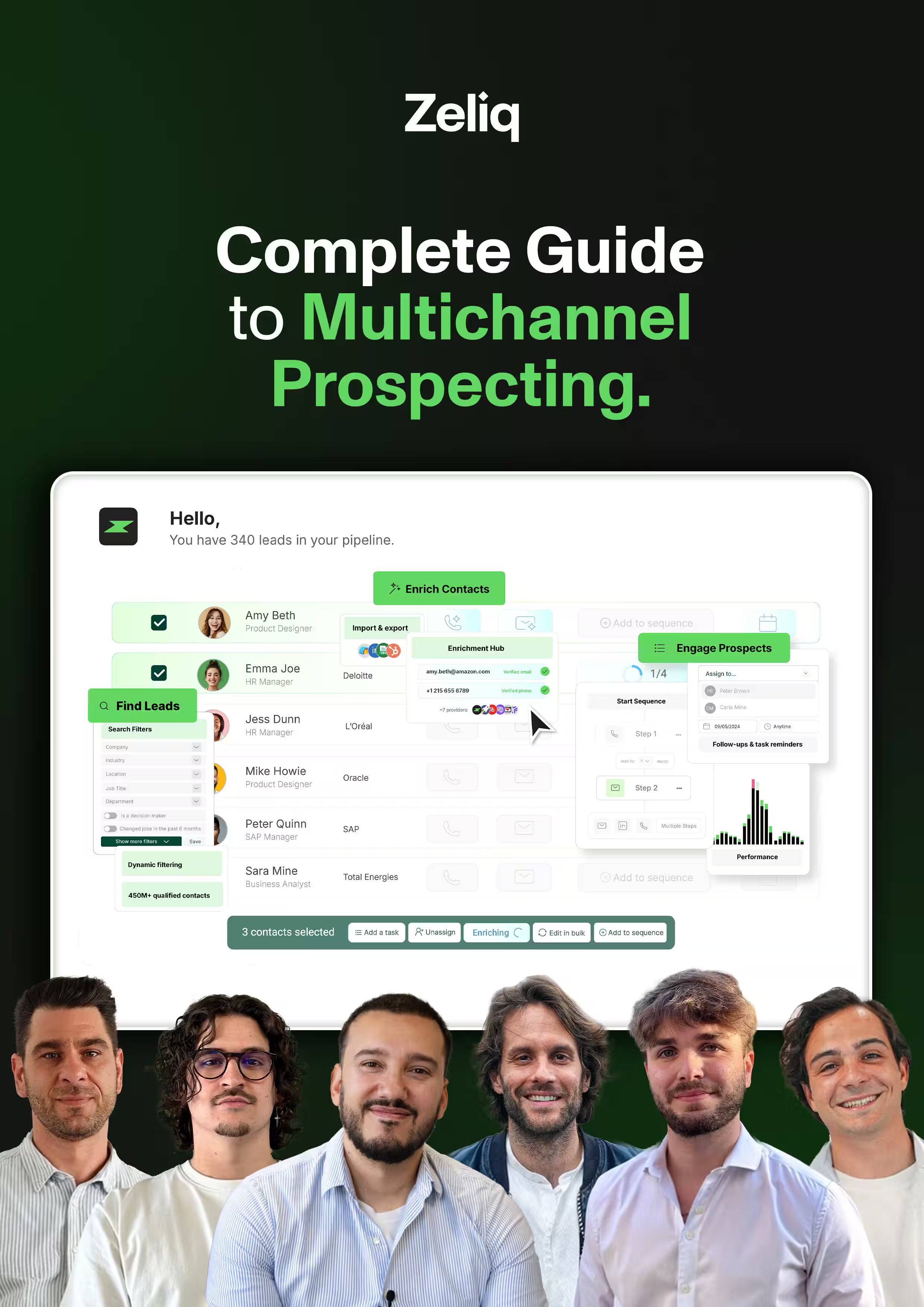
Zeliq consolidates methods 1 through 4 into a single platform: a 450 million B2B contacts ICP-fit database with verified emails and direct dials, buying signal detection (funding, hiring, launches), and multichannel sequences orchestrating email, LinkedIn, and phone in the same cadence. Your SDRs stop switching between 4 tools and operate on clean data.
Concretely: an SDR builds an ICP-fit list in the morning, kicks off a multichannel sequence, sees replies and activity signals in the same interface. RevOps exports to HubSpot or Salesforce without double entry.
Worked example: collapsing a 4-tool stack into one platform
Take a typical mid-market B2B SaaS outbound team: 4 SDRs, $7M ARR, ICP CTOs and VP Engineering in US/EU tech 50-300 employees. Before consolidation, 4-tool stack: Apollo (data), Hunter (email verification), Lemlist (sequencing), Sales Navigator (LinkedIn). Total cost $15,500/year, plus 6 hours per week of switching and double-entry per SDR.
| Metric | Before (4 tools) | After (consolidated) | Delta |
|---|---|---|---|
| Tooling cost / year | $15.5K | $10.6K | -32% |
| Switching hours / SDR / week | 6 h | 1.5 h | -4.5 h |
| Accounts prospected / SDR / month | 240 | 320 | +33% |
| Qualified meetings / SDR / month | 12 | 17 | +42% |
| Multichannel sequence reply rate | 4.2% | 6.1% | +1.9 pt |
| Monthly pipeline generated (team) | $210K | $295K | +$85K |
The sharpest effect is operational: 4.5 hours per week per SDR reclaimed, or 18 hours per month team-wide, redeployed into prospect conversations rather than tool management. At average deal size $12K ARR and AE win rate 22 percent, the $85K incremental monthly pipeline translates to roughly $19K of incremental signed ARR per month at the team level.
Cash ROI over 12 months: ($19K x 12) - $4.9K tooling savings = capped at 10-12x the net investment delta under strict cash-out reasoning. The gain is not just budget, it is operational: less friction, more conversations, more deals.
The 8 tools that cover the full lead-gen stack
To find B2B leads at scale in 2026, you need coverage across six functions: data, enrichment, signal, sequencing, CRM, and analytics. These eight tools cover the stack:
1. ZoomInfo or Apollo for ICP-fit company and contact data. 2. Hunter or Dropcontact for email finder and verification. 3. Clay for data orchestration and enrichment workflows. 4. LinkedIn Sales Navigator for granular account and contact search. 5. Lemlist or Smartlead for cold email sequencing with deliverability hygiene. 6. LaGrowthMachine for multichannel (email + LinkedIn) sequences. 7. HubSpot or Pipedrive as the CRM and pipeline source of truth. 8. PhantomBuster or Bardeen for niche scraping and automations.
You don’t need all eight. The most efficient teams run three to five tools maximum, picked to cover the functions that bottleneck their motion. Start with a B2B database, an email finder, a sequencer, and a CRM. Add the rest only when you can name the gap.
How to combine methods without diluting effort
The common mistake is to try all six methods at once with one SDR. That dilutes effort, kills focus, and produces six mediocre channels. The correct sequence in 2026 is:
Phase 1 (months 1-3): master one outbound channel (typically cold email or LinkedIn) until you produce 10-15 qualified meetings per SDR per month.
Phase 2 (months 3-6): add a second channel that compounds with the first (most often LinkedIn if you started with email, or content + SEO if you have a marketing function).
Phase 3 (months 6-12): introduce a third channel (referrals or events) once the first two are scalable and instrumented.
Each phase has a single owner, a single primary metric, and a 90-day review. Trying everything at once is the fastest path to flat pipeline.
3 mistakes to avoid
Mistake 1: confusing volume with pipeline. A list of 5,000 unverified contacts is not 5,000 leads. It is a deliverability risk. Filter first, enrich second, send third.
Mistake 2: skipping the qualification step. A lead that hasn’t matched your ICP and shown a signal is a name, not a prospect. Score every lead before pushing it into a sequence.
Mistake 3: ignoring the CRM hygiene. No tool fixes a CRM full of duplicates, stale data, or unowned records. Fix the foundation before adding more inputs upstream.
How do I find B2B leads for free?
Several free channels produce qualified B2B leads, provided you accept a slower ramp. Organic LinkedIn with a consistent content and engagement strategy is the most efficient: aim for 3 posts per week and 30 comments on ICP posts per day. Inbound SEO builds a durable asset but takes 6 to 12 months of consistency. Niche communities (Slack, Discord, B2B subreddits) generate highly qualified leads if you contribute value before pitching. And manual LinkedIn prospecting, without automation, remains legal and effective at low volumes (15-25 personalized connection requests per day).
What is the best tool to find leads in 2026?
The best tool depends on your market. For US enterprise coverage, ZoomInfo remains the leader. For European coverage with GDPR compliance, Cognism and Apollo dominate. Hunter and Dropcontact are best in class for email finding. Clay has become the standard for multi-source data orchestration. Sales Navigator stays essential for granular LinkedIn search. For an integrated EU/US stack with scoring and sequencing built in, Zeliq covers data, verification, signals, and sequences on a single platform. The rule: 3 to 5 tools max, not 8.
How do you find quality leads?
Quality starts with definition: a quality lead matches your ICP, has decision power or strong influence, and has emitted at least one buying signal (funding, hiring, product launch, leadership change). Skip any of these three and you spend time on names, not prospects. Then it depends on the channel: signal-based outbound delivers the highest quality at scale, referrals deliver the highest quality at low volume, and SEO delivers a durable flow at zero marginal cost. Combining two channels with disciplined scoring beats running all channels half-heartedly.
Find B2B leads on a single platform
Zeliq unifies B2B data, signals, contact enrichment, and multichannel sequences. Book a 20-minute demo.
Try for freeConclusion: 3 dated next steps
This week: audit your current outbound stack. List every tool, its cost, and the actual usage per SDR. Most teams pay for 4 subscriptions and effectively use 1.5 of them.
Within 30 days: pick one primary outbound channel (cold email or LinkedIn) and instrument it cleanly before adding a second. Measure reply rate, meeting rate, show rate. Without those numbers you will not know whether the method works.
Within 90 days: consolidate the stack to a unified platform if switching friction costs more than the ROI of each isolated tool. If you want to test data + signals + sequences in a single flow, try Zeliq for free and compare monthly pipeline output within 30 days.