

How to Find B2B Companies in 2026: ICP, Tools, Workflow
Finding the right companies to contact is step zero of any B2B prospecting motion. The best cold email in the world sent to the wrong account list will not generate a single meeting. Yet most teams jump straight into outreach with a vague target: “mid-market SaaS in Europe” or “tech companies hiring SDRs”. That is not a list, that is a wish.
This guide walks through how to find B2B companies that actually fit, in 2026. You will learn how to define your Ideal Customer Profile (ICP), where to source target accounts (free and paid), how to layer intent signals on top, and how to build a workflow that produces a clean, prioritized list every month. The persona in mind here is the SDR, RevOps lead, founder, or marketer who has to ship a target account list this quarter and does not have time for theory.
Why finding the right companies matters more than volume
Outbound used to be a volume game. Send 1,000 emails, book 5 meetings, move on. That math has broken. Reply rates on cold email have collapsed: Google and Microsoft filter aggressively, prospects are saturated, and AI-generated outreach has trained inboxes to ignore generic copy. The teams still hitting pipeline targets are the ones who narrow their list before they write a single line of copy.
A smaller, sharper list wins on three fronts:
- Higher reply rate. A message landing in front of someone with the exact pain you solve gets answered. A message in front of “anyone in tech” gets ignored.
- Better deliverability. Fewer, more relevant emails keep your sender reputation clean. Blasting 5,000 generic emails a week destroys it.
- Faster sales cycles. A pre-qualified account already shows fit signals. Less convincing, more closing.
ICP fit beats volume. If you remember one thing from this guide, that is it.
Define your ICP before you open any tool
Your ICP is the written description of the company most likely to buy from you, renew, and refer others. Without it, every database becomes a fishing expedition. With it, every database becomes a filter.
A solid ICP has three layers.
Firmographics: who they are
These are the basic descriptors of a company.
- Industry. Use a real classification (NAICS, SIC, GICS, or your own internal taxonomy). “Tech” is too broad. “Vertical SaaS for healthcare staffing” is workable.
- Company size. Headcount bands (1-10, 11-50, 51-200, 201-500, 501-1000, 1000+) or revenue bands. Pick the one your offer actually fits. A 10-person startup has nothing in common with a 1,000-person enterprise.
- Revenue. Annual revenue range, where data is available. Public companies report it. Private companies are harder, but Crunchbase, PitchBook, and registries help.
- Geography. Country, region, city. Time zone matters too if your team is in one zone and prospects are in another.
- Maturity. Seed, Series A, growth, public. A pre-seed startup buys differently than a 20-year-old PE-owned company.
Technographics: what they use
Technographics tell you what tools a company already runs. This matters because most B2B products are either replacing something, integrating with something, or sitting next to something.
- Do they use Salesforce or HubSpot? That changes how you sell a CRM-adjacent product.
- Do they run AWS, Azure, or GCP? Critical for infra tools.
- Are they on Webflow, Shopify, Magento? Critical for ecommerce or web tools.
- Do they have a marketing automation stack (Marketo, Pardot, HubSpot)?
BuiltWith and Wappalyzer are the standard sources. Most B2B databases (Apollo, ZoomInfo, Zeliq) layer technographic filters on top of firmographics.
Intent: are they ready now
Firmographics tell you a company could buy. Intent tells you they might buy now.
- Hiring. A company posting 5 SDR roles in 60 days is scaling outbound. Time to talk to them.
- Funding. A fresh Series B usually means budget unlocking for tools, hires, and expansion. Crunchbase, PitchBook, and TechCrunch announcements are your sources.
- Headcount growth. A 30% headcount increase in 12 months signals scale-up mode.
- Expansion. New office, new market, new product line, all visible in news and on LinkedIn.
- Tech stack changes. A switch from one CRM to another (visible in BuiltWith) is often a buying window for adjacent tools.
The cleanest ICPs combine all three layers. Example: “Series A to Series C SaaS companies, 50 to 300 employees, headquartered in the US or UK, using HubSpot, with a posted SDR role in the last 30 days.” That is a list of maybe 200 to 500 companies, all of them worth the time.
Free methods to find B2B companies
You can build a credible target account list without paying for a database. It takes more manual work, but for early-stage teams or niche segments, it is often the right starting point.
LinkedIn Sales Navigator
Sales Navigator (around $99 per seat/month) is the most-used B2B prospecting tool on the planet. The filters that matter are all there: industry, headcount, geography, growth rate, hiring activity, recent senior hires. You can save accounts to lists, set alerts on company changes, and map decision-makers per account. Strict free tier: regular LinkedIn search, with industry, size, and location filters.
Crunchbase
Crunchbase tracks funding rounds, founders, key employees, and company news. The free tier lets you search basic firmographics. Paid tiers (from around $49 per month) unlock advanced filters and saved searches. Best in class for funding-based intent (recent rounds, total raised, last raise date).
Google site search
The hacker classic still works. Search operators turn Google into a free database.
- site:linkedin.com/company "B2B SaaS" "Series A" "London" to find UK Series A SaaS companies on LinkedIn.
- site:ycombinator.com/companies "Series A" to surface YC alums who raised.
- "head of sales" site:linkedin.com/in "fintech" "Paris" to find people first, then back-fill the company.
It is slow and the data is unstructured, but for very specific niches it surfaces accounts no database has indexed.
Public registries: SEC EDGAR, Companies House, INSEE Sirene
Government registries are the underrated source. US public companies file with the SEC (EDGAR for 10-Ks and S-1s). UK companies are in Companies House. French companies in INSEE Sirene. German ones in Handelsregister. Verified, official data: legal name, address, directors, often financials. No emails or phones, those you enrich later.
Y Combinator, Product Hunt, Wellfound
For startup ICPs, the YC company directory, Product Hunt, and Wellfound (formerly AngelList) are goldmines. YC alone has 4,000+ companies indexed by batch, industry, and stage. Free, filterable, and unusually clean since companies submit the data themselves.
BuiltWith and Wappalyzer
For technographic filtering, BuiltWith offers a free lookup (paid for bulk lists) and Wappalyzer has a free Chrome extension that reads the stack of any site. If your ICP starts with “uses Shopify Plus”, start here.
Paid databases: where most teams end up
Free methods work, until you need volume and consistency. At that point most teams move to a paid database. Here is how the main options compare.
| Tool | Coverage | Strength | Typical budget |
|---|---|---|---|
| Apollo | Global, broad | Affordable, large contact base | $59 to $149 per user/month |
| ZoomInfo | US-heavy, enterprise | Depth on large US accounts | $15K+ per year, often higher |
| Cognism | EMEA strong, GDPR-clean | Verified mobile numbers in Europe | Custom, mid-market budget |
| Lusha | Direct dials focus | Fast contact lookup, Chrome ext | $29 to $69 per user/month |
| Clearbit (now Breeze, HubSpot) | Enrichment-first | Real-time API enrichment | Bundled with HubSpot tiers |
| Zeliq | Global, find + enrich + engage | All-in-one, waterfall enrichment | From $59 per user/month |
The right choice depends on what you optimize for. ZoomInfo dominates US enterprise. Cognism and Zeliq fit better for GDPR-clean European data. Zeliq covers the full chain (find, enrich, engage) if you want one platform instead of three. A common pattern: pair a Sales Nav seat with one paid database, and skip the rest.
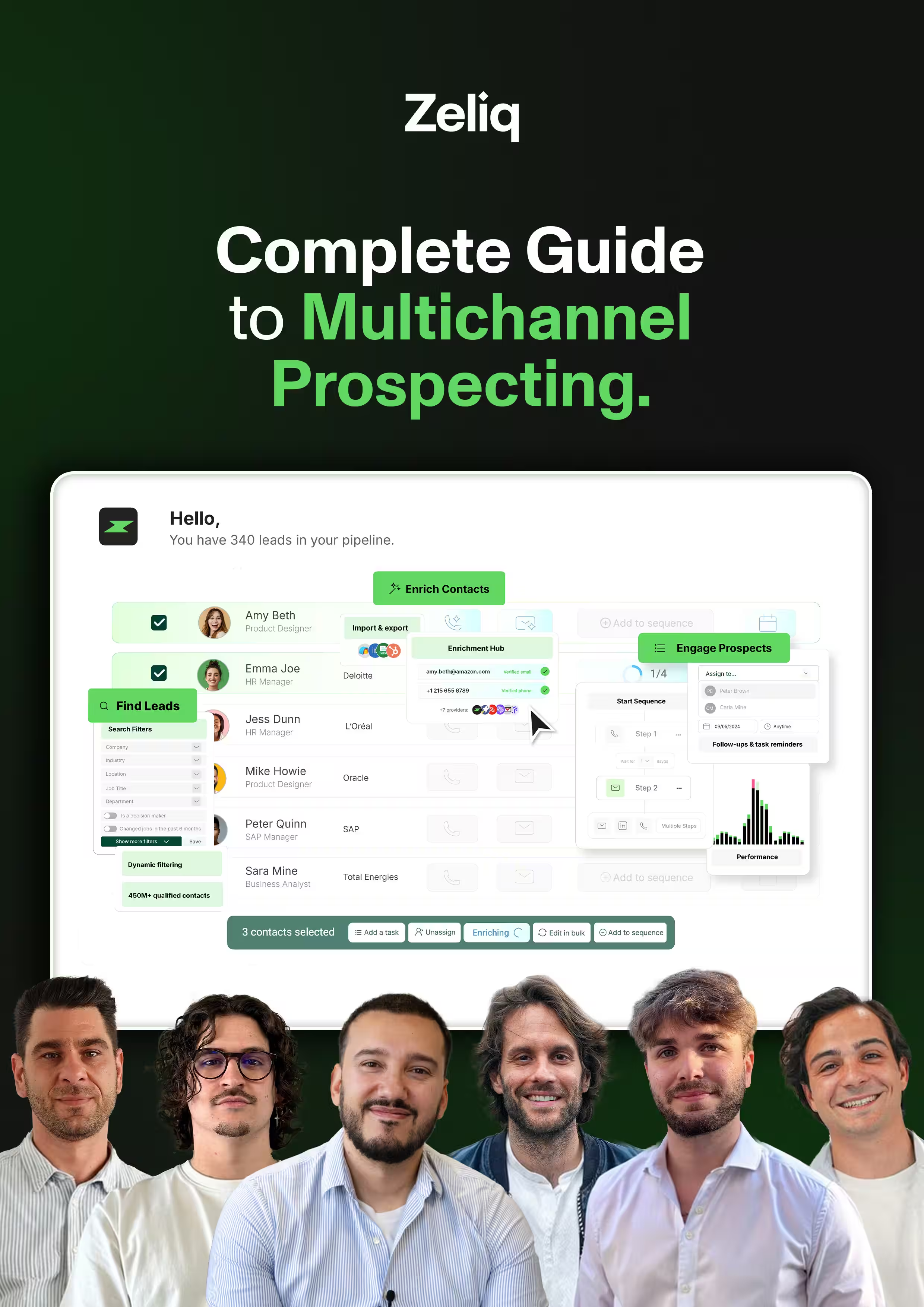
Want to see how a unified find + enrich workflow plays out on a real ICP? Zeliq’s B2B lead database lets you filter 35M+ companies by firmographics, technographics, and intent signals, then enrich the right contacts inside the same tab. Worth a look before you stack three separate tools. Sales leaders managing a team can also browse the sales leader use case to see how this scales across reps.
Enrichment and filtering: turn a list into a target list
Finding 5,000 companies is easy. Finding the 200 worth contacting this month is the work.
Enrichment turns a raw company list into a usable one. You start with names and websites, and you add:
- Verified employee count (actual current headcount, not “around 50”).
- Recent funding (round, amount, date).
- Headcount growth rate (last 6 and 12 months).
- Technographic flags (uses HubSpot, runs on AWS, on Webflow).
- Decision-maker contacts (name, title, email, LinkedIn, sometimes phone).
- News and signals from the last 90 days.
A waterfall enrichment approach, where the system queries 5, 10, 40 different data sources in sequence until it finds a verified record, hits the highest match rates. Zeliq, Clay, and Apollo’s enrich API all offer variations of this. Zeliq advertises around 80% email and 60% direct dial coverage through 40+ providers, which is in the right range for a serious workflow. More on the data enrichment page.
Once enriched, filter aggressively. A practical stack for a 5,000-company raw list:
- Drop everything outside your headcount band.
- Drop everything in disqualified industries.
- Keep only companies with at least one intent signal in the last 90 days.
- Keep only companies with a verified decision-maker contact.
You usually end up with 150 to 400 accounts. That is a real target list.
Layer intent signals on top
Even within a clean ICP, most companies are not buying right now. Intent signals tell you who is.
- Hiring on LinkedIn. Three SDR roles in a month means outbound investment. A “Head of RevOps” hire signals stack rebuilding.
- Funding announcements. Crunchbase, PitchBook, TechCrunch, Sifted. Fresh capital triggers tooling decisions in 60 to 90 days.
- Review site activity. G2 and Capterra surface category research. Some platforms expose which companies are reading reviews in your category.
- Job posting language. A posting mentioning a competitor (“experience with Salesforce required”) is a signal. So is “migrating from X to Y”.
- News and PR. New offices, product launches, M&A. Google Alerts on company names is the cheapest way to track this.
- Headcount acceleration. Sales Nav’s “headcount growth” filter surfaces teams that grew 20%+ in the last year.
Best practice: combine 2 or 3 signals. A company that just raised, is hiring SDRs, and uses your favorite CRM is worth a sequence this week.
Workflow: how to build a target account list
Here is a workflow that works for a 1- to 5-person sales team building a list each month.
1. Lock the ICP for the quarter. Write it down across three layers (firmographics, technographics, intent). Share it with marketing and product.
2. Pull the raw list. Sales Nav for the broad filter, plus one paid database for contact data. Aim for 3,000 to 8,000 accounts. Too narrow here costs flexibility later.
3. Enrich. Run the list through your enrichment tool: headcount, funding, tech stack, news, decision-maker contacts. Waterfall enrichment matters here, since a single-source enricher leaves 30% to 50% of the list with no usable contact.
4. Score and filter. Apply your filter stack and drop anything that fails.
5. Prioritize. Tier the remaining 200 to 500 accounts. Tier 1 is “all signals firing, contact this week”. Tier 2 is “good fit, contact this month”. Tier 3 is “watch list”.
6. Hand off to outreach. Push Tier 1 into your sequence tool with messaging tailored to each signal. The angle for a freshly funded company is not the angle for a company hiring SDRs.
7. Refresh monthly. Companies hire, fire, raise, churn signals. Re-run the pipeline every month and dedupe against last month.
AI for company finding: what works, what does not
AI is everywhere in 2026 prospecting tools. Here is the realistic split.
What works:
- AI-assisted ICP definition. Models turn a vague ICP description into a structured filter set: industry codes, headcount bands, signal definitions.
- Signal extraction. Excellent at parsing job postings, news, and 10-Ks for buying signals (competitor mentions, hiring patterns, expansion language).
- Account research. Given a company name, AI summarizes what they do, who they sell to, recent news. Saves 10 to 15 minutes per account.
- Personalization at scale. On a Tier 1 list, AI drafts per-account opening lines tied to real signals.
What does not work:
- AI-generated lists from scratch. “Give me 100 fintech companies in London with 50-200 employees” produces a plausible list full of errors. Always source from a real database.
- AI personalization without review. A bad line is worse than no line (it screams “AI”). Always review.
- Replacing the database. No model matches an indexed database for coverage and freshness. Use AI on top of a database, not instead.
Common mistakes to avoid
Going too broad. “All SaaS in Europe” is a continent, not an ICP. More than 5,000 accounts after filtering means your ICP is too loose. Tighten it.
No fit signal. Firmographics alone ignore timing. Layer at least one intent signal on top, even if it is just “hiring in the last 90 days”.
Stale data. A list from 6 months ago is a different list today. Roughly 20% of contacts change roles in a year. Refresh monthly.
No segmentation. Same message to a Series A and a Series D in one sequence means both ignore it. Tier the list and tailor per tier.
Treating the ICP as fixed. Your ICP is a hypothesis. After 3 months, check which deals closed and which segments responded best. Adjust.
Buying lists from random vendors. A $1-per-contact list is usually 30% to 50% dead emails. Bad for results, worse for your sender reputation.
Legal and data quality
Two things to keep clean.
GDPR (and CCPA, and emerging US state laws). If you prospect in Europe, your data must come from sources with a documented legal basis. Serious databases (Cognism, Zeliq, ZoomInfo’s European stack) document their compliance. If a vendor cannot tell you where their European data comes from, walk away.
Data freshness. Verified data is data tested in the last 90 days. Anything older decays fast. Real-time waterfall enrichment beats stockpiled data every time.
Faster prospecting starts with the right list
Finding B2B companies in 2026 is not about access to data. It is about discipline: a precise ICP, the right combination of free and paid sources, real-time enrichment, intent signals on top, and a refreshed pipeline every month. The teams that do this consistently spend less time prospecting and more time closing.
If you want to skip the multi-tool setup and build, enrich, and contact your target list in one place, start free with Zeliq. Lead database, waterfall enrichment, multichannel sequences, and a Chrome extension to capture leads from LinkedIn in one click, all under one roof.
FAQ
What is the easiest way to find B2B companies for free?
LinkedIn (free tier) plus Google site search plus public registries (SEC EDGAR, Companies House) cover most use cases. You will not get verified emails, but you will get a clean company list to enrich later.
Should I use Apollo, ZoomInfo, or Zeliq?
It depends on geography and how unified you want your stack. ZoomInfo dominates US enterprise. Apollo is broad and cheap. Zeliq combines find, enrich, and engage in one platform, which is the simplest setup if you do not already own the other tools. Compare on the Zeliq vs Apollo page if those two are on your shortlist.
How big should my target account list be?
For a 1-rep team, 100 to 200 Tier 1 accounts per quarter is realistic. For a 5-rep team, 500 to 1,000. More than that and quality drops. Quality beats volume every time.
What intent signals matter most?
Funding rounds, hiring (especially in your buyer’s function), and headcount growth rate. Tech stack changes are powerful but slower to surface.
How often should I refresh my list?
Monthly. People change jobs, companies raise or shut down, and new accounts enter your ICP every week. A list older than 90 days is mostly noise.
Is buying a B2B list a good idea?
Almost never. Cheap purchased lists are the fastest way to wreck your sender reputation and waste your team’s time. Vetted databases with documented sourcing are the only sustainable option.