
Warm Lead: What It Is, How to Spot One, and How to Convert
A warm lead is the prospect every sales rep wants more of, and the prospect most teams still mishandle. Someone has opened your last three emails, downloaded a guide, hit your pricing page twice this week. They are not ready to sign, but they are not cold either. They sit in the middle of the funnel, and how you treat them in the next 24 hours decides whether they become a meeting, a deal, or a forgotten line in your CRM.
This guide unpacks what a warm lead actually is, the signals that identify one, the frameworks to qualify it, and the motion to convert it. You will learn:
- The difference between cold, warm, and hot leads, and where MQLs and SQLs fit in.
- The behavioral and intent signals that flag a prospect as warm.
- How to score and route warm leads with frameworks like BANT, MEDDIC, and MEDDPICC.
- The conversion playbook that protects speed-to-lead and SDR to AE handoff.
- The mistakes that quietly kill warm pipeline, and the tools that fix them.
What Is a Warm Lead?
A warm lead is a prospect who has shown some level of interest in your company without explicitly asking to buy. They know your brand, they have engaged with your content, your emails, or your website, and they fit, at least partially, your ideal customer profile. They are warmer than cold outreach, but cooler than someone asking for a contract.
The simplest mental model uses three temperatures.
Cold, Warm, and Hot Leads
A cold lead does not know you. They have never visited your site, opened an email, or interacted with your brand. Reaching them takes outbound effort, and conversion rates sit low, often below 2 percent for cold email.
A warm lead has engaged. They opened an email, downloaded a piece of content, attended a webinar, followed your LinkedIn page, or visited a product page more than once. They are aware, curious, and open to a conversation, but they have not raised their hand for a sales call.
A hot lead is actively buying. They booked a demo, asked for pricing, or replied to a sequence with a question about timing. The signal is explicit, and the sales motion shifts from nurture to close.
| Temperature | Awareness | Intent signal | Best motion | Typical conversion rate |
|---|---|---|---|---|
| Cold | None | Zero or implicit fit only | Outbound, prospecting | 1 to 3 percent |
| Warm | Yes | Engagement, repeat visits, content downloads | Nurture, soft outreach, qualification | 5 to 15 percent |
| Hot | High | Demo request, pricing question, RFP | Direct sales, closing | 20 to 40 percent |
Numbers vary by industry, ACV, and funnel stage. Treat the table as a sanity check, not a benchmark.
Where MQLs and SQLs Fit
In the marketing taxonomy used by most B2B teams, a Marketing Qualified Lead (MQL) is a warm lead that crossed a scoring threshold defined by marketing. A Sales Qualified Lead (SQL) is a warm lead that an SDR or AE has accepted into the pipeline after qualifying it against criteria like budget, authority, or timing.
Warm lead is the broader category. MQL and SQL are operational stages inside that category. A warm lead becomes an MQL when scoring rules trigger handoff, and an SQL when sales accepts. Many warm leads never reach MQL status because they engaged but did not match the ICP. That is not a failure, it is the funnel doing its job.
Signals of a Warm Prospect
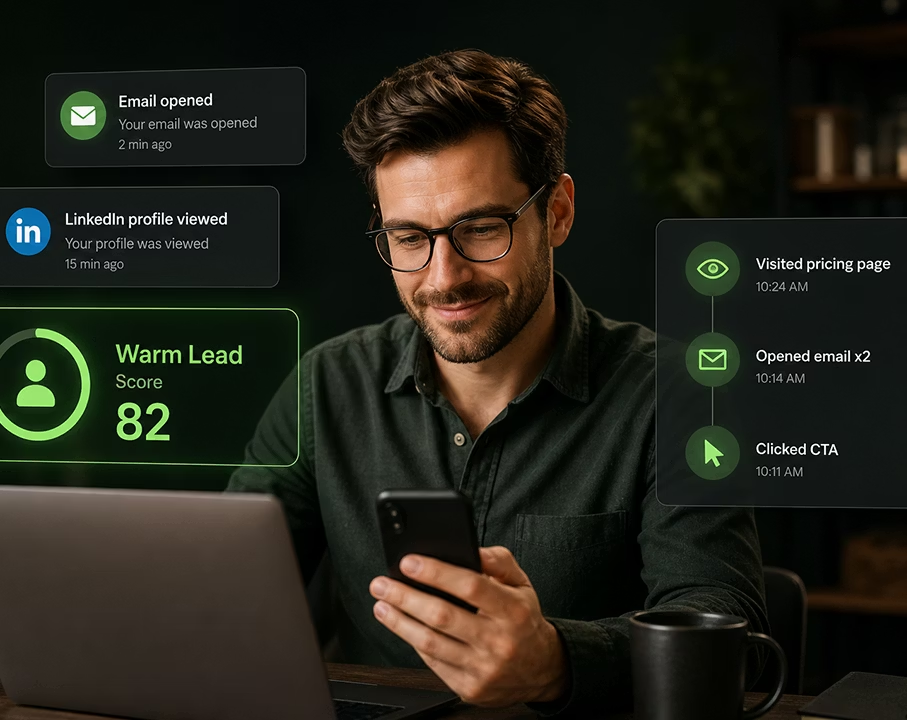
Spotting a warm lead is a question of pattern, not single events. One opened email is not a signal, three opened emails plus a pricing page visit is. Stack the signals, and the picture becomes clear.
Behavioral Signals on Your Owned Channels
These are the cheapest signals to capture because they happen on properties you control.
- Repeat website visits. A prospect who lands on your site twice in a week, especially on commercial pages, is paying attention. Pricing, comparison, and integration pages weigh more than blog posts.
- Content downloads. Whitepapers, comparison guides, and case studies require a form fill. The intent is higher than for a blog skim.
- Webinar attendance. Showing up live signals real interest. Watching a replay matters less but still counts.
- Email opens and clicks. A single open is noise. Opens across three or four sends in a sequence is a pattern. Clicks on product or pricing links are stronger than clicks on blog content.
- Form submissions. Asking a question, requesting a benchmark, or subscribing to a newsletter all qualify, with weight scaling with friction.
- Demo or trial sign-ups. Borderline hot, but if they signed up and ghosted, treat as warm and re-engage.
LinkedIn and Social Engagement
Modern B2B buyers research on LinkedIn before they ever fill a form. Catching social signals matters.
- Following your company page or your founder.
- Liking or commenting on posts from your team.
- Viewing a rep’s profile, especially repeated views.
- Accepting a connection request without a pitch.
These are softer than form fills, but they are early. A prospect who follows your CEO and starts liking product posts is warming up before any landing page knows they exist.
Third-Party Intent Data
Beyond your owned channels, intent platforms like Bombora, 6sense, and G2 surface accounts researching your category on the open web. A buying committee reading reviews of your competitors and topical articles in your space is generating intent signals you cannot see otherwise. Adding this layer turns a vague awareness funnel into a list of accounts you can approach with context, even before they touch your site.
How to Identify Warm Leads in Practice
Combining the signals into a usable workflow comes down to three moves.
1. Pick the signals that actually correlate with revenue. Start with five to seven, not thirty. Pricing page visits, demo page visits, multiple email opens, content downloads, and webinar attendance are a sensible starter set. Add LinkedIn engagement and intent data once the basics work.
2. Layer fit on top of behavior. A junior buyer at a company outside your ICP downloading a guide is not a warm lead, it is a content reader. The same action from a Director of Sales at a 200-person SaaS in your target vertical is. Behavior without fit produces noisy pipelines.
3. Build a scoring model that decays over time. Engagement six weeks ago is not engagement today. Most teams apply a 30 to 60-day decay so old activity drops out of the warm bucket automatically. A warm lead who goes silent for two months is a cold lead again.
See your warmest accounts first
Manual scoring spreadsheets break above 200 leads. Zeliq’s automatic lead scoring ranks prospects in real time on email opens, link clicks, and replies, so reps work the warmest contacts first instead of scrolling through static lists.
Qualification Frameworks: BANT, MEDDIC, MEDDPICC
A warm lead is not a qualified lead. Engagement tells you the door is open, qualification tells you whether walking through it is worth your time. Three frameworks dominate B2B, and choosing the right one matters more than running all three.
BANT
Budget, Authority, Need, Timing. The classic, born at IBM. BANT works when deals are short, ACVs are modest, and the buyer can roughly self-qualify on those four dimensions. SDRs love BANT because it is fast: four questions, four answers, decision.
The weakness: in modern B2B, buyers rarely have a clean budget line ready, authority is shared across committees, and timing is fluid. BANT can throw warm leads out of the funnel too early simply because the rep heard “no budget yet” on a discovery call.
Use BANT for: SMB deals, short cycles, transactional motions, productivity tools.
MEDDIC
Metrics, Economic buyer, Decision criteria, Decision process, Identify pain, Champion. Built at PTC in the 1990s for complex enterprise sales. MEDDIC trades speed for depth. The rep maps the buying committee, the criteria, and the internal champion before pushing toward close.
MEDDIC is heavier than BANT, but it catches the deals BANT loses, the ones where budget is “not really, but yes if we agree on ROI” and where authority is split across three stakeholders.
Use MEDDIC for: mid-market and enterprise, ACVs above 30k, sales cycles above 60 days.
MEDDPICC
MEDDIC plus Paper Process and Competition. The extension that became standard at companies like MongoDB and Snowflake. Paper process tracks the legal, procurement, and security workflow the deal will travel through. Competition tracks who else the buyer is evaluating.
For a warm lead in enterprise, MEDDPICC is often the right level of rigor. The cost of dropping a 200k deal because legal stalled at the last mile is higher than the cost of the extra discovery work.
Use MEDDPICC for: enterprise, regulated industries, multi-stakeholder buying committees, deals where procurement runs the timeline.
Matching Framework to Lead Temperature
Frameworks scale with deal size, not lead temperature. A warm lead in SMB still gets BANT, a warm lead in enterprise still gets MEDDPICC. The temperature changes the message you send, not the framework you qualify against.
A practical heuristic: if the warm lead’s company has more than 200 employees or your ACV exceeds 25k, drop BANT and run MEDDIC at minimum.
SDR and AE Handoff
Warm leads usually get qualified by an SDR before they reach an AE. The handoff is where most warm pipeline leaks.
Three rules keep handoff clean:
- A shared definition of “qualified.” SDRs and AEs need to agree on what passes. Document it. “Met BANT” is too vague, “Confirmed budget tier above X, identified economic buyer, mapped decision process” is workable.
- A SLA on AE follow-up. A warm lead handed off should be contacted within 24 hours. Past 48, conversion drops sharply.
- A feedback loop. Every AE rejection feeds back to the SDR with a reason. Without it, SDRs learn nothing and the bar drifts.
How to Convert a Warm Prospect
A warm lead has interest. Conversion is the work of turning interest into a meeting, then a proposal, then a signature. Four moves matter more than any others.
1. Speed-to-Lead
The single biggest predictor of warm lead conversion is response time. Studies from the Harvard Business Review and Inside Sales repeatedly show that contacting a lead within five minutes of a high-intent action lifts conversion by orders of magnitude over contacting them at 30 minutes.
For a demo request, five minutes is the right target. For a content download or a pricing page visit, an hour is acceptable, a day is risky, two days is dead. Set internal SLAs and instrument them, because reps consistently overestimate how fast they actually respond.
2. The Right Channel for the Signal
Warm leads do not all want the same outreach. A demo request earns a phone call. A whitepaper download earns a personalized email referencing the asset. A LinkedIn engagement earns a soft DM, not a templated sequence.
Mismatching the channel to the signal looks like spam to the prospect. A buyer who downloaded a comparison guide and then receives three cold emails about “scheduling 15 minutes” will assume your team has no idea who they are, because your team has no idea who they are.
Multichannel sequences that adapt to the signal, email plus LinkedIn plus phone where it makes sense, with the cadence calibrated to the warmth, work better than any single channel run at volume.
3. The Discovery Call That Actually Discovers
Once a warm lead accepts a meeting, the goal of the first call is not to pitch. It is to qualify, build context, and confirm fit. Three blocks structure most effective discovery calls.
- Context block (5 to 10 minutes). What triggered their interest, what they have already evaluated, what they are trying to fix.
- Qualification block (10 to 15 minutes). Run the framework. BANT, MEDDIC, MEDDPICC, depending on the deal size and complexity.
- Next step block (5 minutes). Concrete agreement on what happens next, with a calendar invite sent before they hang up.
Demos run after discovery, not during it. Pitching too early on a warm lead burns the only conversation you may get.
4. The Proposal and Closing Motion
Past discovery, the conversion work shifts from interest to commitment. Three patterns separate teams that close warm pipeline from teams that watch it stall.
- Mutual action plans (MAPs). A shared document listing every step from now to signature, with dates and owners on both sides. MAPs cut deal cycles by 20 to 30 percent in most studies.
- Multithreading. A deal anchored on one champion is fragile. Building relationships with two or three stakeholders, the economic buyer, the user, the technical sponsor, protects the deal from a single departure.
- Tight follow-up cadence. After a proposal goes out, silence kills deals. A scheduled “did you have time to review?” plus a value drop, a relevant case study, a benchmark, every five to seven days, keeps momentum without nagging.
Common Mistakes That Kill Warm Pipeline
The same handful of errors show up in pipeline reviews across teams.
Slow follow-up. A warm lead that goes 48 hours without a response is a lead you are choosing to lose. Most teams already know this and still let it happen because the operational layer (alerts, routing, task creation) is not in place.
Over-qualifying out of fear. Some SDRs disqualify warm leads aggressively to protect AE pipeline quality. The result: AEs starve, marketing complains, and the team optimizes for “clean pipe” rather than revenue. Tighten qualification, do not narrow it.
Treating every warm lead the same. A pricing page visit and a webinar attendance are not equivalent. Sequences that ignore the trigger get treated as spam. Personalization matters, and not the “hi {first_name}” kind, the “I saw you watched the deliverability webinar last week” kind.
Bad SDR to AE alignment. When SDRs and AEs use different definitions of qualified, leads bounce back and forth. The handoff becomes friction, the prospect feels the friction, and the deal stalls. Quarterly alignment workshops between sales and marketing fix this faster than any tool.
Ignoring decay. Warm leads cool. A sequence that fires three months after a webinar lands like cold outreach because that is what it is. Build decay into the model and re-engage with a fresh angle, not the same playbook.
No closed-loop reporting. Without tracking which warm leads actually closed, scoring models drift and personas blur. Closed-loop reporting between marketing, SDR, and AE is what keeps warm-lead programs from regressing into vanity metrics.
Tools That Make a Warm-Lead Program Work
A warm-lead motion is one part process, one part stack. The stack does not have to be exotic, but a few categories are non-negotiable.
CRM. HubSpot, Salesforce, Pipedrive. The system of record for every interaction. Without it, scoring is impossible because no one has the full history of the prospect. CRM hygiene, deduplication, field consistency, sync reliability, is unglamorous and the difference between a model that works and one that hallucinates.
Lead scoring engine. Either inside the CRM (HubSpot scoring, Salesforce Einstein) or in a dedicated tool. The choice depends on signal complexity. If you only score on owned-channel behavior, the CRM is enough. If you layer third-party intent and account-level fit, a dedicated layer pays off.
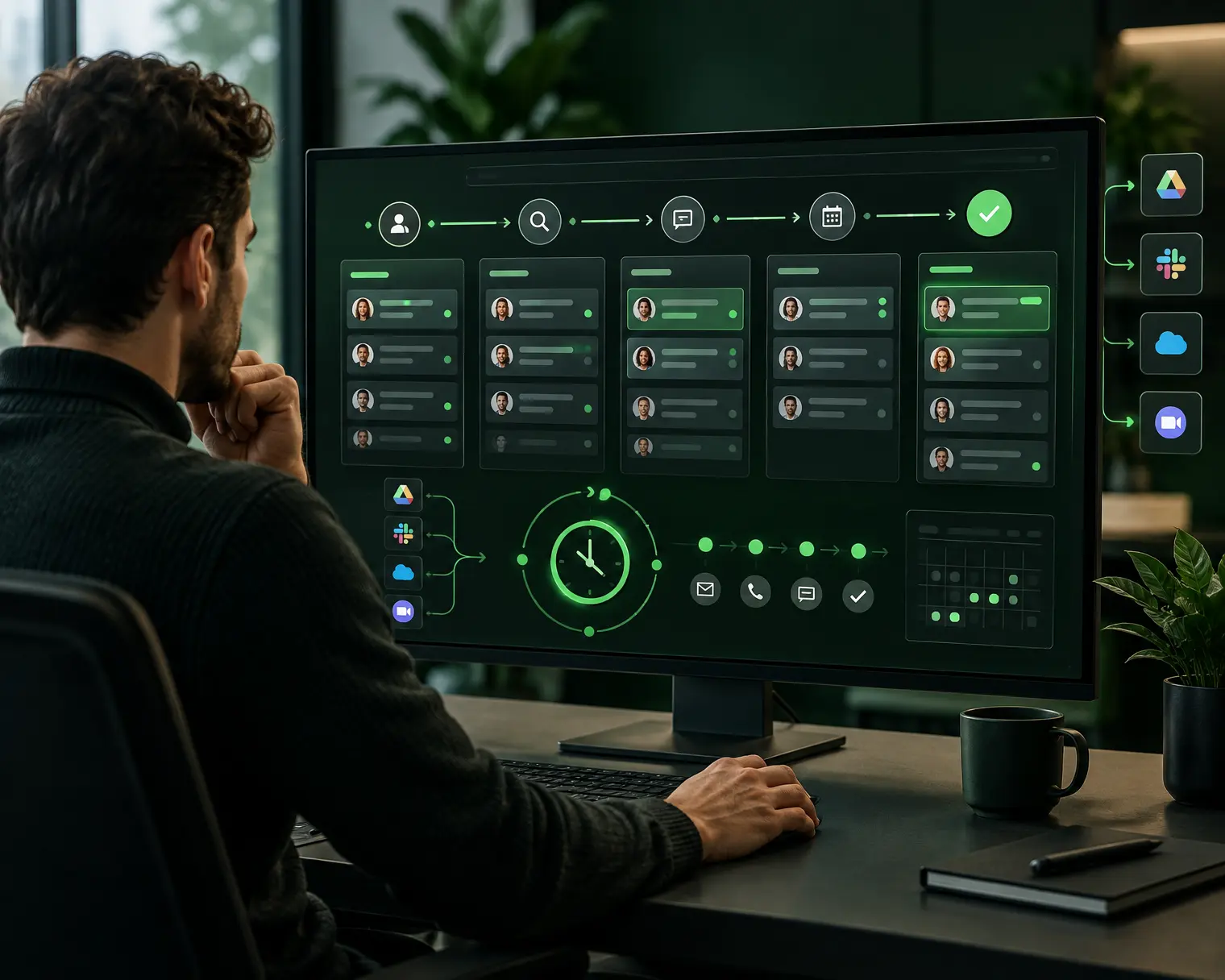
Multichannel sequencing. Email, LinkedIn, phone, all coordinated. Tools like Zeliq, Outreach, Salesloft, and Apollo handle this. The capability to adapt cadence to the warm signal, not just blast a fixed five-step sequence, is what separates a modern motion from a 2018 motion.
Intent and visitor identification. Optional but high-leverage above mid-market ACV. 6sense, Bombora, Clearbit Reveal, RB2B, surface signal you would otherwise miss.
Enrichment. Verified emails and direct phone numbers, ideally enriched in a waterfall across multiple providers. A warm lead with a wrong email is no warm lead.
The point of the stack is not the count of tools. It is whether reps can see, score, and reach a warm lead inside one workflow. A platform that consolidates find, enrich, and engage in one interface, like Zeliq, removes the inter-tool friction that blocks most warm-lead motions in practice.
Frequently Surfaced Questions, Absorbed in the Flow
A few questions come up often enough that they deserve direct answers.
What is the difference between a warm lead and an MQL? A warm lead is any engaged prospect. An MQL is a warm lead whose engagement and fit crossed a marketing-defined threshold. Every MQL is warm. Not every warm lead is an MQL.
How long does a lead stay warm? Most teams use a 30 to 60-day decay. Past that window, treat the lead as cold and re-engage with new context, not the same sequence.
What conversion rate should I expect from warm leads? 5 to 15 percent, with wide variance. SMB self-serve products convert higher, enterprise deals lower. The number to track over time is direction, not absolute.
Can a hot lead become warm again? Yes. A demo that leads nowhere, a champion who leaves, a budget that froze, all push hot leads back to warm. Re-engage at the right time with the right reason and they convert again.
How many touchpoints does a warm lead need? Sales-cycle dependent. SMB SaaS often closes in three to five touches after warm. Enterprise deals require 15 to 25 stakeholder interactions across multithreading. Track the average for your funnel and design sequences against it, not against a generic benchmark.
Convert Warm Pipeline Without the Manual Lift
Warm leads are the highest-leverage segment in any funnel: more interested than cold prospects, less competitive than hot ones, and most likely to fall through the cracks of a stack that is not built for them. Spotting them takes the right signals, qualifying them takes the right framework, converting them takes speed and discipline.
If your team is still ranking warm prospects manually, splicing engagement data across tools, or running fixed sequences that ignore the trigger, the conversion gap is not a strategy problem. It is a tooling problem.
Zeliq combines automatic lead scoring with multichannel sequences and a native HubSpot sync, so warm leads stay visible, prioritized, and worked the moment they signal intent. Start free and see your warmest accounts surface in your first session.