
Lead Generation in 2026: The Complete B2B Playbook
Most lead generation guides treat the topic like a marketing problem solved by more blog posts and a gated ebook. That worked in 2018. In 2026, B2B buyers self-educate in dark social, ignore forms, and decide on a vendor before a sales rep ever talks to them. If your lead generation engine still relies on inbound forms and an SDR cold-calling a stale list, you are losing pipeline to competitors who run modern, multichannel, intent-driven plays.
This guide is built for sales leaders, RevOps, founders, and SDRs who own a number. It covers the definition, the taxonomy, the inbound and outbound playbooks, paid channels, the strategy framework, the metrics that matter, the stack you actually need, and the mistakes that quietly kill performance. By the end, you will have a working blueprint to stand up or rebuild your lead generation engine.
What you will learn:
- What lead generation really is in 2026 (and how it differs from prospecting and demand gen)
- The full lead taxonomy: lead, MQL, SQL, PQL
- How to combine inbound and outbound without picking sides
- The exact channels, sequences, and scoring rules to run
- The metrics, stack, and mistakes that decide whether your pipeline is healthy
What is lead generation?
Lead generation is the process of identifying and capturing the contact details of people or companies that fit your ideal customer profile and could plausibly become customers. In B2B, a lead is usually a named buyer at a target account who has shown some signal of interest (downloaded an asset, visited pricing, replied to an email, raised a hand at an event) or matches your firmographic and behavioral criteria precisely enough to warrant outreach.
Three sentences to keep separate in your head:
- Lead generation is about creating a qualified list of contactable buyers.
- Prospecting is the act of reaching out to those buyers (typically outbound).
- Demand generation is the upstream work of creating awareness and intent in your market so the buyers you eventually capture already trust you.
The three overlap in practice, but they are not interchangeable. Demand gen makes lead gen easier. Lead gen makes prospecting more efficient. Confuse the layers and you build the wrong KPIs.
How is lead generation different from demand generation?
Demand generation is a brand and audience play: thought leadership, organic social, PR, podcast appearances, free communities. The output is awareness and trust, not a CSV. Lead generation is the conversion layer: forms, sequences, lists, signals. You can run lead generation without demand gen (cold outbound on a database), but win rates and reply rates will be brutal. You can run demand gen without lead gen (a podcast with no path to sales), but pipeline will not move. In 2026 winning teams run both, with marketing typically owning demand and SDR or growth owning lead capture and outreach.
Why lead generation matters more than ever in 2026
Three structural shifts have changed the game:
Buyers ignore forms. Roughly 95% of B2B website traffic never converts on a form. Buyers research in private, on Reddit, LinkedIn, podcasts, and AI search engines, then arrive on your site with a shortlist already in mind. Waiting for a “Contact Sales” submission to qualify a deal is leaving money on the table.
Outbound is allowed again. After a few years of “outbound is dead” takes, the data is clear: outbound, when done right, drives a measurable share of B2B pipeline. The catch is that bad outbound (spray cold email blasts to a scraped list) is more punished than ever (deliverability dies, accounts get banned, brand suffers), while good outbound (tight ICP, multichannel, signal-based) prints meetings.
Intent data is mainstream. Tools that surface buyers researching your category (G2, 6sense, Bombora, dark web intent providers) used to be enterprise-only. They now sit in mid-market stacks and let SDR teams prioritize accounts that are actively shopping. The teams that combine intent with strong execution leave volume-only competitors behind.
The job in 2026 is no longer to generate as many leads as possible. It is to generate the right leads and reach them in the right window with a relevant message across the channels they actually use.
The lead taxonomy: lead, MQL, SQL, PQL
Pipeline reporting falls apart when “lead” means different things in different rooms. Lock down a shared vocabulary before you tune anything else.
| Stage | Definition | Owner | Typical signal |
|---|---|---|---|
| Lead | A contact that fits ICP firmographics or showed light interest | Marketing or SDR | Newsletter signup, content download, list match |
| MQL (Marketing Qualified Lead) | A lead that has shown enough engagement to merit sales attention | Marketing | Demo request, multiple high-intent page visits, ebook + webinar |
| SQL (Sales Qualified Lead) | An MQL that sales has accepted as worth pursuing actively | Sales (SDR or AE) | Discovery call booked, pain confirmed, budget hint |
| PQL (Product Qualified Lead) | A user of a free product that has hit a usage threshold predictive of conversion | Product or Sales | Activated workspace, invited teammates, hit a key feature |
A clean lead generation engine produces each of these stages on a predictable cadence. The handoffs (MQL to SQL especially) are where most teams leak revenue. Define them in writing, score them, audit them weekly, and protect the SDR team from chasing junk MQLs that marketing inflated to hit a board metric.
What is the difference between a lead and a prospect?
A lead is a contact that has entered your system, usually with some signal of fit or interest, and that lives in your CRM or sequence tool. A prospect is a contact you have decided to actively pursue, regardless of how they entered your world. Every prospect was a lead first, but plenty of leads (newsletter readers, low-fit form fills) never become prospects. The distinction matters for reporting: you measure lead generation in volume and conversion rate, you measure prospecting in meetings booked and pipeline created.
Inbound versus outbound: stop picking sides
The inbound-versus-outbound debate is a vendor problem, not a buyer problem. Buyers do not care which motion sourced them. What they care about is timing, relevance, and credibility. Modern teams run both, and the best teams run them as a single engine.
| Dimension | Inbound | Outbound |
|---|---|---|
| Trigger | Buyer initiates contact | Seller initiates contact |
| Intent quality | Generally higher (self-selected) | Variable (depends on signal) |
| Volume | Capped by traffic and brand | Scales with list and capacity |
| Time to ramp | 6 to 12 months for SEO and content | Days to weeks |
| Cost profile | High fixed cost (content, SEO), low variable | Lower fixed cost, higher variable (data, tools, headcount) |
| Best for | Building defensible category presence | Hitting a number this quarter |
Two practical rules:
- If you need pipeline in 90 days, lead with outbound. Inbound takes too long to compound.
- If you want compounding pipeline in 18 months, invest in inbound now. Outbound alone has a ceiling and a fatigue problem.
The two motions also feed each other. Inbound creates a pool of warm accounts your SDRs can target outbound. Outbound surfaces objections, language, and ICP signals that feed your content team. Treat them as one funnel, not two teams fighting over leads.
Inbound lead generation methods that still work
Inbound is crowded but not dead. The bar is just higher.
SEO and content
Bottom-of-funnel SEO (comparison pages, alternatives, integration pages, ROI calculators) remains the highest-leverage inbound investment for B2B SaaS. Top-of-funnel content (broad how-tos) is being eaten by AI Overviews and Reddit, so do not anchor your strategy on it. Focus on:
- Category and feature keywords that map to your product
- Comparison content (“X vs Y”, “alternatives to Z”) because buyers shortlist this way
- Use-case content that names a job-to-be-done your buyer types into Google
A modern SEO play also means showing up in AI search (ChatGPT, Perplexity, Google AI Mode), which rewards clear, factual, structured content with strong third-party signals (G2 reviews, Reddit mentions, podcasts).
Lead magnets and gated assets
Templates, calculators, benchmark reports, and checklists still convert. The mistake is gating everything: gate the asset that requires real work to produce (a benchmark report based on proprietary data), keep the rest open. A gated 12-page ebook that summarizes Google searches is a tax on your buyer.
Webinars and live events
Live webinars convert at a few percent registration-to-meeting when you bring a credible host and a specific promise. Pre-recorded “on-demand” webinars rarely beat a good blog post. If you cannot run live, do not run webinars.
Organic social and personal brand
LinkedIn is the dominant B2B inbound channel that does not look like inbound. Founder and exec-led content moves more pipeline than most company pages. The mechanic: a buyer follows your CEO for 6 months, never engages, then books a demo. Inbound, but invisible in attribution.
Podcasts (yours and others)
Hosting a podcast that interviews your ICP is a stealth outbound play disguised as content. Guest appearances on existing podcasts borrow audiences and credibility. Either way, podcasting compounds slowly but produces unusually high-trust leads.
Communities
Slack groups, niche subreddits, and private peer networks are where buyers actually shortlist. You do not “do” community marketing in a quarter, you participate consistently for years. Start now.
Outbound lead generation methods (the modern playbook)
Outbound is where Zeliq’s audience lives, and where most “lead generation” guides go thin. Here is what works in 2026.
Cold email
Cold email is still the backbone of B2B outbound because nothing else combines scale, cost, and personalization the same way. The fundamentals that decide whether it works:
- A clean list built on tight ICP filters (title, industry, company size, geo, tech stack, signal). A great message to the wrong list flops.
- Verified contact data (waterfall enrichment across multiple providers, not single-source). Bounces above 3% trash deliverability fast.
- Deliverability hygiene (SPF, DKIM, DMARC, dedicated sending domains, warmed inboxes, sub-50 emails per inbox per day).
- Short, specific copy that names a concrete pain and proposes a small ask. Generic “I noticed you are the VP of Sales” openers have been dead for two years.
- A sequence, not a one-shot (3 to 5 touches across 10 to 14 days, with each follow-up adding value rather than nagging).
Cold calling
Cold calling is back, partly because inboxes are saturated and a phone number is now a scarce data point. The playbook:
- Triple-verify mobile numbers (waterfall, do not trust a single source).
- Pair calls with email and LinkedIn touches, do not run them solo.
- Use a parallel dialer to skip dead air and lift talk-time per hour.
- Build a 30-second permission opener and a clear CTA (book 15 minutes, not “send a deck”).
LinkedIn outbound
LinkedIn works but is the most aggressively rate-limited channel. Best practice:
- Connect first with a warm reason (mutual content, shared community), pitch later.
- Use voice notes or short videos sparingly (they out-perform text but lose impact when overdone).
- Stay under platform thresholds (around 80 to 100 connection requests per week, lower for new accounts) to avoid restrictions.
- Treat it as a relationship channel, not a blast channel.
Multichannel sequences
The single biggest leverage move in modern outbound is going multichannel. Sequences that combine email, LinkedIn, and calls book 24% to 40% more meetings than email-only sequences in most published benchmarks. The structure is straightforward:
| Day | Channel | Touch |
|---|---|---|
| 1 | Personalized opener, soft ask | |
| 3 | Connection request with context | |
| 5 | Follow-up with proof point | |
| 7 | Call | Permission opener, 30 seconds |
| 10 | LinkedIn message | If connected, value-add |
| 12 | Breakup, clear close |
The reason multichannel wins is exposure: a buyer who sees you only in email writes you off as spam, a buyer who sees you on LinkedIn, in their inbox, and on their phone treats you as a real person worth replying to.
How Zeliq fits here
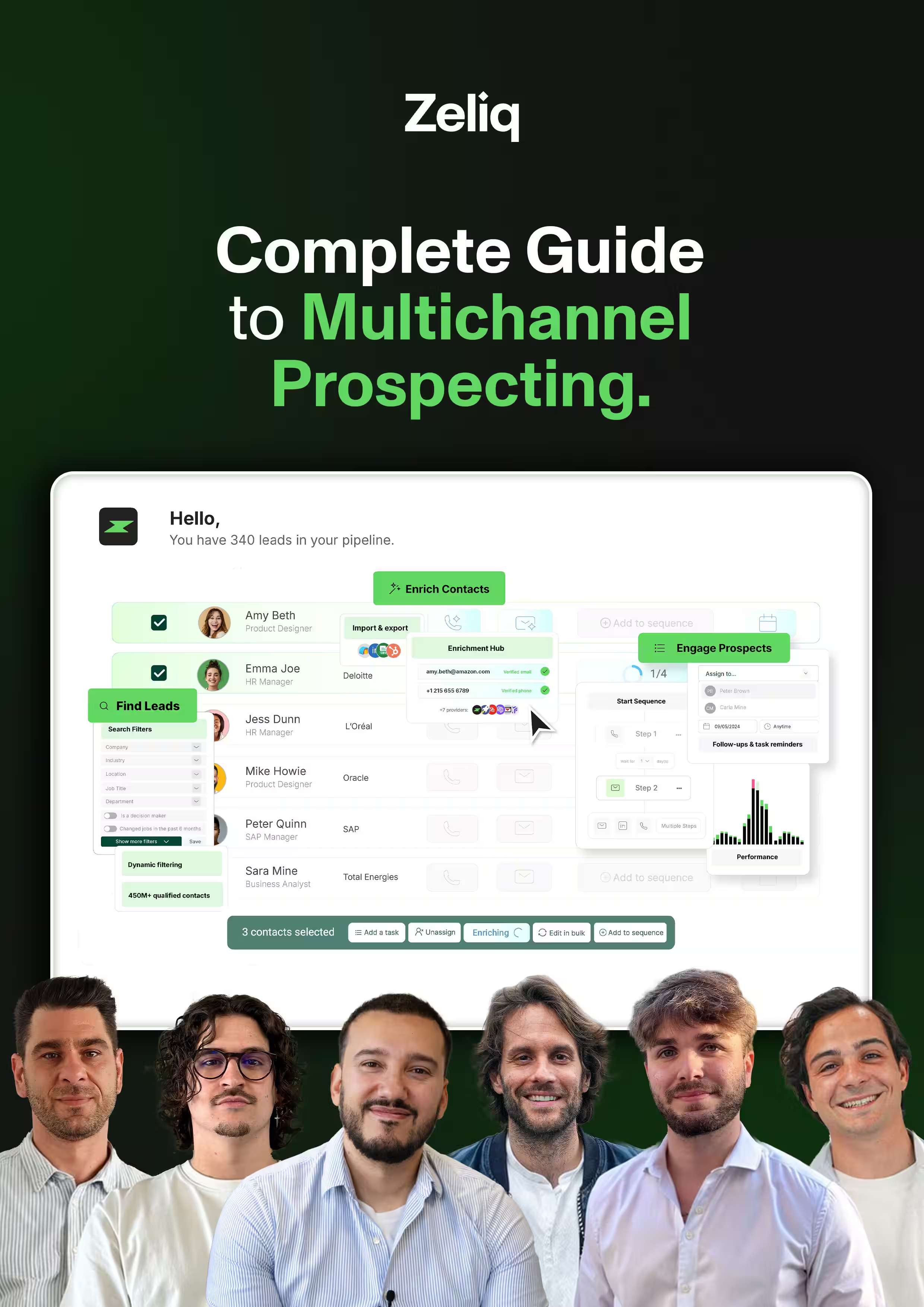
If you are running multichannel from a stack of three or four tools, you already know the cost: data drift between systems, sequences that fall out of sync, and SDRs spending 30% of their day in admin. Zeliq combines a B2B lead database of 450M+ contacts with waterfall enrichment across 40+ providers, so the list you sequence is the list you trust. Start a free trial and check whether your current stack is doing the work of one platform with three logos.
Account-based outbound (ABM)
For higher-ACV deals, narrow your list to a few hundred named accounts and run multichannel plays per account, not per contact. Bring the whole buying committee into your sequence (champion, economic buyer, technical buyer), with a different angle for each. ABM is harder to measure account by account, but the win rate on closed deals is materially higher.
Paid lead generation channels
Paid is the third lever and it is most useful when you have either a clear conversion path (a form on a high-intent landing page) or a strong creative angle for retargeting.
LinkedIn Ads
LinkedIn is the most expensive B2B channel per click and the most precise targeting (job title, seniority, company size, industry). It works best for:
- Lead Gen Forms (in-platform, lower friction, but lower intent than a landing page)
- Document Ads for long-form content distribution
- Retargeting website visitors who did not convert
- ABM lists uploaded against a named account list
Expect cost per lead in the $50 to $400 range depending on category, with 2x to 5x that for cost per qualified opportunity.
Google Ads
Google Search Ads on bottom-of-funnel keywords (your category, your brand, competitor names) are usually the best paid channel for B2B SaaS. Display and YouTube ads matter less unless you are running large-scale demand gen.
Intent platforms (G2, 6sense, Bombora)
Intent platforms surface accounts actively researching your category. Pricing is enterprise-tier, but the play is unique: you are not buying clicks, you are buying signal. The right way to use them:
- Pull a weekly list of accounts showing intent on your topics.
- Cross-reference with your CRM to dedupe.
- Hand off to SDR with a custom outbound sequence that references the signal indirectly (“I saw you have been looking at X, here is how we think about it”).
- Measure account-level engagement, not click-throughs.
Intent data is the closest thing to a cheat code in modern lead generation. It will not save a weak product or weak execution, but on top of either it adds 1.5x to 2x close rates in published benchmarks.
How to build a lead generation strategy that actually fills pipeline
Most “strategies” published online are checklists. Here is the actual operating model. Five layers, in order.
1. Define your ICP with precision
Vague ICPs (“mid-market SaaS in North America”) produce vague pipelines. A workable ICP names:
- Firmographics: industry, employee count, revenue band, geo
- Technographics: tools they already use that signal fit
- Trigger events: hiring a key role, raising a round, launching a product, reorg
- Buying committee: who decides, who blocks, who signs
- Disqualifiers: industries you will not sell to, sizes too small or too big
Write the ICP as a one-page document. Have sales and marketing sign off. Revisit quarterly.
2. Choose your channel mix
Not every channel deserves your time. Score channels on three axes:
- Reach: how many of your ICP can you reach there?
- Cost: what does a meeting cost (CAC, time, tools)?
- Compounding: does effort today still pay in 12 months?
Most B2B teams should run 2 outbound channels (email plus one of: LinkedIn, calls), 1 to 2 inbound channels (SEO plus exec social), and 1 paid channel (Google for capture, LinkedIn for ABM). Doing three things well beats doing eight things badly.
3. Build your content and message map
For each segment in your ICP, draft:
- The pain in their words (not yours)
- The 3 highest-leverage proof points (case studies, benchmarks, demos)
- The 5 to 10 outbound openers you will A/B test
- The 3 inbound assets (one comparison page, one calculator or template, one playbook)
This is where most teams cheap out. Skipping it is why your sequences flop.
4. Design your sequences and lead flow
For each channel, document:
- The exact sequence (touches, days, copy)
- The handoff rules (when does an SDR escalate to AE, when does marketing escalate to SDR)
- The disqualification rules (what kills a lead)
- The recycling rules (how do you re-engage a lead 6 months later)
A flow with no recycling rule loses 30% of its leads to silence.
5. Score, measure, iterate
Plug in lead scoring (rules-based to start, model-based at scale), pick the 5 or 6 metrics you will actually run on, and review them weekly with the people who own each. The goal of measurement is not dashboards, it is decisions: where do we double down, where do we cut?
Lead generation metrics that matter (and the ones that lie)
Track too many metrics and you optimize for none. Track these.
| Metric | What it tells you | Healthy range (B2B SaaS, mid-market) |
|---|---|---|
| CAC (Customer Acquisition Cost) | Total cost to acquire one paying customer | LTV/CAC > 3 |
| CPL (Cost Per Lead) | Cost to capture one lead | Varies wildly; benchmark against your own MQL to SQL rate |
| MQL to SQL conversion | Quality of your MQL definition | 25% to 40% |
| SQL to opportunity | Quality of SDR qualification | 50% to 70% |
| Opportunity to close | Sales execution and ICP fit | 20% to 30% |
| Pipeline velocity | (Opps x avg deal x win rate) / cycle length | Track trend, not absolute |
| Reply rate (cold email) | Quality of list and message | 3% to 10% on cold |
| Meeting-set rate | Sequence performance end-to-end | 1% to 5% on cold lists |
| Lead-to-customer time | Total cycle length | Track to forecast accurately |
The metrics that mislead: raw lead volume (junk MQLs inflate it), open rate (Apple Mail and bots inflate it), website traffic (vanity unless tied to pipeline). If your CMO is reporting on traffic and MQLs without conversion to revenue, your reporting is broken.
How do you generate leads for free?
Genuinely free lead generation is mostly time, not zero cost. The honest list:
- LinkedIn outbound from your existing connections (free, capped by your network size).
- Personal brand content (free, slow, requires consistency).
- Community participation in Slack groups, subreddits, and forums (free, requires real expertise).
- Referrals from happy customers (free, requires asking).
- Free tools on your site (cost to build, free to operate, work for years).
- SEO with existing assets (free if you already have content, otherwise has a cost).
What is not free: scraped lead lists, “free trial” tools that charge after 14 days, anything that promises 1000 leads with no work.
The lead generation stack you actually need
Tool sprawl is the silent tax on lead generation. Most teams use 6 to 12 tools when 3 to 5 would do. The categories that matter:
| Layer | What it does | Examples |
|---|---|---|
| Lead database | Source contacts at scale | Zeliq, Apollo, Cognism, ZoomInfo |
| Enrichment | Verify and complete records | Zeliq waterfall, Clay, FullContact |
| Sequences | Multichannel outreach | Zeliq sequences, Outreach, Salesloft |
| Lead scoring | Prioritize hot leads | Zeliq scoring, HubSpot, custom models |
| CRM | System of record | HubSpot, Salesforce, Pipedrive |
| Intent data | Surface in-market accounts | 6sense, G2 Buyer Intent, Bombora |
| Analytics | Pipeline reporting | CRM-native, Looker, BI tool |
Two principles:
- Buy fewer, integrate better. A unified prospecting platform that does database + enrichment + sequences cuts admin and data drift.
- Your CRM is your foundation, not your prospecting tool. Salesforce and HubSpot are great systems of record and weak prospecting engines. Pair them with a dedicated platform like Zeliq via native HubSpot sync or Salesforce sync, and let each tool do what it is good at.
For RevOps leaders rebuilding the stack, the RevOps use case page walks through the consolidation playbook in detail. For founders running prospecting solo before the first SDR hire, the founder page lays out the all-in-one setup.
The seven mistakes that quietly kill lead generation
Most lead generation engines do not fail because of one big bug. They fail because of a stack of small ones that no one fixes.
1. Volume over quality. Hitting an MQL number with low-fit leads inflates dashboards and tanks SDR morale. Cap volume at the level your sales team can actually work, and raise the bar instead.
2. Single-channel obsession. Email-only sequences plateau fast. So do call-only motions. Mix at least two channels per sequence and three for high-ACV deals.
3. No lead scoring. SDRs working leads in arrival order is a productivity disaster. Score on fit (firmographic) plus engagement (behavioral) and route the top 20% to humans first.
4. Weak ICP. A vague ICP means every channel is wasted ammunition. If marketing and sales cannot recite the ICP from memory, the ICP does not exist.
5. Zero handoff hygiene. MQLs going to SDRs with no SLA, no context, and no feedback loop is how teams lose half their leads. Define the handoff in writing and audit it monthly.
6. Ignoring deliverability. Sending 200 cold emails per inbox per day, with no warm-up, kills your sending domain. Once it is dead, every email you send (cold or otherwise) lands in spam.
7. No recycling. Leads that do not convert today are not dead, they are early. Build a 90-day re-engagement cadence (newsletter, content, light outbound) and you will find 10% to 20% of last quarter’s no-replies become this quarter’s pipeline.
What to do tomorrow morning
If you are starting from scratch, do these five things this week:
- Write your ICP on one page. Get sales and marketing sign-off.
- Pick your two outbound channels (email + LinkedIn or email + calls).
- Stand up a clean lead database with verified data and waterfall enrichment.
- Build one multichannel sequence (10 to 14 days, 5 to 7 touches).
- Define your MQL, SQL, and PQL in writing, with the conversion thresholds.
If you already have a working engine, audit it against the metrics table above and find the leakiest stage. That is where 80% of your next quarter’s lift will come from.
Lead generation in 2026 is not about working harder than the next team. It is about running a tighter ICP, a better stack, and a multichannel motion that respects how buyers actually buy. The teams that get this right will compound pipeline. The teams stuck on volume and single-channel email will keep wondering why their numbers are flat.
When you are ready to consolidate database, enrichment, and multichannel sequences into one platform, Zeliq’s multichannel sequences and one-click Chrome extension for prospecting are built for exactly that motion. Compare against your current stack or start free and run a sequence this week.